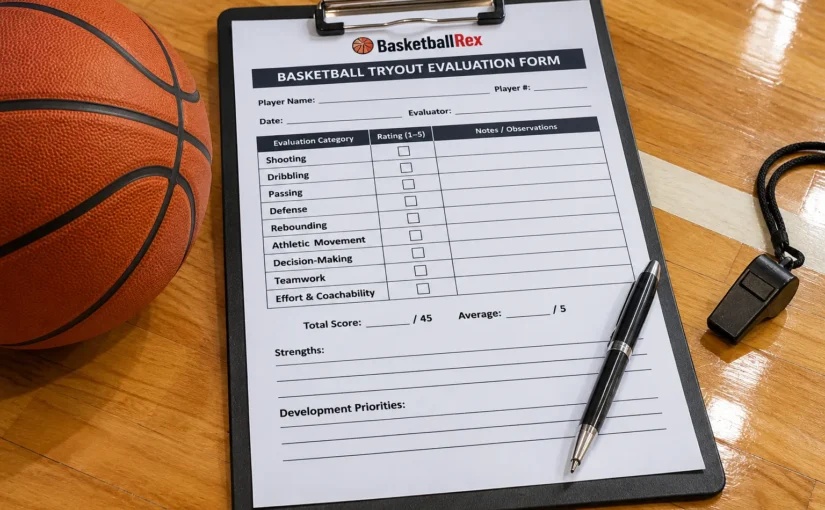
A basketball tryout evaluation form helps coaches assess players using consistent criteria instead of relying on memory or first impressions.
Coaches can record shooting, dribbling, passing, defense, decision-making, teamwork, and other important skills. The results help identify each player’s strengths, development needs, and possible role on the team.
This guide explains how to use a basketball tryout evaluation form, score players fairly, and make informed roster decisions.
Free Basketball Tryout Evaluation Form Downloads
Our BasketballRex evaluation forms are designed for youth, middle school, high school, and amateur basketball coaches.
One-Page Printable PDF
The one-page form provides a quick way to evaluate individual players during tryouts.
It includes:
- Player information and evaluator details
- Nine basketball evaluation categories
- A simple 1–5 scoring scale
- Space for brief observations
- Total score and average
- Player strengths and development priorities
Download the Free One-Page Basketball Tryout Evaluation Form (PDF)
Detailed Two-Page PDF
The extended version provides additional space for recording drills, scrimmage observations, and player development notes.
It is useful when coaches want more evidence before making roster decisions.
Download the Detailed Two-Page Evaluation Form (PDF)
Editable Evaluation Form
The editable Word version allows coaches to adjust evaluation criteria, record player information, and adapt the form to their program.
Download the Editable Basketball Tryout Evaluation Form (Word)
What Is a Basketball Tryout Evaluation Form?
A basketball tryout evaluation form is a scoring sheet used to record a player’s performance during team tryouts.
Coaches use these forms to compare players across agreed evaluation categories, document observations, and identify areas for improvement.
A completed form can support roster decisions, but it should not determine selections automatically.
For example, a player might score highly in shooting but struggle defensively. Another player might score fewer points during scrimmages while contributing through rebounding, passing, and positioning.
Both performances deserve consideration.
Unlike an opponent scouting report, which examines another team’s tendencies, a tryout evaluation form focuses on players being assessed for a team.
Coaches preparing for upcoming games can also use our basketball scouting report template.
What Should Coaches Evaluate at Basketball Tryouts?
A useful basketball player evaluation form should cover fundamental skills and how players apply them during games.
Basketball Skills and Athletic Movement
| Evaluation Category | What Coaches Should Look For |
|---|---|
| Shooting | Shooting technique, balance, consistency, and shot selection |
| Dribbling | Ball control, use of both hands, and handling defensive pressure |
| Passing | Accuracy, timing, receiving, and passing decisions |
| Defense | Staying in front, positioning, closeouts, and help defense |
| Rebounding | Boxing out, positioning, pursuing, and securing rebounds |
| Athletic movement | Footwork, balance, stopping, and changing direction |
Coaches should observe these skills through controlled drills and competitive situations.
For example, a player who dribbles confidently around cones might struggle when facing an active defender.
Decision-Making, Teamwork, and Coachability
Three additional categories help coaches evaluate contributions that basic skill drills might miss.
Decision-making: Does the player recognize open teammates, choose appropriate shots, and respond to defenders?
Teamwork: Does the player share the ball, follow assignments, and contribute to team play?
Effort and coachability: Does the player continue working after mistakes and attempt to apply coaching instructions?
Evaluate observable actions rather than personality. A quiet player can still be an effective teammate.
How to Score Basketball Players During Tryouts
Using a 1–5 Rating Scale
Our recommended form uses five scoring levels.
| Score | Meaning |
|---|---|
| 1 | Needs foundational development |
| 2 | Developing but inconsistent |
| 3 | Functional at the evaluated level |
| 4 | Strong and generally consistent |
| 5 | Advanced for the comparison group |
These ratings are BasketballRex recommendations, not an official USA Basketball or NFHS scoring standard.
Coaches should explain what each score means before tryouts begin.
A score of 4 for a beginner youth player does not represent the same performance level as a 4 for a varsity player.
What Does “Not Observed” Mean?
Use NO (Not Observed) when there is insufficient evidence to evaluate a category.
For example, a player might receive very few shooting opportunities during a short scrimmage.
Do not automatically assign that player a low shooting score.
Record the missing observation and arrange another opportunity when possible.
How to Calculate the Total Score
The form contains nine categories, each worth 1–5 points.
When all categories are scored:
- Minimum total: 9 points
- Maximum total: 45 points
- Average: Total score divided by 9
For example, a player scoring 34 points receives an average of 3.78/5.
If any category is marked NO, treat the total as incomplete.
A higher average does not automatically mean a player deserves a roster position.
How to Run a Fair Basketball Tryout Evaluation
Define Your Evaluation Criteria
Decide which skills matter before the tryout.
Explain the criteria, scoring scale, and general selection process to players.
Keep expectations appropriate for the age group and competitive level.
Assign Player Numbers
Give each player a visible identification number.
Record that number on their evaluation form to avoid mixing up observations.
Numbers can also help coaches focus on performance rather than familiarity with particular players.
Evaluate Players Through Drills and Scrimmages
Use a combination of skill stations and live basketball.
| Activity | What It Helps Evaluate |
|---|---|
| Spot shooting | Shooting preparation and consistency |
| Zigzag dribbling | Ball control and changes of direction |
| Passing on the move | Accuracy, timing, and receiving |
| One-on-one defense | Containment and footwork |
| Competitive rebounding | Positioning and pursuit |
| Three-on-three | Decisions, teamwork, and defensive help |
Give players comparable instructions and opportunities.
Small-sided games are especially useful because players generally have more chances to handle the ball and make decisions.
Score Players Live and Compare Evaluators
Record short observations during each activity.
For example, write “protected ball against pressure” rather than simply “good dribbler.”
When several coaches are evaluating, have them record their observations independently before discussing differences.
Review Results Before Selecting Your Team
Check that each player received sufficient evaluation opportunities.
Review missing scores, conflicting observations, and the team’s actual roster needs.
Where possible, observe closely matched players again before making final decisions.
Basketball Tryout Evaluation Form Example
Here is a fictional completed evaluation for Player #17.
| Category | Score |
|---|---|
| Shooting | 4 |
| Dribbling | 4 |
| Passing | 3 |
| Defense | 3 |
| Rebounding | 2 |
| Athletic movement | 4 |
| Decision-making | 4 |
| Teamwork | 5 |
| Effort and coachability | 5 |
| Total | 34/45 |
Average: 3.78/5
Strengths: Ball control, teamwork, and consistent effort.
Development priority: Rebounding positioning and defensive awareness.
Game observation: Made effective passing decisions during three-on-three but missed several opportunities to box out.
These fictional scores illustrate how the form works. They are not official performance benchmarks.
Common Basketball Tryout Evaluation Mistakes
Judging players from one shooting drill: A short shooting streak does not show overall basketball ability.
Using different scoring standards: Players should be evaluated against the same clearly explained criteria within their comparison group.
Ignoring live gameplay: Cone drills cannot fully demonstrate passing decisions, defensive positioning, or teamwork.
Scoring from memory: Record observations during or immediately after activities.
Treating scores as automatic roster rankings: Team roles, observation quality, and documented selection criteria also matter.
Overlooking missing observations: An unobserved skill is not the same as poor performance.
Evaluating Youth vs. High School Basketball Players
Younger players should generally be evaluated with greater emphasis on age-appropriate fundamentals, coordination, learning, and development.
Middle school evaluations can introduce more defensive pressure, movement, and small-sided decision-making.
High school tryouts may place greater emphasis on executing skills under pressure, understanding team concepts, and fulfilling competitive roles.
Coaches should also recognize that young players develop physically at different rates.
Current height, strength, or speed should not be treated as proof of long-term basketball potential.
Frequently Asked Questions
How Many Criteria Should a Basketball Evaluation Form Have?
Our form uses nine categories covering fundamental skills, movement, decisions, teamwork, and effort. Coaches can adjust the categories to suit their program.
Is a 1–5 or 1–10 Rating Scale Better?
A 1–5 scale is simpler for quick evaluations. A 1–10 scale offers more scoring choices but can create unnecessary distinctions unless each level is clearly defined.
Should Coaches Use Drills or Scrimmages?
Use both. Drills help coaches compare specific skills under controlled conditions. Scrimmages show how players use those skills against defenders and alongside teammates.
Does the Highest Score Guarantee Team Selection?
No. Scores support decisions, but coaches should also consider documented team needs, player roles, observation quality, and previously explained selection criteria.
Final Thoughts
A basketball tryout evaluation form helps coaches organize observations and compare players more consistently.
The most useful approach combines clear scoring criteria, fundamental skill drills, live gameplay, and specific coaching notes.
Use the completed forms to support fairer decisions and identify how each player can continue improving—not simply to rank players by a single number.
One thought on “Basketball Tryout Evaluation Form (Free Printable PDF)”
Comments are closed.