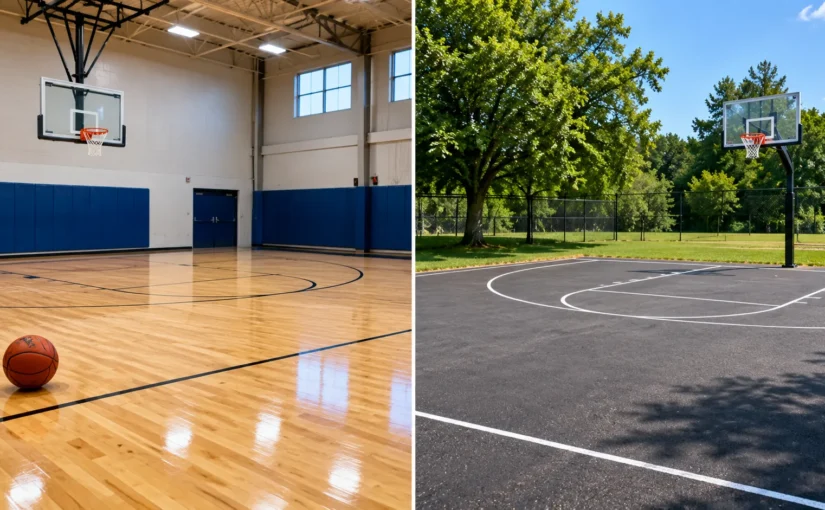
Basketball courts are made from different materials depending on whether they’re indoors or outdoors.
Indoor basketball courts commonly use maple hardwood or synthetic sports flooring. Outdoor basketball courts usually use asphalt, concrete, acrylic-coated surfaces, or modular plastic tiles.
However, the visible playing surface is only part of the construction. A basketball court may also include a concrete foundation, cushioning layers, protective coatings, and painted court lines.
This guide explains the main basketball court materials, how they’re constructed, and which surfaces work best for different locations.
What Are Basketball Courts Made Of?
Basketball courts use several materials and flooring systems, including hardwood, engineered wood, synthetic sports flooring, asphalt, concrete, acrylic coatings, modular plastic tiles, and specialized rubberized surfaces.
The right flooring material depends on the court’s location, intended use, budget, and maintenance requirements.
| Basketball Court Material | Typical Application | Main Advantage |
|---|---|---|
| Maple hardwood | Indoor gyms and professional arenas | Consistent ball bounce and controlled performance |
| Engineered wood | Indoor sports facilities | Stable, purpose-built flooring systems |
| Polyurethane or vinyl | Multipurpose indoor gyms | Versatility and easier maintenance |
| Asphalt | Outdoor public and recreational courts | Practical, relatively affordable paving |
| Concrete | Outdoor courts and structural foundations | Strength and durability |
| Acrylic coatings | Outdoor asphalt or concrete courts | Color, traction, and surface protection |
| Modular plastic tiles | Outdoor recreational and backyard courts | Replaceable panels and surface drainage |
| Rubberized flooring | Selected recreational and multipurpose spaces | Potential cushioning, depending on the system |
Importantly, acrylic coatings are not usually standalone foundations. They’re applied over a suitable structural surface, typically asphalt or concrete.
What Are Indoor Basketball Courts Made Of?
Indoor basketball court flooring is designed to provide reliable traction, consistent ball bounce, and suitable support for running, jumping, and sudden stops.
Maple Hardwood Flooring
Hard maple is one of the most recognizable basketball court materials.
It’s commonly used in professional arenas, college facilities, and school gymnasiums.
Maple wood has a relatively uniform grain and provides a durable playing surface when properly installed and maintained.
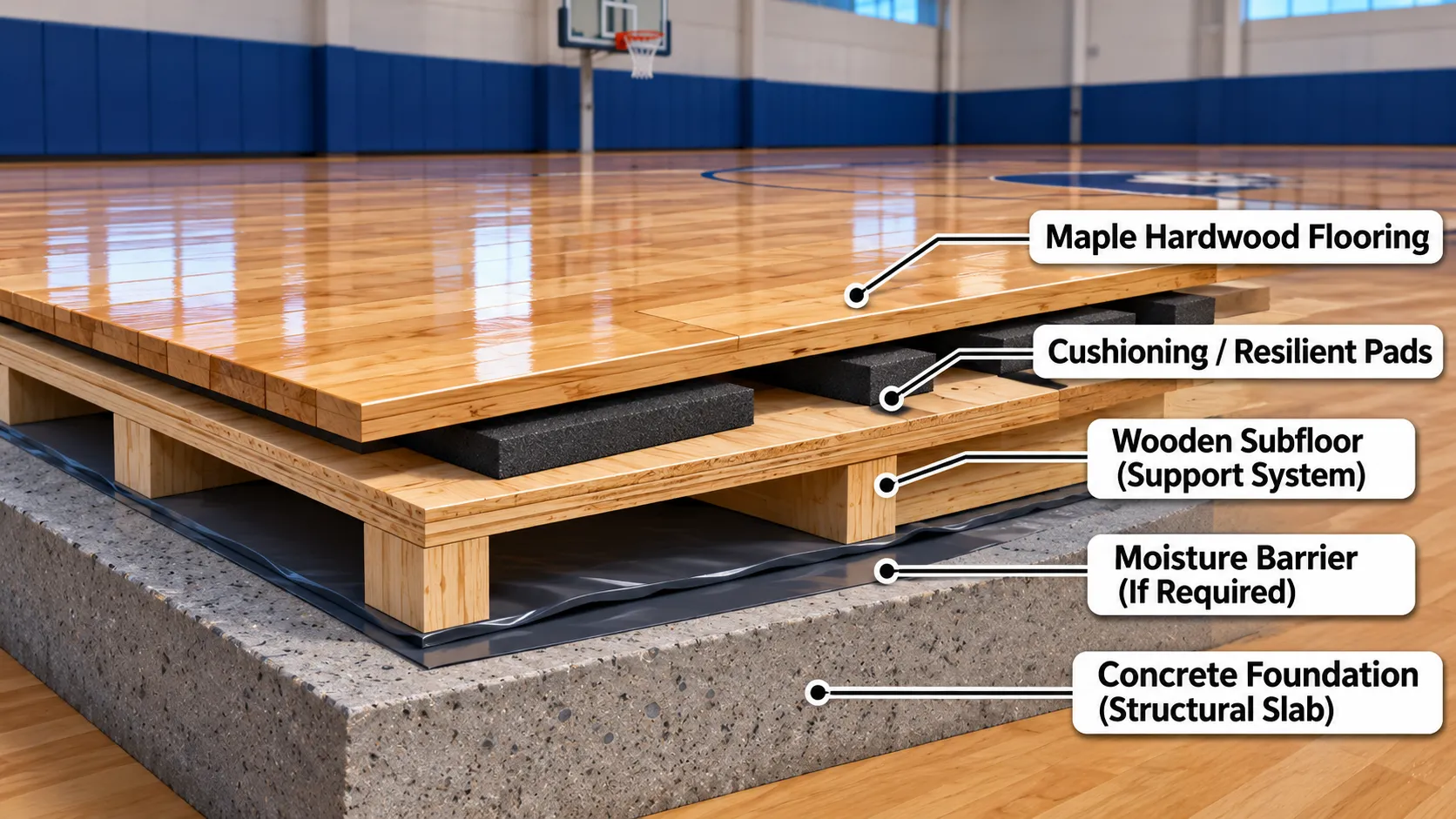
A typical hardwood basketball floor includes:
- A concrete structural slab.
- Moisture protection where required.
- A specialized wooden subfloor or support system.
- Resilient pads or other cushioning components.
- Maple hardwood flooring.
- Protective finish and painted court markings.
The cushioning comes primarily from the complete flooring system, not simply from the hardness of the maple planks.
Different hardwood systems offer different levels of shock absorption, vertical deformation, and ball rebound.
The Maple Flooring Manufacturers Association (MFMA) provides technical guidance for maple sports flooring systems.
Engineered Wood Flooring
Engineered wood uses multiple bonded wood layers rather than a single solid hardwood piece.
Some engineered systems are designed specifically for sports facilities.
They can offer improved dimensional stability under certain conditions, although performance depends on the complete flooring system.
Engineered wood should not be confused with ordinary residential laminate flooring.
A basketball court needs flooring designed for athletic movements, traction, and consistent bounce.
Polyurethane and Vinyl Sports Flooring
Not every indoor basketball court uses hardwood.
Schools, recreation centers, and community centers may choose synthetic sports flooring, particularly when the space supports several activities.
Polyurethane flooring can provide a seamless playing surface with cushioning built into the system.
Vinyl sports flooring is available in specialized products designed for indoor athletics.
Potential advantages include:
- Multiple color and court-marking options.
- Compatibility with different indoor sports.
- Easier routine cleaning in some systems.
- Different cushioning and performance specifications.
However, synthetic flooring is not automatically safer or more comfortable than hardwood.
Shock absorption, slip resistance, and ball bounce depend on the product and installation.
What Are Outdoor Basketball Courts Made Of?
Outdoor basketball courts must withstand rain, sunlight, temperature changes, and regular wear.
Asphalt and concrete are common structural playing surfaces, while acrylic coatings and modular tiles provide alternative finishes.
Asphalt and Concrete Basketball Courts
Asphalt is a practical choice for outdoor recreational courts.
It consists of asphalt binder and mineral aggregates placed over a prepared, compacted base.
Advantages include relatively economical paving and the ability to repair some surface damage.
However, asphalt can develop cracks, depressions, and surface wear over time.
Concrete is another common outdoor basketball court material.
A properly constructed concrete slab provides a strong, durable foundation and a consistent surface for basketball.
Concrete can also crack, particularly when drainage, ground preparation, or joint design is inadequate.
Both materials are relatively hard compared with properly cushioned indoor sports flooring.
For a detailed explanation of outdoor court construction, see our basketball court installation guide.
Acrylic Basketball Court Surfaces
Many colored outdoor basketball courts use acrylic sports coatings.
These coatings are applied over a suitable asphalt or concrete base.
Acrylic court systems can provide:
- Colored playing areas.
- Textured finishes for traction.
- UV-resistant surface coatings.
- Painted basketball lines.
- Easier visual identification of court boundaries.
Some systems include additional cushioning layers.
However, a basic acrylic coating does not turn concrete or asphalt into a sprung indoor sports floor.
The quality of the underlying base remains important.
Modular Tiles and Rubber Surfaces
Modular basketball court tiles are usually made from engineered plastics such as polypropylene.
The tiles connect to form a playing surface over a suitable prepared foundation.
Depending on their design, they may provide drainage channels, textured traction, and individual panel replacement.
Some systems also include features intended to improve player comfort.
However, modular tiles still require a stable base and correct installation.
Rubber basketball court surfaces are less common for full competitive courts.
Rubberized materials may be used in selected recreational spaces or as components within synthetic flooring systems.
A soft rubber surface is not automatically suitable for basketball. Excessive cushioning or unsuitable surface texture can affect movement and ball bounce.
How Is Basketball Court Flooring Constructed?
Basketball court construction involves more than installing the visible flooring material.
The layers vary depending on the surface and location.
1. Foundation and Base Layer
Indoor courts commonly begin with a concrete slab.
Outdoor asphalt courts generally use a compacted aggregate base beneath the asphalt pavement.
Outdoor concrete courts use a prepared subgrade and appropriately designed concrete slab.
The foundation must support the court and help prevent settlement, uneven surfaces, and premature damage.
2. Cushioning and Underlayment
Indoor hardwood systems often include resilient pads, battens, or other engineered components.
These help control how the floor responds when players land or change direction.
Some synthetic flooring systems also include cushioned layers.
Outdoor asphalt and concrete courts usually lack the same type of sprung subfloor.
3. Playing Surface
The playing surface may consist of hardwood planks, synthetic flooring, asphalt, concrete, or modular tiles.
Its construction affects traction, ball bounce, maintenance, and player comfort.
4. Protective Coatings and Court Markings
Hardwood basketball floors commonly receive protective finishes.
Outdoor courts may use acrylic coatings designed for sports surfaces.
Basketball court lines are then applied using materials compatible with the flooring system.
5. Drainage and Moisture Control
Outdoor courts need suitable drainage to prevent standing water and reduce surface damage.
Indoor hardwood floors require appropriate moisture management to reduce the risk of swelling, warping, and other problems.
Poor foundation preparation can shorten the useful life of almost any basketball court surface.
Basketball Court Materials Compared
The following table compares common basketball court flooring materials.
| Material | Ball Bounce | Player Comfort | Maintenance | Relative Cost |
|---|---|---|---|---|
| Maple hardwood | Consistent with a suitable sports system | Often good with a resilient subfloor | Regular cleaning and periodic recoating | High |
| Engineered sports wood | Depends on the system | Depends on cushioning | Product-specific care | Medium to high |
| Polyurethane or vinyl | Product-dependent | Various cushioning options | Routine cleaning and occasional repairs | Varies |
| Asphalt | Generally suitable when smooth and sound | Hard surface | Crack repairs and resurfacing | Often lower |
| Concrete | Generally consistent when properly finished | Hard surface | Cleaning, joints, and crack repairs | Varies |
| Acrylic-coated pavement | Depends on the underlying base | Usually firm without added cushioning | Cleaning and periodic recoating | Additional coating cost |
| Modular plastic tiles | Depends on tile design and installation | System-dependent | Cleaning and tile replacement | Medium to high |
These are general comparisons, not guaranteed performance ratings.
A properly installed sports flooring system may perform very differently from a cheaper product made from a similar material.
What Are NBA, NCAA, and School Basketball Courts Made Of?
NBA Basketball Courts
NBA basketball games are typically played on hardwood flooring systems, commonly using maple.
Professional courts may use portable wooden floor panels installed over an arena’s underlying floor.
These systems are designed to provide consistent playing conditions.
The NBA’s official court and equipment rules establish important court requirements, but those rules should not be confused with a universal specification for every flooring layer.
NCAA Basketball Courts
Many NCAA college basketball facilities use maple hardwood sports flooring.
However, flooring systems vary by college and venue, so not every NCAA court has the same construction.
The fact that a facility hosts college basketball does not establish the exact wood thickness, subfloor design, or manufacturer.
School and Recreational Basketball Courts
School gymnasiums may use hardwood, engineered wood, or synthetic sports flooring.
Community centers often need surfaces suitable for several activities, including basketball, volleyball, and general recreation.
Outdoor public basketball courts commonly use asphalt or concrete, sometimes with acrylic coatings.
The appropriate material depends on the facility’s needs rather than the level of basketball alone.
Which Basketball Court Surface Is Best for Players?
No single basketball court surface is best for every situation.
Several performance factors matter.
Shock absorption: A well-designed cushioned sports floor can reduce the impact transmitted through the playing surface. The level of cushioning depends on the full system.
Ball bounce: Players need predictable rebounds for dribbling, passing, and shooting drills. Uneven surfaces and unsuitable soft flooring can interfere with ball response.
Slip resistance: Basketball requires traction for sudden stops and changes of direction. Excessive slipperiness or inappropriate grip can create problems.
Weather resistance: Outdoor materials must tolerate rain, sunlight, and temperature changes.
Surface condition: Even a high-quality court can become unsafe when damaged, wet, dirty, or poorly maintained.
Standards such as ASTM F2772 address performance characteristics of indoor sports flooring, including shock absorption and ball rebound.
A surface should be assessed using relevant performance testing rather than unsupported claims about injury prevention.
Basketball Court Flooring Costs and Maintenance
Basketball court flooring costs vary considerably across the United States.
The final price depends on:
- Court dimensions.
- Existing ground or foundation conditions.
- Excavation and drainage requirements.
- Material and flooring system.
- Labor and contractor availability.
- Coatings, court markings, and accessories.
- Maintenance and future resurfacing.
Hardwood sports flooring usually involves specialized materials and installation.
Asphalt may be a relatively economical outdoor paving option, but ground preparation and drainage can substantially increase the project cost.
Concrete can provide long service life when properly constructed, although repairs may be expensive.
Modular tiles and acrylic coatings add another layer of cost when installed over new pavement.
Because prices depend heavily on project scope, a basic per-square-foot paving estimate should not be treated as the total cost of a finished basketball court.
For a broader breakdown, see our basketball court installation guide.
How Long Do Basketball Court Surfaces Last?
Lifespan depends on usage, construction quality, climate, and maintenance.
Hardwood courts can remain in service for decades with appropriate care and refinishing.
Asphalt courts may need crack repairs and periodic resurfacing.
Concrete courts can also last many years, but structural movement and cracks may require attention.
Synthetic floors and modular tiles have product-specific maintenance and replacement requirements.
Follow the flooring manufacturer’s maintenance schedule rather than assuming every basketball surface needs the same treatment.
How to Choose the Right Basketball Court Material
For professional indoor basketball: A purpose-built hardwood sports flooring system is a common choice.
For school and multipurpose gyms: Compare hardwood with certified synthetic sports flooring based on the activities offered.
For public outdoor courts: Asphalt or concrete with suitable sports coatings can provide a practical playing surface.
For backyard basketball courts: Consider available space, drainage, budget, local requirements, and whether you want pavement or modular tiles.
For areas with harsh weather: Prioritize appropriate materials, drainage, and installation methods suited to local conditions.
Before choosing a flooring material, consult an experienced sports court installer about the complete construction system.
Frequently Asked Questions
What Wood Are NBA Basketball Courts Made Of?
NBA courts commonly use hard maple hardwood installed as part of a specialized sports flooring system.
Are Outdoor Basketball Courts Asphalt or Concrete?
Both are common. The choice depends on construction costs, ground conditions, maintenance, and the facility’s intended use.
What Is the Cheapest Basketball Court Surface?
An existing suitable paved surface with properly applied basketball markings may be the least expensive option.
For new construction, compare complete contractor quotes rather than looking only at material prices.
Are Rubber Basketball Courts Good?
Some specialized rubberized sports flooring systems can support recreational basketball.
However, ordinary rubber mats and playground surfaces should not automatically be treated as suitable basketball court flooring.
Can Basketball Court Tiles Go Over Concrete?
Yes. Many modular basketball tile systems are designed for installation over a suitable concrete base.
The concrete must meet the tile manufacturer’s requirements for condition, drainage, and surface preparation.
Final Thoughts
Basketball courts are made from several different materials, but hardwood is common indoors, while asphalt and concrete are common outdoors.
Synthetic flooring, acrylic coatings, and modular tiles offer additional options for schools, recreational facilities, and backyard courts.
The best choice depends on the complete flooring system, not just the visible surface.
Consider durability, ball bounce, traction, drainage, player comfort, and long-term maintenance before choosing a basketball court material.
2 thoughts on “What Are Basketball Courts Made Of? Materials Explained”
Comments are closed.