Asphalt Basketball Court | Costs, Pros & Installation

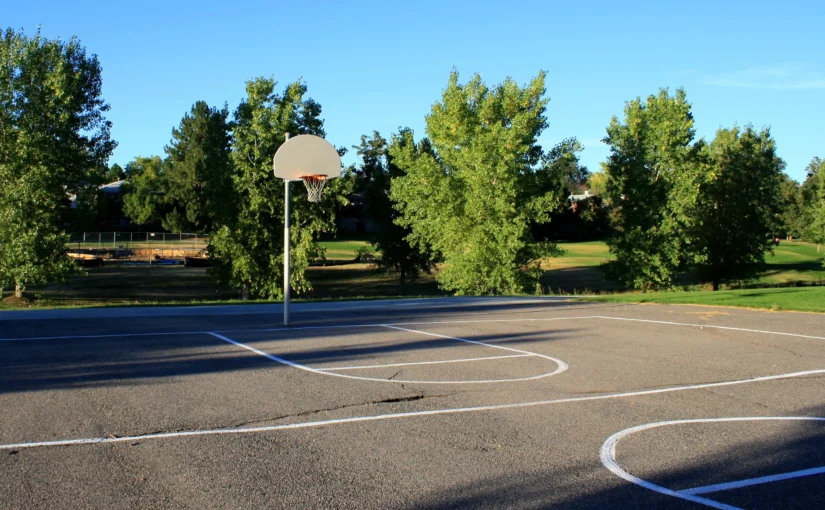
An asphalt basketball court is a popular option for outdoor basketball because it provides a firm playing surface and can cost less to install than some concrete court systems.

Asphalt courts are suitable for backyard basketball, schools, parks, and recreational facilities. They can be left as bare asphalt or finished with an acrylic sports coating for improved appearance and a more consistent playing surface.

However, asphalt courts can develop cracks, require maintenance, and become hot in direct sunlight.

This guide explains asphalt basketball court costs in the US, the installation process, advantages and disadvantages, and how asphalt compares with concrete and modular sports tiles.

What Is an Asphalt Basketball Court?

An asphalt basketball court is an outdoor playing area built using compacted asphalt pavement over a prepared foundation.

Asphalt is also commonly called blacktop.

A typical asphalt basketball court has several layers:

  1. Subgrade: The prepared natural soil supporting the court.
  2. Aggregate base: Compacted crushed stone that provides structural support.
  3. Asphalt layers: Compacted asphalt that creates a stable playing surface.
  4. Acrylic coating: An optional sports coating that adds color and playing texture.
  5. Court markings: Painted basketball lines showing the playing boundaries.

A basketball hoop is installed separately, usually with a dedicated concrete foundation for an in-ground system.

The Wisconsin Asphalt Pavement Association’s 2022 Sport Court Design Guide explains how groundwork, drainage, and asphalt construction affect court performance. The guidance is regional, not a universal US specification.

Bare Asphalt vs Acrylic-Coated Asphalt

You can play basketball on bare asphalt if the surface is smooth, stable, and suitable for play.

However, bare asphalt may feel rougher and cause more wear on basketballs and shoes.

Acrylic sports coatings provide a finished surface with controlled texture and color.

They also allow court owners to create custom basketball court designs.

An acrylic coating does not repair a failing asphalt foundation. Structural problems must be addressed before applying the coating.

How Much Does an Asphalt Basketball Court Cost?

An asphalt basketball court can cost several thousand dollars for a small installation or tens of thousands for a professionally constructed full court.

The total depends on court size, site preparation, asphalt thickness, drainage, sports coatings, and equipment.

Asphalt Basketball Court Cost by Size (Full Court vs Half Court)

The following published US estimates illustrate the range of possible project budgets. They come from different providers and do not represent a national average.

Example court size Area Published estimate Source
Compact asphalt court, 30 × 28 ft 840 sq ft $8,000–$18,000 AsphaPro
Small backyard court, 30 × 30 ft 900 sq ft $15,000–$25,000 Precision Sports CT
Larger half court, 42 × 50 ft 2,100 sq ft $25,000–$45,000 Precision Sports CT
Full court, 94 × 50 ft 4,700 sq ft $35,000–$75,000 AsphaPro
Full court, 94 × 50 ft 4,700 sq ft $60,000–$80,000+ Precision Sports CT

Sources: AsphaPro’s asphalt basketball court cost examples and Precision Sports CT’s 2026 basketball court cost guide. AsphaPro gives asphalt-focused estimates; Precision’s estimates cover broader professional court installations in Connecticut. They are not directly comparable. Check whether each quote includes preparation, surfacing, hoops, fencing, lighting and other extras.

A 30 × 30-foot backyard court is a compact recreational area, not a regulation half court.

Likewise, the 94 × 50-foot dimensions describe an NBA playing area, not necessarily the complete paved area required for safe play.

Asphalt Basketball Court Installation Cost Breakdown

The main expenses include:

Component What affects the cost
Site preparation Excavation, soil conditions, grading, and access
Aggregate base Material depth, compaction, and ground stability
Asphalt paving Court area, asphalt mixture, thickness, and labor
Acrylic top coat Surface preparation, repairs, and coating system
Court lines Basketball layout, markings, and customization
Basketball hoop Portable or permanent system and installation
Optional extras Fencing, lighting, drainage, and landscaping

A contractor may quote only for asphalt paving, while another includes a complete basketball court.

Always check what is included before comparing prices.

What Affects the Total Cost?

The biggest cost factors are:

  • Court size: Larger courts require more asphalt, groundwork, and coating materials.
  • Ground conditions: Soft soil, slopes, and poor drainage can increase construction costs.
  • Location: Labor rates and material delivery costs vary across the US.
  • Playing surface: A basic asphalt court generally requires less finishing work than a multi-layer acrylic system.
  • Equipment: Permanent basketball hoops, fencing, and lighting increase the budget.

For a broader explanation of court construction expenses, see our basketball court installation guide.

Is Asphalt Good for a Basketball Court?

Yes. Asphalt can provide a suitable outdoor basketball surface when it is correctly constructed and maintained.

It offers a firm surface for basketball bounce and can support recreational or competitive play.

However, its performance depends on the quality of the foundation and surface finish.

Advantages of Asphalt Basketball Courts

1. Potentially lower installation costs

Asphalt can be more affordable initially than some concrete court systems, although local contractor quotes are needed for an accurate comparison.

2. Suitable for different court sizes

Asphalt works for small backyard shooting areas, half courts, and full-size outdoor basketball courts.

3. Multiple surface finishes

Owners can choose bare asphalt, acrylic coatings, or compatible modular sports tiles.

4. Repair options

Some cracks and surface defects can be repaired without rebuilding the entire court.

5. Consistent basketball bounce

A properly installed, smooth asphalt surface can provide reliable ball bounce for outdoor basketball. Traction depends on its surface texture, condition and any sports coating used.

Disadvantages of Asphalt Basketball Courts

1. Cracking

Asphalt may crack because of soil movement, poor drainage, weather, or aging.

2. Heat absorption

Dark asphalt absorbs sunlight and can become uncomfortable during hot weather.

3. Hard playing surface

Asphalt offers little cushioning compared with specialized resilient sports flooring.

4. Surface wear

Bare asphalt can become rough, while acrylic coatings gradually wear and require renewal.

5. Maintenance

Court owners must monitor cracks, drainage, surface wear, and other damage.

Asphalt is a practical choice for many outdoor courts, but it is not automatically the best surface for every property.

Asphalt Basketball Court Sizes and Dimensions

Before installing asphalt, determine how much space is available and how the court will be used.

Court type Dimensions Playing area
Small shooting area 20 × 20 ft 400 sq ft
Compact backyard court 30 × 30 ft 900 sq ft
Custom half court 30 × 50 ft 1,500 sq ft
Larger half-court example 42 × 50 ft 2,100 sq ft
High school court 84 × 50 ft 4,200 sq ft
NBA court 94 × 50 ft 4,700 sq ft

The first four examples are recreational planning sizes, not universal regulation dimensions. The high school figure is a commonly specified optimum playing area.

The NBA’s official court dimensions confirm the professional playing area of 94 × 50 feet.

Remember that the paved area may need to extend beyond the court markings.

Extra space helps keep players away from fences, walls, basketball hoop supports, and other obstacles.

How to Build an Asphalt Basketball Court

Building an asphalt basketball court requires more than laying asphalt on the ground.

Proper preparation reduces the risk of cracking, uneven surfaces, and drainage problems.

1. Plan the Court and Assess the Site

Start by choosing the court dimensions and basketball hoop location.

Check the available space, ground slope, soil conditions, and access for construction equipment.

Also investigate local permits, property boundaries, and drainage requirements.

2. Prepare the Ground and Drainage

Remove vegetation, topsoil, roots, and unsuitable materials before preparing the foundation.

The ground must be graded and compacted to the specified design. A court needs a controlled slope for drainage rather than a perfectly level surface.

Make sure the design includes space beyond the marked playing area for safe movement and the basketball hoop support.

Drainage is especially important because standing water can damage the pavement and affect player safety.

3. Install the Aggregate Base

A layer of compacted crushed stone supports the asphalt.

The required thickness depends on soil conditions, climate, and the court’s design.

Poorly compacted material can settle and cause cracks in the playing surface.

4. Lay and Compact the Asphalt

Contractors install the specified asphalt mixture in layers.

A fine-graded upper course helps create a smoother surface suitable for basketball.

Proper compaction and surface grading are essential.

Uneven asphalt can affect ball bounce and create areas where water collects.

5. Apply the Acrylic Sports Coating

Once the new asphalt has met the required curing conditions, contractors can prepare it for an acrylic sports coating.

The process may involve cleaning, repairing defects, applying an acrylic resurfacer, and adding colored coatings.

The exact application method depends on the product.

6. Add Court Markings and Equipment

Basketball lines are measured and painted according to the intended court layout.
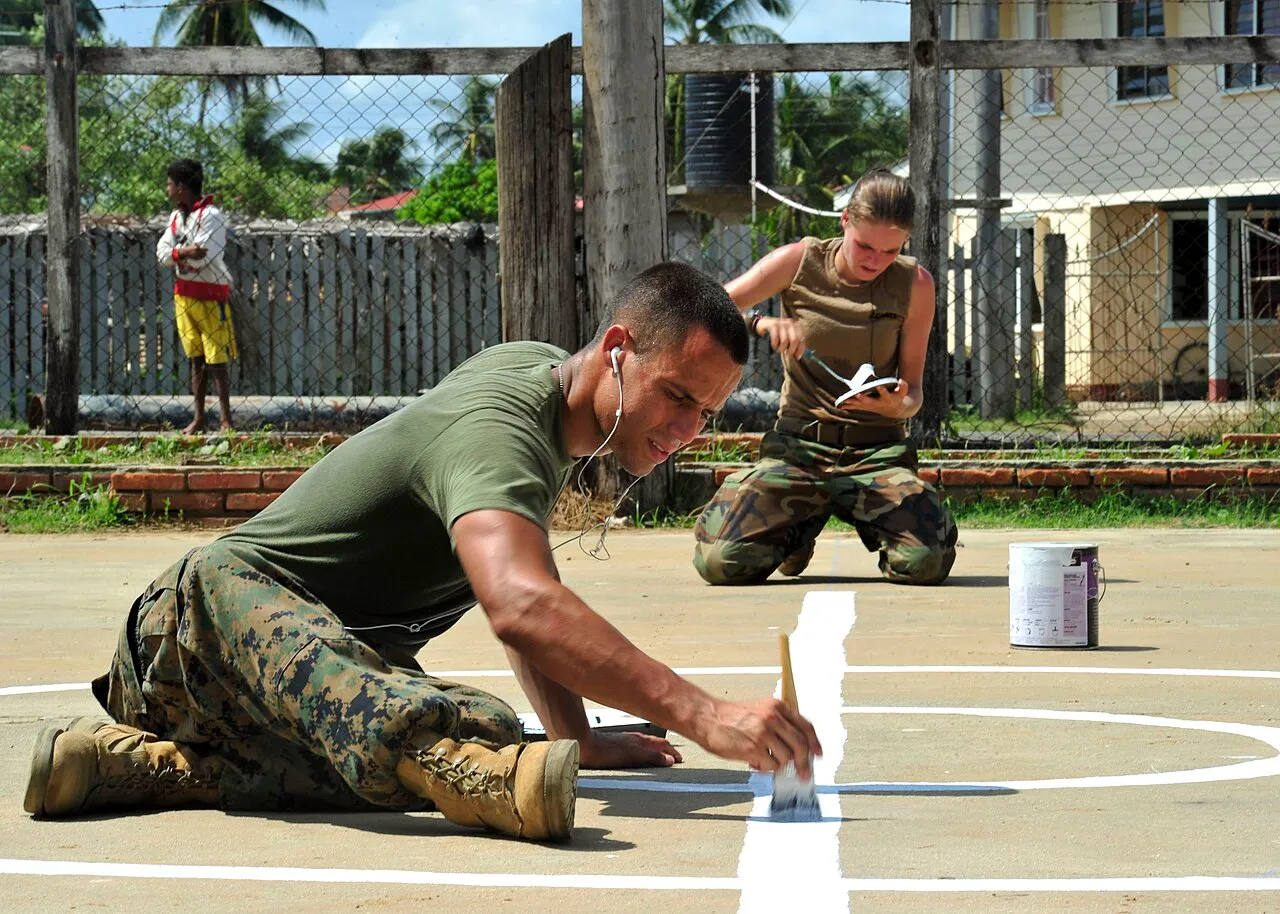
Workers painting white basketball court lines during construction
US service members painting basketball court markings during a community construction project. Photo: U.S. Navy / Public domain. Source: Wikimedia Commons.

Install the basketball hoop using the manufacturer’s foundation and assembly instructions.

Complete the project with any required fencing, padding, or lighting.

Asphalt Thickness, Drainage, and Curing

Three important construction details affect how well an asphalt basketball court performs.

How Thick Should an Asphalt Basketball Court Be?

There is no single asphalt thickness suitable for every basketball court.

The Wisconsin Asphalt Pavement Association’s 2022 guide describes different asphalt layer thicknesses depending on the mixture used.

It also recommends at least 4 inches of compacted aggregate base for the conditions covered by its guidance, increasing to 8 inches for poor or questionable soil.

These are regional technical recommendations, not universal US construction requirements.

A contractor should select the pavement structure based on the site’s soil, drainage, climate, and expected use.

Why Drainage Matters

An asphalt basketball court should have a smooth, consistent plane with enough slope to drain rainwater away.

The Wisconsin guide describes a surface slope of approximately 0.83% to 1%.

That represents about 5–6 inches of elevation change across 50 feet.

However, the correct drainage design depends on the property and local requirements.

Poor drainage can contribute to cracks, settlement, puddles, and surface deterioration.

How Long Does Asphalt Need to Cure?

New asphalt needs an appropriate waiting period before acrylic sports coatings are applied.

SportMaster specifies 14–30 days for its Acrylic Resurfacer, while the Wisconsin Asphalt Pavement Association recommends at least 45 days before applying a wearing or playing surface.

These recommendations are different because they come from different technical sources.

Follow the selected coating manufacturer’s current instructions and the project’s construction specifications.

The waiting period before coating is also different from the time required before the completed court can be used.

Asphalt vs Concrete vs Modular Basketball Courts

Asphalt is not the only option for outdoor basketball.

Concrete and modular sports tiles are also commonly considered.

Feature Asphalt Concrete Modular sports tiles
Initial cost Often lower Can be higher Tiles plus suitable base
Ball bounce Consistent on smooth surfaces Consistent on smooth surfaces Depends on tile system
Cracking Possible Possible Base can still crack
Maintenance Crack repairs and possible recoating Joint/crack care and possible recoating Cleaning and tile inspections
Drainage Surface slope Surface slope Through some tiles, then across base
Playing comfort Hard surface Hard surface Depends on product

Asphalt vs Concrete Basketball Courts

Concrete courts can provide a durable foundation, but construction costs depend on the slab design and site conditions. Both asphalt and concrete can develop cracks from movement, weather, or drainage problems.

Both can support compatible acrylic sports coatings. Compare equivalent local quotes for the same court dimensions, foundation requirements, drainage, finish and equipment rather than comparing pavement-only prices with complete court projects.

The best option depends on construction costs, climate, maintenance expectations, and local contractor expertise.

Asphalt vs Modular Sports Tiles

Modular basketball court tiles are one type of synthetic court system and are usually installed over a suitable hard foundation.

Some modular tile systems allow installation over asphalt and offer different colors, logos, and multi-sport layouts. Check the specific tile manufacturer’s approved base and installation requirements.

However, tiles do not automatically fix poor drainage or structural problems underneath. Some perforated tiles let water pass through, but the foundation still needs suitable drainage. Follow the manufacturer’s instructions for expansion clearance and cleaning.

Learn more about these surfaces in our guide to what basketball courts are made of.

Asphalt Basketball Court Maintenance and Lifespan

Regular maintenance helps protect an asphalt basketball court and keeps the playing surface in suitable condition.

Cleaning and Routine Maintenance

Remove leaves, dirt, loose stones, and other debris.

Clean the surface using methods approved by the coating manufacturer.

Keep drainage outlets clear and inspect the court after severe weather.

Repairing Cracks and Surface Damage

Small cracks may be repairable with compatible products.

However, repeated cracking, settlement, or large damaged areas may indicate deeper foundation problems.

These issues should be assessed before applying new coatings.

Recoating vs Resurfacing vs Rebuilding

These terms describe different types of work.

  • Recoating: Renewing the existing acrylic playing surface.
  • Asphalt resurfacing: Repairing or replacing part of the pavement surface, depending on the project scope.
  • Rebuilding: Removing failed pavement and reconstructing the supporting layers when necessary.

A new coating cannot permanently repair a structurally damaged foundation.

How Long Does an Asphalt Basketball Court Last?

There is no guaranteed lifespan for every asphalt basketball court.

Longevity depends on construction quality, weather, drainage, use, and maintenance. There is no reliable universal lifespan for asphalt basketball courts.

The acrylic surface usually needs attention sooner than the underlying asphalt.

SportMaster describes a standard resurfacing cycle of 5–8 years for its acrylic sports surfaces, although actual conditions may require earlier or later work.

DIY vs Professional Asphalt Basketball Court Installation

Some basketball court tasks are suitable for homeowners.

These include planning the layout, measuring available space, selecting equipment, and routine maintenance.

However, installing asphalt usually requires professional paving equipment and experience.

Poor compaction or drainage can lead to expensive repairs.

What to Ask an Asphalt Basketball Court Contractor

Before accepting a quote, ask:

  1. What are the exact court and paved-area dimensions?
  2. What site preparation and drainage work is included?
  3. What asphalt thickness and materials will be used?
  4. Does the price include acrylic coatings and court lines?
  5. Is basketball hoop installation included?
  6. What maintenance and warranty terms apply?

For larger projects, obtain several itemized quotes using the same specifications.

Frequently Asked Questions

Can You Play Basketball on Bare Asphalt?

Yes. Bare asphalt can be used for basketball if it provides a smooth, stable, suitable playing surface.

An acrylic sports coating is optional but can improve the finished appearance and provide a designed playing texture.

Is Asphalt Cheaper Than Concrete?

Asphalt often has a lower initial paving cost, but this is not guaranteed. Long-term costs depend on the full surface system, maintenance, repairs, and replacement needs.

Compare local quotes that include the same site preparation, drainage, playing surface, and equipment.

Can You Paint an Asphalt Basketball Court?

Yes. Use a coating designed for asphalt sports courts.

Ordinary household paint or driveway sealers may not provide the correct playing characteristics or compatibility.

How Long Before You Can Play on New Asphalt?

It depends on the pavement, coating system, weather, and installation specifications.

New asphalt may require a separate waiting period before acrylic coatings can be applied. The finished coating must also cure before play.

Follow the contractor’s and manufacturer’s instructions.

Can You Install Basketball Court Tiles Over Asphalt?

Yes, some modular sports tile systems are designed for installation over suitable asphalt.

The asphalt must meet the manufacturer’s requirements for stability, surface condition, and drainage. See the VersaCourt base options guide for one manufacturer’s specifications.

Final Thoughts

An asphalt basketball court can be a practical option for homeowners, schools, and recreational facilities.

It provides a firm playing surface, supports different court sizes, and offers several finishing options.

However, proper site preparation, drainage, and installation are essential.

For most new asphalt basketball court projects, the best starting point is to compare detailed local contractor quotes that include groundwork, paving, coatings, and basketball equipment.
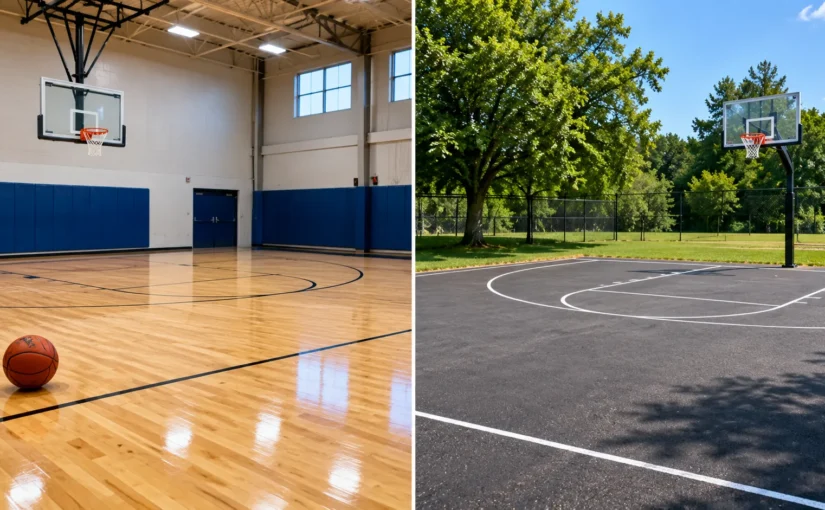
What Are Basketball Courts Made Of? Materials Explained

Basketball courts are made from different materials depending on whether they’re indoors or outdoors.

Indoor basketball courts commonly use maple hardwood or synthetic sports flooring. Outdoor basketball courts usually use asphalt, concrete, acrylic-coated surfaces, or modular plastic tiles.

However, the visible playing surface is only part of the construction. A basketball court may also include a concrete foundation, cushioning layers, protective coatings, and painted court lines.

This guide explains the main basketball court materials, how they’re constructed, and which surfaces work best for different locations.

What Are Basketball Courts Made Of?

Basketball courts use several materials and flooring systems, including hardwood, engineered wood, synthetic sports flooring, asphalt, concrete, acrylic coatings, modular plastic tiles, and specialized rubberized surfaces.

The right flooring material depends on the court’s location, intended use, budget, and maintenance requirements.

Basketball Court Material Typical Application Main Advantage
Maple hardwood Indoor gyms and professional arenas Consistent ball bounce and controlled performance
Engineered wood Indoor sports facilities Stable, purpose-built flooring systems
Polyurethane or vinyl Multipurpose indoor gyms Versatility and easier maintenance
Asphalt Outdoor public and recreational courts Practical, relatively affordable paving
Concrete Outdoor courts and structural foundations Strength and durability
Acrylic coatings Outdoor asphalt or concrete courts Color, traction, and surface protection
Modular plastic tiles Outdoor recreational and backyard courts Replaceable panels and surface drainage
Rubberized flooring Selected recreational and multipurpose spaces Potential cushioning, depending on the system

Importantly, acrylic coatings are not usually standalone foundations. They’re applied over a suitable structural surface, typically asphalt or concrete.

What Are Indoor Basketball Courts Made Of?

Indoor basketball court flooring is designed to provide reliable traction, consistent ball bounce, and suitable support for running, jumping, and sudden stops.

Maple Hardwood Flooring

Hard maple is one of the most recognizable basketball court materials.

It’s commonly used in professional arenas, college facilities, and school gymnasiums.

Maple wood has a relatively uniform grain and provides a durable playing surface when properly installed and maintained.

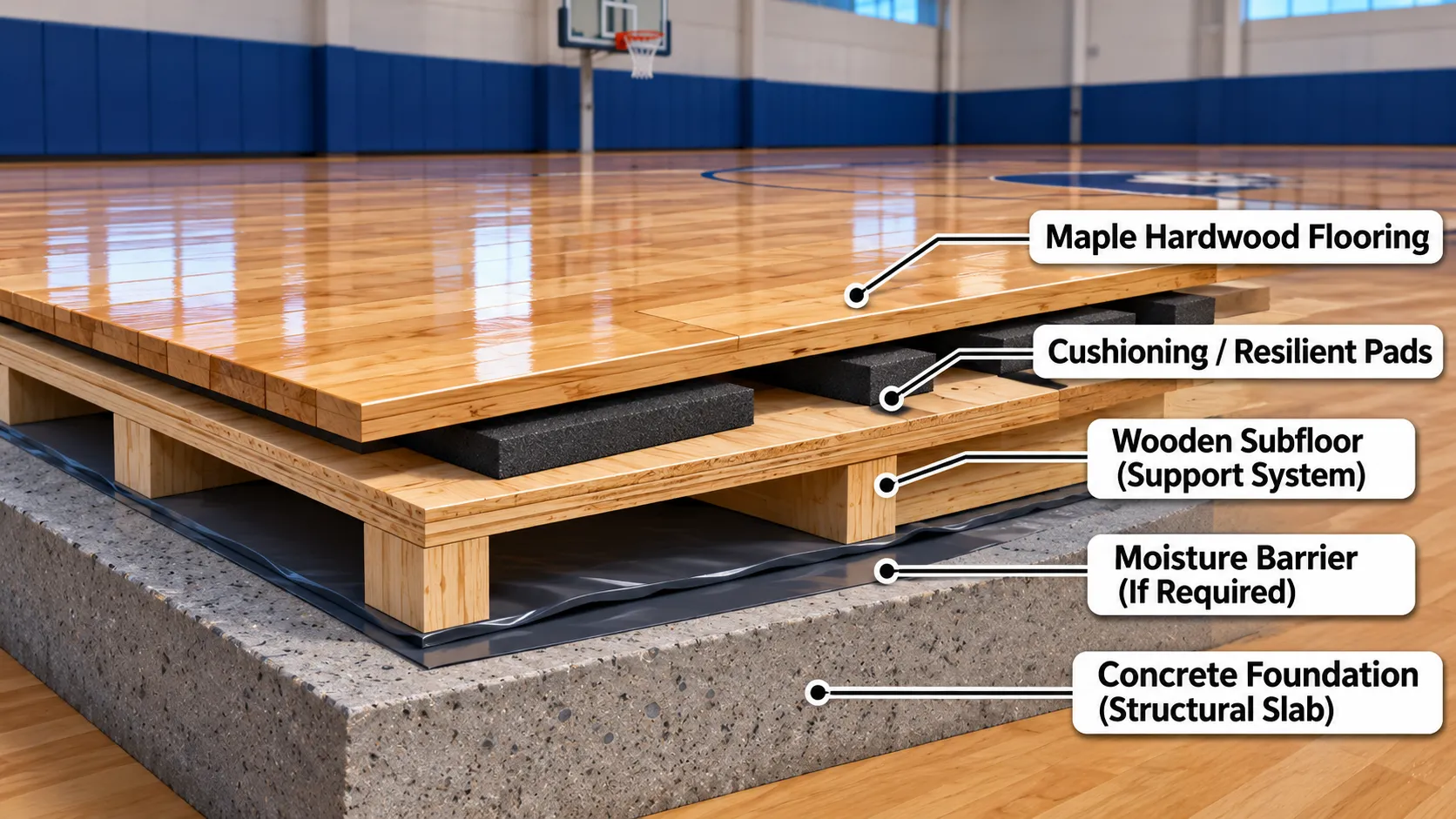
A typical hardwood basketball floor includes:

  • A concrete structural slab.
  • Moisture protection where required.
  • A specialized wooden subfloor or support system.
  • Resilient pads or other cushioning components.
  • Maple hardwood flooring.
  • Protective finish and painted court markings.

The cushioning comes primarily from the complete flooring system, not simply from the hardness of the maple planks.

Different hardwood systems offer different levels of shock absorption, vertical deformation, and ball rebound.

The Maple Flooring Manufacturers Association (MFMA) provides technical guidance for maple sports flooring systems.

Engineered Wood Flooring

Engineered wood uses multiple bonded wood layers rather than a single solid hardwood piece.

Some engineered systems are designed specifically for sports facilities.

They can offer improved dimensional stability under certain conditions, although performance depends on the complete flooring system.

Engineered wood should not be confused with ordinary residential laminate flooring.

A basketball court needs flooring designed for athletic movements, traction, and consistent bounce.

Polyurethane and Vinyl Sports Flooring

Not every indoor basketball court uses hardwood.

Schools, recreation centers, and community centers may choose synthetic sports flooring, particularly when the space supports several activities.

Polyurethane flooring can provide a seamless playing surface with cushioning built into the system.

Vinyl sports flooring is available in specialized products designed for indoor athletics.

Potential advantages include:

  • Multiple color and court-marking options.
  • Compatibility with different indoor sports.
  • Easier routine cleaning in some systems.
  • Different cushioning and performance specifications.

However, synthetic flooring is not automatically safer or more comfortable than hardwood.

Shock absorption, slip resistance, and ball bounce depend on the product and installation.

What Are Outdoor Basketball Courts Made Of?

Outdoor basketball courts must withstand rain, sunlight, temperature changes, and regular wear.

Asphalt and concrete are common structural playing surfaces, while acrylic coatings and modular tiles provide alternative finishes.

Asphalt and Concrete Basketball Courts

Asphalt is a practical choice for outdoor recreational courts.

It consists of asphalt binder and mineral aggregates placed over a prepared, compacted base.

Advantages include relatively economical paving and the ability to repair some surface damage.

However, asphalt can develop cracks, depressions, and surface wear over time.

Concrete is another common outdoor basketball court material.

A properly constructed concrete slab provides a strong, durable foundation and a consistent surface for basketball.

Concrete can also crack, particularly when drainage, ground preparation, or joint design is inadequate.

Both materials are relatively hard compared with properly cushioned indoor sports flooring.

For a detailed explanation of outdoor court construction, see our basketball court installation guide.

Acrylic Basketball Court Surfaces

Many colored outdoor basketball courts use acrylic sports coatings.

These coatings are applied over a suitable asphalt or concrete base.

Acrylic court systems can provide:

  • Colored playing areas.
  • Textured finishes for traction.
  • UV-resistant surface coatings.
  • Painted basketball lines.
  • Easier visual identification of court boundaries.

Some systems include additional cushioning layers.

However, a basic acrylic coating does not turn concrete or asphalt into a sprung indoor sports floor.

The quality of the underlying base remains important.

Modular Tiles and Rubber Surfaces

Modular basketball court tiles are usually made from engineered plastics such as polypropylene.

The tiles connect to form a playing surface over a suitable prepared foundation.

Depending on their design, they may provide drainage channels, textured traction, and individual panel replacement.

Some systems also include features intended to improve player comfort.

However, modular tiles still require a stable base and correct installation.

Rubber basketball court surfaces are less common for full competitive courts.

Rubberized materials may be used in selected recreational spaces or as components within synthetic flooring systems.

A soft rubber surface is not automatically suitable for basketball. Excessive cushioning or unsuitable surface texture can affect movement and ball bounce.

How Is Basketball Court Flooring Constructed?

Basketball court construction involves more than installing the visible flooring material.

The layers vary depending on the surface and location.

Cutaway diagram showing maple hardwood basketball flooring, cushioning pads, wooden subfloor, moisture barrier, and concrete foundation.
Example of a hardwood basketball court flooring system, showing its structural and cushioning layers.

1. Foundation and Base Layer

Indoor courts commonly begin with a concrete slab.

Outdoor asphalt courts generally use a compacted aggregate base beneath the asphalt pavement.

Outdoor concrete courts use a prepared subgrade and appropriately designed concrete slab.

The foundation must support the court and help prevent settlement, uneven surfaces, and premature damage.

2. Cushioning and Underlayment

Indoor hardwood systems often include resilient pads, battens, or other engineered components.

These help control how the floor responds when players land or change direction.

Some synthetic flooring systems also include cushioned layers.

Outdoor asphalt and concrete courts usually lack the same type of sprung subfloor.

3. Playing Surface

The playing surface may consist of hardwood planks, synthetic flooring, asphalt, concrete, or modular tiles.

Its construction affects traction, ball bounce, maintenance, and player comfort.

4. Protective Coatings and Court Markings

Hardwood basketball floors commonly receive protective finishes.

Outdoor courts may use acrylic coatings designed for sports surfaces.

Basketball court lines are then applied using materials compatible with the flooring system.

5. Drainage and Moisture Control

Outdoor courts need suitable drainage to prevent standing water and reduce surface damage.

Indoor hardwood floors require appropriate moisture management to reduce the risk of swelling, warping, and other problems.

Poor foundation preparation can shorten the useful life of almost any basketball court surface.

Basketball Court Materials Compared

The following table compares common basketball court flooring materials.

Material Ball Bounce Player Comfort Maintenance Relative Cost
Maple hardwood Consistent with a suitable sports system Often good with a resilient subfloor Regular cleaning and periodic recoating High
Engineered sports wood Depends on the system Depends on cushioning Product-specific care Medium to high
Polyurethane or vinyl Product-dependent Various cushioning options Routine cleaning and occasional repairs Varies
Asphalt Generally suitable when smooth and sound Hard surface Crack repairs and resurfacing Often lower
Concrete Generally consistent when properly finished Hard surface Cleaning, joints, and crack repairs Varies
Acrylic-coated pavement Depends on the underlying base Usually firm without added cushioning Cleaning and periodic recoating Additional coating cost
Modular plastic tiles Depends on tile design and installation System-dependent Cleaning and tile replacement Medium to high

These are general comparisons, not guaranteed performance ratings.

A properly installed sports flooring system may perform very differently from a cheaper product made from a similar material.

What Are NBA, NCAA, and School Basketball Courts Made Of?

NBA Basketball Courts

NBA basketball games are typically played on hardwood flooring systems, commonly using maple.

Professional courts may use portable wooden floor panels installed over an arena’s underlying floor.

These systems are designed to provide consistent playing conditions.

The NBA’s official court and equipment rules establish important court requirements, but those rules should not be confused with a universal specification for every flooring layer.

NCAA Basketball Courts

Many NCAA college basketball facilities use maple hardwood sports flooring.

However, flooring systems vary by college and venue, so not every NCAA court has the same construction.

The fact that a facility hosts college basketball does not establish the exact wood thickness, subfloor design, or manufacturer.

School and Recreational Basketball Courts

School gymnasiums may use hardwood, engineered wood, or synthetic sports flooring.

Community centers often need surfaces suitable for several activities, including basketball, volleyball, and general recreation.

Outdoor public basketball courts commonly use asphalt or concrete, sometimes with acrylic coatings.

The appropriate material depends on the facility’s needs rather than the level of basketball alone.

Which Basketball Court Surface Is Best for Players?

No single basketball court surface is best for every situation.

Several performance factors matter.

Shock absorption: A well-designed cushioned sports floor can reduce the impact transmitted through the playing surface. The level of cushioning depends on the full system.

Ball bounce: Players need predictable rebounds for dribbling, passing, and shooting drills. Uneven surfaces and unsuitable soft flooring can interfere with ball response.

Slip resistance: Basketball requires traction for sudden stops and changes of direction. Excessive slipperiness or inappropriate grip can create problems.

Weather resistance: Outdoor materials must tolerate rain, sunlight, and temperature changes.

Surface condition: Even a high-quality court can become unsafe when damaged, wet, dirty, or poorly maintained.

Standards such as ASTM F2772 address performance characteristics of indoor sports flooring, including shock absorption and ball rebound.

A surface should be assessed using relevant performance testing rather than unsupported claims about injury prevention.

Basketball Court Flooring Costs and Maintenance

Basketball court flooring costs vary considerably across the United States.

The final price depends on:

  • Court dimensions.
  • Existing ground or foundation conditions.
  • Excavation and drainage requirements.
  • Material and flooring system.
  • Labor and contractor availability.
  • Coatings, court markings, and accessories.
  • Maintenance and future resurfacing.

Hardwood sports flooring usually involves specialized materials and installation.

Asphalt may be a relatively economical outdoor paving option, but ground preparation and drainage can substantially increase the project cost.

Concrete can provide long service life when properly constructed, although repairs may be expensive.

Modular tiles and acrylic coatings add another layer of cost when installed over new pavement.

Because prices depend heavily on project scope, a basic per-square-foot paving estimate should not be treated as the total cost of a finished basketball court.

For a broader breakdown, see our basketball court installation guide.

How Long Do Basketball Court Surfaces Last?

Lifespan depends on usage, construction quality, climate, and maintenance.

Hardwood courts can remain in service for decades with appropriate care and refinishing.

Asphalt courts may need crack repairs and periodic resurfacing.

Concrete courts can also last many years, but structural movement and cracks may require attention.

Synthetic floors and modular tiles have product-specific maintenance and replacement requirements.

Follow the flooring manufacturer’s maintenance schedule rather than assuming every basketball surface needs the same treatment.

How to Choose the Right Basketball Court Material

For professional indoor basketball: A purpose-built hardwood sports flooring system is a common choice.

For school and multipurpose gyms: Compare hardwood with certified synthetic sports flooring based on the activities offered.

For public outdoor courts: Asphalt or concrete with suitable sports coatings can provide a practical playing surface.

For backyard basketball courts: Consider available space, drainage, budget, local requirements, and whether you want pavement or modular tiles.

For areas with harsh weather: Prioritize appropriate materials, drainage, and installation methods suited to local conditions.

Before choosing a flooring material, consult an experienced sports court installer about the complete construction system.

Frequently Asked Questions

What Wood Are NBA Basketball Courts Made Of?

NBA courts commonly use hard maple hardwood installed as part of a specialized sports flooring system.

Are Outdoor Basketball Courts Asphalt or Concrete?

Both are common. The choice depends on construction costs, ground conditions, maintenance, and the facility’s intended use.

What Is the Cheapest Basketball Court Surface?

An existing suitable paved surface with properly applied basketball markings may be the least expensive option.

For new construction, compare complete contractor quotes rather than looking only at material prices.

Are Rubber Basketball Courts Good?

Some specialized rubberized sports flooring systems can support recreational basketball.

However, ordinary rubber mats and playground surfaces should not automatically be treated as suitable basketball court flooring.

Can Basketball Court Tiles Go Over Concrete?

Yes. Many modular basketball tile systems are designed for installation over a suitable concrete base.

The concrete must meet the tile manufacturer’s requirements for condition, drainage, and surface preparation.

Final Thoughts

Basketball courts are made from several different materials, but hardwood is common indoors, while asphalt and concrete are common outdoors.

Synthetic flooring, acrylic coatings, and modular tiles offer additional options for schools, recreational facilities, and backyard courts.

The best choice depends on the complete flooring system, not just the visible surface.

Consider durability, ball bounce, traction, drainage, player comfort, and long-term maintenance before choosing a basketball court material.

Basketball Equipment List | Essentials for Beginners

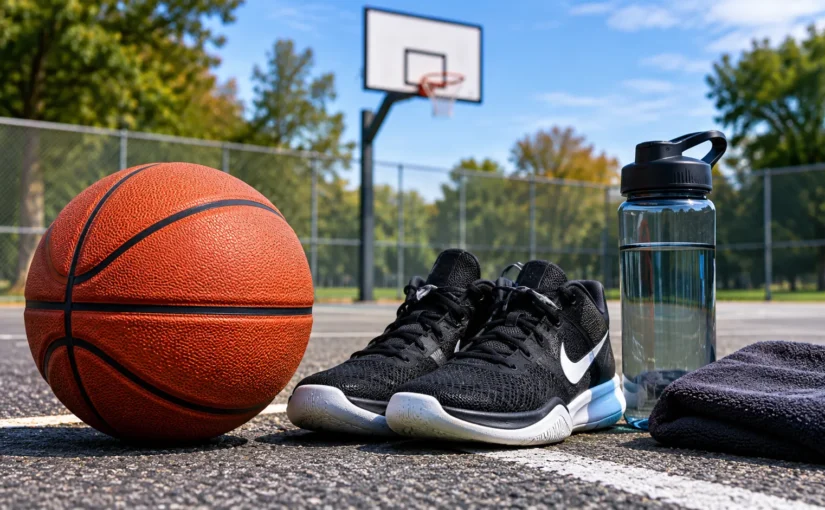
Starting basketball doesn’t require expensive gear. A basic basketball equipment list includes a suitable basketball, supportive shoes, comfortable athletic clothing, drinking water, and access to a safe court with a hoop.

You don’t need to own a basketball hoop or buy specialist training equipment to get started. Public courts and organized programs may already provide much of what you need.

This guide explains the essentials, basketball sizes, optional accessories, and realistic US equipment costs.

Basketball Equipment Checklist: What Do You Really Need?

The following checklist separates essential basketball equipment from optional purchases.

Equipment Priority Do You Need to Buy It?
Basketball Essential Only if you cannot borrow one
Basketball shoes Essential for regular play If your current shoes are unsuitable
Athletic clothing and socks Essential Existing clothes may work
Water bottle Essential practical item Any suitable bottle works
Basketball hoop and court Essential for shooting and games Public courts are an alternative
Basketball pump Useful Can be borrowed
Mouthguard Recommended protection Depends on individual and league needs
Training cones Optional Court markings can work
Dribbling goggles Optional Not necessary for beginners
Home basketball hoop Optional Only if you want to practice at home
Scoreboard and ball cart Team equipment Not needed for individual players

Best starting point: Use a public court, wear suitable shoes, and choose a basketball that matches your age and playing surface.

Essential Basketball Equipment List for Beginners

1. Basketball

A basketball is the most important piece of equipment for practicing shooting, passing, and ball handling.

Choose one based on three factors:

  • Size: Match your age, playing category, or league requirements.
  • Surface: Outdoor basketballs are designed for rougher courts.
  • Material: Rubber and outdoor-rated composite covers are practical for pavement.

For beginners playing mainly outdoors, a durable outdoor basketball is usually the most sensible purchase.

Avoid buying an expensive indoor-only basketball if you mostly practice on asphalt or concrete.

2. Basketball Shoes

A good pair of basketball shoes should provide a secure fit, suitable traction, and comfort during quick movements.

Look for:

  • A secure heel without excessive slipping.
  • Comfortable toe space.
  • Traction suitable for your court.
  • Cushioning that feels comfortable.
  • An outsole in good condition.

You don’t need expensive signature shoes to start playing.

Basketball involves frequent stopping, turning, and sideways movement. Running shoes are primarily designed for forward movement, so they may not be the best choice for regular basketball.

However, shoe suitability depends on the specific model, fit, and playing conditions.

3. Athletic Clothing and Socks

Comfortable athletic clothing allows you to run, jump, and move freely.

A basic outfit includes a breathable shirt, athletic shorts or pants, and comfortable socks.

A supportive sports bra may also be important where needed.

You don’t need professional jerseys, compression sleeves, or matching basketball outfits for casual games.

Organized teams may have specific uniform requirements.

4. Water Bottle

Bring drinking water to practices and games.

A reusable water bottle is sufficient. Expensive sports bottles and sports drinks aren’t essential for beginners.

During outdoor training, especially in hot weather, take appropriate breaks and monitor conditions.

The CDC’s heat safety guidance explains why hydration, rest, and adjusting activity matter.

5. Basketball Hoop and Court Access

You need access to a suitable hoop and playing area, but you don’t necessarily need to own them.

Public parks, recreation centers, schools, and basketball clubs may provide court access.

Check that the playing surface is free from dangerous debris, standing water, and obvious hazards.

For beginners, regular access to a safe court is more valuable than buying a costly home training setup.

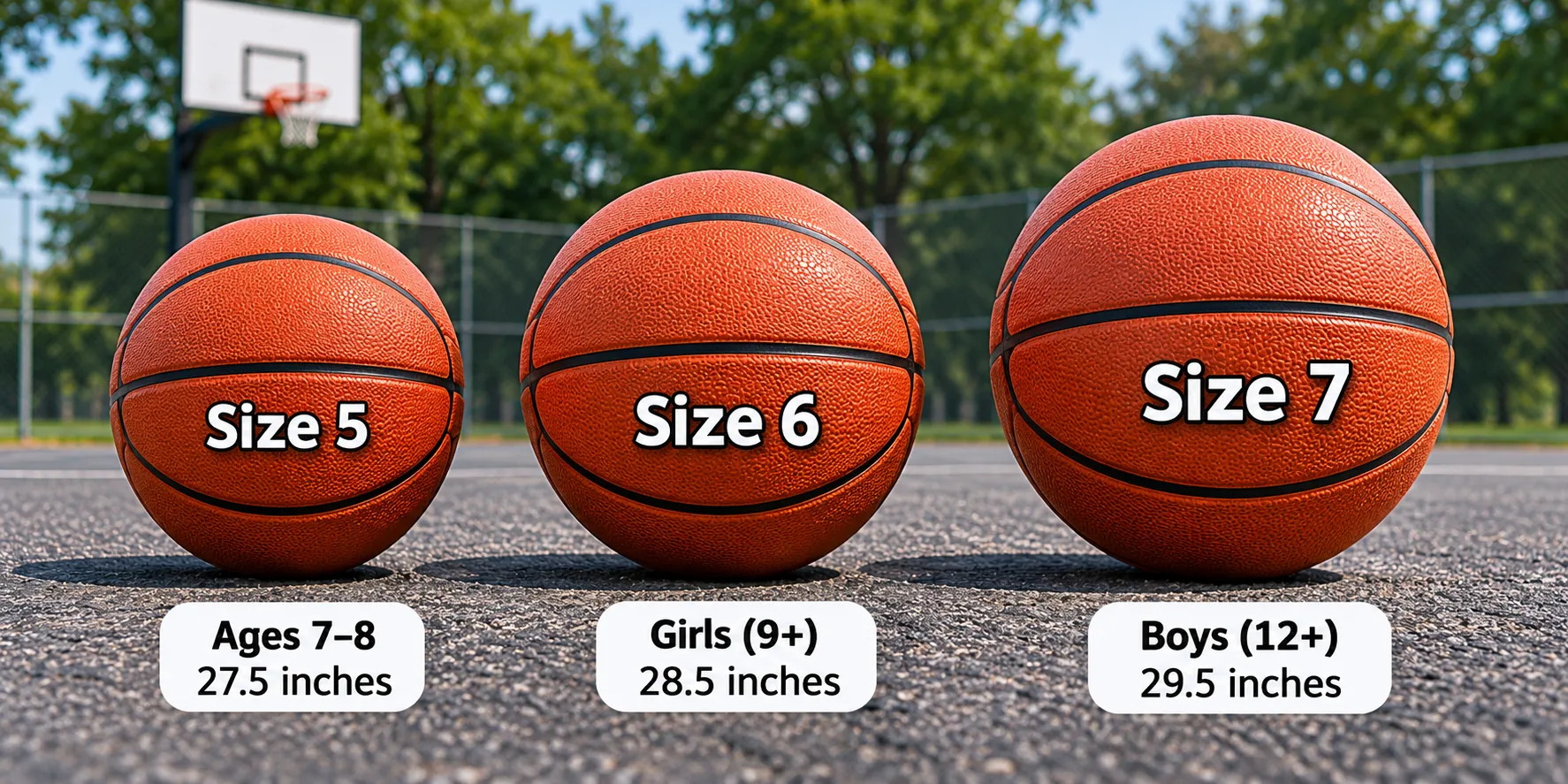
What Size Basketball Do You Need?

Basketball sizes vary by age and playing category.

The following table uses USA Basketball’s youth development guidelines.

Comparison of size 5, 6, and 7 basketballs with their recommended ages and circumferences.
Common basketball sizes based on USA Basketball youth development recommendations.
Playing Group Ball Size Circ. (In) Hoop Height
Ages 7–8, boys and girls Size 5 27.5 inches 8 feet
Ages 9–11, boys and girls Size 6 28.5 inches 9 feet
Ages 12–14, girls Size 6 28.5 inches 10 feet
Ages 12–14, boys Size 7 29.5 inches 10 feet
High school girls Size 6 28.5 inches 10 feet
High school boys Size 7 29.5 inches 10 feet

These are developmental recommendations, not mandatory rules for every US basketball league.

For organized competition, check your league’s equipment requirements before purchasing a ball.

Adults commonly use size 7 for men’s basketball and size 6 for women’s basketball.

You can learn more about age-appropriate rim heights in our basketball hoop height guide.

Indoor vs. Outdoor Basketball Equipment

Your playing surface affects which basketball equipment you should choose.

Equipment Indoor Basketball Outdoor Basketball
Basketball Indoor-rated composite or leather Rubber or outdoor-rated composite
Shoes Suitable traction on clean gym floors Grip and outsole durability for pavement
Court Hardwood or indoor sports flooring Asphalt, concrete, or outdoor sports surfaces
Maintenance Keep equipment clean and dry Remove dirt and inspect wear regularly

An indoor-only basketball can wear faster on rough outdoor pavement.

For example, Wilson identifies its Evolution basketball as an indoor ball, while its NBA DRV model is designed for outdoor use.

If you regularly play both indoors and outdoors, consider a basketball specifically rated for both surfaces.

Store basketballs away from excessive heat and moisture. Follow the manufacturer’s inflation instructions rather than assuming every ball needs the same air pressure.

Optional Basketball Training Equipment and Training Aids

Once you have the essentials, additional basketball gear can make certain activities more convenient.

However, most beginners don’t need specialist training aids immediately.

Basketball pump and needle: Useful for maintaining your ball’s air pressure. A pressure gauge helps you follow the manufacturer’s recommended range.

Training cones: Help organize dribbling and footwork drills. Existing court markings can often serve the same purpose.

Agility ladder: Provides a structured way to practice footwork patterns, but isn’t required for basketball development.

Dribbling goggles: Can encourage players to practice handling the ball without constantly looking down.

Mouthguard: Offers dental protection during contact play. Check your league’s requirements and choose a properly fitted product.

Knee pads and ankle supports: May be useful for particular players, but aren’t universal requirements. Seek appropriate professional guidance for injury-related supports.

The American Academy of Pediatrics’ basketball safety guidance explains the role of protective equipment, including mouthguards, knee pads, and ankle supports.

Weighted basketballs, shooting machines, and expensive ball-return systems can wait until you have a specific training need.

For more options, see our basketball training equipment guide.

Do Beginners Need Their Own Basketball Hoop?

No. A home basketball hoop is convenient, but public courts are often enough for beginners.

If you decide to purchase one, consider these options:

  • Portable hoop: Can be repositioned and typically uses a weighted base.
  • In-ground hoop: Permanently installed and requires suitable ground preparation.
  • Wall-mounted hoop: Requires a compatible supporting structure and correct installation.

Choose a system based on available space, adjustment range, and manufacturer instructions.

Portable basketball goals must have their bases filled or weighted exactly as specified. Never assume a portable hoop is safe for dunking or hanging from the rim.

Our best portable basketball hoop guide explains what to consider before buying.

How Much Does Beginner Basketball Equipment Cost?

You can start playing basketball without spending hundreds of dollars.

The following are manufacturer-listed US price examples recorded during November 2026 research. They aren’t guaranteed prices or nationwide averages.

Beginner Budget Examples

Budget 1: Existing shoes and public court

Buy a $16.95 outdoor basketball. Borrow a pump when needed.

Estimated equipment spending: $16.95.

Budget 2: New basketball and shoes

Using the listed regular prices for the Wilson ball and Nike shoes:

Estimated equipment spending: $96.95.

Budget 3: Basic home hoop setup

Combine the listed Lifetime portable hoop with the Wilson outdoor basketball.

Equipment subtotal: $266.94.

The home setup excludes any additional ballast, delivery, taxes, assembly supplies, or surface preparation.

These examples show why checking existing equipment and court access before shopping can save money.

Basketball Training Setup for Coaches and Teams

Coaches and organized basketball programs need additional equipment beyond an individual player’s essentials.

Common examples include:

  • Multiple basketballs in appropriate sizes.
  • Cones and practice markers.
  • Reversible training vests.
  • Coaching clipboard and whistle.
  • Timer or stopwatch.
  • Ball pump and spare needles.
  • First-aid arrangements.
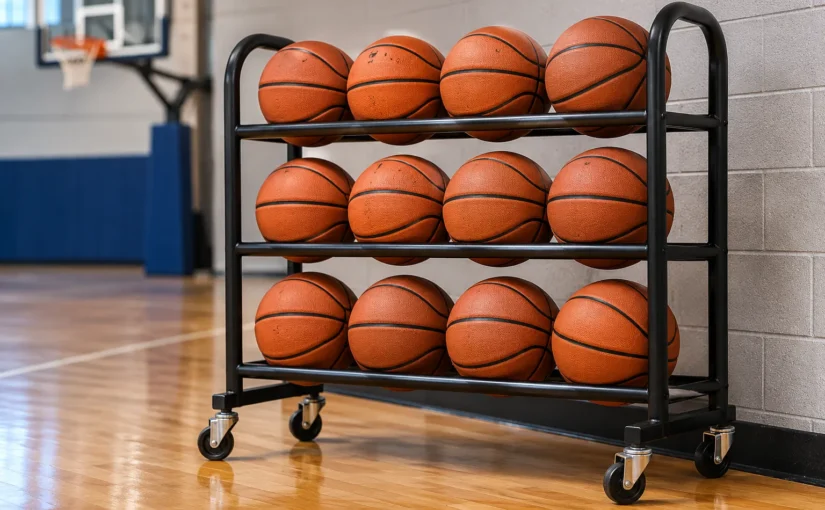
  • Ball rack or storage equipment.
  • Scorebook and scoreboard for organized games.

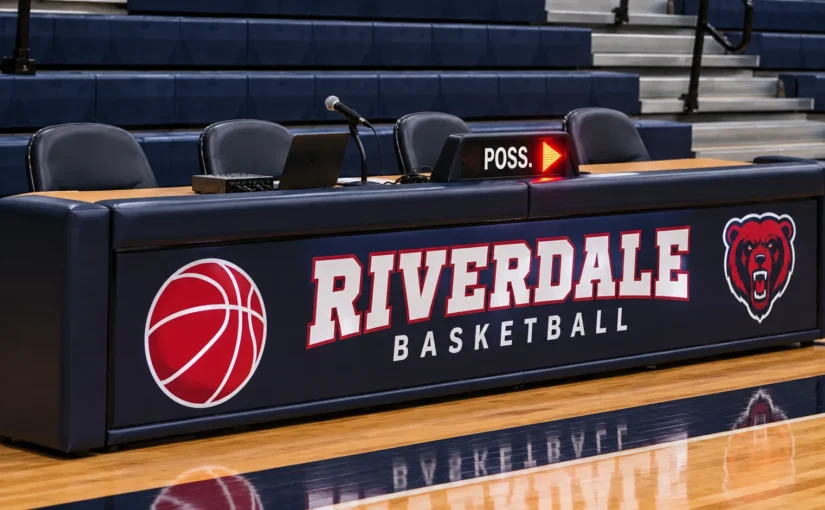
Some competitions also require specific game clocks, possession indicators, or other equipment.

These items aren’t purchases an individual beginner needs to make.

Common Basketball Equipment Buying Mistakes

A simple basketball equipment list can help beginners avoid unnecessary purchases and focus on the essentials.

Buying the wrong basketball size: Check age recommendations and actual league rules.

Using an indoor-only basketball outside: Choose a ball rated for your main playing surface.

Choosing shoes based only on appearance: Fit, comfort, and traction matter more.

Buying too many training aids: Start with basic basketball drills before purchasing specialist equipment.

Ignoring hoop safety: Follow the exact manufacturer’s assembly, anchoring, and ballast instructions.

Spending heavily before checking court access: You may already have access to suitable facilities.

Frequently Asked Questions

What Accessories Do Basketball Players Need?

Useful accessories include a basketball pump, water bottle, athletic bag, and suitable protective equipment. Training cones and other aids are optional.

What Should You Look for When Buying a Basketball?

Check the correct ball size, intended playing surface, cover material, durability, and price. Your league’s rules take priority for organized competition.

Can You Play Basketball in Running Shoes?

Some running shoes may be adequate for light, casual activity, but basketball shoes are generally better suited to frequent lateral movements, stops, and changes of direction.

What Equipment Do You Need for Basketball Practice?

A suitable basketball, appropriate footwear, comfortable clothing, water, and access to a safe hoop and court are enough for basic practice. Coaches may use additional equipment to organize group drills.

Final Thoughts

A beginner basketball equipment list doesn’t need to include expensive shoes, shooting machines, or a home basketball system.

Start with a correctly sized basketball, suitable footwear, comfortable clothing, drinking water, and access to a safe court.

Add training equipment only when it serves a clear purpose.

The right basic equipment, combined with regular practice, is a better starting point than buying accessories you may never use.

Basketball Tryout Evaluation Form (Free Printable PDF)

A basketball tryout evaluation form helps coaches assess players using consistent criteria instead of relying on memory or first impressions.

Coaches can record shooting, dribbling, passing, defense, decision-making, teamwork, and other important skills. The results help identify each player’s strengths, development needs, and possible role on the team.

This guide explains how to use a basketball tryout evaluation form, score players fairly, and make informed roster decisions.

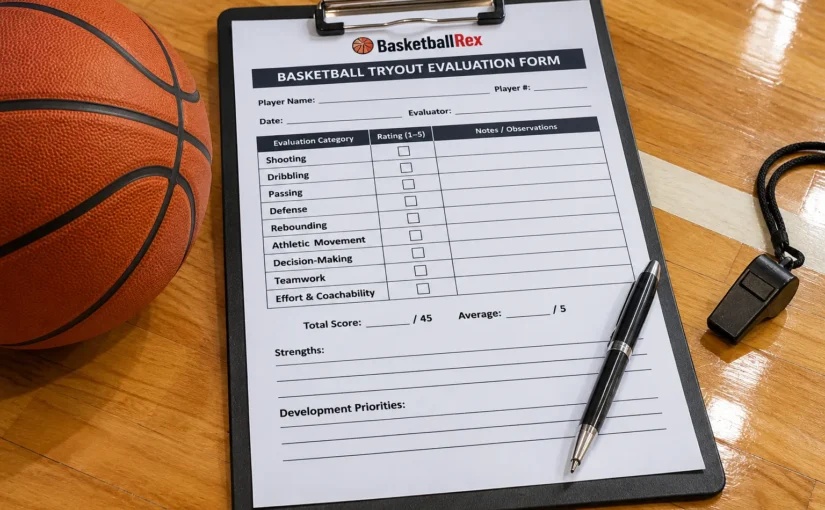
Free Basketball Tryout Evaluation Form Downloads

Our BasketballRex evaluation forms are designed for youth, middle school, high school, and amateur basketball coaches.

One-Page Printable PDF

The one-page form provides a quick way to evaluate individual players during tryouts.

It includes:

  • Player information and evaluator details
  • Nine basketball evaluation categories
  • A simple 1–5 scoring scale
  • Space for brief observations
  • Total score and average
  • Player strengths and development priorities

Download the Free One-Page Basketball Tryout Evaluation Form (PDF)

Detailed Two-Page PDF

The extended version provides additional space for recording drills, scrimmage observations, and player development notes.

It is useful when coaches want more evidence before making roster decisions.

Download the Detailed Two-Page Evaluation Form (PDF)

Editable Evaluation Form

The editable Word version allows coaches to adjust evaluation criteria, record player information, and adapt the form to their program.

Download the Editable Basketball Tryout Evaluation Form (Word)

What Is a Basketball Tryout Evaluation Form?

A basketball tryout evaluation form is a scoring sheet used to record a player’s performance during team tryouts.

Coaches use these forms to compare players across agreed evaluation categories, document observations, and identify areas for improvement.

A completed form can support roster decisions, but it should not determine selections automatically.

For example, a player might score highly in shooting but struggle defensively. Another player might score fewer points during scrimmages while contributing through rebounding, passing, and positioning.

Both performances deserve consideration.

Unlike an opponent scouting report, which examines another team’s tendencies, a tryout evaluation form focuses on players being assessed for a team.

Coaches preparing for upcoming games can also use our basketball scouting report template.

What Should Coaches Evaluate at Basketball Tryouts?

A useful basketball player evaluation form should cover fundamental skills and how players apply them during games.

Basketball Skills and Athletic Movement

Evaluation Category What Coaches Should Look For
Shooting Shooting technique, balance, consistency, and shot selection
Dribbling Ball control, use of both hands, and handling defensive pressure
Passing Accuracy, timing, receiving, and passing decisions
Defense Staying in front, positioning, closeouts, and help defense
Rebounding Boxing out, positioning, pursuing, and securing rebounds
Athletic movement Footwork, balance, stopping, and changing direction

Coaches should observe these skills through controlled drills and competitive situations.

For example, a player who dribbles confidently around cones might struggle when facing an active defender.

Decision-Making, Teamwork, and Coachability

Three additional categories help coaches evaluate contributions that basic skill drills might miss.

Decision-making: Does the player recognize open teammates, choose appropriate shots, and respond to defenders?

Teamwork: Does the player share the ball, follow assignments, and contribute to team play?

Effort and coachability: Does the player continue working after mistakes and attempt to apply coaching instructions?

Evaluate observable actions rather than personality. A quiet player can still be an effective teammate.

How to Score Basketball Players During Tryouts

Using a 1–5 Rating Scale

Our recommended form uses five scoring levels.

Score Meaning
1 Needs foundational development
2 Developing but inconsistent
3 Functional at the evaluated level
4 Strong and generally consistent
5 Advanced for the comparison group

These ratings are BasketballRex recommendations, not an official USA Basketball or NFHS scoring standard.

Coaches should explain what each score means before tryouts begin.

A score of 4 for a beginner youth player does not represent the same performance level as a 4 for a varsity player.

What Does “Not Observed” Mean?

Use NO (Not Observed) when there is insufficient evidence to evaluate a category.

For example, a player might receive very few shooting opportunities during a short scrimmage.

Do not automatically assign that player a low shooting score.

Record the missing observation and arrange another opportunity when possible.

How to Calculate the Total Score

The form contains nine categories, each worth 1–5 points.

When all categories are scored:

  • Minimum total: 9 points
  • Maximum total: 45 points
  • Average: Total score divided by 9

For example, a player scoring 34 points receives an average of 3.78/5.

If any category is marked NO, treat the total as incomplete.

A higher average does not automatically mean a player deserves a roster position.

How to Run a Fair Basketball Tryout Evaluation

Define Your Evaluation Criteria

Decide which skills matter before the tryout.

Explain the criteria, scoring scale, and general selection process to players.

Keep expectations appropriate for the age group and competitive level.

Assign Player Numbers

Give each player a visible identification number.

Record that number on their evaluation form to avoid mixing up observations.

Numbers can also help coaches focus on performance rather than familiarity with particular players.

Evaluate Players Through Drills and Scrimmages

Use a combination of skill stations and live basketball.

Activity What It Helps Evaluate
Spot shooting Shooting preparation and consistency
Zigzag dribbling Ball control and changes of direction
Passing on the move Accuracy, timing, and receiving
One-on-one defense Containment and footwork
Competitive rebounding Positioning and pursuit
Three-on-three Decisions, teamwork, and defensive help

Give players comparable instructions and opportunities.

Small-sided games are especially useful because players generally have more chances to handle the ball and make decisions.

Score Players Live and Compare Evaluators

Record short observations during each activity.

For example, write “protected ball against pressure” rather than simply “good dribbler.”

When several coaches are evaluating, have them record their observations independently before discussing differences.

Review Results Before Selecting Your Team

Check that each player received sufficient evaluation opportunities.

Review missing scores, conflicting observations, and the team’s actual roster needs.

Where possible, observe closely matched players again before making final decisions.

Basketball Tryout Evaluation Form Example

Here is a fictional completed evaluation for Player #17.

Category Score
Shooting 4
Dribbling 4
Passing 3
Defense 3
Rebounding 2
Athletic movement 4
Decision-making 4
Teamwork 5
Effort and coachability 5
Total 34/45

Average: 3.78/5

Strengths: Ball control, teamwork, and consistent effort.

Development priority: Rebounding positioning and defensive awareness.

Game observation: Made effective passing decisions during three-on-three but missed several opportunities to box out.

These fictional scores illustrate how the form works. They are not official performance benchmarks.

Common Basketball Tryout Evaluation Mistakes

Judging players from one shooting drill: A short shooting streak does not show overall basketball ability.

Using different scoring standards: Players should be evaluated against the same clearly explained criteria within their comparison group.

Ignoring live gameplay: Cone drills cannot fully demonstrate passing decisions, defensive positioning, or teamwork.

Scoring from memory: Record observations during or immediately after activities.

Treating scores as automatic roster rankings: Team roles, observation quality, and documented selection criteria also matter.

Overlooking missing observations: An unobserved skill is not the same as poor performance.

Evaluating Youth vs. High School Basketball Players

Younger players should generally be evaluated with greater emphasis on age-appropriate fundamentals, coordination, learning, and development.

Middle school evaluations can introduce more defensive pressure, movement, and small-sided decision-making.

High school tryouts may place greater emphasis on executing skills under pressure, understanding team concepts, and fulfilling competitive roles.

Coaches should also recognize that young players develop physically at different rates.

Current height, strength, or speed should not be treated as proof of long-term basketball potential.

Frequently Asked Questions

How Many Criteria Should a Basketball Evaluation Form Have?

Our form uses nine categories covering fundamental skills, movement, decisions, teamwork, and effort. Coaches can adjust the categories to suit their program.

Is a 1–5 or 1–10 Rating Scale Better?

A 1–5 scale is simpler for quick evaluations. A 1–10 scale offers more scoring choices but can create unnecessary distinctions unless each level is clearly defined.

Should Coaches Use Drills or Scrimmages?

Use both. Drills help coaches compare specific skills under controlled conditions. Scrimmages show how players use those skills against defenders and alongside teammates.

Does the Highest Score Guarantee Team Selection?

No. Scores support decisions, but coaches should also consider documented team needs, player roles, observation quality, and previously explained selection criteria.

Final Thoughts

A basketball tryout evaluation form helps coaches organize observations and compare players more consistently.

The most useful approach combines clear scoring criteria, fundamental skill drills, live gameplay, and specific coaching notes.

Use the completed forms to support fairer decisions and identify how each player can continue improving—not simply to rank players by a single number.

Basketball Scouting Report Template (Free Printable PDF)

A basketball scouting report template helps coaches organize information about upcoming opponents and prepare a clear game plan.

Instead of relying on memory, you can record team tendencies, key players, defensive systems, and important plays in one place.

Our free basketball scouting report template is designed for youth, high school, and amateur coaches who want a simple way to prepare for games.

Free Basketball Scouting Report Template

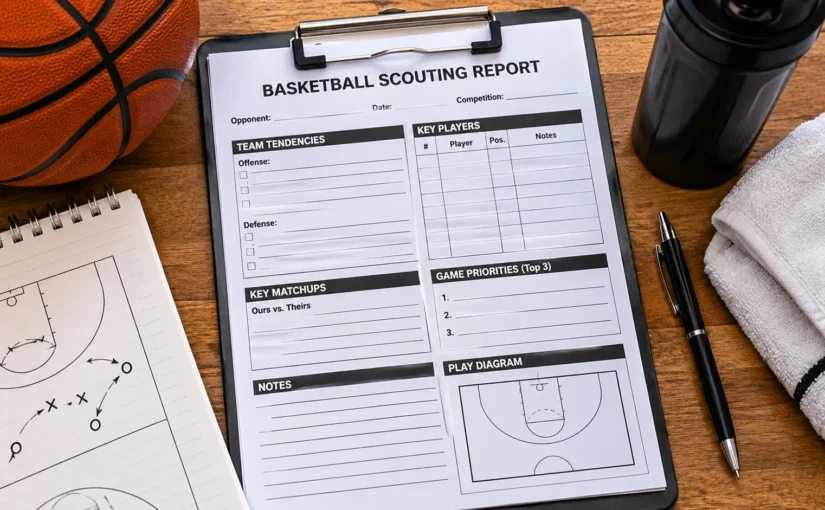
Our printable basketball scouting report uses two pages to organize opponent information, personnel notes, and coaching decisions.

Download the Free Basketball Scouting Report PDF

Download the Editable Basketball Scouting Report (Excel)

The blank templates are intended for printing or completing before your next game.

Page 1: Opponent Scout

The first page covers the information coaches need most:

  • Opponent name, game date, and competition.
  • Offensive and defensive tendencies.
  • Key players and their strengths.
  • Important matchups.
  • Three priorities for your game plan.

This page provides a quick reference during team preparation.

Page 2: Scouting Notes and Game Plan

The second page provides space for more detailed observations.

Coaches can record video timestamps, special plays, transition offense, defensive adjustments, and practice priorities.

It also includes space to draw basketball plays and write possible responses to an opponent’s system.

What Is a Basketball Scouting Report?

A basketball scouting report is a document that summarizes an opposing team’s playing style, personnel, strengths, and weaknesses.

Coaches use scouting reports to prepare practices, assign defensive matchups, and develop strategies before games.

The FIBA World Association of Basketball Coaches Level 2 manual recommends observing team and individual tendencies, preferred tempo, substitutions, and offensive actions.

A team scouting report differs from a player evaluation form. The first focuses on preparing for an opponent, while the second assesses an individual player’s abilities and development. Coaches evaluating players for their own team can use our basketball tryout evaluation form to score skills and record observations.

What Should a Basketball Scouting Report Include?

A useful report should explain what the opponent does and how your team might respond.

Offensive and Defensive Tendencies

Record how the opponent attacks and defends.

For offense, look for:

  • Fast breaks and transition offense.
  • Common half-court plays.
  • Ball screens and player movement.
  • Preferred shooting areas.
  • Offensive rebounding habits.

For defense, note whether the opponent uses man-to-man defense, zone defense, full-court pressure, or trapping.

Also record how defenders respond to screens and drives toward the basket.

Key Players and Personnel

Identify players who have the greatest influence on the game.

Record jersey numbers, positions, preferred shooting areas, and observed habits.

For example, a guard might frequently attack the right side of the court, while a center might be particularly active on offensive rebounds.

Avoid describing a player as a poor shooter or defender based on one possession.

Special Situations

Include any important plays the opponent uses during specific situations.

These might include baseline out-of-bounds plays, sideline out-of-bounds plays, and actions following timeouts.

You can also record late-game strategies when enough information is available.

How to Fill Out a Basketball Scouting Report

Follow these five steps.

  1. Gather opponent information. Write down the team name, game date, roster information, and available scouting sources.
  2. Watch games or review video. Focus on the opponent’s offensive system, defensive approach, and important personnel. Record video timestamps when useful.
  3. Identify repeated tendencies. Look for actions that occur across several possessions rather than making conclusions from isolated plays.
  4. Plan your matchups. Consider how your players can defend the opponent’s main threats and attack weaknesses in its defensive system.
  5. Choose three game priorities. Turn your observations into clear instructions that players can practice and remember.

Keep detailed notes for your coaching staff, but make the information shared with players manageable.

Basketball Scouting Report Example

Here’s a fictional example showing how a coach might turn scouting observations into a game plan.

Scouting observation Possible coaching response
Opponent frequently pushes the ball after rebounds Prioritize transition defense
Point guard regularly uses high ball screens Practice existing ball-screen coverage
Opponent attacks offensive rebounds aggressively Emphasize boxing out
Defense frequently uses full-court pressure Rehearse press-break spacing

These observations are examples, not findings about a real team.

A good scouting report connects each observation to a practical coaching decision.

Common Scouting Mistakes

Avoid these mistakes when preparing a basketball scouting report:

  • Recording too much information: Focus on details that can influence your game plan.
  • Making unsupported assumptions: One successful play does not establish a reliable tendency.
  • Ignoring recent changes: Check whether the opponent has changed its lineup or system.
  • Overcomplicating the game plan: Use strategies your players understand.
  • Forgetting to update the report: Review your observations during and after the game.

For younger teams, keep scouting simple and prioritize player development rather than overwhelming players with tactical instructions.

Frequently Asked Questions

What should a basketball scouting report include?

A basketball scouting report should include opponent information, offensive and defensive tendencies, key personnel, important matchups, special situations, and a game plan.

How do you scout a basketball team without video?

Watch the opponent play in person when possible. Record its offensive and defensive systems, key players, and repeated tendencies. You can also review available statistics, but these may not explain how the team creates scoring opportunities.

Can youth basketball coaches use scouting reports?

Yes. Youth coaches can use simplified scouting reports to identify a few important teaching points. Player development should remain a priority.

Can I edit the basketball scouting report template?

Yes. The editable Excel template allows coaches to enter opponent information, record observations, and customize their game plans before printing.

A basketball scouting report helps coaches prepare for opponents without relying entirely on memory.

The most useful reports focus on repeated tendencies, important personnel, and clear coaching responses.

Use our free basketball scouting report template to organize your observations and turn them into a practical game plan.

Are Basketball Shoes Good for Running? Pros, Cons & Risks

Basketball shoes are fine for short runs, court sprints, and occasional jogging, but they are generally not the best choice for regular or long-distance running. Proper running shoes are designed around repeated forward movement, while basketball shoes prioritize stability, traction, and quick changes of direction.

That does not mean running in basketball shoes is automatically dangerous. Basketball involves plenty of running, and modern basketball footwear can provide substantial cushioning and support.

Running a few laps during basketball practice is different from running several miles on pavement. The longer and more frequently you run, the more useful dedicated running shoes become.

This guide compares both types of athletic footwear, explains when basketball shoes can work for running, and examines what the research says about comfort, performance, and injury risks.

Basketball Shoes vs Running Shoes: What’s the Difference?

Basketball shoes and running shoes share several features. Both need to provide traction, cushioning, and a secure fit.

However, their design choices reflect different sports.

Basketball players regularly sprint, stop, jump, land, and move sideways. A basketball shoe must accommodate these movements while helping the player remain stable.

Most running shoes are built primarily for repeated forward strides. They can vary considerably in cushioning, flexibility, weight, and support depending on their intended use.

Here is how the two types of footwear generally compare.

Feature Basketball Shoes Running Shoes
Main purpose Basketball movements, including cuts, jumps, and short sprints Repeated forward running
Cushioning Designed for court movement and landings Designed for different running demands
Weight Varies; some models have extra structure and weight Varies; many models prioritize running efficiency
Stability Often emphasizes side-to-side containment Usually emphasizes forward-running needs
Flexibility Depends on the shoe’s construction Varies from flexible trainers to stiff racing shoes
Traction Often uses multidirectional court patterns Designed for road, trail, track, or other running surfaces
Durability Depends on indoor or outdoor court design Depends on the intended running surface and shoe

These are general differences, not fixed rules.

For example, some lightweight basketball shoes weigh less than certain running shoes. Similarly, some running shoes have stiff soles, while some basketball shoes allow considerable forefoot flexibility.

The exact model matters more than its appearance or category alone.

Cushioning and Shock Absorption

Basketball shoes need cushioning because basketball involves repeated jumping, landing, and running.

Many models use thick foam midsoles or other materials intended to absorb impact.

However, more cushioning does not automatically mean a shoe is better for running.

Running involves repeated loading across thousands of steps. Running shoes are designed with this movement in mind, although cushioning systems vary widely between models.

A 2018 study involving 18 male collegiate basketball players examined how running speed and basketball-shoe cushioning affected impact loading and tibial shock.

The researchers found that faster running increased the measured loading. They also found that the most heavily cushioned condition did not consistently produce the lowest loading measurements.

This is important because it challenges the idea that softer or thicker soles must always provide better shock absorption during running.

However, the study did not compare basketball shoes directly against running shoes or measure long-term injury rates.

Weight and Running Performance

Extra weight can affect running performance.

Some basketball shoes contain additional materials around the heel, sides, or midfoot to provide stability during court movements.

That can make certain models feel heavier during sustained running.

However, not every basketball shoe is heavy. Lightweight basketball models exist, and running shoes vary considerably in weight.

Research has found that adding weight to running shoes can affect running economy.

In a 2020 study involving 11 trained runners, researchers tested the effects of added shoe mass on running economy and performance.

Adding 100 grams to each shoe had measurable negative effects under the tested conditions.

That does not establish a specific speed penalty for basketball shoes.

It simply shows that footwear weight can matter during running, particularly when performance is important.

For an occasional short jog, a slightly heavier shoe might not be a major concern.

For someone training for a marathon, unnecessary extra weight becomes a more relevant consideration.

Flexibility and Heel-to-Toe Movement

Running involves repeated heel-to-toe movement, although individual footstrike patterns differ.

The foot lands, supports the body’s weight, and moves through the stride before pushing off again.

A running shoe’s shape, sole construction, and bending stiffness can influence how that movement feels.

Some basketball shoes use relatively stiff midsoles, plates, or other structural features.

These features may help the shoe provide stability during cuts and changes of direction.

However, less flexibility is not automatically a disadvantage.

Some modern running shoes also use stiff plates and specially shaped soles to influence running mechanics.

The question is whether the shoe feels comfortable and appropriate for the activity.

A basketball shoe that feels excellent during quick court movements might feel less natural after repeated straight-line strides.

You cannot determine that from collar height or appearance alone.

Lateral Stability and Ankle Support

Lateral movement is one of basketball’s defining demands.

Players repeatedly shuffle, cut, pivot, and change direction while defending or attacking.

Basketball shoes generally emphasize lateral stability to help accommodate those movements.

Running shoes are usually designed around forward movement, although their support systems vary.

That makes basketball footwear useful when a training session combines running with basketball drills.

However, extra side-to-side support does not automatically improve running performance.

High-top basketball shoes are another common source of confusion.

A high collar may change how secure a shoe feels around the ankle, but this does not prove that high-tops prevent ankle injuries.

The American Orthopaedic Foot & Ankle Society recommends considering the demands of each sport when choosing athletic shoes.

For regular jogging, a secure fit and comfortable forward movement matter more than simply choosing the highest ankle collar.

Traction and Durability

Basketball shoes need reliable grip when players stop, turn, and accelerate on a basketball court.

Indoor models often use multidirectional outsole patterns designed for gym floors.

Running shoes use different tread designs depending on whether they are intended for roads, trails, tracks, or other surfaces.

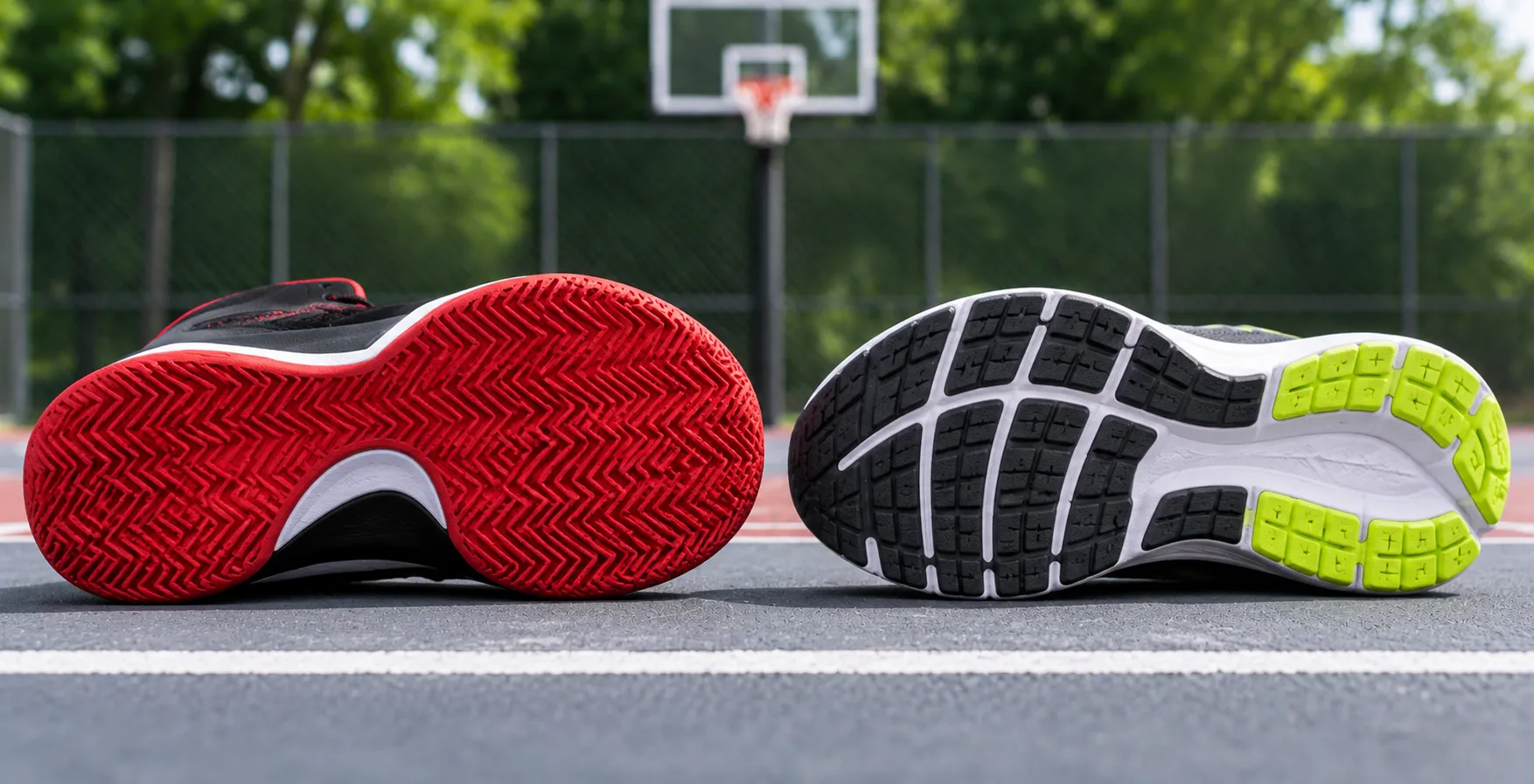
Basketball shoe herringbone outsole beside a running shoe outsole with segmented rubber tread.
Illustrative comparison of basketball and running shoe outsole patterns. Actual tread designs vary by model.

Good indoor basketball traction does not guarantee the same grip on wet pavement or loose gravel.

The playing surface also affects durability.

Under Armour’s outdoor basketball shoe guidance explains that asphalt and concrete can wear down shoes made for indoor gym floors more quickly.

If you regularly run outdoors in an indoor basketball shoe, the outsole may wear faster than it would during normal indoor use.

An outdoor basketball model may handle rough surfaces better.

Even so, outdoor durability does not automatically make it the right shoe for distance running.

When Can You Run in Basketball Shoes?

Basketball shoes can be suitable for some types of running.

The main considerations are distance, frequency, surface, fit, and the specific shoe.

There is no scientifically established distance at which basketball shoes suddenly become unsafe.

Instead, consider how different types of running place different demands on your footwear.

Short Runs and Casual Jogging

Occasional short runs are generally the most reasonable use outside basketball.

For example, you might jog to a nearby outdoor court or complete a short warm-up before practice.

If your basketball shoes fit properly, feel comfortable, and have suitable traction, they may work for these activities.

You do not necessarily need to carry another pair of shoes for every brief jog.

However, pay attention to the surface.

An indoor-only basketball shoe might not be ideal for running along rough pavement, especially if you want to preserve its court traction.

Comfort is another consideration.

A shoe that feels good during a few explosive movements may begin rubbing or feeling restrictive during continuous running.

If that happens, stop rather than forcing yourself to continue.

Short runs can be reasonable, but there is no universal safe distance for every basketball shoe or runner.

Basketball Sprints and Conditioning

Basketball shoes are designed to accommodate running as part of basketball.

That includes quick accelerations, defensive recovery runs, fast breaks, and repeated court-length sprints.

Basketball involves forward movement, backward movement, jumping, and lateral movement, often within a few seconds.

If your conditioning session involves suicides, shuttle runs, defensive slides, and other basketball drills on a suitable court, basketball shoes are generally the logical choice.

They provide the sport-specific traction and stability those drills require.

This is different from wearing the same shoes for repeated sprint sessions on a running track.

Track shoes and sprint-specific footwear may use different designs to suit those surfaces and movements.

Use the right shoe for the actual session rather than assuming all running activities are identical.

Treadmill Running

You can often use basketball shoes on a treadmill, provided they fit properly and are suitable for the equipment.

An occasional short treadmill jog may be comfortable in some models.

However, running on a treadmill still involves repeated forward strides.

The moving belt does not remove the importance of footwear fit, grip, and comfort.

If treadmill running becomes a regular part of your workouts, proper running shoes are generally the better option.

Before using basketball shoes on a treadmill, inspect the soles.

Remove stones, grit, or other debris that could affect the belt or your footing.

Check the gym’s footwear rules if necessary.

Do not assume that a treadmill makes every basketball shoe suitable for running longer distances.

Moderate Running and Regular Road Runs

Regular road running places repeated demands on your feet, shoes, and lower limbs.

Even a moderate running routine can involve substantial mileage over several weeks.

Basketball shoes may feel acceptable at first, but comfort during one short session does not guarantee they will suit repeated runs.

Some models may feel heavy or restrictive.

Others may provide enough comfort for occasional use but wear more quickly on asphalt.

If you plan to run several times a week, dedicated running shoes are a more sensible investment.

They are designed for the movement pattern and surface you will use most often.

You also avoid putting unnecessary outdoor mileage on basketball shoes you want to preserve for games.

Long-Distance Running and Marathon Training

Basketball shoes generally are not the best choice for long-distance running.

You might be physically capable of completing a 5K or longer run in them, but that does not make them ideal.

Running longer distances means repeating similar movements for an extended period.

Small differences in fit, weight, and how the shoe feels can become more noticeable as the run continues.

A basketball shoe that feels secure during a game may feel less comfortable after sustained forward running.

Regular road mileage can also wear down court-specific outsoles.

If you are training for your first half marathon or preparing for a marathon, choose running footwear suited to your training.

That does not mean a basketball shoe will automatically cause injury during a long run.

It means purpose-built running shoes make more practical sense for frequent distance running.

Pros and Cons of Running in Basketball Shoes

Basketball shoes offer some advantages for mixed activities, but they also involve trade-offs.

The benefits are strongest when running is only one part of a basketball workout.

Advantages

Convenience

One pair can cover shooting practice, court sprints, warm-ups, and short occasional runs.

This can be useful when you do not want to carry multiple pairs.

Court-specific stability

Basketball shoes provide stability for movements involving stops, cuts, and changes of direction.

That makes them suitable for conditioning sessions that include basketball drills.

Cushioning

Many modern basketball shoes include substantial cushioning.

However, the amount and type of cushioning differ between models, and cushioning alone does not determine running suitability.

Familiarity

If you regularly play basketball, you may already feel comfortable in your basketball shoes.

That familiarity can make them a practical option for brief activity.

However, comfort during basketball does not automatically mean the shoes will feel equally good during a long run.

Disadvantages

Possible extra weight

Some models contain additional materials for support and stability.

That extra weight may be less desirable during sustained running.

Different movement priorities

Basketball shoes are generally built around multidirectional movement rather than repeated forward strides.

Some models may therefore feel less natural during steady jogging.

Outdoor outsole wear

Running on concrete or asphalt may wear down indoor basketball shoe traction patterns.

This is particularly relevant if you want to keep the shoes for hardwood court use.

Possible comfort issues

A shoe might rub, feel restrictive, or allow unwanted heel movement during longer runs.

The response depends on the fit, model, and individual runner.

Cost of replacing shoes

Regular running adds wear.

If you use an expensive basketball pair for both frequent road runs and court play, you may eventually need to replace it sooner.

The tradeoff is not always worth it when a separate running pair would better serve your needs.

Can Running in Basketball Shoes Cause Injuries?

Running in basketball shoes does not automatically cause injuries.

However, wearing shoes that fit poorly or feel unsuitable for your activity can contribute to discomfort.

Common concerns include knee pain, shin splints, ankle problems, and foot pain.

What Does the Research Say?

A 2022 Cochrane systematic review examined whether different types of running shoes affected lower-limb running injuries.

The review included 12 trials involving 11,240 participants.

Researchers found that much of the evidence comparing different running-shoe categories was uncertain.

Importantly, the review did not identify trials directly comparing running shoes against non-running shoes.

That means the findings cannot tell us exactly how injury rates differ between basketball shoes and proper running shoes.

There is also no reliable universal figure showing that basketball shoes increase running injuries by a particular percentage.

This does not mean footwear is irrelevant.

It means the evidence is not strong enough to make categorical injury claims.

Shin Splints and Knee Pain

Shin splints and knee pain can occur during running for several reasons.

Training volume, previous injuries, changes in activity, running surfaces, and individual movement patterns may all matter.

Footwear comfort and fit are also relevant.

However, it would be misleading to claim that basketball shoes directly cause shin splints or knee problems.

The research reviewed for this article does not establish that relationship.

If you develop pain during running, assess the whole situation rather than immediately blaming one feature of your shoes.

For example, suddenly increasing the distance or frequency of your runs may be relevant.

The same applies if your shoes feel uncomfortable or no longer fit securely.

Ankle Support and Injury Prevention

Basketball players often choose shoes partly for ankle support.

Some prefer high-tops, while others feel more comfortable in low-top models.

However, a taller ankle collar does not guarantee protection against ankle sprains.

Likewise, a high-top basketball shoe is not automatically safer for running than a low-top shoe.

Running generally involves different movement demands from repeatedly cutting and landing during basketball.

The best practical approach is to choose footwear that fits well and suits the activity.

If you experience persistent pain, swelling, or localized discomfort, stop running and seek advice from a qualified healthcare professional.

Do not continue running through increasing pain because you assume your shoes must be safe.

Does Running Damage Basketball Shoes?

Running does not automatically damage basketball shoes.

They are made for athletic movement, and running is part of basketball.

However, running outside the shoes’ intended use can increase wear.

Outsole Wear and Court Performance

Indoor basketball shoes are often designed for clean gym floors.

Their outsole patterns are intended to provide grip during basketball movements.

Asphalt and concrete can be more abrasive.

Repeated outdoor running may gradually wear down the rubber or reduce the depth of the traction pattern.

This can matter when you return to an indoor basketball court.

A worn or dirty outsole may feel different from a clean, unworn one.

However, there is no established number of road miles that guarantees a specific loss of basketball performance.

One short jog will not necessarily ruin a pair of shoes.

The concern is accumulated wear, particularly when using indoor-only basketball footwear on rough surfaces.

Cushioning and General Wear

Running also adds repeated use to the midsole and upper.

Over time, athletic footwear can lose some of its original feel as materials wear.

However, the rate depends on the design, conditions, and how frequently you use the shoes.

Do not apply running-shoe replacement mileage directly to basketball shoes.

There is no reliable universal mileage limit for basketball footwear used for running.

Instead, inspect the shoes regularly.

Look for worn tread, damaged materials, loose sections, or changes in how securely they fit.

If you regularly play indoor basketball, keeping a dedicated court pair can help preserve it for that purpose.

Tips for Running in Basketball Shoes

If basketball shoes are your only available footwear, you do not necessarily need to avoid every short run.

Use them carefully and pay attention to how they feel.

1. Check the Fit Before Running

Your toes should have enough room to move.

The heel should feel secure without excessive slipping.

Do not assume that uncomfortable shoes will become suitable after a long break-in period.

2. Inspect the Soles

Check for worn traction, tears, loose materials, or objects stuck in the tread.

Avoid running in shoes that are clearly damaged.

3. Start With a Short, Easy Run

Do not begin with a long-distance session simply to test whether the shoes work.

Start modestly and see how they feel.

There is no universally approved safe running distance for basketball shoes.

4. Choose an Appropriate Surface

A flat, dry, predictable surface is easier to assess than wet pavement or loose gravel.

Check whether your specific basketball shoes are intended for indoor or outdoor use.

5. Pay Attention to Comfort

Notice rubbing, heel movement, pressure around the toes, or pain.

If the shoes feel unstable or uncomfortable, stop and reconsider your footwear.

Comfort is useful feedback, although it cannot guarantee injury prevention.

6. Avoid Unnecessary Road Mileage in Indoor Shoes

If you want to preserve your basketball shoes for hardwood courts, limit unnecessary outdoor use.

Regular road running may gradually wear down their traction.

7. Consider Separate Shoes if Running Becomes a Habit

If you start running several times per week, a comfortable pair of dedicated running shoes is generally a better long-term choice.

You do not need the most expensive model.

Focus on proper fit, intended use, and the surface where you usually run.

When Should You Choose Running Shoes Instead?

The right shoe depends on which activity you do most often.

If you mainly play basketball and occasionally complete short runs, basketball shoes may be enough.

If you mostly run, proper running shoes make more sense.

If you regularly do both, owning two separate pairs is worth considering.

For more basketball-specific gear, see our basketball training equipment guide.

For basketball, use footwear designed for court traction, jumping, landing, and quick directional changes.

For regular running, use footwear designed for the surface and type of running you do.

That might mean a daily road-running shoe, a trail-running shoe, or another specialized model.

Track shoes are not automatically the right choice for road running simply because they are made for runners.

Likewise, a basketball shoe is not automatically suitable for every running activity just because basketball players run during games.

Consider the actual activity rather than buying based on appearance, price, or brand alone.

For example, Nike and other major manufacturers make both basketball and running footwear.

A model’s intended purpose matters more than the logo.

The best choice is footwear that fits properly, feels comfortable, and is appropriate for your main activity.

Frequently Asked Questions

Can you run a mile in basketball shoes?

Yes, you may be able to run a mile in basketball shoes if they fit properly and feel comfortable.

A single mile is not automatically dangerous, but there is no scientifically established safe-distance limit that applies to everyone.

For regular running, dedicated running shoes are preferable.

Can you run a 5K in basketball shoes?

It is possible, but basketball shoes are generally not ideal for repeated 5K runs.

Running longer distances involves sustained forward movement, and dedicated running footwear is usually the more practical choice.

A 5K is not a proven injury threshold for basketball shoes.

Are basketball shoes good for sprinting?

Basketball shoes are suitable for the short accelerations and sprints involved in basketball.

For repeated track sprinting or specialized speed training, footwear designed for that activity and surface may be more appropriate.

The exact shoe and training conditions matter.

Can you wear basketball shoes on a treadmill?

Yes, basketball shoes can often be worn on a treadmill.

They should fit securely, provide suitable traction, and meet the facility’s rules.

For regular treadmill running, proper running shoes are generally preferable.

Are high-top basketball shoes better for running?

Not necessarily.

High-top shoes may feel more supportive around the ankle, but collar height alone does not determine running comfort or injury risk.

Cushioning, weight, fit, outsole design, and the individual’s needs also matter.

Can you use running shoes to play basketball?

You can perform some basketball activities in running shoes, but they are generally not ideal for full games.

Basketball involves lateral movement, sudden stops, and jumping.

Shoes designed for basketball usually provide more appropriate court-specific traction and containment for those demands.

Are basketball shoes good for walking?

Some basketball shoes can be comfortable for everyday walking.

However, weight, fit, cushioning, and personal comfort vary between models.

A shoe that works for short walks may not be the best choice for long walking days.

Will running outside ruin indoor basketball shoes?

Not necessarily.

One short outdoor run is unlikely to guarantee damage, but repeated use on rough pavement can increase outsole wear.

If maintaining indoor court traction is important, reserve your indoor basketball shoes mainly for gym floors.

Final Verdict: Are Basketball Shoes Good for Running?

Basketball shoes are good for running as part of basketball. They can also work for occasional short jogs when they fit comfortably and suit the surface.

However, they are generally less suitable for regular road running, long-distance training, and marathon preparation.

The main differences involve movement demands, shoe weight, traction, comfort, and durability.

There is no strong direct evidence proving that running in basketball shoes automatically causes injuries.

If basketball is your main sport, use basketball shoes. If running becomes a regular activity, choose proper running shoes.

Basketball Rack | Types, Sizes, Prices & Buying Guide

A basketball rack keeps basketballs organized, off the gym floor, and easy to access. It can help coaches run drills, schools manage sports gear, and homeowners keep their garages tidy.

The right basketball storage rack depends on how many balls you own, your available space, and whether you need wheels or locks. This guide explains the main types, sizes, prices, and features worth considering.

For other useful practice accessories, see our guide to basketball training equipment.

What Is a Basketball Rack?

A basketball rack is a storage unit designed to hold multiple basketballs. Most use metal rails, shelves, or enclosed compartments.

Basketball ball racks are common in schools, gyms, recreation centers, and home garages. They help keep balls from rolling across the floor and make equipment easier to find.

A ball rack usually has open shelves or rails. A ball cart is designed for moving equipment, while a ball locker adds security through locking bars or an enclosed cage.

Types of Basketball Racks

Stationary Basketball Racks

Stationary racks stay in one place. They’re suitable for equipment rooms, garages, and gym storage areas where balls don’t need moving frequently.

Rolling Basketball Racks

Rolling racks have wheels that let coaches transport basketballs between storage areas and courts.

Many use two or three tiers, making basketballs easy to grab during practice while keeping unused balls organized.

Wall-Mounted Basketball Racks

Wall-mounted racks save floor space by attaching to a suitable wall.

They’re useful in smaller gyms and garages. However, installation requires the correct mounting hardware and adequate wall support.

Vertical Basketball Storage Racks

Vertical racks store balls in a taller arrangement with a relatively small floor footprint.

They work well where floor space is limited, although reaching balls near the top may be less convenient.

Lockable Basketball Storage Cages

A ball locker protects equipment using an enclosed frame, locking lid, or locking bars.

These are useful for schools, teams, and shared facilities that need controlled access. Some models require a separate padlock.

Folding Basketball Carts

Folding ball carts usually have a fabric or mesh basket supported by a collapsible frame.

They’re convenient for coaches who need portable storage during practice and want to fold the cart away afterward.

Rack type Main advantage Best suited for
Stationary Simple storage Garages, equipment rooms
Rolling Easy movement Schools, coaches
Wall-mounted Saves floor space Small gyms, garages
Vertical Compact footprint Limited storage areas
Lockable cage Equipment security Shared facilities
Folding cart Portable and compact Training sessions

How Much Does a Basketball Rack Cost?

Basketball rack prices vary depending on capacity, materials, mobility, and security features.

Here are examples from US manufacturer and retailer listings checked in November 2026.

Basketball rack Capacity Listed price
BSN Sports 12 Ball Wide Body Cart 12 balls $119.99
Pro Down Wall Mounted Ball Rack Up to 18 balls $174.99
BSN Sports E-Z Fold Cart 20 basketballs $199.99
Trigon ProCage CART315 15 balls $294.58
BSN Standard Portable Ball Locker 20 balls $499.99

Prices may change. Shipping, taxes, availability, and selected product options can affect the final cost.

For a home garage, a simple storage organizer may be enough. Schools and athletic directors may need heavier-duty equipment designed for frequent use.

How to Choose the Right Basketball Rack

Basketball Capacity

Count how many basketballs you need to store before buying.

A 12-ball rack may suit a small training group, while a school or sports club might need a larger cart or multiple racks.

Always check whether the advertised capacity applies to full-size basketballs.

Rack Dimensions and Height

Measure your available storage space, including clearance around doors and walkways.

For example, the Jaypro Atlas BBABC-1 measures approximately 51.5 inches long, 18 inches wide, and 36 inches high.

A rack’s height depends on its design. There is no single standard height for every basketball rack.

Materials, Heavy-Duty Construction, and Durability

Commercial basketball racks commonly use steel tubing with protective finishes.

Look for secure connections and materials suitable for your intended environment.

For daily school or gym use, choose a heavy-duty rack designed for frequent handling. However, a heavy-duty design doesn’t automatically mean the rack is suitable for outdoor storage.

Wheels and Brakes

Wheels make it easier to move basketballs between courts, storage rooms, and practice areas.

Check whether the wheels suit your gym floor and whether the model includes brakes. Don’t assume every rolling rack has locking wheels.

Indoor and Outdoor Sports Gear Storage

Indoor basketball racks should generally stay in dry storage areas unless their manufacturer approves outdoor use.

Moisture can damage some metal components and shorten equipment life. A protective coating alone doesn’t guarantee year-round weather resistance.

Security Features

Open racks provide quick access but little protection against unauthorized use.

A lockable cage is better suited to shared equipment storage. Check whether a padlock is included, as some products require one to be purchased separately.

Which Basketball Rack Is Best for Your Needs?

For home storage, choose a compact stationary or wall-mounted rack. These help organize basketballs without taking up unnecessary space.

For schools and gyms, a rolling steel rack is practical because coaches can move basketballs between drills and storage areas. It also helps keep equipment organized during practice.

For basketball coaches, a folding cart provides convenient access to multiple balls during training sessions.

For outdoor courts, choose equipment specifically approved for outdoor conditions.

For small spaces, consider a vertical rack or wall-mounted holder.

Basketball Rack Assembly and Maintenance

Most commercial racks require some assembly, and assembly time varies by model. Follow the manufacturer’s instructions and check that all connections are secure.

For wall-mounted models, use suitable anchors and confirm the wall can support the loaded rack.

Keep wheels clean, inspect loose fittings, and check metal surfaces for corrosion. Store the rack in a dry location unless it’s designed for outdoor use.

Common Basketball Rack Buying Mistakes

Avoid these common mistakes:

  • Choosing insufficient capacity: Count your basketballs before purchasing.
  • Ignoring dimensions: Measure the storage area and nearby walkways.
  • Overlooking wheel quality: Check floor compatibility and brakes.
  • Assuming outdoor suitability: Read the manufacturer’s storage guidance.
  • Forgetting extra costs: Check delivery charges, mounting hardware, and locks.

Frequently Asked Questions

How should I store my basketballs?

Store basketballs in a cool, dry location, away from prolonged direct sunlight and excessive heat. Use a rack, shelf, or suitable storage bag to keep them organized.

If you need to release some air before storage, read our guide on how to deflate a basketball safely.

How tall is a basketball rack?

Height varies by design. The Jaypro Atlas BBABC-1 is 36 inches tall, while the Champion Sports 20BC vertical ball cage is 48 inches tall.

Check the exact model dimensions before buying.

Where is the best place to store a basketball?

A dry indoor location, such as a garage, equipment room, or storage closet, is generally best. Avoid prolonged exposure to extreme temperatures and moisture.

How many balls does a basketball rack hold?

Capacity depends on the model. Some racks hold 8–12 basketballs, while larger carts and cages can accommodate 15–30 or more.

Always check the manufacturer’s stated capacity for your ball size.

Final Thoughts

A basketball rack makes storing, organizing, and transporting basketballs easier.

For most coaches, a rolling rack provides convenient access during practice. Homeowners may prefer a smaller wall-mounted unit, while schools with shared sports gear may benefit from a lockable ball locker.

Choose based on capacity, available space, mobility, and durability, rather than price alone.

Basketball Scorers Table | Types, Sizes, Prices & Buying Guide

A basketball scorers table is a courtside workstation where game officials record scores, manage the clock, track fouls, and handle other game information.

Schools, recreation centers, and professional venues use different scorers tables depending on their budget, available space, and equipment needs.

This guide explains the main types, dimensions, prices, safety features, and buying considerations.

What Is a Basketball Scorers Table?

A basketball scorer’s table sits near the sideline, usually around midcourt. It provides space for the official scorer, game timer, and other personnel.

Depending on the competition, staff may include a shot-clock operator, announcer, or statistician.

The table holds equipment such as scorebooks, controllers, laptops, microphones, and possession indicators.

Unlike a basketball scoreboard, which displays game information to players and fans, the scorers table provides a workspace for the people managing the game.

Types of Basketball Scoring Tables

Standard and Padded Scorers Tables

Standard scoring tables provide a work surface and seating for game personnel.

Many models include protective foam padding covered in vinyl. Padding helps reduce the risk of injury if players collide with the table.

The Bison ST84F, for example, has 2-inch front padding and 1-inch side padding.

Close-up of protective padding on a basketball scorers table
Padded edges help reduce injury risks during player collisions.

Folding and Portable Scorers Tables

Before buying, check whether the product will fit through gym doors and into storage. A folding design can make setup easier, but larger tables may still require several people to move safely.

Folding scorers tables suit school gyms and facilities that host multiple indoor sports.

Their worktops or frames fold for easier storage. Some models also include wheels or a transport cart.

Check the folded dimensions and weight before purchasing. Portable does not always mean lightweight.

Illuminated Scorers Tables

Illuminated tables display school logos, team colors, or sponsor graphics using backlit panels.

These models can promote school identity and improve sponsor visibility during games.

However, a backlit graphic is not the same as a programmable video display.

LED Video Scorers Tables

LED scorers tables can rotate multiple sponsor logos, advertisements, and animations during games. Some systems can also display live game information, depending on their features.

LED video scoring tables use digital panels to display animations, sponsor advertisements, and other visual content.

They are common in larger basketball facilities where digital branding and sponsorship revenue are important.

These tables require suitable power, controls, and sometimes additional software.

LED basketball scorers table displaying fictional sponsor advertisements
LED scorers tables can display digital sponsor graphics and advertisements.

Bleacher-Mounted Scorers Tables

Bleacher-mounted tables are designed for facilities with limited sideline space.

They attach to compatible bleacher structures or use manufacturer-approved stabilizers.

They should not be treated as ordinary freestanding tables without checking installation requirements.

Basketball Scorers Table Dimensions

Basketball scorers tables come in different lengths, depths, and heights.

An 8-foot table is a common school gym option, but dimensions vary between manufacturers.

For example:

Model Dimensions or capacity
Bison ST84F 8 ft long × 30 in deep; four seats
Nevco ST-8-NL 8 ft × 3 ft × 34 in
Varsity Video Table 4420 8 ft 3 in long × 3 ft deep × 3 ft 4 in high

Larger tables accommodate additional chairs, laptops, and scoring equipment.

Measure the available floor space, operator seating, and storage route before choosing a size.

How Much Does a Basketball Scorers Table Cost?

Basketball scorers table prices depend on construction, size, padding, graphics, and electronic features.

The following are published US prices researched on November 14, 2026.

Scorers table Listed price
Bison ST84F folding table $2,808 MSRP
Bison Sport Pride Graphic $4,695–$6,986
Bison ST85FI illuminated $6,431
Nevco ST-8-NL Quote required
Varsity Video Table 4420 $15,894.73
BSN Digital Scorers Table $34,999.99

Some models, including the Bison ST84F and ST80LED, were listed as sold out by their manufacturer. Prices may exclude freight, installation, graphics, and other costs.

A basic padded table usually costs less than a customized LED video model.

Basketball Scorers Table Padding and Safety

Protective padding is an important consideration because basketball players may collide with courtside equipment.

Look for padded front panels, protected corners, secure frames, and stable supports.

Tables equipped with wheels should have suitable locking mechanisms.

Keep electrical cables away from playing areas and walkways.

Padding can reduce impact risks, but it cannot guarantee that injuries will not occur.

Where Should a Basketball Scorers Table Be Positioned?

The scorers table is generally positioned along the sideline near the center of the basketball court.

The NBA identifies an 8-foot substitution box in front of the table. This does not mean the table itself must be 8 feet long.

NCAA and NFHS competitions have their own court and game-management requirements.

Check the applicable rules and facility layout rather than assuming one placement distance applies everywhere.

For more information about playing areas and sideline layouts, see our basketball court dimensions guide.

What Equipment Goes on a Scorers Table?

A basketball scoring table may hold:

  • Official basketball scorebook.
  • Game clock and scoreboard controller.
  • Shot-clock controller, where required.
  • Possession arrow.
  • Microphone and communication equipment.
  • Laptop or statistics equipment.

The equipment depends on the competition and the personnel working at the table.

For facilities that need movable scoring displays, see our portable basketball scoreboard guide.

How to Choose a Basketball Scorers Table

Consider these factors before buying:

  1. Size: Allow enough room for chairs, operators, and equipment.
  2. Padding: Check front and side protection.
  3. Storage: Compare folding designs, wheels, and available storage space.
  4. Graphics: Choose plain, customized, illuminated, or LED video panels.
  5. Power: Confirm electrical requirements for illuminated models.
  6. Budget: Include delivery, installation, accessories, and maintenance.

For most small school gyms, a padded folding table is a practical starting point.

Frequently Asked Questions

How many people sit at a basketball scorers table?

It depends on the model. Some 8-foot tables accommodate three or four people, while larger models provide additional seating.

How far should a scorers table be from the court?

There is no single verified distance that applies to every basketball competition. Follow the relevant governing rules and facility safety requirements.

Can basketball scorers tables fold for storage?

Yes. Many portable models have folding worktops or frames. Some also include transport wheels.

Do basketball scorers tables need padding?

Padding is an important safety feature, especially where players could contact the table. Exact requirements depend on the competition and facility.

Can you customize a basketball scorers table?

Yes. Manufacturers offer custom team colors, school logos, sponsor graphics, and illuminated or digital displays.

Final Thoughts

A basketball scorers table should provide enough workspace for game personnel while maintaining safe courtside conditions.

For smaller gyms, padded folding tables offer useful storage and flexibility. Larger facilities may benefit from customized or LED video tables.

Compare dimensions, features, manufacturer specifications, and total costs before purchasing.

Portable Basketball Scoreboard | Types, Features & Costs

A portable basketball scoreboard displays game scores and, depending on the model, the clock, period, possession, and bonus indicators. Unlike permanent basketball scoreboards, portable models can move between courts or into storage.

They suit school gyms, youth leagues, recreational games, and temporary venues. The right choice depends on visibility, available power, required features, and budget.

Types of Portable Basketball Scoreboards

Electronic LED Scoreboards

LED basketball scoreboards use illuminated digits to show scores and game information. Many include a clock, buzzer, and handheld controller.

The Varsity LED-4 is a compact tabletop model designed for basketball and other indoor sports, including volleyball and wrestling.

LCD Basketball Scoreboards

LCD scoreboards use liquid crystal displays instead of illuminated LED digits.

The Ultrak T-300 has 4-inch LCD digits and operates using an AC adapter or four D batteries. Its battery option makes it useful where power outlets are limited.

Manual Flip Scoreboards

Manual scoreboards use numbered cards that an operator flips to update the score.

They are lightweight, inexpensive, and require no electricity. However, they lack an automatic game clock and horn.

Portable manual flip basketball scoreboard showing home score 28 and guest score 24
Manual flip scoreboard used to track basketball scores without electricity.

Freestanding and Mobile Scoreboards

Larger portable scoreboards can use stands, tripods, or wheels.

These models suit facilities that need to move equipment between courts. Check their dimensions, weight, and stand stability before purchasing.

How Much Does a Portable Basketball Scoreboard Cost?

Portable basketball scoreboards range from under $100 for basic manual models to over $2,000 for larger electronic units.

Portable Basketball Scoreboard Price Comparison

Scoreboard Listed price
Champion Sports FAS4 $77.09 MSRP
Varsity LED-4 $380
Ultrak T-300 $755
Champion Sports T90/T90R $930.84–$1,053.59
ScoreTronics PCK-4 $1,650
Seiko KT-601 $1,795
First Team FT810W $2,193–$2,397

Prices are from research dated November 14, 2026. Availability, shipping, accessories, and final costs may differ. The Champion FAS4 was listed out of stock by its manufacturer.

The Varsity LED-4 offers an entry-level electronic option, while larger models provide different display sizes and mounting choices.

What Features Should You Look For?

A portable electronic basketball scoreboard should meet the needs of the games being played.

Important features include:

  • Score display: Home and guest team points.
  • Game clock: Countdown or count-up timing.
  • Period indicators: Current quarter or half.
  • Bonus and possession indicators: Useful game information.
  • Horn: Audible signals.
  • Controller: Convenient score and clock adjustments.

Some scoreboards also display team fouls and timeouts. Check the specifications because a bonus indicator does not necessarily display the number of team fouls.

Battery-Powered vs Plug-In Scoreboards

Battery-powered scoreboards offer flexibility when outlets are unavailable.

The ScoreTronics PCK-4 uses AA batteries, while the Ultrak T-300 accepts D batteries or an AC adapter.

Plug-in models need a suitable power supply. A wireless handheld controller does not mean the scoreboard itself operates without a power cord.

Do Portable Basketball Scoreboards Include Shot Clocks?

Most basic portable basketball scoreboards do not include a complete regulation shot-clock system.

NBA games use a 24-second shot clock, while NCAA basketball uses a 30-second shot clock. High school associations may adopt a 35-second shot clock.

Facilities hosting official games must confirm their league’s equipment requirements. A portable game clock alone may not be sufficient.

Choosing a Portable Basketball Scoreboard for Indoor Sports

Schools and Youth Leagues

Choose an electronic model with clear digits, a reliable game clock, and simple controls.

Recreation Centers and Gyms

A multisport scoreboard can serve basketball, volleyball, wrestling, and other indoor sports.

Home Basketball Games

A manual flip scoreboard is often enough for informal games. Electronic models add timing and audible signals.

How to Set Up a Portable Basketball Scoreboard

  1. Place the scoreboard where players and fans can see it.
  2. Keep stands and electrical cables outside playing areas.
  3. Check the power supply and handheld controller.
  4. Test the clock, score buttons, and horn.
  5. Confirm the display is readable from the farthest seats.

For outdoor use, check the manufacturer’s weather-resistance specifications.

Common Buying Mistakes

Avoid buying a scoreboard without checking its power requirements, display visibility, and game functions.

Also consider shipping costs, optional stands, storage space, and replacement parts. Larger electronic scoreboards may require additional equipment.

Frequently Asked Questions

Can a portable basketball scoreboard run on batteries?

Yes. Some models use replaceable batteries, while others require AC power.

Can portable scoreboards be used outdoors?

Only when the manufacturer confirms suitable outdoor operation. Weather resistance varies between models.

Can one scoreboard work for multiple sports?

Yes. Many electronic models support basketball, volleyball, wrestling, and other sports.

Are portable scoreboards suitable for high school games?

They can be, but the scoreboard and any required shot-clock equipment must meet the relevant competition rules.

Final Thoughts

The best portable basketball scoreboard depends on the venue, budget, and game requirements.

For small indoor gyms, a tabletop electronic model offers a practical balance of features and portability. For informal home games, a manual scoreboard may be sufficient. Larger facilities should prioritize visibility, reliable controls, and equipment compatibility.

Basketball Scoreboard | Types, Features, Prices & Buying Guide

A basketball scoreboard displays the score, game clock, and period during a basketball game. Many models also show team fouls, timeouts, possession, and bonus indicators.

For schools, gyms, and recreation centers, choosing the right scoreboard means comparing display size, features, installation requirements, and total cost.

This guide covers fixed basketball scoreboards, including indoor, outdoor, and professional systems.

Types of Basketball Scoreboards

LED Basketball Scoreboards

An LED basketball scoreboard uses illuminated digits to display game information. These displays are common in schools, sports facilities, and indoor basketball courts.

LED scoreboards can show scores, periods, fouls, and other information. Available features depend on the model.

Digital and Electronic Scoreboards

Digital, electronic, and LED scoreboards are not necessarily different products.

Most modern electronic basketball scoreboards use LED technology. The word digital can describe either a standard numeric display or a more advanced video screen.

For schools and gyms that need a movable option, see our portable basketball scoreboard guide for types, features, and prices.

Video Basketball Scoreboards

Video scoreboards use large screens to display scores, team logos, player statistics, advertisements, and video content.

They are commonly associated with larger sports venues. Their equipment and installation requirements can be considerably more complex than those of standard numeric scoreboards.

Electronic basketball scoreboard displaying scores and game time inside a school gymnasium.
Indoor basketball scoreboard at Pasay City West High School.

Photo by JustinLRT, via Wikimedia Commons. Licensed under CC BY-SA 4.0. Resized and converted to WebP.

Indoor vs Outdoor Basketball Scoreboards

Indoor scoreboards are designed for gyms and enclosed sports facilities. Outdoor models must withstand environmental conditions.

Feature Indoor scoreboard Outdoor scoreboard
Location Gym or arena Outdoor basketball court
Weather protection Not necessarily weather-rated Designed for outdoor exposure
Visibility Indoor lighting Sunlight and outdoor lighting
Installation Wall or overhead structure Weather-appropriate mounting

Choose a scoreboard specifically approved by its manufacturer for the intended environment.

What Does a Basketball Scoreboard Display?

A basketball scoreboard can include several scoring and timing features:

  • Score counter: Shows each team’s points.
  • Game clock: Displays the time remaining.
  • Period: Identifies the current quarter or half.
  • Team fouls: Tracks fouls against each team.
  • Bonus indicators: Show when a team has reached the foul limit for free-throw penalties. The rules differ between the NBA, NCAA, and high school basketball. Some scoreboards also display a double-bonus indicator.
  • Possession indicator: Shows which team receives the ball at the next alternating-possession opportunity. This applies to competitions using alternating-possession rules, such as NCAA and high school basketball.
  • Timeouts: Shows remaining team timeouts.
  • Player statistics: Available on advanced models.
  • Team names, logos, and colors: Some scoreboards offer customizable team names, logos, and display colors. These options depend on the model and may cost extra.

A shot clock may be separate from the main scoreboard. Check whether compatible shot clocks are included before purchasing.

How Much Does a Basketball Scoreboard Cost?

Basketball scoreboard prices vary by size, manufacturer, features, and configuration.

The following are manufacturer-listed examples researched on November 14, 2026.

Basketball scoreboard Listed price
Daktronics BB-2101 Starting at $5,290
Daktronics BB-2103 Starting at $7,440

Source: Daktronics basketball scoreboard catalog.

Nevco also provides an estimated price range of $3,500–$14,000 for indoor basketball scoreboards in its scoreboard cost guide.

These figures are not complete installation quotes.

Basketball Scoreboard Installation Costs

Installation expenses depend on the mounting location, electrical requirements, structural support, and equipment access.

A full project may require brackets, wiring, lift equipment, professional installation, and testing.

Request an itemized quote rather than relying on the scoreboard’s purchase price alone.

Additional Equipment Costs

Shot clocks, controllers, backboard lights, and other accessories can increase the total cost.

For example, Daktronics listed several shot-clock packages starting at $3,125 when researched.

Check which accessories are included and which must be purchased separately.

Basketball Scoreboard Manufacturers

Several established manufacturers supply fixed basketball scoreboards.

Daktronics

Daktronics offers electronic scoreboards, controllers, shot clocks, and video display systems.

Its BB-2101 scoreboard measures 8 feet wide and 4 feet high.

Nevco

Nevco supplies indoor basketball scoreboards, wireless controllers, and center-hung displays.

Its Model 2700 is an indoor scoreboard measuring 8 feet wide and 3 feet high.

Fair-Play

Fair-Play offers basketball scoreboards with different display layouts, player-stat panels, and control systems.

Electro-Mech

Electro-Mech manufactures indoor and outdoor basketball scoreboards.

Its LX7260 is an outdoor model measuring 9 feet wide and 5 feet high.

How to Choose a Basketball Scoreboard

The best basketball scoreboard depends on the facility and competition requirements.

Consider these factors before purchasing:

  1. Display size and viewing angles: Choose digits large enough for players, coaches, and spectators to read from different positions. Check visibility from the farthest seats and both ends of the court. Avoid locations where beams, banners, or lighting obstruct the display.
  2. Game features: Check scores, fouls, timeouts, possession, and shot-clock compatibility.
  3. Control system: Basketball scoreboards are typically operated using a controller at the scorer’s table. Compare wired, wireless, and app-based controls. Check compatibility, ease of use, and connection reliability.
  4. Competition rules: Confirm the correct timing and scoring requirements.
  5. Total cost: Include installation, accessories, maintenance, and support.

The controller is usually operated from a courtside workstation. Our basketball scorers table guide covers table types, dimensions, prices, and safety features.

For a typical school gym, a fixed numeric LED scoreboard is often a practical starting point.

If you’re planning a new facility, our basketball court dimensions guide explains how court sizes differ between competitions.

Basketball Scoreboard Rules

Different basketball organizations use different shot-clock rules.

Competition Shot clock
NBA 24 seconds
NCAA men’s and women’s 30 seconds
NFHS high school 35 seconds where adopted

The NBA also uses shorter shot-clock resets in certain situations.

NFHS allows state associations to adopt shot clocks. Therefore, not every US high school requires one.

Check the relevant competition rules before purchasing equipment.

Sources: NBA, NCAA, and NFHS.

Basketball Scoreboard Installation

Fixed basketball scoreboards are commonly wall-mounted or suspended from overhead structures.

Wall-mounted systems require suitable structural support and clear viewing angles.

Center-hung scoreboards can be substantially heavier and require professional structural planning.

A qualified installer should assess mounting, electrical connections, and safe access before installation.

For wider facility projects, our basketball court installation guide explains the construction process and what to check when hiring an installer.

Basketball Scoreboard Maintenance

Regular maintenance helps keep the scoreboard operating correctly.

Check the display, power connections, controller, and timing equipment according to the manufacturer’s instructions.

Wireless systems can experience interference or connection problems. A compatible wired backup may help prevent interruptions.

Frequently Asked Questions

Are LED and digital basketball scoreboards the same?

Often, yes. Many digital scoreboards use LED digits. However, digital can also describe advanced video displays.

Can basketball scoreboards work for multiple sports?

Yes. Many electronic scoreboards support basketball, volleyball, and other sports through compatible controls.

Can you control a basketball scoreboard with a phone?

Some models support mobile control. For example, compatible Daktronics scoreboards can use the All Sport Lite app (formerly DAK Score).

Does every basketball scoreboard include a shot clock?

No. Shot clocks are often separate equipment and may require compatible controllers.

Final Thoughts

A basketball scoreboard should provide clear scoring information, reliable timing, and the features required for its intended competition.

Compare manufacturers, verify compatibility, and obtain complete installation quotes before purchasing.

Featured image: Photo by Sullymaan, via Wikimedia Commons. Licensed under CC BY-SA 4.0. Resized and converted to WebP.