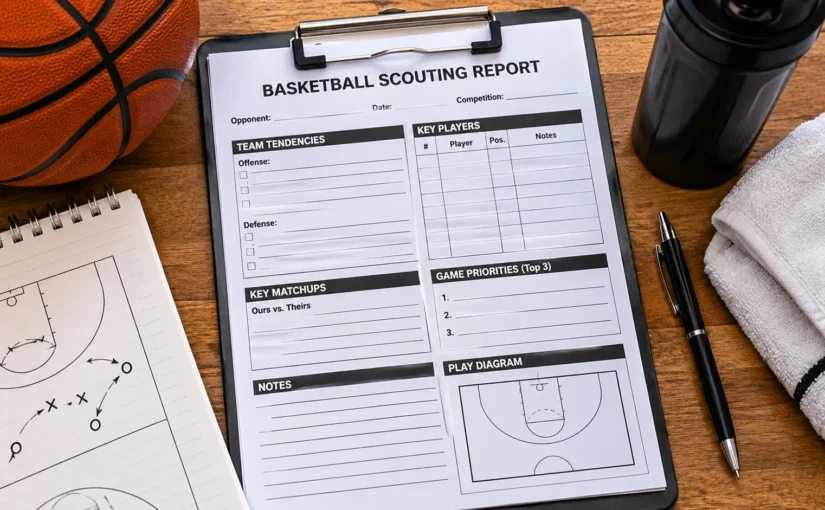
A basketball scouting report template helps coaches organize information about upcoming opponents and prepare a clear game plan.
Instead of relying on memory, you can record team tendencies, key players, defensive systems, and important plays in one place.
Our free basketball scouting report template is designed for youth, high school, and amateur coaches who want a simple way to prepare for games.
Free Basketball Scouting Report Template
Our printable basketball scouting report uses two pages to organize opponent information, personnel notes, and coaching decisions.
Download the Free Basketball Scouting Report PDF
Download the Editable Basketball Scouting Report (Excel)
The blank templates are intended for printing or completing before your next game.
Page 1: Opponent Scout
The first page covers the information coaches need most:
- Opponent name, game date, and competition.
- Offensive and defensive tendencies.
- Key players and their strengths.
- Important matchups.
- Three priorities for your game plan.
This page provides a quick reference during team preparation.
Page 2: Scouting Notes and Game Plan
The second page provides space for more detailed observations.
Coaches can record video timestamps, special plays, transition offense, defensive adjustments, and practice priorities.
It also includes space to draw basketball plays and write possible responses to an opponent’s system.
What Is a Basketball Scouting Report?
A basketball scouting report is a document that summarizes an opposing team’s playing style, personnel, strengths, and weaknesses.
Coaches use scouting reports to prepare practices, assign defensive matchups, and develop strategies before games.
The FIBA World Association of Basketball Coaches Level 2 manual recommends observing team and individual tendencies, preferred tempo, substitutions, and offensive actions.
A team scouting report differs from a player evaluation form. The first focuses on preparing for an opponent, while the second assesses an individual player’s abilities and development.
What Should a Basketball Scouting Report Include?
A useful report should explain what the opponent does and how your team might respond.
Offensive and Defensive Tendencies
Record how the opponent attacks and defends.
For offense, look for:
- Fast breaks and transition offense.
- Common half-court plays.
- Ball screens and player movement.
- Preferred shooting areas.
- Offensive rebounding habits.
For defense, note whether the opponent uses man-to-man defense, zone defense, full-court pressure, or trapping.
Also record how defenders respond to screens and drives toward the basket.
Key Players and Personnel
Identify players who have the greatest influence on the game.
Record jersey numbers, positions, preferred shooting areas, and observed habits.
For example, a guard might frequently attack the right side of the court, while a center might be particularly active on offensive rebounds.
Avoid describing a player as a poor shooter or defender based on one possession.
Special Situations
Include any important plays the opponent uses during specific situations.
These might include baseline out-of-bounds plays, sideline out-of-bounds plays, and actions following timeouts.
You can also record late-game strategies when enough information is available.
How to Fill Out a Basketball Scouting Report
Follow these five steps.
- Gather opponent information. Write down the team name, game date, roster information, and available scouting sources.
- Watch games or review video. Focus on the opponent’s offensive system, defensive approach, and important personnel. Record video timestamps when useful.
- Identify repeated tendencies. Look for actions that occur across several possessions rather than making conclusions from isolated plays.
- Plan your matchups. Consider how your players can defend the opponent’s main threats and attack weaknesses in its defensive system.
- Choose three game priorities. Turn your observations into clear instructions that players can practice and remember.
Keep detailed notes for your coaching staff, but make the information shared with players manageable.
Basketball Scouting Report Example
Here’s a fictional example showing how a coach might turn scouting observations into a game plan.
| Scouting observation | Possible coaching response |
|---|---|
| Opponent frequently pushes the ball after rebounds | Prioritize transition defense |
| Point guard regularly uses high ball screens | Practice existing ball-screen coverage |
| Opponent attacks offensive rebounds aggressively | Emphasize boxing out |
| Defense frequently uses full-court pressure | Rehearse press-break spacing |
These observations are examples, not findings about a real team.
A good scouting report connects each observation to a practical coaching decision.
Common Scouting Mistakes
Avoid these mistakes when preparing a basketball scouting report:
- Recording too much information: Focus on details that can influence your game plan.
- Making unsupported assumptions: One successful play does not establish a reliable tendency.
- Ignoring recent changes: Check whether the opponent has changed its lineup or system.
- Overcomplicating the game plan: Use strategies your players understand.
- Forgetting to update the report: Review your observations during and after the game.
For younger teams, keep scouting simple and prioritize player development rather than overwhelming players with tactical instructions.
Frequently Asked Questions
What should a basketball scouting report include?
A basketball scouting report should include opponent information, offensive and defensive tendencies, key personnel, important matchups, special situations, and a game plan.
How do you scout a basketball team without video?
Watch the opponent play in person when possible. Record its offensive and defensive systems, key players, and repeated tendencies. You can also review available statistics, but these may not explain how the team creates scoring opportunities.
Can youth basketball coaches use scouting reports?
Yes. Youth coaches can use simplified scouting reports to identify a few important teaching points. Player development should remain a priority.
Can I edit the basketball scouting report template?
Yes. The editable Excel template allows coaches to enter opponent information, record observations, and customize their game plans before printing.
A basketball scouting report helps coaches prepare for opponents without relying entirely on memory.
The most useful reports focus on repeated tendencies, important personnel, and clear coaching responses.
Use our free basketball scouting report template to organize your observations and turn them into a practical game plan.