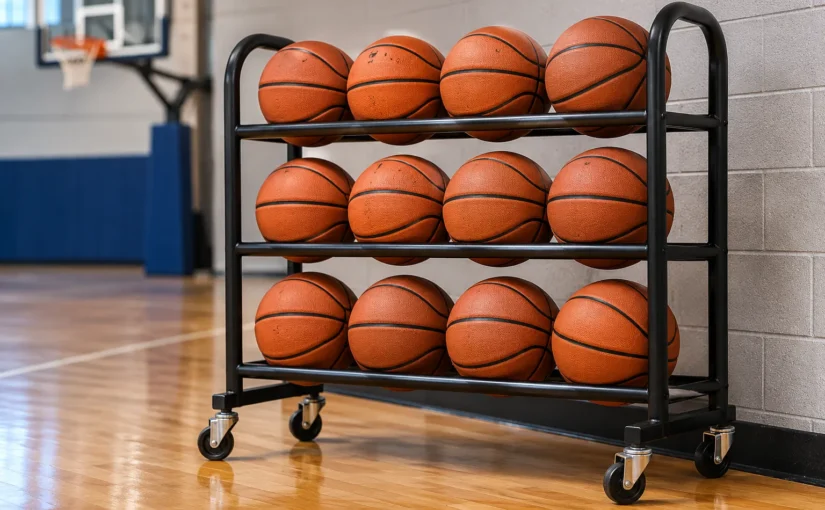
A basketball rack keeps basketballs organized, off the gym floor, and easy to access. It can help coaches run drills, schools manage sports gear, and homeowners keep their garages tidy.
The right basketball storage rack depends on how many balls you own, your available space, and whether you need wheels or locks. This guide explains the main types, sizes, prices, and features worth considering.
For other useful practice accessories, see our guide to basketball training equipment.
What Is a Basketball Rack?
A basketball rack is a storage unit designed to hold multiple basketballs. Most use metal rails, shelves, or enclosed compartments.
Basketball ball racks are common in schools, gyms, recreation centers, and home garages. They help keep balls from rolling across the floor and make equipment easier to find.
A ball rack usually has open shelves or rails. A ball cart is designed for moving equipment, while a ball locker adds security through locking bars or an enclosed cage.
Types of Basketball Racks
Stationary Basketball Racks
Stationary racks stay in one place. They’re suitable for equipment rooms, garages, and gym storage areas where balls don’t need moving frequently.
Rolling Basketball Racks
Rolling racks have wheels that let coaches transport basketballs between storage areas and courts.
Many use two or three tiers, making basketballs easy to grab during practice while keeping unused balls organized.
Wall-Mounted Basketball Racks
Wall-mounted racks save floor space by attaching to a suitable wall.
They’re useful in smaller gyms and garages. However, installation requires the correct mounting hardware and adequate wall support.
Vertical Basketball Storage Racks
Vertical racks store balls in a taller arrangement with a relatively small floor footprint.
They work well where floor space is limited, although reaching balls near the top may be less convenient.
Lockable Basketball Storage Cages
A ball locker protects equipment using an enclosed frame, locking lid, or locking bars.
These are useful for schools, teams, and shared facilities that need controlled access. Some models require a separate padlock.
Folding Basketball Carts
Folding ball carts usually have a fabric or mesh basket supported by a collapsible frame.
They’re convenient for coaches who need portable storage during practice and want to fold the cart away afterward.
| Rack type | Main advantage | Best suited for |
|---|---|---|
| Stationary | Simple storage | Garages, equipment rooms |
| Rolling | Easy movement | Schools, coaches |
| Wall-mounted | Saves floor space | Small gyms, garages |
| Vertical | Compact footprint | Limited storage areas |
| Lockable cage | Equipment security | Shared facilities |
| Folding cart | Portable and compact | Training sessions |
How Much Does a Basketball Rack Cost?
Basketball rack prices vary depending on capacity, materials, mobility, and security features.
Here are examples from US manufacturer and retailer listings checked in November 2026.
| Basketball rack | Capacity | Listed price |
|---|---|---|
| BSN Sports 12 Ball Wide Body Cart | 12 balls | $119.99 |
| Pro Down Wall Mounted Ball Rack | Up to 18 balls | $174.99 |
| BSN Sports E-Z Fold Cart | 20 basketballs | $199.99 |
| Trigon ProCage CART315 | 15 balls | $294.58 |
| BSN Standard Portable Ball Locker | 20 balls | $499.99 |
Prices may change. Shipping, taxes, availability, and selected product options can affect the final cost.
For a home garage, a simple storage organizer may be enough. Schools and athletic directors may need heavier-duty equipment designed for frequent use.
How to Choose the Right Basketball Rack
Basketball Capacity
Count how many basketballs you need to store before buying.
A 12-ball rack may suit a small training group, while a school or sports club might need a larger cart or multiple racks.
Always check whether the advertised capacity applies to full-size basketballs.
Rack Dimensions and Height
Measure your available storage space, including clearance around doors and walkways.
For example, the Jaypro Atlas BBABC-1 measures approximately 51.5 inches long, 18 inches wide, and 36 inches high.
A rack’s height depends on its design. There is no single standard height for every basketball rack.
Materials, Heavy-Duty Construction, and Durability
Commercial basketball racks commonly use steel tubing with protective finishes.
Look for secure connections and materials suitable for your intended environment.
For daily school or gym use, choose a heavy-duty rack designed for frequent handling. However, a heavy-duty design doesn’t automatically mean the rack is suitable for outdoor storage.
Wheels and Brakes
Wheels make it easier to move basketballs between courts, storage rooms, and practice areas.
Check whether the wheels suit your gym floor and whether the model includes brakes. Don’t assume every rolling rack has locking wheels.
Indoor and Outdoor Sports Gear Storage
Indoor basketball racks should generally stay in dry storage areas unless their manufacturer approves outdoor use.
Moisture can damage some metal components and shorten equipment life. A protective coating alone doesn’t guarantee year-round weather resistance.
Security Features
Open racks provide quick access but little protection against unauthorized use.
A lockable cage is better suited to shared equipment storage. Check whether a padlock is included, as some products require one to be purchased separately.
Which Basketball Rack Is Best for Your Needs?
For home storage, choose a compact stationary or wall-mounted rack. These help organize basketballs without taking up unnecessary space.
For schools and gyms, a rolling steel rack is practical because coaches can move basketballs between drills and storage areas. It also helps keep equipment organized during practice.
For basketball coaches, a folding cart provides convenient access to multiple balls during training sessions.
For outdoor courts, choose equipment specifically approved for outdoor conditions.
For small spaces, consider a vertical rack or wall-mounted holder.
Basketball Rack Assembly and Maintenance
Most commercial racks require some assembly, and assembly time varies by model. Follow the manufacturer’s instructions and check that all connections are secure.
For wall-mounted models, use suitable anchors and confirm the wall can support the loaded rack.
Keep wheels clean, inspect loose fittings, and check metal surfaces for corrosion. Store the rack in a dry location unless it’s designed for outdoor use.
Common Basketball Rack Buying Mistakes
Avoid these common mistakes:
- Choosing insufficient capacity: Count your basketballs before purchasing.
- Ignoring dimensions: Measure the storage area and nearby walkways.
- Overlooking wheel quality: Check floor compatibility and brakes.
- Assuming outdoor suitability: Read the manufacturer’s storage guidance.
- Forgetting extra costs: Check delivery charges, mounting hardware, and locks.
Frequently Asked Questions
How should I store my basketballs?
Store basketballs in a cool, dry location, away from prolonged direct sunlight and excessive heat. Use a rack, shelf, or suitable storage bag to keep them organized.
If you need to release some air before storage, read our guide on how to deflate a basketball safely.
How tall is a basketball rack?
Height varies by design. The Jaypro Atlas BBABC-1 is 36 inches tall, while the Champion Sports 20BC vertical ball cage is 48 inches tall.
Check the exact model dimensions before buying.
Where is the best place to store a basketball?
A dry indoor location, such as a garage, equipment room, or storage closet, is generally best. Avoid prolonged exposure to extreme temperatures and moisture.
How many balls does a basketball rack hold?
Capacity depends on the model. Some racks hold 8–12 basketballs, while larger carts and cages can accommodate 15–30 or more.
Always check the manufacturer’s stated capacity for your ball size.
Final Thoughts
A basketball rack makes storing, organizing, and transporting basketballs easier.
For most coaches, a rolling rack provides convenient access during practice. Homeowners may prefer a smaller wall-mounted unit, while schools with shared sports gear may benefit from a lockable ball locker.
Choose based on capacity, available space, mobility, and durability, rather than price alone.
2 thoughts on “Basketball Rack | Types, Sizes, Prices & Buying Guide”
Comments are closed.