Best Outdoor Basketball | 7 Top Picks Compared

The Wilson NBA Authentic Outdoor is our best overall outdoor basketball pick. It combines a rubber cover designed for outdoor courts with strong grip and bounce results from independent hands-on testing.

But it isn’t the only basketball worth considering.

The Spalding Street and Wilson NBA DRV Pro offer affordable alternatives. The Mikasa BX1000 costs even less, while the Baden Contender gives players a composite-cover option.

The right choice depends on your playing surface, budget, preferred feel, and basketball size.

We compared manufacturer specifications, US product listings, independent reviews, and customer feedback. BasketballRex has not personally tested these seven models. Our recommendations reflect the available evidence, not invented performance scores or durability rankings.

Best Outdoor Basketballs at a Glance

Basketball Our Recommendation Cover Approximate US Price
Wilson NBA Authentic Outdoor Best Overall Tackskin rubber $33
Spalding Street Phantom Full-Size Streetball Option Performance rubber $30
Wilson NBA DRV Pro Affordable Wilson Alternative Partly recycled Tackskin $28
Spalding Street Budget Pick With Hands-On Evidence Rubber $30
Jordan Playground Casual Outdoor Play Rubber $30
Mikasa BX1000 Low-Cost Rubber Option Outdoor rubber $17
Baden Contender Composite Alternative Performance composite $40

Prices are approximate US listings checked on November 6, 2026. Prices and availability can change by retailer, size, and color.

The 7 Best Outdoor Basketballs

1. Wilson NBA Authentic Outdoor — Best Overall

Best for: Players who want an outdoor basketball for regular shooting practice, driveway basketball, and recreational games.

The Wilson NBA Authentic Outdoor Basketball is our overall recommendation because it combines verified outdoor construction with positive independent testing.

Wilson uses a Tackskin rubber cover with an additional cushioning layer. The ball also features NBA Pro Seams and an inflation-retention lining.

Wilson promotes these features for grip, handling, and air retention. However, manufacturer claims alone cannot prove that a basketball performs better than its competitors.

The stronger evidence comes from Verywell Fit’s hands-on basketball testing.

Its testers found the NBA Authentic Outdoor comfortable to hold, with a slightly tacky surface that remained easy to control when their hands were sweaty.

They also reported responsive bounce after correcting excessive inflation. The ball showed minimal visible wear during their outdoor testing period.

These findings make it a stronger recommendation than products supported only by manufacturer descriptions.

Advantages

  • Positive independent grip and bounce observations.
  • Designed for outdoor surfaces.
  • Comfortable, cushioned rubber cover.
  • Available in Sizes 5, 6, and 7.
  • Reasonably priced for recreational players.

Drawbacks

  • The available test does not establish durability over several years.
  • Overinflation affected bounce during testing.
  • Its rubber feel may not suit players accustomed to softer indoor composite balls.

Verdict: The Wilson NBA Authentic Outdoor offers the strongest combination of relevant testing, practical features, and price in this comparison.

2. Spalding Street Phantom — Full-Size Streetball Option

Best for: Players wanting a dedicated Size 7 basketball for concrete, asphalt, and outdoor pickup games.

The Spalding Street Phantom is designed specifically for outdoor basketball.

Spalding identifies concrete and asphalt as suitable playing surfaces.

The ball uses a high-performance rubber cover with Soft Grip Technology, a sponge-rubber design, and deep channels.

These features are intended to support grip and handling. However, there is no reliable independent comparison proving that the Street Phantom has better grip or longer durability than the Wilson NBA Authentic Outdoor.

The model is available in an official Size 7, measuring 29.5 inches around.

Customer reviews provide mixed evidence about long-term performance. Some owners describe years of use, while others report irregular bounce or problems with the ball’s shape.

Neither experience establishes what a typical buyer should expect.

The Street Phantom also has an availability limitation. Spalding’s own US product page displayed it as unavailable during our check, although DICK’S Sporting Goods listed the model at approximately $30.

Advantages

  • Explicitly intended for concrete and asphalt.
  • Rubber cover with deep channels.
  • Standard Size 7 construction.
  • Ships inflated according to Spalding.

Drawbacks

  • Limited independent testing.
  • Mixed customer durability reports.
  • Availability differs between retailers.
  • No verified performance advantage over other outdoor rubber balls.

Verdict: Consider the Street Phantom if you want a full-size Spalding basketball specifically designed for rough outdoor courts. Check retailer availability before purchasing.

3. Wilson NBA DRV Pro — Affordable Wilson Alternative

Best for: Players who want an outdoor-focused Wilson basketball at a moderate price.

The Wilson NBA DRV Pro is designed for recreational outdoor play.

The current WZ30160 version uses a partly recycled Tackskin cover, NBA Pro Seams, and Wilson’s Pressure Lock bladder construction.

Wilson promotes these features for handling and inflation retention, although no controlled comparison establishes a measurable advantage over the other basketballs here.

The reviewed manufacturer listing showed a price of approximately $28. Retailer prices may be lower.

An older version also received some independent attention.

In a 2023 Hoopsbeast review, Max Kesler described predictable bounce and grip that felt somewhat better than basic rubber basketballs.

However, the reviewer had limited experience with the ball, and the review predates the current partly recycled-cover version.

We therefore cannot assume its handling observations apply exactly to today’s model.

Advantages

  • Outdoor-specific construction.
  • More affordable than many premium basketballs.
  • Textured Tackskin cover.
  • Current manufacturer listing identifies Sizes 6 and 7.
  • Some older independent handling evidence.

Drawbacks

  • Limited current-model testing.
  • No verified long-term durability advantage.
  • The current recycled-cover version may differ from older reviews.

Verdict: The NBA DRV Pro is a sensible affordable Wilson option. Choose the NBA Authentic Outdoor instead if independent testing evidence is your main priority.

4. Spalding Street — Budget Pick With Hands-On Evidence

Best for: Beginners, families, and occasional outdoor players who want a straightforward rubber basketball.

The Spalding Street Outdoor Basketball is designed for outdoor use.

It features a performance rubber cover and deep channels. Spalding lists Sizes 5, 6, and 7, with a manufacturer price around $30.

Its biggest advantage over many budget basketballs is the availability of independent testing.

Verywell Fit tested the Spalding Street during shooting practice and recreational games.

Testers reported comfortable grip, consistent bounce across surfaces, and little hand fatigue. They also noted that the ball arrived inflated and ready to use.

However, there was an important drawback.

The surface texture and grip began deteriorating during their month of testing.

That does not mean every Spalding Street will wear out within a month. Court conditions, playing frequency, and other factors affect durability.

It does mean buyers should consider grip retention rather than judging the ball only by how it feels when new.

Advantages

  • Independent hands-on evidence.
  • Affordable and easy to find.
  • Consistent bounce during testing.
  • Multiple sizes available.
  • Ships inflated according to Spalding.

Drawbacks

  • Grip deterioration observed during testing.
  • Not a proven long-term durability winner.
  • Price varies across retailers.

Verdict: The Spalding Street is worth considering for casual outdoor play. Its known testing limitation makes it a more transparent recommendation than an untested budget basketball.

5. Jordan Playground — Casual Outdoor Play

Best for: Recreational players who want an outdoor rubber basketball with distinctive styling.

The Jordan Playground Basketball uses a 100% rubber exterior.

Nike identifies the model as suitable for outdoor play and lists Sizes 5, 6, and 7.

The ball features eight panels with deep channels designed to help players control it during shooting, passing, and dribbling.

The reviewed US listing displayed a price of $30.

That places it close to the Spalding Street and Wilson NBA DRV Pro.

Its main attractions are outdoor suitability, size availability, and Jordan branding.

However, the available evidence does not prove it has better grip, bounce, or durability than competing outdoor basketballs.

Nike’s product page includes customer feedback, but its AI-generated review summary should not be treated as independent performance testing.

Advantages

  • Rubber exterior approved for outdoor use.
  • Sizes 5, 6, and 7.
  • Deep-channel design.
  • Recognizable Jordan styling.

Drawbacks

  • Limited independent testing.
  • No established long-term grip advantage.
  • Size and color availability may vary.

Verdict: The Jordan Playground is a reasonable choice for casual outdoor basketball, especially if you prefer its appearance. Its branding does not establish superior performance.

6. Mikasa BX1000 — Low-Cost Rubber Option

Best for: Budget-conscious players looking for a basic outdoor basketball.

The Mikasa BX1000 Series is among the least expensive options in this comparison.

Mikasa lists a premium outdoor rubber cover, wide channels, and an outdoor-use designation.

The manufacturer’s US listing showed a price of $16.99.

That makes it worth considering for recreational practice or as an affordable spare basketball.

Mikasa uses different model numbers for different ball sizes.

Model Size Circumference
BX1000 7 29.5 inches
BX1010 6 28.5 inches
BX1008 5 27.5 inches
BX1006 4 25.5 inches

Check the model number carefully, especially when purchasing for a younger player.

Although the BX series is inexpensive, there is insufficient independent testing to establish how its grip and durability compare with more expensive basketballs.

Advantages

  • Low advertised purchase price.
  • Outdoor rubber construction.
  • Wide channels.
  • Several size-specific models.
  • Manufacturer-listed one-year warranty.

Drawbacks

  • Limited independent performance evidence.
  • No proven long-term durability advantage.
  • Exact variant stock may change.

Verdict: The Mikasa BX1000 is a practical starting point if keeping the purchase price low matters most. Its low cost does not automatically make it the best long-term value.

7. Baden Contender — Composite Alternative

Best for: Players who prefer an outdoor-rated composite cover rather than standard rubber.

The Baden Contender differs from most basketballs in this guide.

It uses a performance composite cover rather than conventional outdoor rubber.

Baden explicitly approves the Contender for indoor and outdoor use, including blacktop courts.

Its symmetrical panel construction is intended to provide a more even feel and consistent bounce.

The manufacturer lists three sizes:

  • Size 7: B301
  • Size 6: B285W
  • Size 5: B251

The reviewed price was $39.99.

Composite basketballs can appeal to players who prefer a different surface feel from rubber. However, composite construction does not automatically mean better grip or greater durability.

Customer feedback on Baden’s product page includes favorable outdoor-grip reports alongside complaints about seam failure.

These are individual experiences rather than controlled testing.

Availability also requires checking. The manufacturer page displayed inconsistent add-to-cart and out-of-stock signals during our research.

Advantages

  • Composite cover.
  • Approved for indoor and outdoor courts.
  • Sizes 5, 6, and 7.
  • Alternative feel to basic rubber basketballs.

Drawbacks

  • More expensive than several rubber options.
  • Limited independent long-term testing.
  • Mixed customer durability reports.
  • Variant availability needs confirmation.

Verdict: The Baden Contender is worth considering if you specifically want an outdoor-rated composite basketball. For players who mainly use concrete or asphalt, a dedicated rubber model may be the simpler choice.

If you regularly play on both hardwood and outdoor courts, our best indoor outdoor basketballs guide compares more mixed-surface options.

How to Choose an Outdoor Basketball

The right basketball depends on where you play, how often you practise, and what feels comfortable in your hands.

Rubber vs Composite Basketballs

Rubber and composite are common materials used for outdoor-capable basketballs.

Rubber basketballs are widely used for outdoor recreation because manufacturers offer models specifically intended for concrete, asphalt, and other hard courts.

They are often affordable, but their grip and firmness vary.

Composite basketballs use synthetic covers that can provide a different playing feel.

Some are suitable for both indoor and outdoor play. Others are intended for indoor courts only.

A composite cover does not automatically make a basketball unsuitable for outdoor use. The exact manufacturer’s designation matters more than the material name alone.

For dedicated outdoor play, an outdoor-rated rubber basketball is usually the simplest starting choice.

Grip and Surface Texture
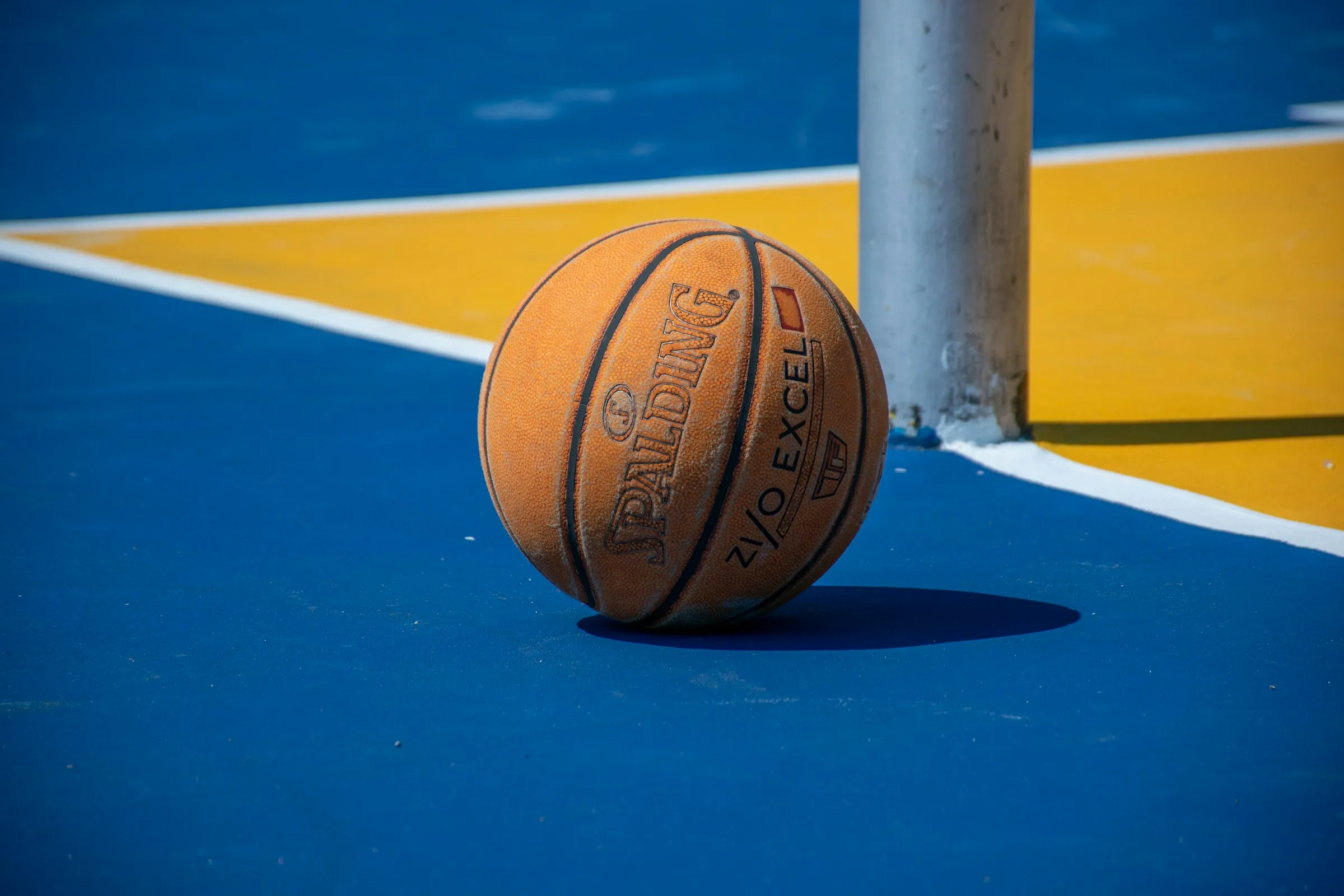
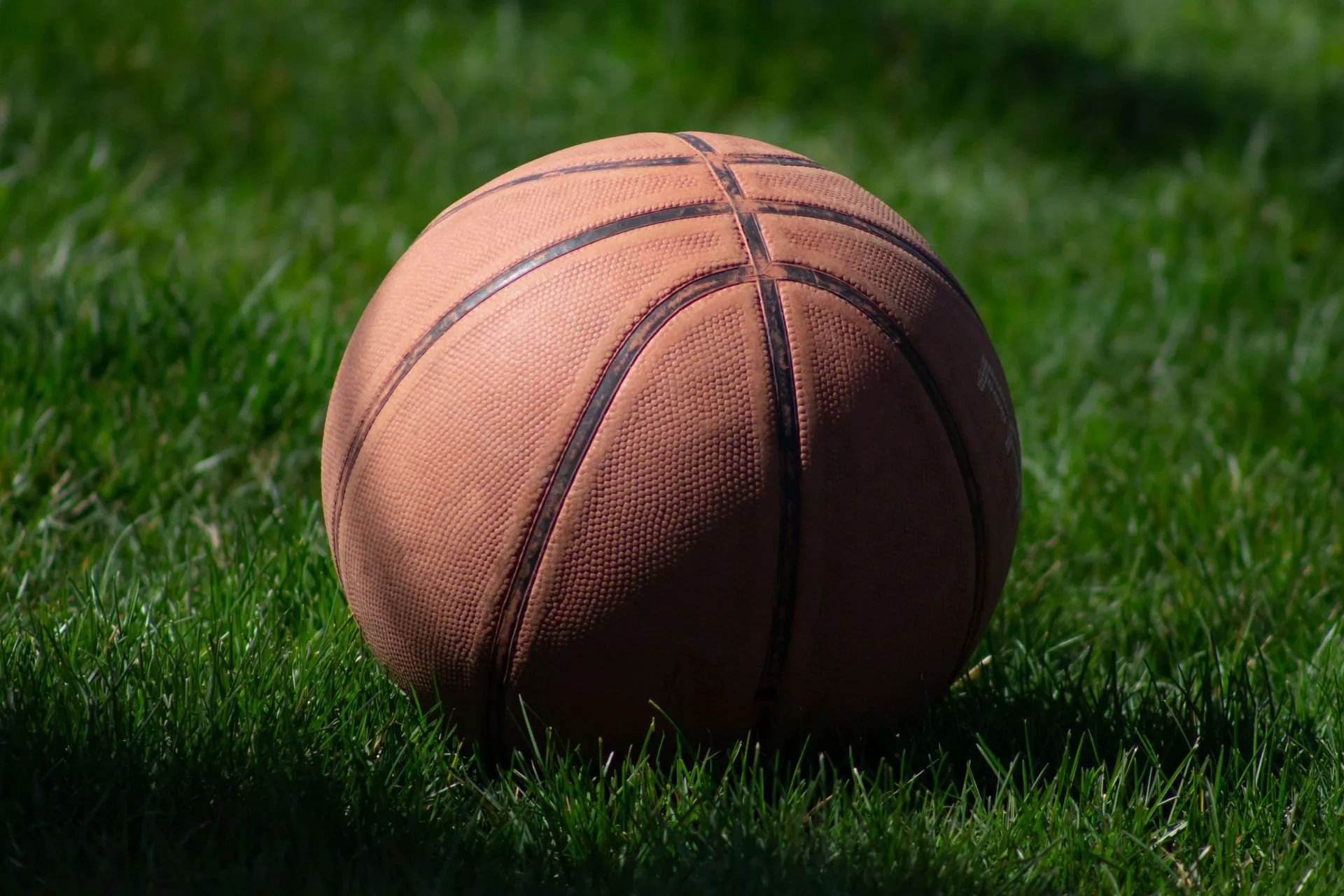
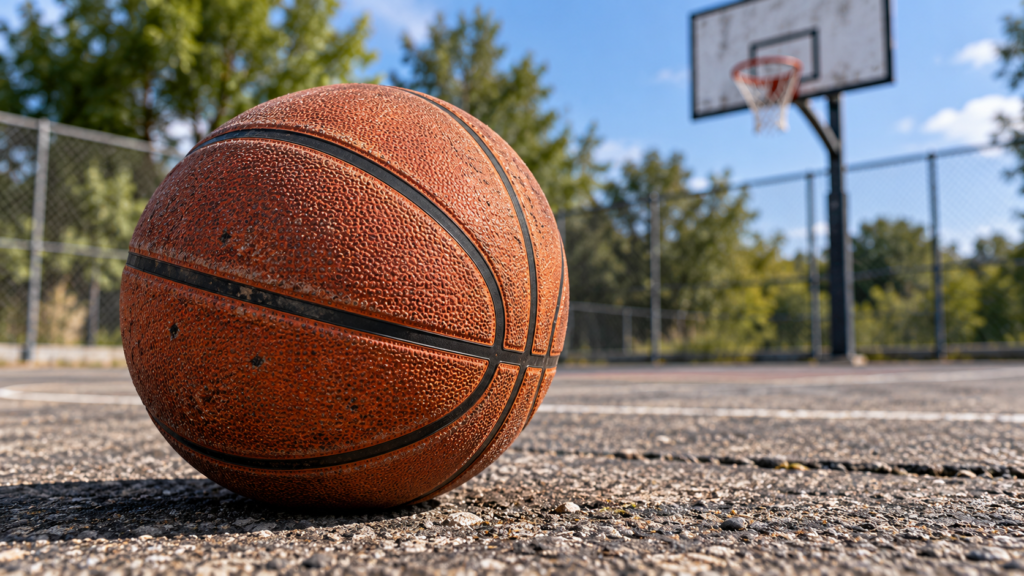
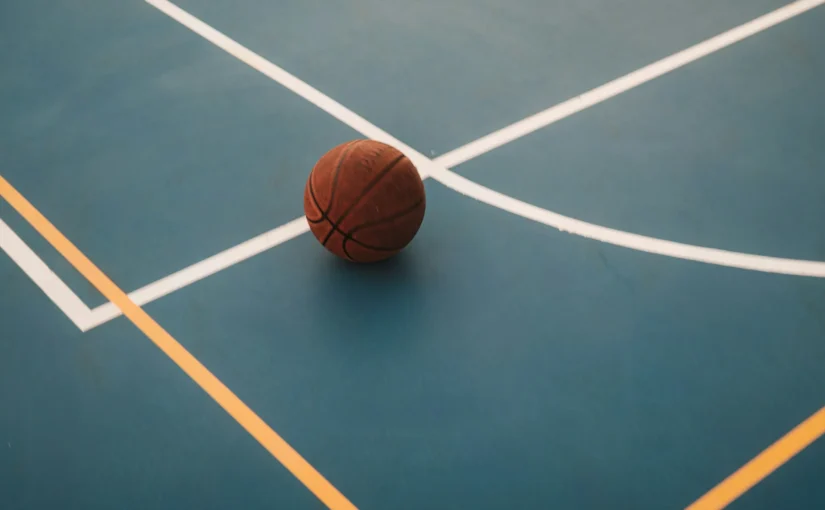
Close-up of a basketball showing its textured cover on an outdoor court
Basketball cover texture and channels. Photo by Robin Jonathan Deutsch / Unsplash.

Grip affects how securely you can catch, pass, shoot, and dribble.

Outdoor basketballs commonly feature textured covers and channels between the panels.

However, good grip when new is not the same as long-term grip retention.

Dirt and moisture can temporarily change how a basketball feels. Physical wear can permanently reduce its surface texture.

The Spalding Street demonstrates the difference. Its testers initially praised its grip but later observed deterioration.

Choose a basketball with a suitable cover rather than assuming a manufacturer’s grip technology guarantees superior performance.

Durability on Concrete and Asphalt
Basketball resting on a hard outdoor surface
Basketball on a hard outdoor surface. Photo by Jason Hawke / Unsplash.

Concrete and asphalt are abrasive playing surfaces.

Repeated contact can gradually wear down a basketball’s exterior.

Outdoor-rated basketballs are designed for these conditions, but none is wear-proof.

Durability also depends on court texture, playing frequency, ball construction, and maintenance.

There is no reliable controlled comparison establishing a separate concrete winner and asphalt winner among these seven models.

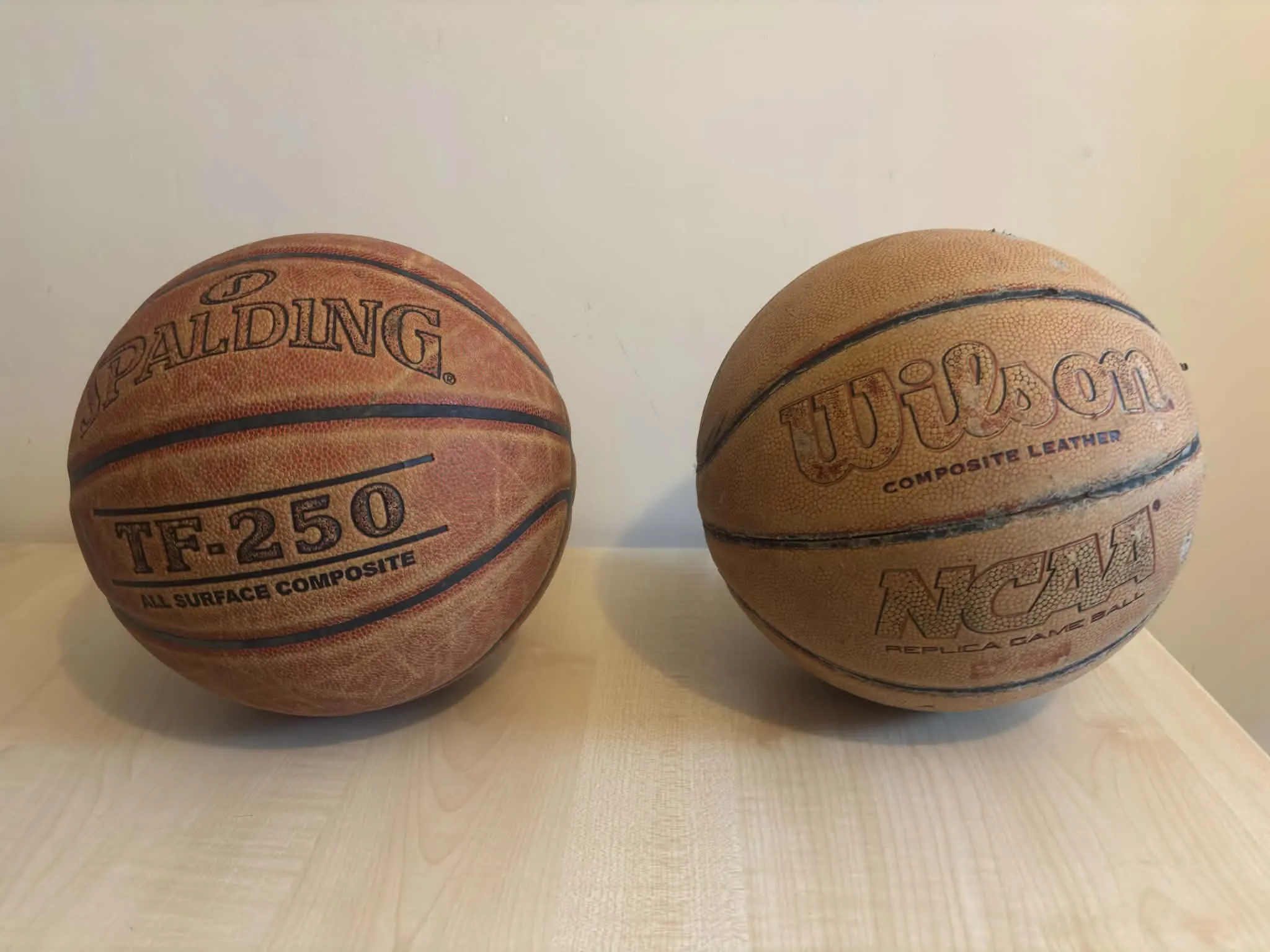
I have also experienced outdoor cover wear firsthand. My older Wilson NCAA Replica Game Ball became heavily worn after years of outdoor use. That experience reinforces the importance of surface choice, but it is not a performance test of the basketballs reviewed here.

Choosing the Right Basketball Size

Basketball size affects handling, shooting, and dribbling comfort.

Size Circumference Common Use
7 29.5 inches Men’s standard competition
6 28.5 inches Women’s standard competition and many youth leagues
5 27.5 inches Younger players

Circumference means the measurement around the basketball, not straight across it.

Youth age recommendations can vary between organizations. Always check your league’s rules before buying.

Price and Replacement Cost

A more expensive outdoor basketball is not automatically better.

The models in this guide range from approximately $17 to $40 in the researched US listings.

Spending more may provide a different cover, construction, or preferred feel.

However, without comparable long-term testing, we cannot calculate which basketball has the lowest replacement cost over several years.

For occasional players, an affordable outdoor rubber ball may be sufficient.

For frequent players, handling comfort and replacement cost both deserve consideration.

How to Make an Outdoor Basketball Last Longer

Basic maintenance can help prevent unnecessary wear.

1. Remove dirt after playing. Wipe loose dirt and debris from the ball using a suitable soft cloth. Follow the manufacturer’s instructions before using cleaning products.

2. Use the correct inflation pressure. Check the pressure printed on the ball or its packaging. Do not assume every basketball uses the same PSI.

3. Store it somewhere dry. Avoid leaving the basketball outdoors in rain, direct sunlight, or extreme temperatures for extended periods.

4. Inspect the cover. Look for worn texture, separating panels, loss of roundness, or other significant damage.

5. Check persistent air loss. A basketball that repeatedly loses air may have a valve or bladder problem.

Cleaning can remove dirt, but it cannot replace material worn away by abrasive courts.

If you need to remove air for travel or storage, follow our guide on how to deflate a basketball safely.

Frequently Asked Questions

What Is the Best Outdoor Basketball?

The Wilson NBA Authentic Outdoor is our overall recommendation.

It has a rubber cover designed for outdoor use and received positive grip, bounce, and comfort results during independent hands-on testing.

The Spalding Street and Wilson NBA DRV Pro are reasonable alternatives for buyers comparing lower-cost options.

Is Rubber or Composite Better for Outdoor Basketball?

Rubber is a practical starting point for dedicated outdoor play because many rubber models are designed specifically for rough courts.

Composite basketballs can also be suitable outdoors when their manufacturers approve them for that use.

Neither material guarantees better grip or durability across every model.

Which Basketball Is Best for Concrete?

The Wilson NBA Authentic Outdoor is a strong general choice.

The Spalding Street Phantom is another suitable candidate because Spalding explicitly identifies concrete and asphalt as intended surfaces.

There is insufficient controlled evidence to prove which model lasts longest on concrete.

How Long Does an Outdoor Basketball Last?

There is no universal lifespan.

Playing frequency, surface roughness, construction, storage, and maintenance all affect wear.

Some basketballs remain usable for years, while others lose their original grip much sooner.

Replace yours when significant damage or performance problems make it unsuitable for play.

Can Outdoor Basketballs Be Used Indoors?

Some can.

Basketballs specifically approved for indoor/outdoor use are designed for both types of court.

Dedicated outdoor models may feel different from premium indoor game balls.

Check the manufacturer’s guidance and the facility’s rules before using one indoors.

Our indoor vs outdoor basketball guide explains the differences.

Which Brand Is Better Outdoors, Spalding or Wilson?

Neither brand has a proven overall durability advantage.

Wilson offers the NBA Authentic Outdoor and NBA DRV Pro, while Spalding sells the Street and Street Phantom.

Compare the individual models rather than choosing based on brand alone.

For a broader comparison, see our Spalding vs Wilson basketball guide.

Can You Play Basketball Outside in the Rain?

An outdoor basketball is designed for outdoor surfaces, but that does not mean it is waterproof or that wet conditions are safe.

Rain can reduce grip and make playing surfaces slippery.

Avoid unsafe courts, and follow the manufacturer’s cleaning and drying instructions if the ball becomes wet.

Do Outdoor Basketballs Come Inflated?

It depends on the model and retailer.

Spalding lists both the Street and Street Phantom as shipping inflated.

Other products may arrive deflated, and a pump is not always included.

Check the exact listing before buying.

Final Verdict

The Wilson NBA Authentic Outdoor is our best overall outdoor basketball recommendation.

It offers outdoor-specific construction, comfortable handling, and positive independent testing results.

For a budget option supported by hands-on testing, consider the Spalding Street, while remembering its reported grip deterioration.

The Wilson NBA DRV Pro is an affordable Wilson alternative, and the Mikasa BX1000 is worth considering if your main priority is a low purchase price.

The Spalding Street Phantom is another option for full-size streetball, while the Baden Contender offers a different cover material.

Whichever basketball you choose, check its playing-surface designation, select the correct size, and follow the manufacturer’s inflation and care instructions.

The best outdoor basketball is the one that suits your court, budget, and preferred feel.
Best Indoor Outdoor Basketball | 7 Picks for 2026

The Spalding Zi/O TF Excel is our best indoor outdoor basketball pick for 2026. Its composite cover, foam backing, and slightly tacky feel make it a strong option for players who switch between hardwood courts and outdoor basketball.

For better value, the Spalding React TF250 offers all-surface composite construction for approximately $35. The Baden Crossover is another affordable composite option, while the Spalding Varsity TF150 is worth considering if you mainly play outdoors.

All seven basketballs in this guide are approved for indoor and outdoor use by their manufacturers. However, outdoor surfaces gradually wear down basketball covers, even when the balls are designed for them.

Our recommendations are based on manufacturer specifications, independent reviews where available, and value for money. They are not presented as hands-on tests of all seven current models.

Best Indoor Outdoor Basketballs at a Glance

Basketball Best for Cover Approx. US price
Spalding Zi/O TF Excel Best overall Composite $45
Spalding React TF250 Best value Composite $35
Baden Crossover Budget composite Flex composite $27
Spalding Varsity TF150 Budget rubber Rubber $25
Molten BG3800 FIBA-style preference Synthetic $50
Wilson NBA Authentic Indoor/Outdoor Wilson fans PU composite $50
Nike Elite All-Court Outdoor-heavy mixed use Rubber/synthetic $35

Prices are approximate US listings checked October 31, 2026. Prices, stock, and shipping costs may have changed.

The 7 Best Indoor Outdoor Basketballs

1. Spalding Zi/O TF Excel — Best Overall

Best for: Players who regularly move between indoor gyms and outdoor courts.

The Spalding Zi/O TF Excel is our leading recommendation for mixed-surface basketball. It features a Zi/O Tournament composite cover with foam backing. Spalding describes its surface as soft and slightly tacky, making it appealing to players who prefer a composite feel over a basic rubber basketball.

Grip and feel

An independent Hoopsbeast review reported strong tack and consistent bounce. However, the review tested an older NBA-branded Zi/O model, not the exact current TF Excel. Its observations provide useful background rather than proof of identical performance. The reviewer also noticed dirt collecting on the cover, which affected handling.

Outdoor durability

After approximately three months, the reviewer reported visible pebble wear, although the basketball remained playable. An indoor/outdoor basketball can withstand its intended playing surfaces without remaining in its original condition.

Advantages

  • Composite cover with foam backing
  • Suitable for hardwood and outdoor courts
  • Some useful independent review evidence
  • More affordable than many premium indoor-only basketballs

Drawbacks

  • Outdoor use gradually wears the surface
  • Tacky cover can collect dirt
  • No Size 5 option listed in the reviewed US range

Verdict: The Zi/O TF Excel is our best overall recommendation because of its construction, mixed-surface suitability, and supporting evidence. It has not been proven superior to every competitor through controlled testing.

2. Spalding React TF250 — Best Value

Best for: Recreational players wanting a reasonably priced composite basketball.

The Spalding React TF250 offers all-surface composite construction for approximately $34.99. That makes it around $10 cheaper than the Zi/O TF Excel. It features Spalding’s Shooter’s Seam design, which the manufacturer promotes for improved ball recognition and control.

Grip and feel

The composite cover makes the React TF250 worth considering if you prefer a different feel from traditional rubber basketballs. However, current independent testing does not establish whether its grip is better than the Baden Crossover or more expensive models.

Bounce and inflation

Spalding recommends 8 PSI and ships the ball inflated. Correct inflation matters because too much or too little air can change how a basketball bounces and handles.

Outdoor durability

The React TF250 is designed for driveways and gyms. Its outdoor suitability is established by the manufacturer, but reliable long-term wear comparisons against the other shortlisted models are unavailable.

Advantages

  • Affordable composite construction
  • Sizes 5, 6, and 7
  • Explicit indoor/outdoor suitability
  • Clear inflation guidance

Drawbacks

  • Limited independent long-term testing
  • No established grip or durability advantage over competitors

Verdict: The React TF250 is our best-value pick for players who want one composite basketball without spending around $50.

3. Baden Crossover — Best Budget Composite

Best for: Players wanting composite construction at a low price.

The Baden Crossover costs approximately $26.99 before shipping. It uses a Flex composite cover and symmetrical panel construction. Baden promotes the design as providing a consistent playing feel, although that advantage has not been independently established against every competing basketball.

Grip and feel

The manufacturer describes the Crossover as soft and tacky. Customer reviews include favorable experiences with outdoor grip and mixed-surface use. However, individual experiences vary and should not be treated as controlled performance tests.

Outdoor durability

The Crossover is intended for indoor and outdoor recreation. Some customers describe satisfactory outdoor performance, while others report wear or valve problems. Those reports highlight possible issues without establishing how frequently they occur.

Advantages

  • Low starting price for a composite ball
  • Sizes 5, 6, and 7
  • Suitable for indoor and outdoor recreation
  • Multiple color options

Drawbacks

  • Limited independent testing
  • Some variants may be unavailable
  • Shipping can reduce its value advantage

Verdict: The Baden Crossover is a strong budget candidate. Compare its delivered price with the React TF250 before deciding.

4. Spalding Varsity TF150 — Best Budget Rubber Basketball

Best for: Beginners, families, and outdoor-heavy recreational play.

The Spalding Varsity TF150 uses a performance rubber cover rather than composite leather. It costs approximately $24.99 and is available in Sizes 5, 6, and 7.

Grip and feel

Rubber basketballs often have a different feel from softer composite models. The TF150 may not appeal to players who prefer a premium indoor-game-ball sensation. However, beginners practising shooting, passing, and dribbling do not necessarily need an expensive composite basketball.

Durability

Spalding explicitly designates the TF150 for all-surface use. Its rubber construction makes it a sensible option for outdoor-heavy recreation, although no reliable comparison proves it lasts longer than every composite alternative.

Advantages

  • Affordable
  • Performance rubber cover
  • Three common basketball sizes
  • Manufacturer-recommended pressure of 8 PSI

Drawbacks

  • Different feel from premium composite models
  • Limited model-specific durability testing

Verdict: Choose the Varsity TF150 if affordability and outdoor recreation matter more than premium composite feel.

5. Molten BG3800 — Best for FIBA-Style Play

Best for: Players who prefer Molten’s distinctive 12-panel basketball design.

The Molten BG3800 features a synthetic cover, nylon winding, and a butyl bladder. Its 12-panel, two-tone construction distinguishes it from traditional eight-panel basketballs. Molten lists the BG3800 for indoor and outdoor use.

Grip and feel

Molten promotes its handling characteristics, including control when moisture is present. However, independent evidence does not establish that its grip is superior to the other models here. Customer feedback includes both positive handling experiences and requests for more grip.

Bounce and durability

The BG3800’s butyl bladder and nylon winding are verified construction details. They do not, by themselves, establish better air retention or outdoor durability than competing basketballs.

Advantages

  • Distinctive 12-panel construction
  • Sizes 5, 6, and 7
  • Synthetic cover
  • Indoor/outdoor suitability
  • Manufacturer-listed FIBA approval

Drawbacks

  • More expensive than budget alternatives
  • Mixed subjective grip feedback
  • Limited comparative durability evidence

Verdict: The BG3800 is worth considering if you prefer Molten’s panel design. FIBA approval does not mean it is the flagship ball used in every FIBA competition.

6. Wilson NBA Authentic Indoor/Outdoor — Best Wilson Option

Best for: Players who prefer Wilson basketballs and want a mixed-surface model.

The Wilson NBA Authentic Indoor/Outdoor features a polyurethane composite cover. Wilson lists PureFeel, Ever Bounce, NBA Pro Seams, and a Pressure Lock bladder among its construction features. These technologies are intended to support handling, bounce, and air retention. Their names alone do not establish superior performance.

Grip and feel

Wilson markets the PureFeel cover for its playing feel and moisture-management properties. An Awesome Hoops comparison also gives favorable opinions about its grip and bounce. However, the available review does not provide controlled head-to-head testing.

Durability and availability

Wilson approves the model for indoor and outdoor play. During the October 31 research check, Wilson’s direct US store showed the reviewed sizes as unavailable. Selected sizes were listed through other retailers.

Advantages

  • PU composite cover
  • Manufacturer-listed grip and bounce technologies
  • Indoor/outdoor suitability
  • Sizes 5, 6, and 7 in the manufacturer catalog

Drawbacks

  • Limited manufacturer-direct availability
  • No proven performance advantage over competing models
  • Higher price than several alternatives

Verdict: A reasonable option for Wilson fans, provided the correct size is available at a competitive price.

7. Nike Elite All-Court — Best Outdoor-Heavy Alternative

Best for: Players who frequently use outdoor courts but also want indoor suitability.

The Nike Elite All-Court features eight panels and deep channels. Nike lists its composition as 85% rubber and 15% synthetic leather. The manufacturer explicitly describes it for gym and blacktop use.

Grip and feel

Nike promotes its tacky surface and deep channels. Customer experiences vary, with some players recommending it for outdoor use and others describing certain versions as firm or plastic-like. These are subjective impressions.

Outdoor durability

The ball’s composition and official surface designation make it a reasonable outdoor-heavy mixed-use candidate. However, its material percentages do not prove that it lasts longer than composite alternatives.

Advantages

  • Suitable for gym and blacktop
  • Sizes 5, 6, and 7
  • Published material composition
  • Competitive mid-budget price

Drawbacks

  • May feel firmer than softer composite models
  • Limited long-term comparative testing
  • Not interchangeable with Nike’s indoor-focused Elite Competition or Championship models

Verdict: Consider the Elite All-Court if outdoor basketball makes up most of your playing time, but you occasionally use indoor courts.

How We Chose These Basketballs

We prioritized basketballs that manufacturers explicitly approve for indoor and outdoor use. Our assessment considered intended playing surfaces, cover material and construction, price and size availability, independent reviews where available, and customer feedback.

We did not invent grip, bounce, or durability scores. No controlled, current-model comparison of all seven basketballs across hardwood, concrete, and asphalt was established. Our categories are editorial recommendations based on available evidence, not measured performance rankings.

How to Choose the Best Indoor Outdoor Basketball

Close-up of a basketball resting on grass
Basketball resting on grass.

Cover Material

Basketball covers commonly use rubber, composite leather, synthetic leather, or genuine leather. For mixed-surface play, the manufacturer’s indoor/outdoor designation matters more than the material name alone.

Some composite basketballs are designed for both court types. Others are intended only for indoor use. Rubber basketballs are common recreational outdoor options, although their feel differs between models.

For a fuller comparison, read our indoor vs outdoor basketball guide.

Grip and Feel

Grip depends on surface texture, moisture, dirt, and wear. A tacky basketball may feel secure when new, but some covers collect dirt. Deep channels and pebbled surfaces can also influence handling.

No reliable evidence establishes one universal grip winner among these seven models.

Bounce and Inflation

A basketball’s bounce depends on air pressure, construction, condition, and the playing surface. Too much air can make a ball feel excessively hard. Too little can make it feel sluggish.

Follow the pressure printed on the ball or specified by its manufacturer. For example, Spalding recommends 8 PSI for the React TF250. Do not assume every basketball requires the same pressure.

Durability on Concrete and Asphalt

Concrete and asphalt can gradually wear down a basketball’s cover. Even models intended for outdoor use may lose some of their original texture.

If you play outside frequently, consider a recreational model that fits your replacement budget. For players who also compete indoors, keeping a separate indoor basketball can help preserve its surface.

If you mainly play on rough outdoor courts, see our best outdoor basketball guide for seven dedicated outdoor options.

Basketball Size

Youth rules vary, so check the player’s league or coach before buying. Circumference means the measurement around the basketball, not straight across it.

Size Circumference Common use
7 29.5 inches Men’s standard competition
6 28.5 inches Women’s competition and many youth leagues
5 27.5 inches Younger players

Price and Value

The seven basketballs in this guide were listed at approximately $25–$50 during the October 31 research check. Spending more may provide different materials, construction, or feel. It does not guarantee better performance.

For most beginners, a correctly sized basketball approved for their main playing surface is a sensible starting point.

Can One Basketball Really Work Indoors and Outdoors?

Yes. Indoor/outdoor basketballs are specifically designed for both environments. That makes them useful for players who practise in gyms and also play on driveways or public courts.

However, outdoor use gradually changes a basketball’s surface. A ball may remain playable even after its original pebbling has worn down. Dirt from outdoor courts may also need removing before indoor use.

If you play frequently on both surfaces, owning two basketballs can make sense:

  • A dedicated indoor basketball for hardwood
  • An outdoor-rated basketball for concrete and asphalt

This helps protect your indoor ball from abrasive surfaces. It is not essential for everyone. A suitable indoor/outdoor basketball can still serve both purposes.

My Experience With Indoor/Outdoor Basketballs

Used Spalding TF-250 and Wilson NCAA Replica basketballs side by side
My old Spalding TF-250 and Wilson NCAA Replica basketballs, showing signs of use.

I’ve owned several basketballs over the years, including a Wilson NCAA Replica Game Ball and an older Spalding TF-250. I used the Wilson NCAA for years and really enjoyed playing with it. However, I used it exclusively outdoors, and its cover eventually became heavily worn.

That experience showed me why playing surfaces matter when choosing a basketball. It does not prove that every Wilson NCAA basketball wears quickly.

I also owned a Spalding TF-250 before the Wilson. I cannot remember its grip or bounce clearly enough to give it a reliable performance rating today. The basketball is now punctured. My older TF-250 should not be confused with the current React TF250 recommended above.

These are genuine personal experiences, but they are not substitutes for controlled testing of the current models.

Frequently Asked Questions

What Is the Best Basketball for Both Indoor and Outdoor Use?

Our overall recommendation is the Spalding Zi/O TF Excel. It offers composite construction, mixed-surface suitability, and some supporting independent review evidence. The React TF250 is a more affordable alternative.

Are Composite Basketballs Good for Outdoor Courts?

Some are. Composite basketballs explicitly designated indoor/outdoor are intended for both surfaces. However, indoor-only composite models should not automatically be used on concrete or asphalt. Always check the exact product.

Which Indoor Outdoor Basketball Has the Best Grip?

There is no proven universal winner. The Zi/O has favorable published grip impressions, while other manufacturers promote different cover technologies. Grip also depends on dirt, moisture, wear, and personal preference.

How Long Do Indoor Outdoor Basketballs Last?

There is no reliable universal lifespan. Durability depends on playing frequency, surface roughness, construction, maintenance, and storage. Frequent use on rough outdoor courts can accelerate cover wear.

Can You Use an Indoor Outdoor Basketball in the Rain?

Indoor/outdoor does not mean waterproof. Wet basketballs can be harder to grip, while wet courts can become slippery. Avoid unsafe wet playing surfaces and follow the manufacturer’s drying instructions if the ball gets wet.

Is Spalding or Wilson Better for Indoor Outdoor Basketball?

Neither brand has a proven overall advantage. Spalding offers several mixed-surface options at different prices. Wilson offers models such as the NBA Authentic Indoor/Outdoor. Compare individual basketballs rather than relying on brand reputation alone.

How Do You Clean an Indoor Outdoor Basketball?

Remove loose dirt with a soft cloth and follow the manufacturer’s instructions for the exact model. Use mild soap only when permitted, and avoid harsh cleaners or direct heat. For detailed guidance, see our guide to cleaning an indoor basketball safely.

Final Verdict

The Spalding Zi/O TF Excel is our best overall indoor/outdoor basketball recommendation for 2026. Its composite construction, mixed-surface suitability, and supporting review evidence make it a strong starting choice.

For better value, choose the Spalding React TF250. If you mainly play outdoors and want an affordable rubber basketball, consider the Spalding Varsity TF150.

Choose the correct size, check the intended playing surfaces, and maintain the recommended air pressure. The best basketball is the one that suits your courts, budget, and preferred feel.
How to Clean an Indoor Basketball Safely

Learning how to clean an indoor basketball safely helps protect its cover and grip. For ordinary dust and sweat, a soft cloth and a little water are often enough. Some can also be cleaned with diluted mild dish soap.

The safest method depends on the basketball’s material and the manufacturer’s instructions. A composite leather basketball, such as the Wilson Evolution, may have different cleaning requirements from a genuine leather basketball.

Here’s how to clean your basketball without unnecessarily damaging its grip or surface.

How to Clean an Indoor Basketball (Step by Step)

Start with the gentlest cleaning method. You don’t need strong chemicals or a stiff brush to remove ordinary dust from an indoor basketball.

What you’ll need:

  • Two or three clean, soft cloths
  • A small bowl of water
  • Mild dish soap, if permitted for your basketball
  • A clean, dry towel
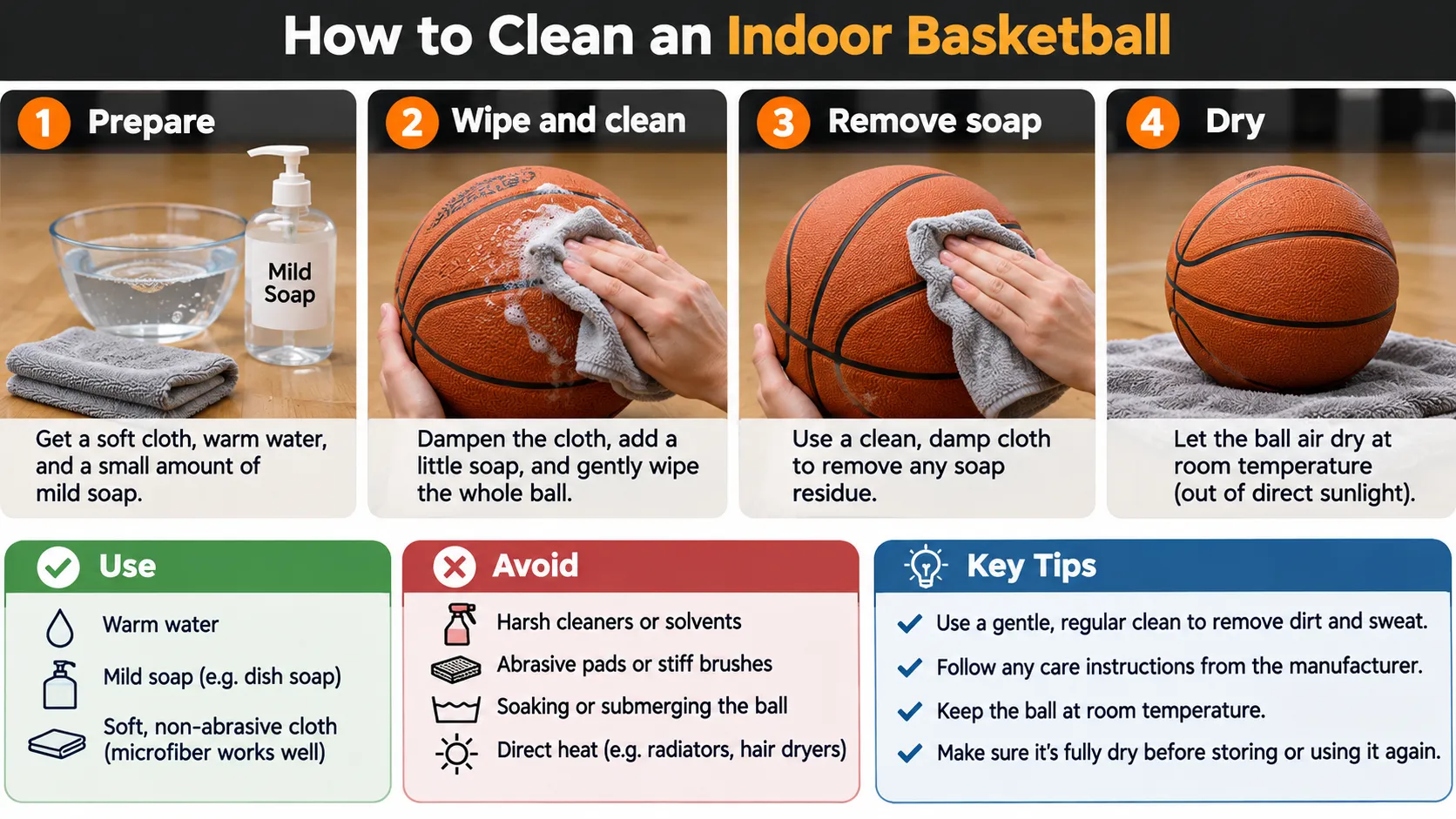
Four steps for cleaning an indoor basketball safely
How to clean an indoor basketball using a soft cloth and approved cleaning solution.

1. Check Your Basketball’s Material

Before cleaning, check whether your basketball has a composite leather, synthetic leather, or genuine leather cover.

You can usually find this information on the manufacturer’s product page.

Don’t assume every indoor basketball is made from genuine leather. Many popular indoor basketballs use composite or synthetic materials.

If your basketball has special cleaning instructions, follow those first.

2. Remove Loose Dust and Dirt

Wipe the basketball with a clean, soft cloth.

Rotate the ball as you work so you can reach the entire surface, including the channels between its panels.

Start with a dry cloth. You may not need water if the basketball only has a light layer of dust.

Avoid scrubbing aggressively. Indoor basketball covers can have textured surfaces that you don’t want to wear down.

3. Wipe With a Slightly Damp Cloth

If dry wiping doesn’t remove the dirt, dampen a clean cloth with water.

Wring it out thoroughly so it’s moist rather than dripping.

Gently wipe the basketball’s surface. Pay attention to areas where dust, sweat, and grime have collected.

Don’t pour water directly onto the basketball or submerge it in a sink.

A damp cloth is enough for routine cleaning on many indoor basketballs, but check the instructions for your model.

4. Use Diluted Mild Soap if Needed

For basketball covers whose instructions permit soap, a diluted mild dish-soap solution can help remove dirt that water alone doesn’t lift.

Wilson’s published game-ball cleaning instructions provide a specific mixture:

1 tablespoon of mild dish soap in 1 gallon of warm water.

Dip a clean towel into the solution, wring it out, and gently wipe the entire ball for at least 30 seconds, as Wilson directs. This is not a proven disinfection time.

This is a diluted cleaning solution, not a reason to soak the basketball.

Only use soap when the manufacturer’s instructions permit it. Genuine leather basketballs may require different care.

5. Remove Any Soap Residue

If you used soap, take another clean cloth and dampen it with plain water.

Wring it out and wipe the basketball again.

The goal is to remove leftover soap without oversaturating the cover.

Don’t skip this step. Leftover detergent may cause discoloration.

6. Dry the Basketball Properly

Use a clean, dry towel to remove surface moisture.

Then leave the basketball in a shaded, well-ventilated place until it has dried.

Avoid direct sunlight, radiators, hair dryers, and other heat sources.

Wilson’s published soap-cleaning procedure specifies overnight airing. A quick damp wipe may require less time, but there isn’t one proven drying time for every basketball.

The main rule: Don’t put the basketball away while its cover is still damp.

Cleaning Different Indoor Basketball Materials

Not all indoor basketballs use the same cover.

Basketball material Recommended starting method Main precaution
Composite leather Soft cloth and a lightly damp wipe Avoid harsh scrubbing and unapproved chemicals
Synthetic leather Soft cloth and a lightly damp wipe Check the model’s cleaning instructions
Genuine leather Follow model-specific instructions Don’t assume ordinary leather cleaners are safe

Composite leather and synthetic leather are overlapping terms in basketball manufacturing. They shouldn’t automatically be treated as two completely different cleaning categories.


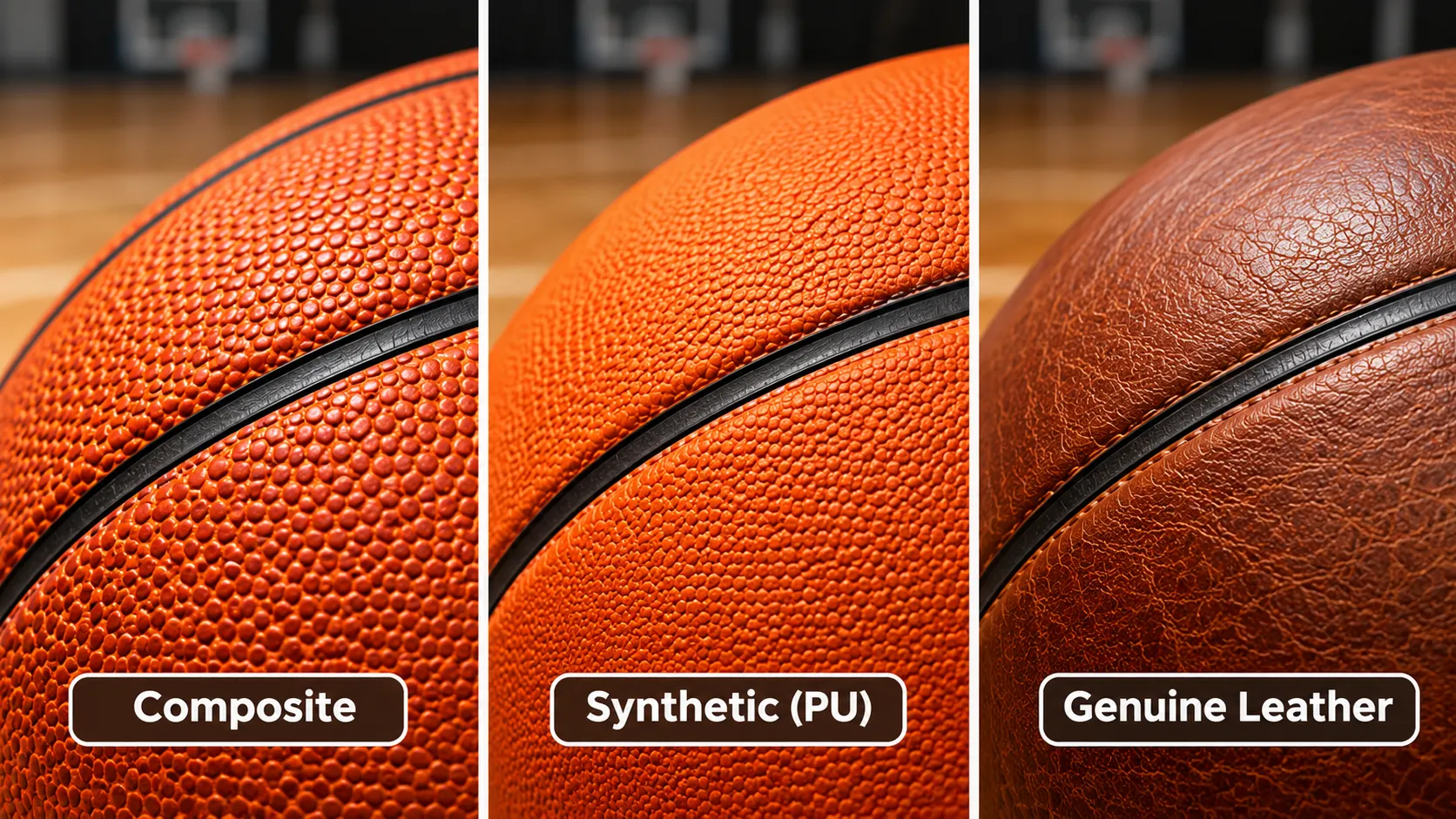
Illustrative comparison of composite, synthetic PU, and genuine leather basketball surfaces
Illustration of common indoor basketball cover materials. Actual textures vary by model.

How to Clean a Composite or Synthetic Leather Basketball

Composite leather basketballs are common in indoor basketball.

The Wilson Evolution, for example, uses a composite cover rather than genuine leather.

For routine cleaning:

  1. Remove loose dust with a soft cloth.
  2. Use a lightly damp cloth for remaining dirt.
  3. If permitted, clean with diluted mild soap.
  4. Remove residue and dry the ball thoroughly.

Wilson’s game-ball cleaning guidance covers several composite basketball models, including the Evolution.

Avoid using abrasive sponges or strong cleaners simply because the ball feels dirty.

How to Clean a Genuine Leather Basketball

Genuine leather basketballs need more careful attention to their specific model instructions.

For example, Wilson’s official NBA game basketball uses genuine leather. The cover changes as players break it in, developing a darker appearance and a different feel.

That darkening doesn’t necessarily mean the basketball is dirty.

Don’t try to scrub away normal leather discoloration.

Some genuine leather basketballs allow wiping with a firmly wrung-out damp cloth. However, this doesn’t mean every leather basketball can be cleaned with soap or a general leather conditioner.

Check the manufacturer’s instructions before applying any cleaning product.

Special Care for the Molten BG5000

The Molten BG5000 is an important example of why model-specific instructions matter.

Molten’s Japanese product guidance allows cleaning with a dry cloth or a wet cloth that has been firmly wrung out.

However, Molten specifically warns against using its standard BC leather cleaner on the BG5000 because it may cause staining, discoloration, or color loss.

The manufacturer also provides instructions for using its designated natural-leather basketball wax, BC0010.

That doesn’t mean you should apply ordinary shoe polish, furniture wax, or household leather conditioner.

For a Molten BG5000, follow the manufacturer’s exact care instructions rather than generic leather-cleaning advice.

What Can You Use to Clean an Indoor Basketball?

Water and Mild Dish Soap

A soft cloth and a little water are suitable starting points for many basketballs.

For tougher dirt, diluted mild dish soap may be appropriate when the manufacturer permits it.

Wilson’s published instructions support a mild dish-soap solution for compatible game balls.

However, this doesn’t mean every brand of dish soap or every basketball cover has been tested.

For genuine leather, check the exact model instructions before using soap.

Can You Use Disinfecting Wipes?

Sometimes, but not on every basketball.

Wilson has published compatibility information for specific disinfecting products on certain composite basketballs, including the Evolution and Evo NXT.

Those findings don’t mean all disinfecting wipes are safe for all basketballs.

Different products may contain different chemicals.

Spalding’s cleaning guidance also warns against alcohol-based cleaners and bleach.

If you need to disinfect a basketball, check both the manufacturer’s compatibility instructions and the disinfectant label.

Cleaning a basketball and disinfecting it are not the same thing. A product that removes visible dirt doesn’t necessarily kill germs.

Cleaning Products to Avoid

Unless your basketball manufacturer specifically approves them, avoid:

  • Rubbing alcohol and hand sanitizer
  • Bleach and strong household cleaners
  • Acetone and nail polish remover
  • Magic Erasers and abrasive sponges
  • Shoe polish and ordinary leather conditioners
  • Vinegar or baking soda cleaning mixtures
  • Stiff brushes on leather or composite covers

These products may damage the cover, alter its feel, or lack evidence of safe use on basketballs.

A soft cloth and an approved cleaning solution are better starting points.

How to Remove Common Basketball Dirt

Start with the basketball’s approved cleaning method and avoid trying increasingly harsh products.

Dust and Sweat

Indoor basketballs collect dust from the court and moisture from players’ hands.

Wipe the ball with a soft cloth after playing if it feels dusty or damp.

If necessary, use a lightly damp cloth.

For compatible covers, diluted mild soap can help with more persistent grime.

Stubborn Dirt and Stains

For dirt that won’t come off with a dry cloth, try the manufacturer’s approved damp-cloth method.

If soap is permitted, use a diluted solution and gentle wiping.

Avoid scrubbing harder simply because a stain remains.

Some marks may not be removable without damaging the basketball’s surface.

Why Is My Basketball Sticky?

A sticky basketball isn’t always dirty.

Some basketballs are designed with a tacky-feeling surface for handling.

However, abnormal stickiness can also develop as certain synthetic materials deteriorate.

If the cover is becoming sticky alongside cracking or peeling, cleaning may not solve the problem.

Don’t use alcohol or solvents to strip away the sticky layer without manufacturer approval.

Can Cleaning Restore Basketball Grip?

Cleaning can help when dirt and grime are making the basketball slippery.

Removing that buildup may make the original surface texture easier to feel.

However, cleaning can’t rebuild worn-out surface pebbles or repair a damaged cover.

If your basketball has lost grip because of heavy wear, washing it won’t necessarily restore its original performance.

Using the basketball on its intended playing surface also matters.

Our indoor vs outdoor basketball guide explains how different court surfaces affect basketball selection and durability.

How Often Should You Clean an Indoor Basketball?

You don’t need to wash your indoor basketball with soap after every practice.

Spalding Europe suggests wiping a basketball after practice and performing a deeper clean every few weeks. However, Spalding’s US guidance also warns that excessively frequent cleaning may damage the cover or markings.

A practical routine is:

  • After playing: Check for dust, sweat, and visible dirt. Wipe the ball with a soft cloth when needed.
  • When dirt builds up: Use a lightly damp cloth.
  • For stubborn grime: Use diluted mild soap if your basketball’s manufacturer permits it.
  • Before storing: Make sure the cover is dry.

There’s no need to follow a strict cleaning schedule if your basketball is already clean.

For shared basketballs used by schools, clubs, or teams, additional hygiene requirements may apply.

How to Dry and Store Your Basketball

Leaving moisture on the cover or storing a basketball in unsuitable conditions can cause problems over time.

Dry the Basketball Away From Heat

After cleaning, wipe the basketball with a dry towel.

Leave it somewhere with good airflow, away from direct sunlight.

Don’t use a hair dryer, radiator, or heater to speed up the process.

Spalding and Mikasa recommend natural drying rather than exposing sports balls to excessive heat.

If you followed Wilson’s diluted-soap cleaning procedure, its instructions specify leaving the basketball to air out overnight.

Store the Basketball Somewhere Cool and Dry

Once the basketball has dried, store it in a clean, dry location.

Avoid leaving it:

  • In direct sunlight.
  • Next to radiators or other heat sources.
  • In a damp, poorly ventilated bag.
  • Inside a hot car for extended periods.

Molten’s storage guidance warns against high temperatures and humidity.

If your basketball needs more air before your next session, check the recommended pressure printed on the ball.

You can also read our guide to deflating a basketball safely if you need to release excess air.

Common Basketball Cleaning Mistakes

Avoid these mistakes when cleaning an indoor basketball.

1. Soaking the basketball

Don’t submerge the basketball in a sink or bucket.

Excess moisture can damage the cover or seams. Use a damp cloth instead.

2. Using harsh chemicals

Bleach, alcohol-based cleaners, and strong household chemicals aren’t suitable general cleaning recommendations.

Spalding warns that some of these products can damage the cover and markings.

3. Scrubbing too hard

Abrasive materials can wear down the surface.

Use gentle pressure, especially on composite leather and genuine leather basketballs.

4. Applying the wrong leather cleaner

Don’t assume a product is suitable simply because its label says it’s made for leather.

Molten’s BG5000 is a clear example of a basketball with specific cleaning-product restrictions.

5. Leaving soap on the basketball

If you’ve used diluted soap, remove the residue with a clean, lightly damp cloth.

Wilson’s cleaning procedure includes this step before drying.

6. Drying the basketball with heat

Don’t place the basketball beside a radiator or use a hair dryer.

Dry it naturally in a shaded, ventilated location.

7. Cleaning normal leather discoloration aggressively

Genuine leather basketballs can darken during their normal break-in period.

Don’t assume that a darker basketball needs stronger cleaning.

8. Using an indoor basketball on rough outdoor courts

Even a perfectly cleaned indoor basketball can wear prematurely if used on unsuitable surfaces.

Follow the manufacturer’s intended-use designation rather than assuming every basketball can handle concrete or asphalt.

Frequently Asked Questions

Can You Wash an Indoor Basketball With Water?

Yes, many indoor basketballs can be cleaned with a lightly damp cloth.

However, washing doesn’t mean soaking the ball or holding it under running water.

Some genuine leather basketballs have specific restrictions. Always check the manufacturer’s instructions before cleaning.

Can You Use Dawn Dish Soap to Clean a Basketball?

A mild dish soap may be suitable for certain basketballs, but the exact formulation matters.

Wilson’s published game-ball cleaning procedure uses one tablespoon of mild dish soap in one gallon of warm water. It doesn’t establish that every Dawn product is approved for every basketball.

Check your basketball’s cleaning instructions before using soap.

How Do You Clean a Wilson Evolution Basketball?

The Wilson Evolution has a composite leather cover.

Start by removing loose dust with a soft cloth.

For more thorough cleaning, Wilson’s published game-ball instructions provide a diluted mild dish-soap procedure covering the Evolution.

Wipe gently with a wrung-out towel, remove any soap residue with a clean-water wipe, towel-dry, and allow the basketball to air out overnight.

Can You Use Clorox Wipes on a Basketball?

Only when the specific wipe is compatible with your basketball.

Wilson’s published guidance identifies Clorox Disinfecting Wipes with EPA registration number 5813-79 among products tested on certain composite basketballs.

That doesn’t establish long-term compatibility or approval for every Clorox product or basketball.

Don’t use disinfecting wipes on genuine leather basketballs without specific manufacturer approval.

Does Cleaning Restore Basketball Grip?

Cleaning can remove dirt and grime that make a basketball slippery.

However, it can’t restore worn-out surface texture or repair a deteriorating cover.

If your basketball is losing grip because of physical wear, cleaning alone may not solve the problem.

Why Is My Basketball Still Sticky After Cleaning?

Some basketballs naturally have a tacky surface.

However, persistent abnormal stickiness, particularly alongside cracking or peeling, can indicate deterioration of certain synthetic materials.

If approved cleaning doesn’t help, avoid applying stronger chemicals without checking the manufacturer’s instructions.

Can You Clean a Genuine Leather Basketball With Soap?

Not necessarily.

Some genuine leather basketballs have special cleaning requirements that differ from composite leather models.

For example, Molten’s BG5000 instructions permit a dry or firmly wrung-out damp cloth but warn against its standard BC leather cleaner.

Follow the instructions for your exact model rather than applying a general soap-cleaning method.

How Long Does an Indoor Basketball Take to Dry?

It depends on the cover material and how much moisture was used.

Wilson specifies overnight airing after its published soap-cleaning procedure.

For a quick damp wipe, the reviewed manufacturer guidance doesn’t establish one universal drying time.

Wait until the cover has dried before using or storing the basketball.

Final Takeaway

The safest way to clean an indoor basketball is to start with a soft cloth and use as little moisture as necessary.

For compatible composite and synthetic leather covers, a lightly damp cloth and diluted mild soap can remove dirt and grime. Genuine leather basketballs require closer attention to model-specific instructions.

Avoid harsh chemicals, soaking, abrasive scrubbing, and heated drying.

Gentle, model-appropriate care helps keep the cover clean without exposing it to unnecessary wear.

Indoor vs Outdoor Basketball | What’s the Difference?

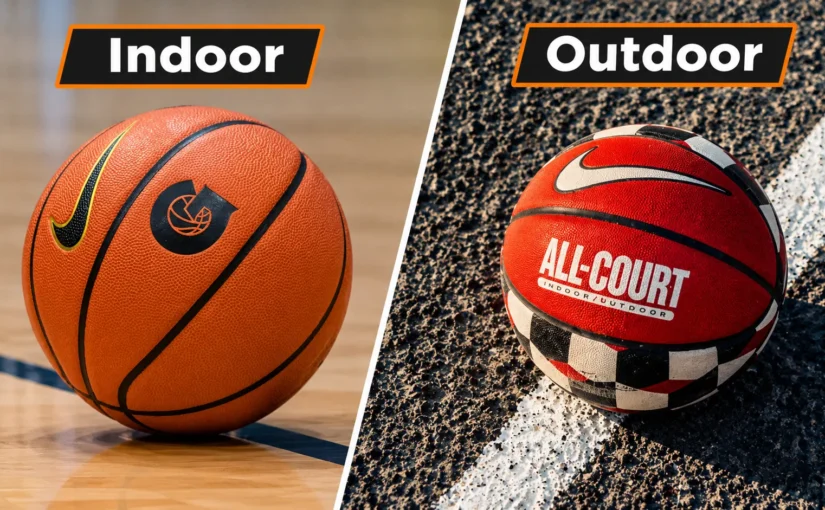
When comparing indoor vs outdoor basketball options, the main difference is where each ball is designed to be used. Indoor basketballs are made for gym courts, while outdoor basketballs are designed for rougher surfaces like concrete and asphalt.

The main difference is the ball’s intended playing surface and cover construction. Indoor basketballs often use genuine leather or softer composite covers. Outdoor basketballs commonly use rubber or durable synthetic materials.

Some basketballs are labelled indoor/outdoor, meaning the manufacturer approves them for both environments.

The simplest rule: Check the basketball’s playing-surface label before buying. Material and price alone won’t tell you where it belongs.

Indoor vs Outdoor Basketball: Key Differences

Feature Indoor Basketball Outdoor Basketball
Playing surface Hardwood and suitable indoor courts Concrete, asphalt, and outdoor courts
Common materials Genuine leather or composite leather Rubber or durable synthetic covers
Feel Often softer, depending on the model Often firmer, depending on the model
Grip Varies by cover and condition Varies by cover and condition
Durability Indoor-only covers can wear quickly on rough surfaces Designed to tolerate rougher surfaces
Maintenance Genuine leather may need special care Generally easier to maintain
Price Includes midrange and premium balls Often includes affordable recreational balls
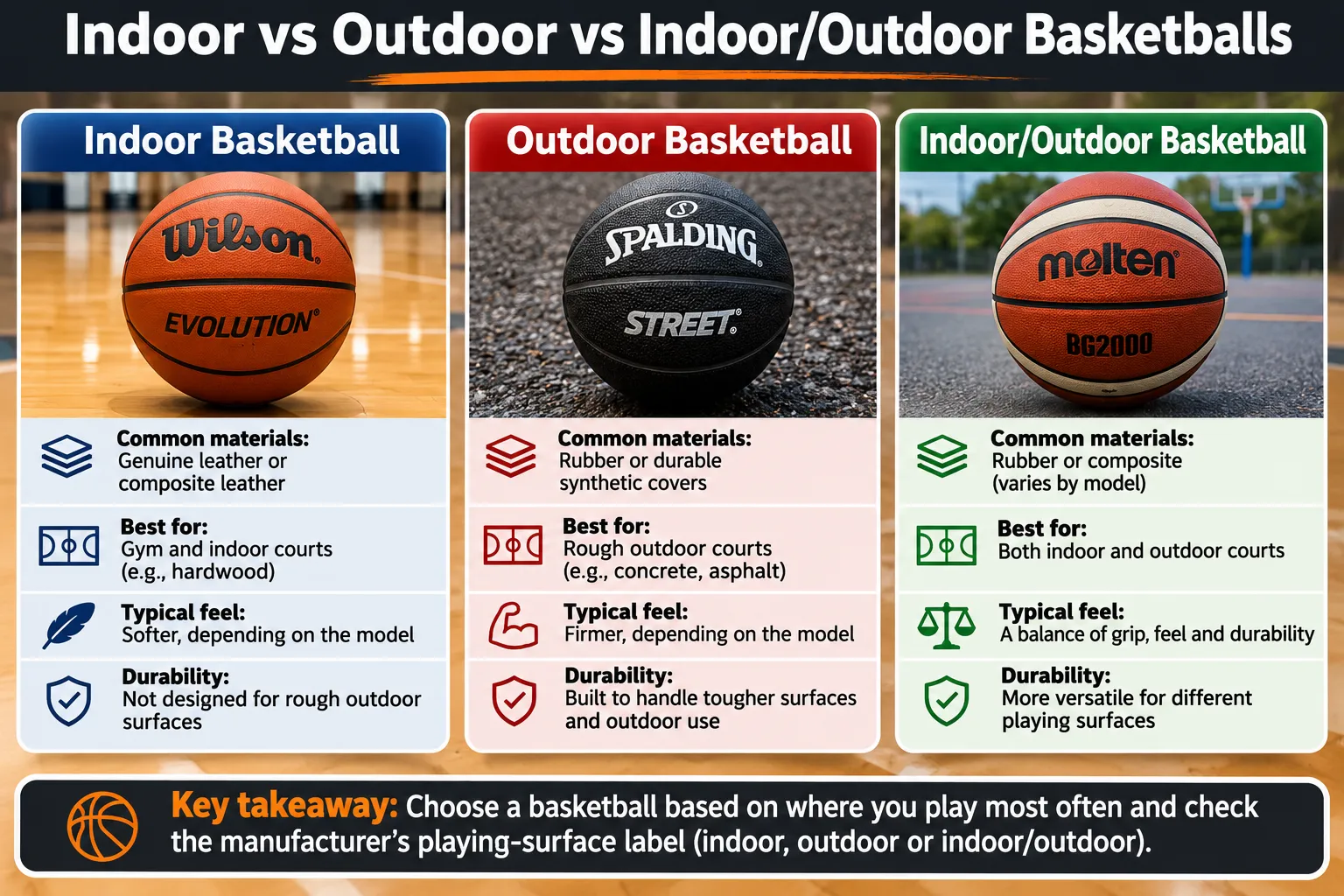
Infographic comparing indoor, outdoor, and indoor/outdoor basketballs by materials, playing surfaces, feel, and durability.
Indoor, outdoor, and indoor/outdoor basketballs compared.

These are general differences, not rules for every basketball.

For example, Spalding sells indoor-only composite basketballs, while other composite models are approved for indoor and outdoor use. Some rubber basketballs are also suitable for both settings.

That is why the exact model’s intended use matters more than its material alone.

Indoor vs Outdoor Basketball Materials

Basketball covers generally fall into three main material categories: genuine leather, composite or synthetic leather, and rubber.

Indoor Basketball Materials

Genuine leather is used for premium game basketballs, including the official NBA game ball.

New leather can initially feel stiff or slippery. Its texture and feel change as the ball breaks in through indoor play.

Wilson specifically recommends breaking in its official NBA game ball on hardwood rather than concrete.

Composite leather is a man-made material designed to provide leather-like playing characteristics.

Many indoor basketballs use composite covers because they offer a softer feel without the same break-in requirements as genuine leather.

However, not every composite basketball is approved for outdoor use.

Outdoor Basketball Materials

Rubber is common in outdoor basketballs because it is generally affordable and suited to rough playing surfaces.

Rubber basketballs often feel firmer than premium indoor balls, although this depends on the construction.

Synthetic and composite covers are also used on outdoor basketballs. Some are specifically designed for both indoor and outdoor courts.

For example, Molten labels its BG2000 rubber basketball for indoor and outdoor use.

The material tells you something about the ball, but its playing-surface designation tells you where the manufacturer intends it to be used.

Indoor vs Outdoor Basketball: Grip, Bounce and Durability

Which Basketball Has Better Grip?

Neither indoor nor outdoor basketballs have universally better grip.

Grip depends on the cover material, surface texture, moisture, dirt, and condition of the ball.

Indoor composite basketballs often feel softer, while outdoor rubber basketballs may feel firmer.

A worn or dirty basketball can also feel different from a clean one.

Choose a ball suitable for your court rather than assuming leather, composite, or rubber always provides the best grip.

Do Indoor and Outdoor Basketballs Bounce Differently?

They can, but cover material alone does not determine bounce.

Inflation pressure, internal construction, ball condition, and the playing surface all affect how a basketball rebounds.

An underinflated indoor basketball may bounce poorly. A properly inflated outdoor basketball can perform normally on a suitable indoor floor.

Before blaming the material, check the recommended pressure printed on the ball.

Which Basketball Lasts Longer?

For concrete and asphalt, an outdoor-rated basketball is generally the better durability choice.

Indoor-only leather and composite covers are not intended for repeated contact with abrasive outdoor surfaces.

However, there is no reliable universal lifespan for either category.

How long a basketball lasts depends on its construction, playing surface, frequency of use, and maintenance.

Can You Use an Indoor Basketball Outside?

Yes, physically, but it is not recommended for indoor-only basketballs.

Concrete and asphalt can wear down the cover faster than suitable indoor courts.

Repeated outdoor play may damage the surface texture and change how the basketball feels.

One outdoor session does not automatically destroy an indoor basketball. However, there is no guaranteed number of outdoor sessions that will be harmless.

If you accidentally use an indoor ball outside, clean it according to the manufacturer’s instructions and inspect its cover.

Cleaning can remove dirt, but it cannot restore material worn away by rough surfaces.

Can You Use an Outdoor Basketball Indoors?

Yes. Many outdoor basketballs can also be used indoors.

Some rubber and composite models are explicitly labelled indoor/outdoor.

Before bringing an outdoor basketball into a gym:

  • Remove dirt and debris.
  • Check the facility’s rules.
  • Make sure the ball is suitable for the floor.
  • Use the required game ball for organised competition.

An outdoor ball may feel different from an indoor game ball, but that does not automatically make it unsuitable for indoor practice.

Which Basketball Should You Use on Different Courts?

Choose your basketball based on the actual playing surface, not just whether the court has a roof.

Playing Surface Recommended Basketball
Hardwood gym court Indoor composite or suitable indoor/outdoor ball
Concrete driveway Outdoor rubber or approved indoor/outdoor ball
Asphalt court Outdoor rubber or approved indoor/outdoor ball
Painted outdoor court Outdoor or indoor/outdoor ball
Outdoor modular sports tiles Outdoor or indoor/outdoor ball
Indoor synthetic sports floor Indoor or indoor/outdoor ball permitted by the facility
Garage with rough concrete flooring Outdoor or indoor/outdoor ball
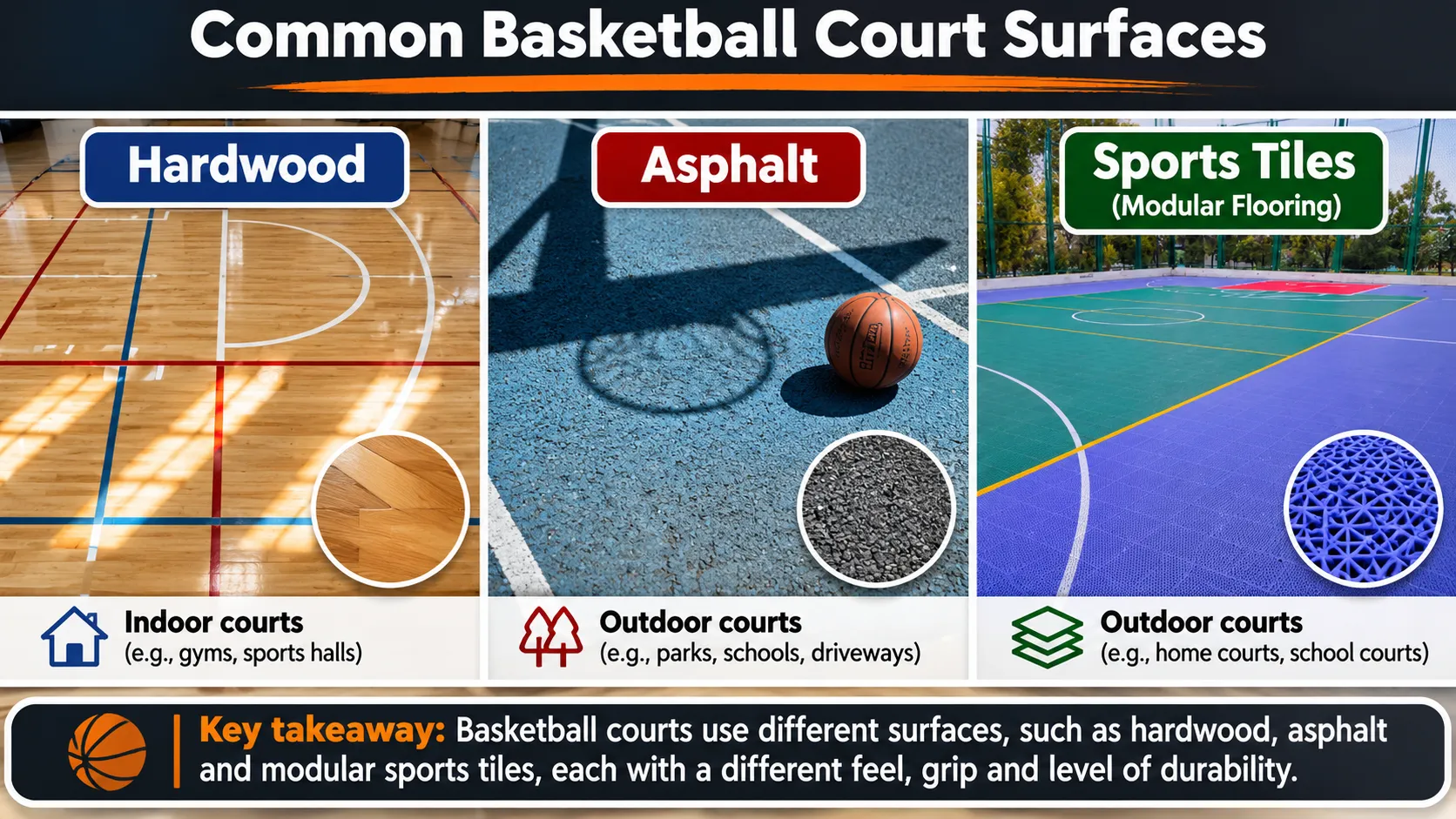
Comparison of indoor hardwood, outdoor asphalt, and modular sports tile basketball courts.
Three common basketball court surfaces: hardwood, asphalt, and modular sports tiles.

Photo: Rayzonglobal001 / Wikimedia Commons, licensed under CC BY-SA 4.0. Modified and combined with other photographs by BasketballRex. This infographic is shared under CC BY-SA 4.0.

A garage is a useful example.

Even though you are playing indoors, a rough concrete floor can still wear down an indoor-only basketball.

Painted and modular courts also vary in texture. Check your ball manufacturer’s guidance rather than assuming every surface behaves the same.

Indoor vs Outdoor Basketball: Which Should You Buy?

Your best option depends on where you play most often.

Your Situation Best Starting Choice
Mostly play in a gym Indoor composite basketball
Mostly play on concrete or asphalt Outdoor rubber basketball
Regularly switch between indoor and outdoor courts Basketball labelled indoor/outdoor
Beginner on a budget Affordable ball approved for your main playing surface
Want a genuine-leather game ball Indoor leather basketball, with appropriate break-in and care

If you mainly play on concrete or asphalt, see our best outdoor basketball guide for seven options compared by price, materials, and available testing evidence.

If you play on both types of court, check out our guide to the best indoor outdoor basketballs for specific recommendations.

You do not need an expensive leather basketball to learn shooting, dribbling, or passing.

Choose the correct size first. For example, men’s standard competition uses Size 7, while women’s standard competition uses Size 6. Youth players should check their league requirements.

If you’re putting together a practice setup, our basketball training equipment guide explains which additional tools are useful.

For quieter dribbling practice at home, foam basketballs are another option. Our best silent basketballs guide compares six models, although they are not direct replacements for regular game balls.

How to Clean and Maintain Your Basketball

Basic care helps protect your basketball from unnecessary wear.

  1. Remove dirt: Wipe rubber and synthetic basketballs with a damp cloth.
  2. Clean gently: Use mild soap only when suitable for your model.
  3. Dry properly: Avoid soaking the ball or drying it near direct heat.
  4. Check inflation: Use the recommended pressure marked on the basketball.
  5. Store indoors: Keep the ball somewhere dry, away from extreme heat and direct sunlight.

For detailed cleaning instructions, read our guide to cleaning an indoor basketball safely.

Genuine leather basketballs can require different cleaning products and care methods. Follow the exact manufacturer’s instructions.

Spalding provides additional guidance on cleaning and maintaining basketballs.

If you need to release air before storage or travel, read our guide on how to deflate a basketball safely.

Frequently Asked Questions

Does It Matter if a Basketball Is Indoor or Outdoor?

Yes. Indoor-only basketballs are designed for suitable gym surfaces, while outdoor-rated basketballs are made to handle rougher courts. Using the correct type helps avoid unnecessary cover wear.

How Do I Tell if My Basketball Is Indoor or Outdoor?

Check the markings on the ball, its packaging, or the manufacturer’s product page.

Look for indoor, outdoor, or indoor/outdoor. Do not rely on material or appearance alone.

Can Rubber Basketballs Be Used in Gyms?

Yes, some can. Certain rubber basketballs are approved for indoor and outdoor use. Check the exact model and the gym’s rules.

Are Indoor Basketballs Worth the Extra Money?

They can be if you regularly play on indoor courts and prefer their feel.

However, paying more does not automatically improve shooting accuracy or ball-handling skills.

How Long Should a Basketball Last?

There is no universal lifespan.

Playing surface, frequency of use, construction, and maintenance all matter.

Consider replacing a basketball when it has badly damaged panels, unusable grip, significant shape problems, or persistent air loss that cannot be fixed.

Final Verdict

The difference between indoor and outdoor basketballs comes down to their intended playing surfaces and construction.

For most gym players, an indoor composite basketball is a sensible choice.

For concrete and asphalt, an outdoor rubber basketball is usually the practical option.

If you regularly play in both environments, choose a basketball specifically labelled indoor/outdoor.

Above all, check the exact model’s intended use before buying.

Best Silent Basketballs for Indoor Dribbling

Silent basketballs let you practise dribbling indoors without the loud bouncing of a regular basketball. Most use soft foam to reduce impact noise, although they aren’t completely silent.

The best silent basketball depends on its size, weight, bounce, durability, and price. Some models focus on realistic handling, while others suit casual play or younger players.

Here are six options worth comparing, along with what to expect from silent basketballs before buying.

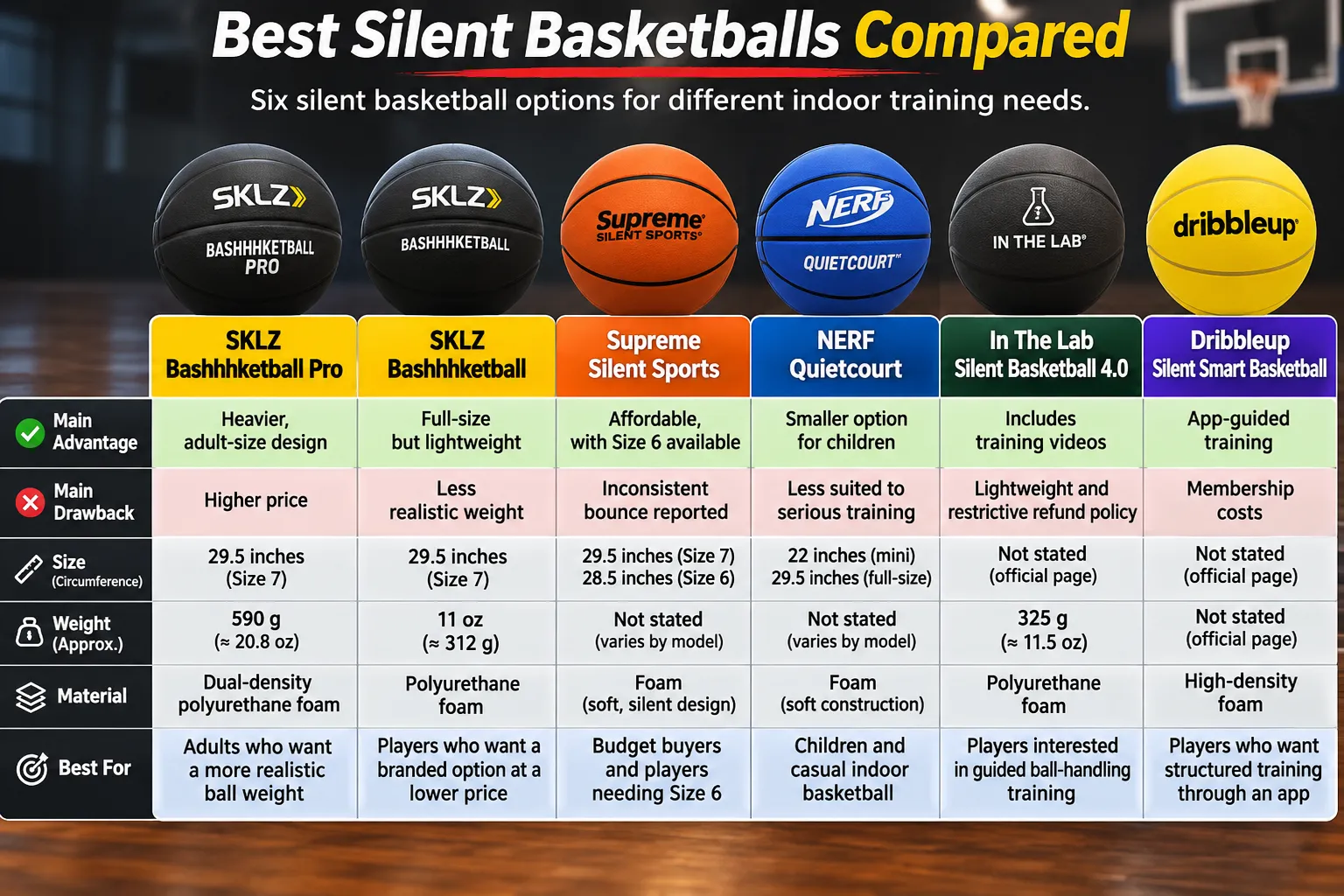
Best Silent Basketballs Compared: Size, Weight and Features

These recommendations are based on published specifications and customer feedback, not hands-on testing of every product.

Silent basketball Main advantage Main drawback
SKLZ Bashhhketball Pro Heavier, adult-size design Higher price
SKLZ Bashhhketball Full-size but lightweight Less realistic weight
Supreme Silent Sports Budget option with Size 6 available Inconsistent bounce reported
NERF Quietcourt Smaller option for children Less suited to serious training
In The Lab 4.0 Includes training videos Lightweight and restrictive refund policy
Dribbleup Silent Smart Basketball App-guided training Membership costs
Comparison of six silent basketballs by advantages, drawbacks, size, weight and materials
Six silent basketball options compared by their features and intended uses.

A heavier ball isn’t necessarily quieter. Consider your playing space and training needs before choosing.

Best Silent Basketballs for Different Needs

SKLZ Bashhhketball Pro — Realistic Weight

The SKLZ Bashhhketball Pro is worth considering if you want a silent basketball closer to the weight of a regular men’s basketball.

SKLZ lists a 29.5-inch circumference and 590 g weight. Its dual-density polyurethane foam construction includes deep grooves for grip and ball handling.

The heavier design may feel more familiar than lightweight foam balls, but weight alone doesn’t guarantee identical bounce.

Best for: Adults who prioritise realistic weight during indoor training.

Consider: Higher price and possible floor vibrations.

SKLZ Bashhhketball — Lightweight Practice

The standard SKLZ Bashhhketball is different from the Pro.

It has the same published 29.5-inch circumference but weighs approximately 11 oz, making it considerably lighter.

Its polyurethane foam and molded grooves support indoor ball-handling practice, although the lighter weight may affect dribbling rhythm.

Best for: Players wanting a branded full-size foam basketball at a lower price than the Pro.

Consider: Less realistic weight for serious training.

Supreme Silent Sports — Budget Option

The Supreme Silent Sports Silent Basketball is a budget-priced alternative. DICK’S Sporting Goods advertised it at $19.99 when checked in October 2026, although availability varies.

It comes in a full-size version and a separate 28.5-inch Size 6 model.

Customer reviews include positive reports about quieter dribbling, alongside complaints about inconsistent bounce and foam deterioration after getting wet.

Best for: Budget buyers and players needing Size 6.

Consider: Protect the foam from rough outdoor surfaces and moisture.

NERF Quietcourt — Indoor Play for Kids

The Franklin Sports NERF Quietcourt comes in a mini 22-inch-circumference version and a full-size 29.5-inch version.

The mini is better suited to younger players, while the larger version offers a more familiar basketball size.

Its soft foam reduces impact noise, but customer feedback includes complaints about dust buildup and weaker bounce.

Best for: Children and casual indoor basketball.

Consider: Check the size before ordering.

In The Lab Silent Basketball 4.0 — Training Videos

The In The Lab Silent Basketball 4.0 combines a foam basketball with training content from Devin Williams.

Its product listing states polyurethane foam construction and a weight of 325 g.

The ball is considerably lighter than a regular men’s basketball, so don’t assume identical handling or rebound.

The manufacturer also states that refunds aren’t available for this basketball.

Best for: Players interested in the included ball-handling videos.

Consider: Its light weight and return policy.

Dribbleup Silent Smart Basketball — App-Guided Practice

The Dribbleup Silent Smart Basketball combines high-density foam with app-guided training and ball tracking.

Its guided classes require a separate membership. When checked, Dribbleup advertised a two-week trial followed by $19.99 per month plus tax.

The research didn’t establish the silent model’s exact weight or available sizes.

Best for: Players who want structured indoor training through an app.

Consider: Membership costs and current product specifications.

Do Silent Basketballs Really Work for Indoor Training?

Yes. Silent basketballs can make indoor dribbling quieter because soft foam absorbs more impact than a conventional inflated basketball.

However, the results depend on the ball, flooring, and room.

How Quiet Are Silent Basketballs?

Silent basketballs still make noise when they hit the ground.

Demonstrations suggest meaningful noise reductions in particular environments, but there isn’t enough consistent testing to assign every model a reliable decibel rating.

Hardwood and tile floors may produce more noticeable sound than softer surfaces. Vibrations can also travel through floors and walls, potentially disturbing neighbors.

Do They Bounce Like Regular Basketballs?

Not always.

Foam balls can bounce lower than regular basketballs, while differences in weight and shape affect their feel.

A lighter ball may require more force to maintain dribbling height. A heavier ball may feel more familiar without matching regulation bounce.

This makes silent basketballs useful for supplementary practice rather than complete replacements.

My Experience Using a Silent Basketball

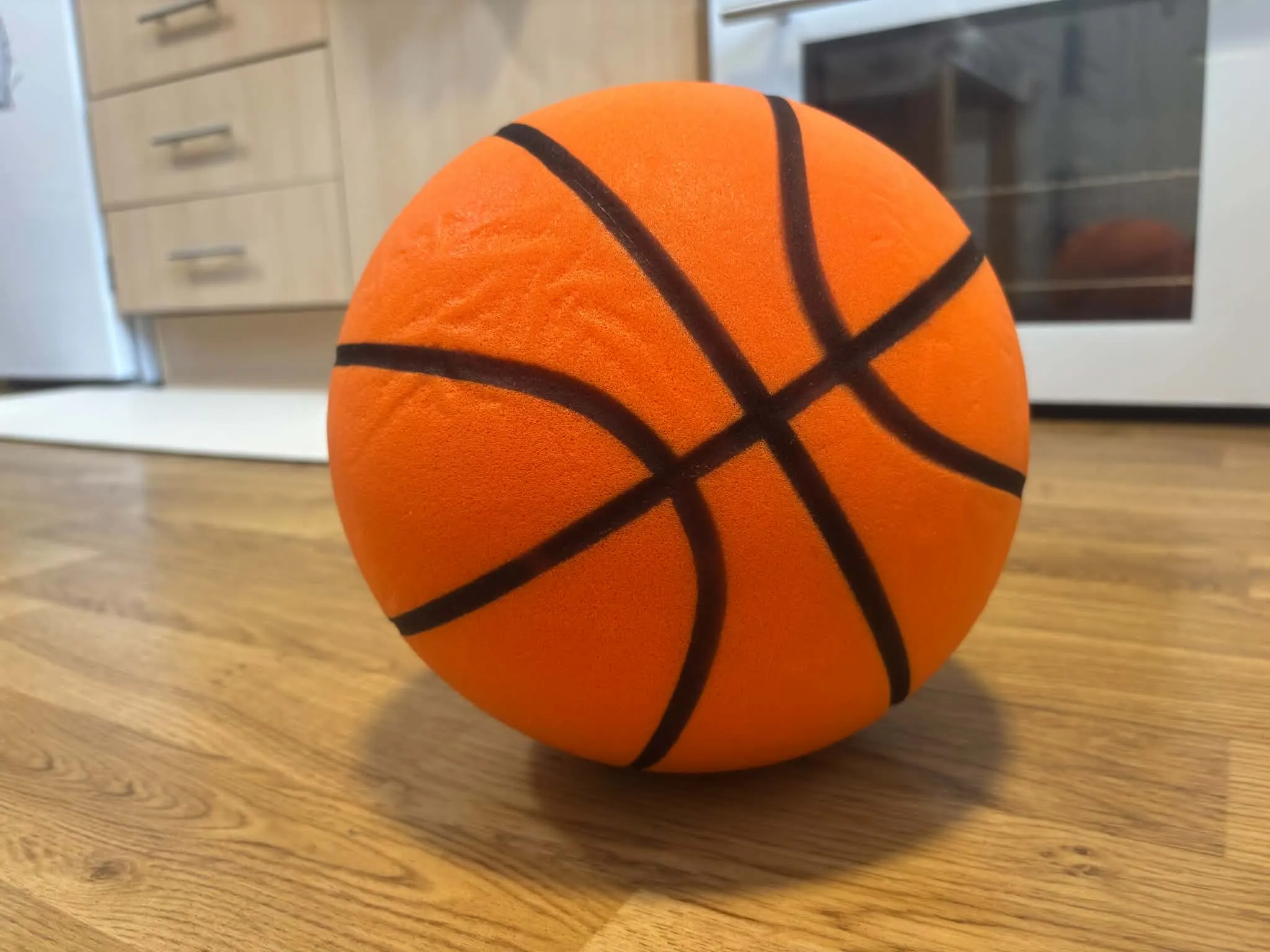
I’ve used a HUALEI-V Size 7 silent basketball for indoor dribbling in my kitchen.

Compared with a regular basketball, I found it noticeably quieter. My rough impression was around half the noise, although I didn’t measure it with a sound meter.

That made indoor dribbling more practical for me.

I use my silent basketball for casual practice rather than following a strict programme.

This is my experience with one ball, not a controlled comparison of the six models above.

Orange HUALEI-V Size 7 foam silent basketball on a wooden kitchen floor
My HUALEI-V Size 7 silent basketball, which I use for indoor dribbling practice.

How to Choose a Silent Basketball

Official Size, Weight and Grip

Start with the size you normally use. Size 7 is common in men’s basketball, while Size 6 and smaller options suit other players.

Check weight as well as circumference. A full-size foam ball can be much lighter than a regular basketball.

Deep grooves and surface texture can improve grip, but the feel varies between models.

Silent basketballs are useful for indoor practice, but if you’re setting up a space for shooting too, our guide to the parts of a basketball hoop explains the equipment you’ll need.

High-Density Foam and Durability

Many silent basketballs use polyurethane foam, although manufacturers don’t always disclose the exact material grade.

Foam reduces impact noise, but some balls shed particles, collect dirt, or lose their shape.

A protective cover may reduce exposed-foam wear, although it can change grip and bounce.

Read recent reviews and check the return policy before buying.

Floors and Indoor Use

Use the ball on surfaces approved by its manufacturer.

Smooth indoor floors are common intended surfaces. Carpet compatibility varies, and rough outdoor concrete can damage exposed foam.

For regular basketballs, read our indoor vs outdoor basketball guide to learn which ball suits different court surfaces.

Water may also affect certain models, so avoid wet surfaces unless the manufacturer permits them.

Are Silent Basketballs Good for Ball-Handling Drills?

Silent basketballs can help you practise crossovers, alternating-hand dribbles, between-the-legs moves, and behind-the-back dribbles indoors.

Their main advantage is convenience. They may let you complete more practice reps without making as much noise.

However, different bounce and weight characteristics can affect your timing and control.

Continue practising with a regular basketball to develop game-specific ball handling.

Common Silent Basketball Problems

Foam shedding: Small pieces may break away after repeated use, especially on unsuitable surfaces.

Misshapen balls: Some arrive compressed or uneven. Follow the manufacturer’s instructions if the ball doesn’t recover its shape.

Inconsistent bounce: Uneven foam or deformation can make dribbling unpredictable.

Dirt buildup: Foam surfaces can collect dust. Check the manufacturer’s cleaning instructions.

Water damage: Certain models may deteriorate after becoming wet.

Avoid heat, solvents, or improvised repairs unless the manufacturer approves them.

Frequently Asked Questions

Are Silent Basketballs Completely Silent?

No. They reduce bouncing noise but still produce sound and vibrations. Flooring, room acoustics, and dribbling force affect the result.

Is the SKLZ Silent Basketball Good?

Both SKLZ models are worth considering for indoor training. The Pro has a heavier design, while the standard version is lighter and less expensive.

Neither has been independently established as the quietest model.

Is There a Silent Basketball That Doesn’t Shed?

Some covered foam designs may reduce shedding, but no researched model has demonstrated that it will never deteriorate.

Check customer reviews and warranty terms.

Can You Use a Silent Basketball on Carpet?

Some models can be used on carpet, but suitability varies. Check the manufacturer’s instructions because carpet may affect bounce and wear.

Are Silent Basketballs Worth Buying?

They can be worthwhile if they make indoor practice more convenient.

However, they won’t provide complete silence or necessarily match a regulation basketball’s bounce and handling.

Final Verdict

Silent basketballs can make indoor dribbling more practical, but they differ in weight, bounce, durability, and price.

The SKLZ Bashhhketball Pro is worth considering for realistic adult-size weight. Budget buyers can compare the standard SKLZ and Supreme models, while NERF Quietcourt offers smaller options for children.

In The Lab and Dribbleup add training features, although their purchasing terms deserve attention.

Choose according to your needs, and continue using a regular basketball for game-specific practice.

Basketball Rebounder | Which Type Is Best for Training?

A basketball rebounder can save a lot of time when you practice alone, but the name covers several different products.

For a broader look at useful training tools, see our guide to basketball training equipment.

Some return only made shots. Others catch missed shots too. Passback nets are mainly for passing practice, while a powered machine can catch the ball and send passes back to different spots on the court.

That difference matters more than almost anything else.

If you buy a cheap rim-mounted return expecting it to catch missed shots, you will probably be disappointed. If you buy a passback net expecting it to sit under the hoop and return shots, you have bought the wrong type entirely.

For most people, the right basketball rebounder depends on how often you train alone, how much you miss, the type of hoop you own, and how much you want to spend.

On a home court or driveway, the right return system can make consistent reps easier because you spend less time chasing the ball. That does not mean faster practice is always better. Shooting form still matters, especially for a beginner who may simply repeat the same mistake more often.

What Is a Basketball Rebounder?

A basketball rebounder is a training tool that returns, redirects, or collects the ball during practice.

The term can describe:

  • rim-mounted return chutes
  • hoop return nets
  • elevated shot trainers
  • passback nets
  • rebounding trainers
  • powered shooting machines

These products do very different jobs, so always check what a basketball return system actually does before buying it.

Types of Basketball Return Systems

Basketball rebounder infographic comparing rim-mounted ball returns, rebound nets, passback trainers, and shooting machines

Rim-Mounted Ball Return Chutes

These attach underneath the rim and send the ball back after a made shot.

They are cheap, simple, and useful for repetitive shooting.

The main weakness is that they do nothing for missed shots. If you miss most of your attempts, you will still spend plenty of time chasing the ball.

Hoop Return Nets

A hoop return net covers a larger area around the basket.

It can collect made shots and many misses before guiding the basketball back toward the player.

This can work well on a driveway where missed shots are the biggest interruption.

The trade-off is more space and stricter compatibility with the hoop, backboard, or pole.

Elevated Shot Trainers

Products such as the Dr. Dish iC3 place a large net above and around the hoop.

They catch makes and most misses before feeding the ball into a rotating return chute.

This gives a solo player far more continuous shooting practice than a basic rim attachment.

The iC3 costs around $500, so it makes more sense for someone who practices regularly than for casual shooting.

Passback Rebounder Nets

A passback net sits on the ground.

You throw the ball into the net, and it rebounds back toward you.

These are useful for:

  • chest passes
  • bounce passes
  • catching before a shot
  • footwork
  • catch-and-shoot drills

They do not collect shots from the hoop.

Rebounding Trainers

Some products called rebounders are designed for actual rebounding drills.

A rim cover blocks the ball from going through the basket, so it bounces away for players to catch.

These are mainly useful for coaches working on boxing out and rebounding.

Powered Shooting Machines

A shooting machine catches the basketball and mechanically passes it back.

Some machines can direct passes around the court and support very high-volume shooting sessions.

They are also expensive.

Home machines can cost from roughly $1,300 to more than $4,000 and may require power, storage space, and sometimes a subscription.

Best Basketball Return Options to Consider

Best Cheap Option: Spalding Back Atcha

The Spalding Back Atcha is one of the cheapest ways to try a basketball return system.

Research found prices around $17 to $35 at the lower end.

It uses a 90-degree return arc and is designed for simple made-shot practice.

Compatibility is the main concern. Spalding lists several of its own rim designs as incompatible, so check your exact hoop before buying.

Best Adjustable Chute: SKLZ Kick-Out

The SKLZ Kick-Out costs roughly $42 to $50 at some retailers.

Its main advantage is a 360-degree rotating chute, which lets you adjust where the basketball returns.

It still only works with made shots.

Owner reviews also mention broken clips, loose straps, warped plastic, and unwanted movement, so it is not perfect.

Best Budget Option for Catching Misses: Goalrilla/Goaliath Hoop Return Net

The Goalrilla/Goaliath Hoop Return Net costs roughly $100 to $120.

Unlike a basic chute, it is designed to catch made and missed shots.

It can also work as a backstop.

It is mainly designed for in-ground hoops, and owner reviews mention stitching, Velcro, and hook failures.

Best Serious Solo Option: Dr. Dish iC3

The Dr. Dish iC3 sits between basic rebounders and powered machines.

It catches makes and most misses and then rolls the ball back through a 180-degree chute.

Its main advantages include:

  • no electricity
  • no subscription
  • catches many misses
  • adjustable return direction
  • wheels
  • folding frame

It costs around $500.

Compatibility matters. The manual includes restrictions involving the rim, rear crossbars, chain nets, and hoop support.

It also says the iC3 is not intended for children under 14 and calls for two adults during installation.

For a serious player who shoots alone several times a week, it can make sense.

For casual practice, it is harder to justify.

Best Passback Net Value: GoSports Basketball Rebounder

The GoSports Basketball Rebounder costs around $80.

It has an adjustable frame and can be used for passing and catch-and-shoot practice.

Remember that this is not a shot-return system.

It will not sit under the hoop and collect your shots.

What to Look for Before Buying

Does It Return Missed Shots?

This is the biggest difference between rebounders.

Basketball rebounder comparison showing a made-shot return chute versus a rebounder that catches missed shots

A cheap chute may return the ball after a make, but if you miss most shots, you still have to retrieve the basketball yourself.

A larger net or elevated trainer makes more sense if catching misses is your priority.

Will It Fit Your Hoop?

Never assume a basketball rebounder fits every hoop.

Check:

  • rim type
  • breakaway mechanism
  • spring box
  • backboard size
  • pole size and shape
  • rear support bars
  • chain nets
  • portable vs in-ground hoop

If you’re setting up or checking your basket, our basketball hoop height guide explains the correct rim height and how to measure it.

Compatibility problems are one of the most common issues with these products.

Where Does the Ball Return?

Some products return the ball in one direction.

Others rotate through 180 or 360 degrees.

A powered machine can send passes to multiple positions.

Think about where you actually shoot from before paying more for extra adjustment.

Can You Leave It Outside?

Do not assume a basketball rebounder is weatherproof.

Owner reports mention rust, corrosion, sun damage, and damaged fabric.

If possible, store larger equipment in a garage, shed, or dry indoor space when you finish practice.

How Difficult Is Assembly?

A plastic rim attachment may take only a few minutes.

A larger trainer can be completely different.

For example, the iC3 requires two adults for installation and has specific hoop requirements.

Check the manual before buying.

Is a Basketball Rebounder Worth It?

A rebounder can be worth buying if chasing the ball is reducing the amount of useful practice you get.

The biggest benefit is simple: more time shooting and less time retrieving the basketball.

The goal is not just more volume. A good return system should make practice more efficient without reducing your focus on shooting quality.

But it is not automatically better than practicing with another person.

A partner can rebound, make realistic passes, change positions, and give feedback.

For a beginner, that may be more useful than buying an expensive machine.

A sensible progression is:

  • cheap chute for basic made-shot returns
  • larger return net for catching misses
  • iC3-style trainer for frequent solo shooting
  • powered machine for serious high-volume practice

Common Basketball Rebounder Buying Mistakes

Avoid these:

  • buying a makes-only chute when you miss most shots
  • assuming it fits your rim
  • confusing a passback net with a shot-return system
  • leaving equipment outside permanently
  • paying a large marketplace markup
  • buying an expensive machine before you know you will use it regularly

Basketball Rebounder FAQ

Do Basketball Rebounders Return Missed Shots?

Some do.

Basic rim chutes usually return made shots only.

Larger nets, elevated shot trainers, and powered machines can catch at least some misses.

Can Kids Use Basketball Rebounders?

It depends on the product.

Check the manufacturer’s age and safety instructions.

For example, the Dr. Dish iC3 manual says it is not intended for children under 14.

Can You Use One With a Portable Basketball Hoop?

Sometimes.

Other rebounders require an in-ground pole, certain backboard dimensions, or specific rim clearance.

Check compatibility before ordering.

Can You Leave a Basketball Rebounder Outside?

Some can be used outside, but that does not mean they should stay outside permanently.

Weather can damage plastic, metal, straps, and nets.

Is a Basketball Rebounder Better Than a Partner?

Not necessarily.

A rebounder is most useful when you regularly practice alone.

A partner can still provide more realistic passes, feedback, and variety.

Final Answer

There is no single best basketball rebounder because different products solve different problems.

For a cheap starting point, a Spalding Back Atcha or SKLZ Kick-Out can work if your rim is compatible.

If you want to catch missed shots, look at a larger return net or a system such as the Dr. Dish iC3.

If your goal is passing practice, choose a passback net.

And if you are considering a powered machine, make sure you practice enough to justify the cost, storage, and setup.

The most important question is simple:

What do you need the rebounder to return?

Basketball Goggles | What to Look For and Best Options

Basketball goggles can protect your eyes while letting you see the court clearly. You can also fit them with prescription lenses if you normally wear glasses.

But not every pair of sports goggles offers the same protection.

For basketball, the main thing to look for is protective eyewear documented for the ASTM F803 basketball standard. The current edition is ASTM F803-25.

Ordinary prescription glasses, generic safety glasses, or sports eyewear made from polycarbonate should not automatically be treated as equivalent.

This guide explains what basketball goggles are, what safety standard matters, how to choose the right pair, and some of the best basketball glasses and goggles to consider.

What Are Basketball Goggles?

Basketball goggles are protective sports eyewear designed to stay secure while you run, jump, change direction, and deal with contact around the face.

There are two main styles.

Strap goggles wrap around your head with an adjustable strap. These usually look like traditional basketball goggles.

Convertible basketball glasses use normal-looking arms or temples but can often be fitted with a strap for a more secure fit during play.

Both types may be available with prescription lenses.

The important difference is not whether they look like glasses or goggles. It is whether the finished eyewear is actually intended and documented for basketball protection.

Do not confuse protective basketball goggles with dribbling goggles. Dribbling goggles deliberately block part of your lower vision to make looking down at the ball harder. They are training aids, not eye protection.

What Safety Standard Should Basketball Goggles Meet?

ASTM F803-25

ASTM F803-25 is the current ASTM standard covering protective eyewear for basketball, baseball or softball, and soccer.

For basketball, the standard is intended to reduce the risk of eye injuries and injuries around the eye caused by basketballs, hands, fingers, and elbows.

It covers both mechanical and optical performance. That includes impact resistance as well as areas such as field of view, optical quality, haze, and refractive properties.

One important detail is the wording.

A manufacturer may say that its basketball goggles meet or exceed ASTM F803. That does not mean ASTM itself tested, approved, or certified that specific product.

So avoid claims such as “ASTM approved” unless genuine independent certification is documented.

Polycarbonate Alone Is Not Enough

Polycarbonate is a strong choice for basketball eyewear. It is commonly recommended for protective sports goggles because of its impact resistance.

But seeing the word “polycarbonate” on a product page does not prove that the whole pair of protective glasses meets ASTM F803.

The frame, lenses, lens retention, fit, and finished construction all matter.

This becomes especially important with prescription sports eyewear. Installing different prescription lenses into a protective frame can change the finished product.

You should therefore confirm that the complete prescription setup retains the protection claimed for the frame instead of assuming that any lens can be fitted into an ASTM F803 frame.

ANSI Ratings Are Different

Some sports glasses or safety glasses carry ANSI Z87.1 or military ballistic ratings.

Those ratings show that the eyewear has passed other types of impact testing, but they are not substitutes for the basketball-specific ASTM F803 standard.

For example, the Wiley X XL-1 Advanced carries ANSI and military ballistic ratings but does not list ASTM F803 on its current official specifications.

For basketball eye protection, look for documentation tied specifically to ASTM F803 and basketball.

Basketball goggles infographic showing secure fit, impact-resistant lenses, padding, and ASTM F803-25

Best Basketball Goggles to Consider

There is no single pair that is best for every player.

Face shape, prescription needs, fogging, strap preference, and budget all matter.

These are some of the strongest current options.

Rec Specs Maxx 31 — Best All-Around Established Option

The Rec Specs Maxx 31 is one of the most widely available basketball goggles in this group.

It comes in more than one size and can be fitted with prescription lenses. Rec Specs says the Maxx 31 meets or exceeds ASTM F803, although its current product page does not specify the edition.

Pricing varies depending on whether you are buying the frame, clear lenses, or a complete prescription setup.

The biggest downside is fogging.

Multiple owners report that the Maxx 31 can fog during strenuous activity, including some who have already tried anti-fog treatment.

Do not expect it to be fog-proof.

For players who want an established brand with prescription support and multiple sizes, the Maxx 31 remains one of the strongest options to consider.

Rec Specs Slam / Slam Goggle XL — Best Full-Strap Option

The Rec Specs Slam family is another strong option.

The manufacturer explicitly names basketball under its ASTM F803 claim, and prescription versions are available.

The Slam models also use vented padding and softer contact materials around the frame. Those features may appeal to players who dislike the enclosed feel of some sports goggles.

The exact model matters because Rec Specs sells both glasses-style and full-goggle versions.

If you want a secure strap-only design, look specifically at the Slam Goggle versions.

Hilco Leader C2 — Best Flexible Prescription Option

The Hilco Leader C2 is one of the most interesting alternatives to Rec Specs.

Hilco’s current documentation explicitly lists ASTM F803 for basketball, although it does not state which edition of the standard applies.

The C2 comes in several sizes, ranging from smaller youth fits to larger adult options.

It can also be configured with temples or a fuller strap setup.

That combination of sizing, prescription support, and flexibility makes the Leader C2 one of the better options for players who want prescription sports eyewear without being locked into a single fit style.

Rec Specs Maxx 21 and Hilco Jam’n — Best Youth Options

For kids and younger players, the Rec Specs Maxx 21 and Hilco Leader Jam’n are two of the clearer youth-focused choices.

The Maxx 21 comes in smaller sizes and is designed around youth fitting. Rec Specs says it meets or exceeds ASTM F803.

The Hilco Jam’n is also aimed at smaller faces. Hilco explicitly lists basketball under ASTM F803 on its current product information.

Do not choose basketball goggles purely from an age label.

Two kids of the same age can have very different face widths and bridge shapes.

The goggles should sit securely without creating painful pressure around the nose, cheeks, or temples.

Zenni Sport Protective Goggles — Best Budget Prescription Option

Zenni offers one of the cheaper prescription basketball-goggle options.

Adult and youth Sport Protective Goggles are available, making them worth considering for players who need vision correction but do not want to spend as much as they might on premium sports eyewear.

There is one important limitation.

Zenni currently states that its Sport Protective Goggles meet ASTM F803-19.

F803-19 has now been replaced by F803-25.

That means they should not be described as confirmed F803-25 goggles without newer documentation.

For players on a tighter budget, they are still worth comparing.

Tourna / Unique Sports Super Specs — Best Budget Non-Prescription Option

Tourna Super Specs are much cheaper than most prescription-focused basketball goggles.

Tourna says the product meets ASTM F803 and specifically lists basketball.

However, the company does not identify which edition of F803 its claim refers to.

Owner feedback is mixed.

Some users like the visibility and low price, while others complain about fogging, strap comfort, frame visibility, and scratching.

Its documentation is thinner than the strongest Rec Specs and Hilco options, but it remains an interesting budget choice for non-prescription protection.

Basketball Goggles for Kids

Kids can wear protective basketball goggles, including prescription versions.

Polycarbonate sports goggles are commonly recommended for children playing basketball because ordinary glasses are not designed to provide the same level of sports protection.

Fit matters more than simply buying whatever product has the right age printed on the listing.

A good pair should stay secure during running and jumping without digging into the cheeks, nose, or sides of the head.

For children who need prescription lenses, professional fitting is sensible.

It gives you a better chance of getting the frame size, prescription, and finished protective setup right.

Prescription Basketball Goggles

Prescription protective basketball goggles are available.

Different basketball goggles and prescription sports eyewear styles


Rec Specs has one of the largest ranges, including different frame widths and strap styles.

Hilco is another strong option, particularly the C2, Jam’n, and T-Zone families.

Zenni is much cheaper for some prescriptions, although its current safety documentation still references the older ASTM F803-19 standard.

Progear also sells prescription sports eyewear and says its Eyeguard meets ASTM F803, although older documentation creates some uncertainty over which edition was tested.

The key point is not simply finding a frame labeled “prescription ready.”

You want the finished prescription glasses or goggles to retain the protection the manufacturer claims.

How Do I Choose the Right Sport Goggles?

Start with protection, then fit.

First, look for clear documentation connecting the protective eyewear to ASTM F803 and basketball.

Then check:

  • whether you need prescription lenses
  • youth or adult sizing
  • face width
  • bridge fit
  • strap adjustment
  • padding
  • ventilation
  • anti-fog features
  • replacement parts
  • return policy

A secure fit matters because basketball involves constant movement.

The goggles should not slide down your nose when you run, jump, or change direction.

At the same time, they should not feel painfully tight.

How Should Basketball Goggles Fit?

Basketball goggles should feel secure without pressing hard into your face.

They should stay in position when you move your head quickly.

The strap should hold them in place without pulling the frame painfully into your cheeks.

The protective glasses should also cover the eye area properly.

Published measurements can help, but there is no universal rule saying a certain age always needs a certain lens width.

Face width, bridge shape, cheek position, prescription strength, and strap tension all affect fit.

This is especially important for kids and players with stronger prescriptions.

Do Basketball Goggles Fog Up?

They can.

Fogging is one of the most common complaints with sports goggles, including expensive models.

Manufacturers may use vents, coatings, or more open wraparound frames to reduce the problem.

Those features can help, but an anti-fog coating does not mean the goggles will never fog.

A better description is:

Designed to reduce fogging.

Not:

Fog-proof.

ASTM F803 protection and anti-fog performance are also separate issues.

A pair can offer strong impact protection and still fog during hard exercise.

Do Basketball Goggles Prevent Eye Injuries?

Proper sports eye protection can substantially reduce the risk of sports-related eye injuries.

Basketball player wearing protective basketball goggles

The National Eye Institute says appropriate protective eyewear can prevent about 9 in 10 sports-related eye injuries.

That does not mean a particular pair of basketball goggles prevents 90% of basketball injuries.

No protective eyewear can make injury impossible.

ASTM F803 is intended to reduce injury risk, not guarantee complete protection.

Basketball Goggles vs Dribbling Goggles

These are completely different products.

Protective basketball goggles are worn for eye protection.

Dribbling goggles are training aids that restrict part of your downward vision, so it becomes harder to stare at the ball while dribbling.

Dribbling goggles should not be treated as protective eyewear unless a specific product separately documents the appropriate basketball safety standard.

If you are looking for the training version, see our guide to dribbling goggles.

What to Avoid

Be careful with generic sports goggles that only use phrases such as:

  • impact resistant
  • sports safe
  • shatterproof
  • polycarbonate
  • protective

Those words alone do not establish ASTM F803 basketball protection.

Also avoid assuming that ordinary prescription glasses, ANSI-rated workplace glasses, military ballistic glasses, or dribbling goggles are automatically suitable substitutes for basketball-specific protective eyewear.

For a protective recommendation, look for clear documentation connecting the product to ASTM F803 and basketball.

Frequently Asked Questions

Can You Wear Prescription Goggles for Basketball?

Yes.

Several protective sports eyewear brands offer basketball goggles with prescription lenses.

The important part is making sure the finished prescription setup retains the protection claimed for the product.

Are Basketball Goggles Required?

We found no blanket NFHS, NCAA, or USA Basketball rule requiring every player to wear ASTM F803 goggles.

Individual leagues, schools, or medical situations may have their own requirements.

Can Kids Wear Basketball Goggles?

Yes.

Protective basketball goggles are available in smaller youth sizes and can also be made with prescription lenses.

Fit is more important than relying only on the age printed on the product page.

Can Basketball Goggles Fog Up?

Yes.

Even goggles with anti-fog coatings or ventilation can still fog during hard exercise.

Look for good ventilation and a comfortable fit, but treat “anti-fog” as a feature designed to reduce fogging rather than a guarantee.

Are Regular Glasses Safe for Basketball?

Ordinary prescription glasses are not a substitute for protective sports eyewear.

Look for dedicated basketball goggles or protective glasses designed for sports use and documented for ASTM F803.

What Does ASTM F803 Mean?

ASTM F803 is a sport-specific protective eyewear standard.

The current edition is ASTM F803-25, and basketball is one of the sports it covers.

It includes both impact and optical performance requirements.

Are Dribbling Goggles Protective?

No.

Dribbling goggles are designed to restrict your downward view during basketball training.

They should not be treated as protective eyewear unless a specific product separately documents the appropriate basketball safety standard.

Dribbling Goggles | Do They Actually Work?

Dribbling goggles can help if you keep looking down at the basketball.

Their job is simple. They block part of your lower vision, making it harder to watch the ball while you dribble. That encourages you to control the ball more by feel and keep your eyes farther out toward the court.

Some real research supports this type of training. However, dribbling goggles are not a shortcut to better court vision, basketball IQ, passing, or decision-making.

They are a training aid for one specific problem: depending too much on seeing the basketball while you dribble.

What Are Dribbling Goggles?

Dribbling goggles are usually lensless frames with a solid lower section.

You can still see forward, while part of your lower field of vision is blocked. This makes it difficult to look down and keep track of the basketball without moving your whole head.

They are sometimes called dribbling glasses, dribble blinders, or ball-handling goggles.

The idea is to make you rely less on watching the basketball.

That matters because basketball players need to see defenders, teammates, open space, and the basket while controlling the ball. Jr. NBA coaching material also teaches players to dribble without constantly looking down so they can see more of the court.

Do Dribbling Goggles Actually Work?

There is some evidence that they can help reduce downward-looking habits.

A 2019 study divided 15 skilled male basketball players into three groups. Five trained with spatial-occlusion goggles, five practiced normally, and five acted as a control group. The players had at least 10 years of basketball experience.

The training groups completed 400 crossover-dribble sequences over four days.

Players who trained with the goggles significantly reduced their downward gaze errors. The improvement was also still seen during later testing after the goggles had been removed.

Basketball player dribbling with goggles that restrict the lower field of vision

That is useful evidence.

But the study was small, and the players performed a controlled crossover drill in a laboratory. There were no defenders, teammates, passing reads, or live game decisions.

So the evidence supports a fairly narrow conclusion:

Dribbling goggles can help train you to control the basketball without constantly looking down at it.

They have not been proven to automatically improve overall court vision or game performance.

What Can Dribbling Goggles Help With?

Their most useful role is improving ball control without constantly looking at the ball.

They can help you:

  • notice how often you look down
  • practice dribbling with an outward gaze
  • rely more on feel while controlling the ball
  • work on keeping your visual attention away from the basketball

They can also make simple ball-handling skills harder by removing the visual feedback you normally rely on.

Research supports reduced downward gaze during controlled dribbling, although the evidence is still limited.

This makes dribbling goggles useful for a player who already knows how to dribble but keeps checking where the ball is.

What Dribbling Goggles Cannot Teach

Looking up is not the same thing as having good court vision.

Dribbling goggles can make it harder to watch the ball, but they do not teach you what to look at instead.

They cannot automatically teach:

  • how to read a defender
  • where help defense is coming from
  • when a teammate is open
  • how to find passing lanes
  • change of pace
  • crossover technique
  • weak-hand control
  • ball protection
  • footwork
  • basketball IQ

Those skills still need proper drills and game-like practice.

This is where some marketing goes too far.

Claims that dribbling goggles improve peripheral vision, reaction time, basketball IQ, or make you improve twice as fast are not supported by the basketball research found.

Who Should Use Dribbling Goggles?

The best candidate is a beginner or intermediate player who can already control a basic dribble but still keeps looking down.

The goggles can expose that habit because the ball becomes harder to see in your lower field of vision.

They may be less useful for a complete beginner.

If you can barely control the basketball yet, occasionally looking at it can still help while you learn the basic hand-ball relationship. You can gradually reduce that dependence as your control improves.

Advanced players may get less benefit if they already dribble naturally without watching the ball.

At that stage, reacting to defenders, reading movement, making passes, and playing small-sided games are likely to be more useful than simply blocking your lower vision.

Best Dribbling Goggles

You do not need an expensive pair.

The basic mechanism is simply blocking the lower part of your vision, and there is no evidence that paying more creates a better training effect.

HoopsKing Basketball Dribble Goggles

The HoopsKing Basketball Dribble Goggles currently cost around $3.99 direct from HoopsKing.

They use a simple adjustable, lensless design that blocks the lower field of vision.

For value, they are probably the most sensible option.

I would ignore HoopsKing’s stronger claims about improving reaction time, peripheral vision, or helping players improve twice as fast. Those are manufacturer claims rather than proven results.

Otter Basketball Ball-Handling Goggles

Otter Basketball also sells a basic pair for around $5.

They use the same general concept: stop the player from easily watching the basketball during ball-handling drills.

There is not much independent owner evidence, but at that price they are another reasonable low-cost option.

SKLZ Court Vision

SKLZ Court Vision is probably the best-known product in this category.

It has an adjustable elastic strap, flexible plastic construction, and blocks part of your lower view during dribbling.

The problem is current US availability.

SKLZ still references Court Vision in its basketball material, but it was not clearly available through the current US product range during the research. Walmart showed a $19.99 listing that was out of stock.

That makes it difficult to recommend over a $4 or $5 alternative unless you find it easily available.

Chin Up Goggles

Chin Up Goggles are the most interesting option from a research point of view.

The product is closely connected with the research group that studied spatial-occlusion training in basketball. The current price found was €14.99 plus international shipping.

For US players, the extra buying hassle probably makes them more interesting as a research-backed example than as the obvious product to buy.

How Should You Use Dribbling Goggles?

There is no proven rule such as:

  • 10 minutes every day
  • three sessions per week
  • 21 days of training

The basketball study used 100 crossover sequences per day for four days, but that does not mean this is the perfect training schedule for everyone.

A more sensible approach is to use goggles for short parts of your workout.

For example:

normal warm-up → goggles drill → remove goggles → repeat the drill normally → add a decision or visual cue

The goal is not to become good at wearing goggles.

The goal is to keep the same head-up control after you take them off.

Basketball player repeating a dribbling drill with and without dribbling goggles

Ball Handling Drills With Dribbling Goggles

Stationary Ball-Handling

Start with simple pound dribbles using each hand.

Then add:

  • crossovers
  • between-the-legs dribbles
  • behind-the-back dribbles

Keep the movement controlled.

These dribbling drills should stay controlled before you add more speed.

If you practice these drills at home, a foam basketball can help reduce dribbling noise. See our guide to the best silent basketballs for indoor dribbling for six options.

The crossover drill is especially relevant because it is similar to the task used in the published spatial-occlusion study.

Moving Dribbling

Once you can control the ball comfortably, start moving.

Walk first, then jog, then add changes of direction.

Do not immediately start sprinting through crowded drills. These goggles deliberately block part of your vision and are not protective eyewear.

If you need eye protection for play, see our guide to basketball goggles.

Partner Number Drill

Have somebody stand in front of you while you dribble.

They can:

  • hold up fingers
  • call numbers
  • show colors
  • point left or right

You have to identify the cue without stopping your dribble.

Basketball player using dribbling goggles while reacting to a partner holding up fingers

This is better than simply trying to stare straight ahead because your eyes now have something useful to process.

Goggles On, Goggles Off

Perform a short drill wearing the goggles.

Then take them off and immediately repeat the same movement.

Try to keep your gaze outward even though you can see the basketball again.

This directly tests whether the habit is transferring to normal basketball.

Free Alternatives to Dribbling Goggles

You do not need goggles to learn head-up dribbling.

A training partner can hold up fingers while you dribble and ask you to call out the number.

You can also focus on:

  • a clock
  • a spot on the wall
  • the backboard
  • a distant object
  • colored cones
  • directions given by a coach or partner

Small-sided games and one-on-one play become important once you have enough ball control because you have to react to real basketball information.

That is why I would describe dribbling goggles as convenient rather than necessary.

If you already have somebody who can give you visual cues while you dribble, you may not need to buy them at all.

If you’re building a wider training setup, our guide to basketball training equipment also covers other tools and cheaper alternatives.

Common Dribbling Goggles Mistakes

One mistake is wearing them for the entire workout.

There is no evidence that more visual restriction is automatically better. You still need plenty of normal basketball practice.

Another mistake is thinking that “head up” means staring rigidly straight ahead.

Your eyes should move around the court and collect useful information.

You also should not expect the goggles to fix poor dribbling technique. They do not automatically correct your hand placement, stance, footwork, pace, or weak hand.

And do not rush into high-speed drills before you have enough control. Blocking part of your lower vision makes that unnecessarily riskier.

FAQ

Do dribbling goggles improve peripheral vision?

There is no good evidence that they improve your actual peripheral vision.

They restrict part of your vision and encourage you to stop looking down at the basketball. That is different from improving your visual system itself.

Are dribbling goggles good for beginners?

They can be useful once a beginner has enough control to dribble consistently but still keeps looking down.

The main basketball study involved experienced adult players, so dribbling goggles have not been scientifically proven specifically for young beginners.

How long should you wear dribbling goggles?

There is no research-backed exact duration.

Use them in short training blocks, then remove them and repeat the drill normally.

Can you learn head-up dribbling without goggles?

Yes.

Partner cues, wall targets, coach instructions, two-ball drills, and normal game-like practice can all train you to control the ball without constantly watching it.

Are SKLZ Court Vision goggles worth it?

They are a legitimate training aid, but there is no evidence that they train head-up dribbling better than much cheaper goggles using the same basic design.

If you find them easily available and prefer the construction, they can make sense. Otherwise, a cheaper pair can probably perform the same basic job.

Final Verdict

Dribbling goggles can be useful if you repeatedly look down at the basketball.

There is limited but real research showing that spatial-occlusion training can reduce downward gaze during dribbling, and that change can remain after the goggles are removed.

But keep their purpose narrow.

They do not automatically create court vision, basketball IQ, better reactions, or better decisions.

They simply make it harder to watch the basketball.

For a player who needs help breaking that habit, a cheap pair of dribbling goggles can be worth trying.

For everyone else, normal head-up drills, external visual cues, and live basketball practice may be enough without goggles.

Spalding vs Wilson Basketball | Which Brand Is Better?

If you’re comparing Spalding vs Wilson basketball options, there is no single winner for every player.

The best basketball depends on where you play, your budget, the ball your league uses, and the feel you prefer.

For serious indoor players, Wilson has the stronger overall case because of the Evolution, Evo NXT, and NBA Official Game Basketball. Spalding still has strong indoor options such as the Precision TF1000 and Legacy TF1000, and it can offer better value in some price ranges.

Spalding vs Wilson Basketball at a Glance

Best overall for serious indoor play: Wilson

Best mainstream indoor value: Spalding Precision TF1000

Best-known soft indoor feel: Wilson Evolution

Best for NCAA players: Wilson Evo NXT

Best budget outdoor option: Wilson NBA DRV

Best Spalding outdoor option: Spalding Street

Best indoor/outdoor brand: No clear winner

Best for durability: Depends more on the playing surface than the brand

The biggest mistake is choosing a brand first and ignoring the type of basketball you actually need.

Wilson vs Spalding for Indoor Basketball

Wilson wins this category overall.

Basketball player practising on an indoor hardwood court

The Wilson Evolution is one of the strongest indoor basketball options because it has a soft microfiber-composite cover, composite channels, and Wilson’s Cushion Core. It currently costs around $99.95. Large owner-review pools commonly praise its grip, soft feel, bounce, and indoor durability.

The Wilson Evo NXT sits above it in Wilson’s range at around $124.95. It is the NCAA March Madness ball and has a different Micro-Touch cover and Super Soft Core. It is designed for higher-level competition, but that does not automatically mean every player will prefer it to the Evolution.

Spalding’s main rival is the Precision TF1000.

It is an indoor-only, NFHS-approved basketball with a microfiber composite cover, butyl bladder, and Spalding’s Shooter’s Seam. The current price is around $89.99, making it slightly cheaper than the Wilson Evolution.

The Legacy TF1000 is another serious Spalding indoor ball, although pricing varies between versions.

If you simply want the safest premium indoor recommendation, I would choose the Wilson Evolution.

If you already play with a TF1000 in games, though, practise with the same ball rather than switching brands just because Wilson wins the overall comparison.

Spalding vs Wilson for Outdoor Basketball

For outdoor basketballs, there is no proven durability winner between Spalding and Wilson.

Wilson does have the cheaper entry point.

Worn outdoor basketball on a rough concrete court

The basic Wilson NBA DRV currently costs around $16.95, while the Spalding Street is around $29.99. Spalding also has the Varsity at around $24.99.

That makes Wilson the better budget choice for someone who just wants a basketball for the driveway or outdoor court.

It does not mean Wilson basketballs are automatically more durable outdoors.

There is not enough current head-to-head testing to prove that either company’s rubber cover lasts longer.

For outdoor play, choosing a dedicated rubber basketball matters more than choosing between the Spalding and Wilson logos.

For a closer look at specific outdoor models, see our best outdoor basketball guide, which compares seven options from Wilson, Spalding, and other brands.

Which Brand Is Better for Indoor and Outdoor Use?

This category is much closer.

Spalding offers:

  • React TF250
  • Excel TF500
  • Zi/O TF Excel

Wilson offers:

  • NBA Forge
  • Forge Plus
  • Forge Pro
  • NBA Authentic Indoor/Outdoor

The Spalding Zi/O TF Excel costs around $44.99 and has useful hands-on evidence behind it. Testing found a consistent bounce and good air retention, but also noticeable cover wear after repeated outdoor use.

The Wilson Forge Pro costs around $54.95 and uses Wilson’s Pure Feel cover, deeper channels, and inflation-retention construction. Those features are real, but claims about superior bounce or air retention mainly come from Wilson itself rather than independent testing.

For indoor/outdoor basketballs, I would call it a tie.

For specific product recommendations, see our guide to the best indoor outdoor basketballs.

Which Brand Has Better Grip and Feel?

This comes down largely to personal preference.

Hand gripping an indoor basketball to show surface texture and channels

The Wilson Evolution is known for a soft, cushioned, and grippy feel.

Spalding’s models also vary noticeably in feel:

  • Precision TF1000: dry-grip microfiber composite
  • Legacy TF1000: moisture-management grip
  • Zi/O TF Excel: softer, slightly tacky composite
  • TF Model M: genuine leather

So saying “Wilson has better grip” or “Spalding feels better” is too broad.

If you specifically want a soft indoor basketball, the Wilson Evolution is the safer recommendation.

Which Brand Is More Durable?

Neither brand wins overall.

The playing surface matters more.

Build quality matters, but using the right ball on the right surface matters more.

Premium indoor balls such as the Wilson Evolution, Spalding Precision TF1000, and Legacy TF1000 are indoor-only. Regular use on concrete or asphalt will wear their softer covers much faster.

Indoor/outdoor composite balls can handle both surfaces, but they still tend to wear faster outdoors than dedicated rubber basketballs.

For proper maintenance, see our guide to cleaning an indoor basketball safely.

If durability is your priority, buy the correct type of ball before worrying about the brand.

Spalding vs Wilson Price

The Spalding Precision TF1000 currently has a slight price advantage over the Wilson Evolution.

The Precision TF1000 is around $89.99 compared with around $99.95 for the Wilson Evolution.

Wilson has the stronger ultra-budget outdoor option, with the NBA DRV at around $16.95.

Prices change regularly, so I would not choose based on a $10 difference alone.

Does the NBA Use Spalding or Wilson?

The NBA currently uses Wilson as its official ball supplier.

Wilson returned as the NBA’s official game-ball supplier for the 2021–22 season. The current NBA Official Game Basketball is genuine leather.

Older articles may still describe Spalding as the NBA ball, but that information is outdated.

Wilson also supplies the Evo NXT for NCAA March Madness.

That gives Wilson a stronger current connection to top-level professional and college basketball.

Why Was Spalding Replaced by Wilson?

The important point for buyers is simply that the NBA partnership changed.

Spalding was previously the official NBA basketball brand, but Wilson became the league’s official game-ball supplier again starting with the 2021–22 season.

That change does not mean Spalding suddenly became a worse basketball brand.

Spalding still makes serious indoor game balls and genuine-leather basketballs.

Which Brand Is Better for Beginners?

A cheaper Spalding ball or Wilson ball is usually enough when you are just starting out.

For beginners, I would not choose based on brand first.

Use this order:

surface → correct size → budget → preferred feel → brand

For a beginner playing outside, something like the Wilson NBA DRV, Spalding Varsity, or Spalding Street makes more sense than taking a $100 indoor basketball onto concrete.

If you regularly switch between a gym and an outdoor court, choose an indoor/outdoor model instead.

If you’re building your setup beyond the ball itself, see our guide to basketball training equipment.

Which Brand Is Better for Serious Players?

For serious indoor players, Wilson wins overall.

The Evolution has a strong real-world reputation, the Evo NXT is tied to NCAA competition, and Wilson supplies the official NBA ball.

But the best basketball for a competitive player is often the same ball used in games.

If your league uses a Spalding TF1000, practice with that.

If it uses a Wilson model, practice with the Wilson.

Consistency matters more than winning an online brand debate.

FAQ

Which basketball brand is best?

Wilson has the stronger overall case for serious indoor players, but there is no universal best brand. Spalding can be a better choice depending on the surface, price, and feel you want.

Is Wilson Evolution better than Spalding TF1000?

The Wilson Evolution is the safer recommendation for players who want a soft, cushioned indoor feel. The Spalding Precision TF1000 is slightly cheaper and is also a serious NFHS-approved indoor basketball. There is not enough current independent head-to-head testing to prove one is objectively better.

Does the NBA use Spalding or Wilson?

The NBA currently uses Wilson.

Does NCAA basketball use Wilson?

Wilson’s Evo NXT is the NCAA March Madness basketball.

Which is better outdoors, Spalding or Wilson?

There is no proven brand winner for outdoor durability. Wilson currently has the cheaper entry-level option, while both brands make dedicated outdoor rubber basketballs.

Final Verdict

If I had to choose one brand overall for serious indoor basketball, I would choose Wilson.

The Evolution is a strong mainstream indoor ball, Wilson has the Evo NXT for NCAA competition, and it currently supplies the official NBA basketball.

But that does not make Wilson better in every situation.

For outdoor play, indoor/outdoor basketballs, value, and personal feel, Spalding can make just as much sense.

The best choice is not simply Spalding vs Wilson.

It is which Spalding or Wilson basketball fits where and how you actually play.

Basketball Training Equipment | What’s Actually Worth Buying?

Basketball training equipment can help, but you do not need a pile of gadgets to become a better player.

Some training tools solve a clear problem. Dribbling goggles can make it harder to look down at the ball. A blocking pad lets you practice finishing through contact. A rebounder can save you from chasing the ball after every shot.

Other products cost a lot without adding much that you could not get from cones, court lines, a wall, or another person.

This guide focuses on basketball training equipment that has a clear purpose, while pointing out cheaper options where they make more sense.

Best Basketball Training Equipment at a Glance

  • Best basic training tool: Basketball training cones
  • Best for keeping your eyes up: SKLZ Court Vision
  • Best weighted basketball: Baden Skilcoach Heavy Trainer
  • Best for contact finishing: GoSports Blocking Pad
  • Best premium solo shooting trainer: Dr. Dish iC3
  • Best for guide-hand problems: HoopsKing Perfect Jump Shot Strap
  • Best for solo catch-and-shoot practice: SKLZ Solo Assist

Basketball Training Cones: Best Basic Training Equipment

If you are starting from scratch, cones are one of the easiest pieces of basketball training equipment to recommend.

You can use them to prepare drills for ball control, defense, footwork, quickness, and finishing.

  • dribbling routes
  • crossover points
  • change-of-direction drills
  • finishing angles
  • defensive footwork
  • shooting positions
  • warmups

Basketball player practising a dribbling drill through training cones

You also do not need an expensive brand.

Basic mini or disc cones can usually do the job. SKLZ currently sells Mini Cones for around $19.99, but there is no strong reason to believe one branded cone will improve your basketball training more than another cheap set.

If money is tight, you can even use chalk, tape, or existing court markings.

The important part is the drill. The cone just gives you a position or target.

SKLZ Court Vision: Best for Dribbling Without Looking Down

The SKLZ Court Vision is a simple pair of dribbling goggles that blocks part of your downward view.

For a closer look at the evidence, drills, cheaper options, and limitations, see our guide to dribbling goggles.

That means you cannot easily watch the ball while you dribble.

Basketball player dribbling while wearing vision-restricting goggles

This can be useful for younger players or beginners who constantly look down during ball-control drills. The tool does not automatically teach you to read defenders or make better decisions, but it can help you practice keeping your eyes up during ball-control drills.

Court Vision has recently sold for around $20, although current US availability is not always consistent.

A free alternative is to dribble while a coach, friend, or parent holds up fingers, calls out numbers, or gives random instructions.

That encourages you to keep your eyes up without buying anything.

Baden Skilcoach Heavy Trainer: Best Weighted Basketball

The Baden Skilcoach Heavy Trainer is a weighted basketball designed for training.

The current Size 7 version is 29.5 inches and weighs around 40 to 44 ounces. Baden also sells a Size 6 version. The ball has a rubber cover and is designed for indoor and outdoor use. The current official price is $39.99.

A heavier basketball can make ball-control and passing drills harder, but that does not mean heavier is always better.

There is not strong evidence that this particular ball will automatically create rapid improvements in handles. In fact, altered ball weight can change how players perform the skill itself.

I would treat it as an optional training tool.

Use it for short ball-handling or passing drills, then return to a regulation basketball for most of your practice.

You can also get plenty of ball-control work from hard pound dribbles, two-ball drills, and normal passing without buying a weighted ball.

GoSports Blocking Pad: Best for Contact Finishing

Basketball is a physical game, especially around the basket.

A blocking pad lets another person give you controlled contact while you practice layups, finishes and body control.

Basketball player practising a contact drill with a blocking pad

The standard GoSports Blocking Pad measures 24 x 16 x 5 inches, weighs about 4 pounds, and has several handles so a coach or training partner can control the contact. Current pricing is around $59.

It is a useful training tool if you practice with somebody else.

The obvious problem is that it is almost useless for its main purpose when you are training alone.

A large firm cushion can work for light contact at home, although a proper blocking pad is easier for the person holding it to control.

Dr. Dish iC3: Best Premium Solo Shooting Trainer

The Dr. Dish iC3 is the expensive option on this list.

It currently costs $499.99, weighs 35 pounds, and attaches around the hoop to collect makes and many misses before returning the ball through a manually adjustable ramp.

That solves a real problem for solo shooters: chasing rebounds.

Basketball player shooting with a rebounder system around the hoop Caption: blank

Cheap ball-return chutes normally only help after the shot goes through the rim.

Dr. Dish says the system can allow up to 800 shots per hour when using two basketballs, but that is a manufacturer claim rather than an independently proven result.

The downsides are obvious:

  • it costs about $500
  • it weighs 35 pounds
  • it needs storage space
  • setup and maintenance can take some effort
  • it does not automatically fire passes like a full shooting machine

For a beginner who shoots occasionally, it is overkill.

For somebody with a home hoop who spends a lot of time shooting alone, it is one of the few expensive basketball training tools here that solves a difficult problem.

Other Basketball Training Tools Worth Considering

HoopsKing Perfect Jump Shot Strap

This strap is designed for players whose guide hand interferes with the shot, especially through a thumb flick or push.

It currently costs about $19.97. The underlying idea of restricting guide-hand interference has some research support, although there is much less independent evidence for this exact HoopsKing product.

It only makes sense if you actually have that shooting problem.

If your guide hand is already fine, there is little reason to use it.

SKLZ Solo Assist

The Solo Assist is a rebound net that sends your pass back toward you so you can practice catching, setting your feet and shooting.

Its current price is $179.99.

The idea is useful, especially for a player training alone, but the price is harder to justify. Owner feedback also includes complaints about netting, cords, and assembly.

A solid wall or controlled self-toss can cover some of the same training without costing nearly $180.

SKLZ Reaction Ball

The SKLZ Reaction Ball costs $11.99 and has an irregular shape that makes it bounce in unpredictable directions.

It can be a fun warm-up for reaction and coordination, but it is not basketball-specific and should not replace dribbling, passing, or defensive drills.

SKLZ Kick Out

The Kick Out is a cheaper ball-return option at around $44.95.

It rotates to send made shots in different directions.

It can work well for free throws and spot shooting.

The catch is simple: you still have to chase your misses.

BlazePod

BlazePod reaction lights are real training equipment, not just a gimmick. Research has found improvements in some measured reaction and agility tasks.

The problem for most players is value.

A set can cost hundreds of dollars, while a coach or training partner can create random visual and verbal cues for almost nothing.

Basketball Training Equipment You Probably Don’t Need

Some products are not necessarily bad. They are just difficult to recommend for the money.

The SKLZ Quick Ladder Pro is well designed and avoids the tangling problem of cheap ladders, but its current $72.99 price is high when a basic ladder, tape, or chalk can create the same drill layout.

Ball Hog weighted training gloves currently cost $59.99 and make strong performance claims, but there is not enough independent evidence to justify making them a main beginner recommendation.

The SKLZ Dribble Stick is another product I would skip for now. Its current US product status is unclear, and cones or other simple obstacles can create similar dribbling drills much more cheaply.

What Basketball Training Equipment Should a Beginner Buy First?

Keep it simple.

A simple beginner setup is:

  1. A basketball
  2. A hoop or access to a court
  3. A few cones or markers

Choose a basketball that suits your playing surface. Our indoor vs outdoor basketball guide explains which type works best on different courts.

If you’re setting up your own hoop, see our guide to basketball hoop height.

After that, buy a training tool only when you know what problem you are trying to solve.

If you constantly watch the ball while dribbling, Court Vision may help.

If you want to practice dribbling indoors without making as much noise, a foam basketball is another option. See our guide to the best silent basketballs for indoor dribbling to compare six options.

If you practice finishing with another person, a blocking pad makes sense.

If you shoot alone several times every week and have a big budget, a rebounder like the iC3 could save a huge amount of ball chasing.

If you want harder ball-control drills, you could experiment with a weighted basketball.

Do not buy equipment first and then try to invent a reason to use it.

Expensive Basketball Gear vs Simple Alternatives

More expensive basketball gear is not automatically better.

A $73 agility ladder does not create better footwork by itself.

A $180 rebound net is not always better than a suitable wall.

Reaction lights are not automatically better than reacting to a real person’s movement or instructions.

The best reason to pay more is when the equipment removes a genuine limit from your practice.

That is why the iC3 makes more sense for a serious solo shooter than an expensive ladder does for a beginner.

FAQ

What equipment is needed for basketball?

At the most basic level, you need a basketball, a hoop, and a suitable place to play. Cones or markers are useful for structured practice, but most specialist basketball training equipment is optional.

If you need to adjust your ball’s air pressure, see our guide on how to deflate a basketball safely.

What is the best basketball training equipment for beginners?

Basic cones are one of the best places to start because they can be used for dribbling, footwork, shooting, and finishing drills.

Are weighted basketballs good for training?

They can add resistance to ball-handling and passing drills, but they should be used as a supplement rather than replacing practice with a normal basketball.

Do dribbling goggles work?

They restrict your downward view, which can make it harder to watch the basketball while dribbling which can be useful if that is one of your bad habits. They do not automatically teach full-court vision.

Are basketball shooting trainers worth it?

They can be if you shoot alone regularly. Premium systems such as the Dr. Dish iC3 remove a lot of rebound chasing, but the price makes them unnecessary for casual players.

For a closer look at ball-return chutes, rebound nets, passback trainers, and shooting machines, see our guide to basketball rebounders.

Can you train without special basketball equipment?

Yes. A basketball, hoop, court lines, a wall, and another person can cover a large amount of basketball training.

Final Takeaway

Good basketball training equipment should solve a problem.

Cones help organize drills. Dribbling goggles restrict your downward view. A blocking pad lets you practise contact. A rebounder saves time when you shoot alone.

If a cheap or free alternative does the same job, use it.

You will get more from equipment you actually need and use than from filling your gym bag with training tools just because they look useful.