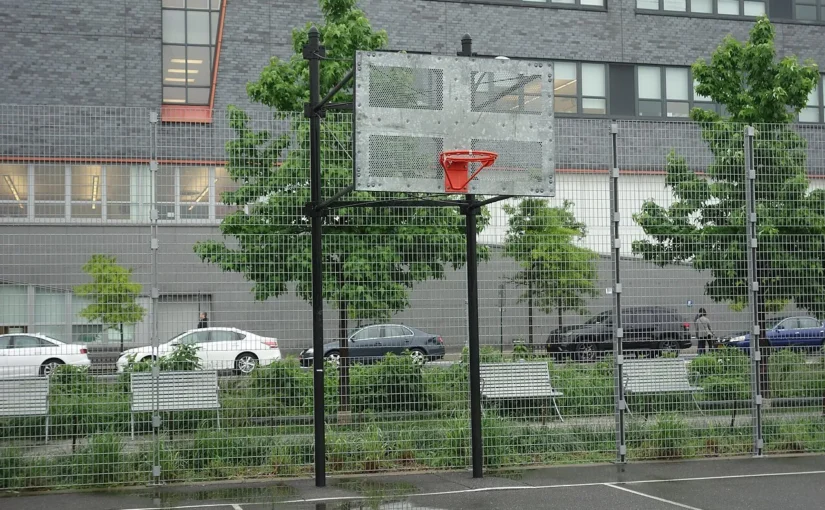
A playground basketball hoop is designed for outdoor basketball in schools, public parks, community playgrounds, and recreational facilities.
For most unattended public courts, a permanent, fixed-height basketball hoop with a galvanized steel pole, steel backboard, and heavy-duty rim is a practical choice. Adjustable basketball hoops are worth considering for supervised facilities serving different age groups.
Published US equipment prices range from approximately $1,450 to $7,000 for single-hoop commercial systems. Installation, freight, and additional equipment can increase the total cost.
This guide explains how to choose a playground basketball hoop based on durability, player age, safety, installation requirements, and budget.
What Is a Playground Basketball Hoop?
A playground basketball hoop is a basketball goal system intended for recreational use in outdoor play areas.
Unlike many residential basketball hoops, commercial playground systems are designed with frequent use, weather exposure, and demanding playing conditions in mind.
A typical system includes:
- A steel support pole.
- A backboard.
- A basketball rim and net.
- A permanent foundation or anchoring system.
- Optional protective padding.
The appropriate design depends on the facility, expected users, and level of supervision.
Commercial vs Residential Basketball Hoops
Commercial and residential basketball hoops can differ considerably in construction, mounting methods, and warranty coverage.
| Feature | Residential basketball hoop | Commercial playground basketball hoop |
|---|---|---|
| Support pole | Often smaller and lighter | Heavy-duty steel construction |
| Backboard | Glass, acrylic, or polycarbonate | Steel, fiberglass, acrylic, or glass |
| Rim | Often breakaway | Fixed double-ring or heavy-duty breakaway |
| Height | Frequently adjustable | Fixed or adjustable |
| Installation | Portable or permanent | Usually permanent |
| Warranty | Often limited to residential use | Model-specific commercial coverage |
There is no universal definition of a commercial-grade basketball hoop that guarantees its suitability for every public facility.
Always confirm that the manufacturer approves the system for its intended location. A residential basketball hoop may not have warranty coverage when installed in a public park or school.
Types of Playground Basketball Hoops
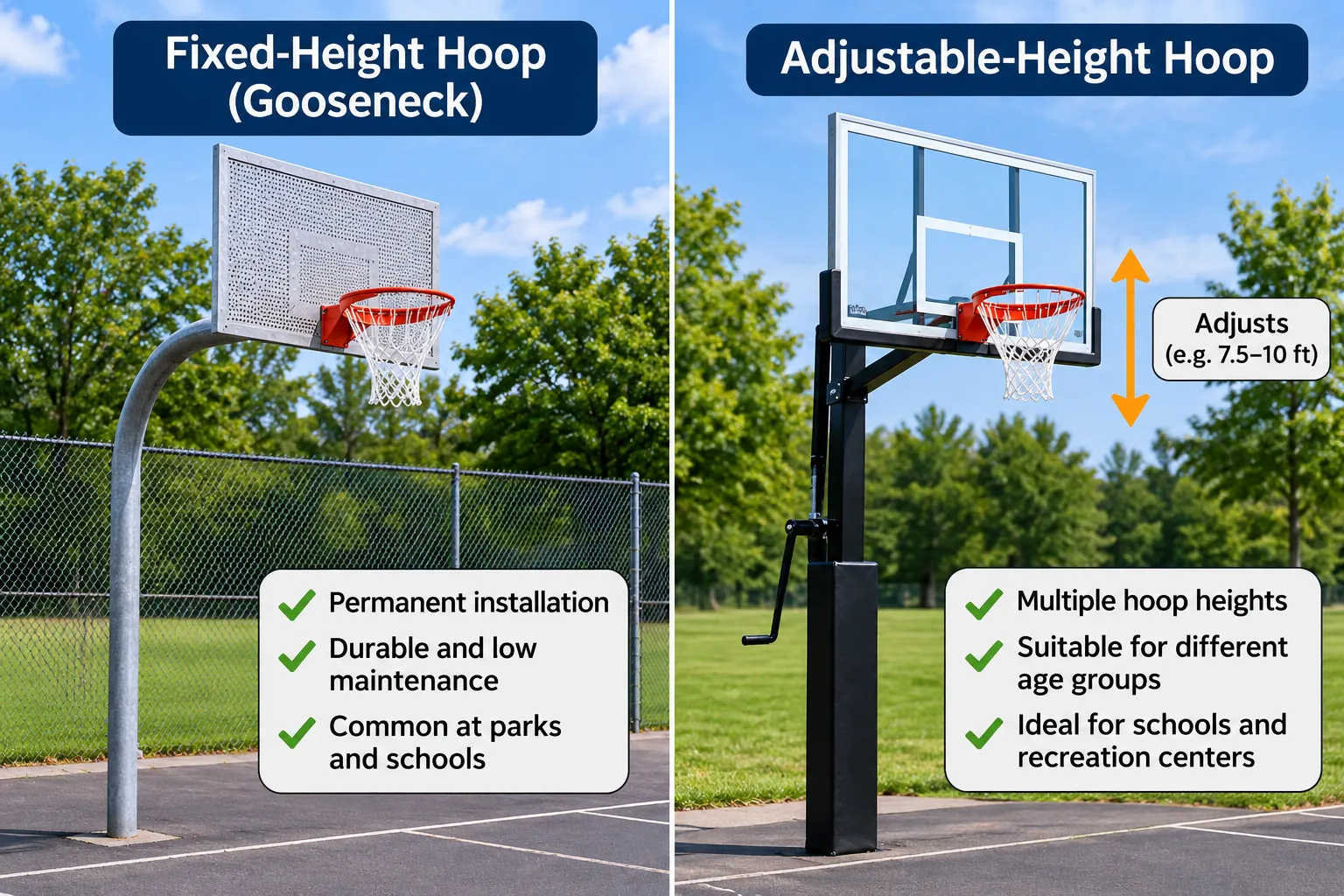
Permanent In-Ground Basketball Hoops
Permanent in-ground basketball hoops are common at schools, parks, and outdoor recreational courts.
Two common installation methods are:
- Direct-burial systems: The support pole is installed directly into a concrete footing.
- Bolt-down systems: The support pole attaches to an anchor assembly secured within a concrete foundation.
Direct-burial gooseneck basketball hoops are particularly common at public playgrounds. Their curved support poles position the backboard away from the base of the pole.
Bolt-down systems allow the main support pole to be removed from its anchor assembly when necessary.
Some public facilities specify direct-burial systems rather than bolt-down models. Check the owner’s construction requirements before selecting a hoop.
Fixed-Height Basketball Hoops
A fixed-height basketball hoop has a rim that remains at a predetermined height.
Most full-size fixed-height systems have a rim positioned 10 feet above the playing surface.
Fixed-height hoops have fewer moving components than adjustable systems. This makes them attractive for unattended public parks where adjustment mechanisms could be damaged or misused.
However, a standard 10-foot rim may be too high for younger children.
Adjustable-Height Basketball Hoops
Adjustable basketball hoops allow users or facility staff to raise and lower the rim.
These systems are particularly useful at elementary schools, summer camps, and supervised recreation centers.
Some commercial models feature removable adjustment handles. Staff can change the rim height without allowing unrestricted access to the adjustment mechanism.
Adjustable systems contain additional moving parts that require inspection and maintenance.
Double-Sided Basketball Hoops
Double-sided basketball hoops feature two baskets mounted on opposite sides of a shared support structure.
They can provide multiple shooting areas without requiring two completely separate support poles.
These systems may suit schools and recreational facilities with limited space or specific court layouts.
However, each playing area still needs adequate clearance. A double-sided system does not eliminate the space required for safe basketball play.
Playground Basketball Hoops for Younger Children
Some manufacturers offer smaller basketball hoops specifically designed for children’s play areas.
For example, the Infinity Playgrounds Fun Shot is available in 4-foot and 6-foot versions.
Landscape Structures also offers its Drop Shot playground component for users aged five through adulthood.
These products differ from traditional full-size basketball goals. Check their intended age range, installation requirements, and required play area before purchasing.
Playground Basketball Hoop Height by Age
The appropriate basketball hoop height depends on the age and development of the players.
USA Basketball and the NBA recommend lower rim heights for younger basketball players to encourage suitable shooting mechanics and skill development.
Recommended Basketball Hoop Heights by Age
| Player age | Recommended rim height |
|---|---|
| Under 7 years | No authoritative height identified in the sources reviewed |
| 7–8 years | 8 feet |
| 9–11 years | 9 feet, when possible |
| 12–14 years | 10 feet |
| High school age | 10 feet |
| Adults | 10 feet |
Source: NBA and USA Basketball age-appropriate youth basketball guidelines.
These recommendations are developmental guidelines for basketball programs, not legal requirements for public playgrounds.
Choosing Hoops for Mixed-Age Playgrounds
A single 10-foot basketball hoop may not adequately serve a playground used by younger children and teenagers.
Facilities can address this by installing an adjustable basketball hoop, providing separate fixed-height hoops, or adding a smaller basketball goal specifically designed for children.
For supervised facilities, adjustable systems offer flexibility.
For unattended playgrounds, separate fixed-height hoops may reduce the need for adjustment mechanisms while accommodating different age groups.
What to Look for When Buying a Playground Basketball Hoop
Backboard Materials and Sizes
The backboard affects basketball rebound, appearance, maintenance requirements, and suitability for public use.
| Backboard material | Main advantage | Main consideration |
|---|---|---|
| Solid steel | Heavy-duty construction | Opaque appearance |
| Perforated steel | Common option for unattended courts | Different rebound characteristics from glass |
| Fiberglass | Available in institutional systems | Construction quality varies |
| Acrylic | Transparent appearance | Can scratch or become damaged |
| Tempered glass | Traditional competitive basketball feel | Vulnerability to deliberate damage |
| Aluminum | Lightweight and naturally corrosion-resistant | Suitability depends on construction |
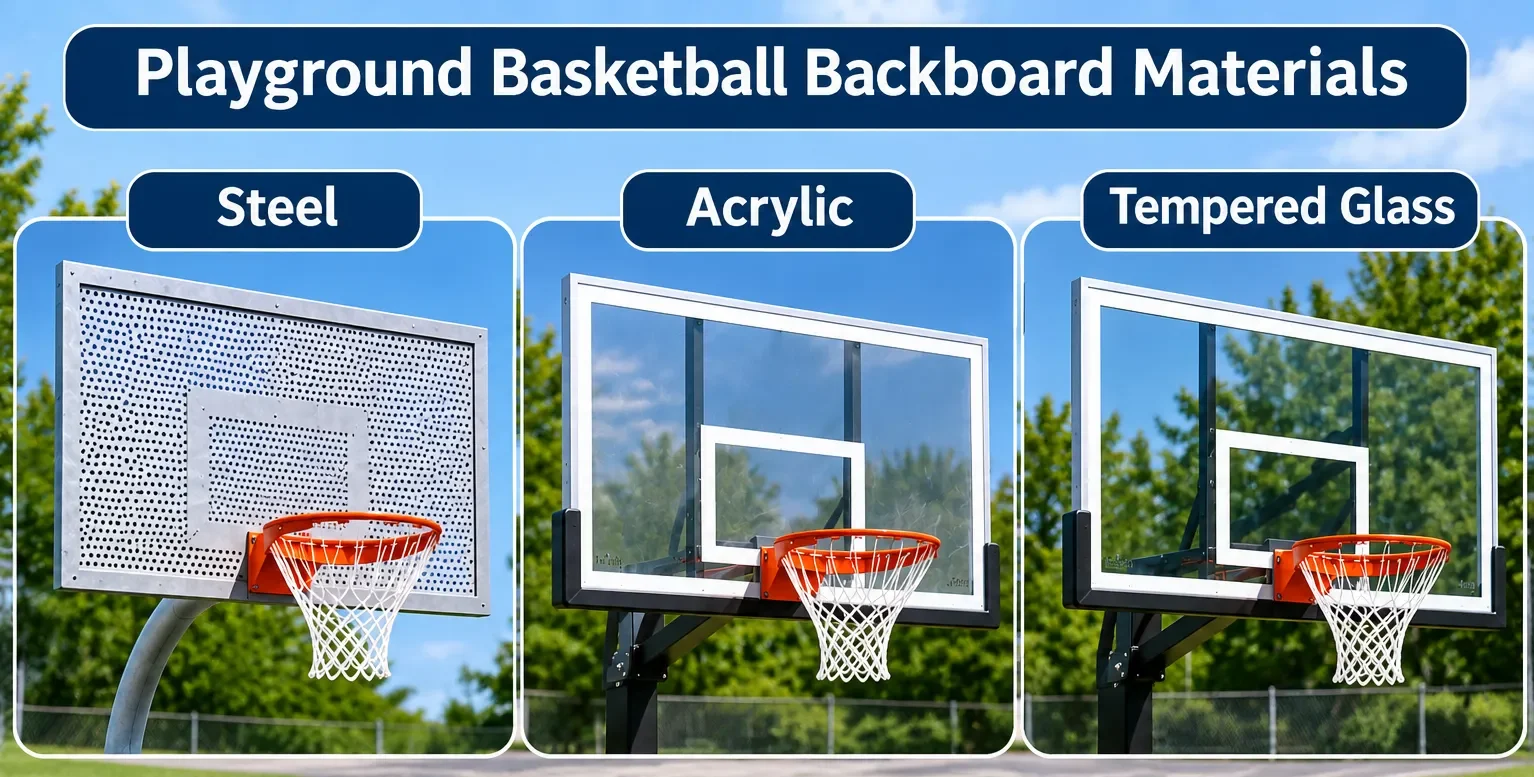
Steel and perforated steel backboards are worth considering for unattended public basketball courts.
However, manufacturers and facility owners do not always agree on the best backboard material.
First Team recommends acrylic over tempered glass in certain unsupervised settings because of concerns about vandalism. Meanwhile, the City of Muskegon excludes acrylic and polycarbonate backboards in its 2026 park basketball hoop replacement specification.
These are different purchasing recommendations, not independent comparative durability tests.
Common commercial backboard widths include 54, 60, and 72 inches. A 72 × 42-inch rectangular backboard provides regulation-size dimensions, although smaller backboards may be suitable for recreational playgrounds.
Basketball Rim Types
Commercial playground basketball hoops commonly use fixed double-ring rims or heavy-duty breakaway rims.
Fixed double-ring rims feature two steel rings that reinforce the basket. They are popular at outdoor recreational courts where durability and mechanical simplicity are priorities.
Breakaway rims contain a mechanism that allows the rim to move downward under sufficient force before returning to its original position.
Some commercial breakaway rims are designed specifically for playground use. However, their moving components may require additional maintenance.
The City of Muskegon’s park hoop specification requires fixed double-ring steel rims and excludes breakaway rims.
This is an example of a municipal purchasing requirement, not a nationwide rule.
Support Pole Strength
Commercial basketball hoop manufacturers offer several support pole sizes and construction designs.
| Pole size | Example application |
|---|---|
| 3.5-inch round pole | Lighter-duty playground systems |
| 4.5-inch round pole | Schools and recreational courts |
| 5-9/16-inch round pole | Heavy-duty outdoor basketball systems |
| 6-inch square pole | Commercial and institutional systems |
| 8-inch square pole | Large, heavy-duty basketball systems |
Pole diameter alone does not determine structural strength.
Steel thickness, material quality, welds, support arms, backboard weight, foundation design, and installation quality also affect the complete system.
Choose a basketball hoop based on its full specifications rather than pole size alone.
Overhang and Playing Clearance
Basketball hoop overhang describes how far the backboard extends away from the support pole.
A longer overhang can provide more space beneath the basket and help position the support pole farther from the main playing area.
Commercial systems offer various overhang distances, including 36, 48, 60, 72, and 96 inches.
First Team recommends considering extensions of approximately 66–72 inches for certain playground and park applications.
However, manufacturers may measure overhang from different reference points. Check the technical drawings before comparing systems.
A longer overhang does not eliminate the risk of players colliding with the support pole.
Weather and Vandalism Resistance
Outdoor basketball hoops must withstand rain, sunlight, temperature changes, and other environmental conditions.
Features worth considering include:
- Hot-dip galvanized steel support poles.
- Outdoor-rated protective coatings.
- Corrosion-resistant fasteners.
- Heavy-duty steel backboards.
- Reinforced basketball rims.
- Tamper-resistant net attachments.
- Replaceable components.
Coastal facilities and locations exposed to road salt may require additional corrosion protection.
Ask the manufacturer whether the selected system is suitable for the local environment.
No basketball hoop should be considered completely vandal-proof. Independent comparative vandalism and corrosion test results were not identified for the systems reviewed.
Warranty Coverage
Commercial basketball hoop warranties vary significantly.
Some manufacturers cover structural defects but exclude deliberate damage, rim hanging, improper installation, or unauthorized modifications.
Other warranties provide broader coverage for certain heavy-duty commercial systems.
For example, First Team offers unconditional lifetime warranties on selected playground basketball systems. Other First Team warranty categories exclude vandalism or deliberate rim hanging.
Before purchasing, confirm:
- Whether public or commercial use is covered.
- Which components have warranty protection.
- Whether dunking and rim hanging are covered.
- Whether vandalism and corrosion are excluded.
- Whether replacement labor and freight are included.
A lifetime warranty does not necessarily cover every component or cause of damage.
Best Playground Basketball Hoops for Different Facilities
Different facilities have different equipment requirements.
| Facility | Recommended system characteristics |
|---|---|
| Elementary school | Lower fixed-height or staff-controlled adjustable hoop |
| Middle or high school | Heavy-duty 10-foot basketball hoop |
| Public park | Fixed-height, galvanized steel system with a durable backboard |
| Community playground | Separate age-appropriate hoops or supervised adjustable system |
| Recreation center | Commercial adjustable or fixed-height system |
| Apartment or HOA court | Permanent system approved for shared recreational use |
Elementary Schools
Elementary school playgrounds benefit from basketball hoops that accommodate younger players.
An adjustable commercial system with a removable adjustment handle can help staff select an appropriate rim height.
Alternatively, schools can install separate fixed-height goals for different age groups.
Prioritize appropriate playing clearance, durable components, and protective padding where suitable.
Public Parks
Public park basketball hoops often experience frequent use with limited supervision.
A fixed-height system with a galvanized steel support pole, steel backboard, and heavy-duty double-ring rim is a practical starting point.
Check local procurement specifications and warranty coverage before purchasing.
Community Playgrounds
Community playgrounds may serve children, teenagers, and adults.
Providing different basketball hoop heights can make the facility more suitable for a wider range of users.
Where basketball equipment is located near swings, slides, or other playground equipment, the layout should prevent basketball activities from interfering with adjacent play areas.
Recreation Centers
Supervised recreation centers have greater flexibility when choosing basketball equipment.
Adjustable basketball hoops can support youth training sessions, recreational games, and adult basketball programs.
Glass or acrylic backboards may also be appropriate where staff can monitor equipment use and the manufacturer approves the intended application.
How Much Does a Playground Basketball Hoop Cost?
Published US prices for single-hoop commercial playground systems range from approximately $1,450 to $7,000.
These are equipment prices rather than complete installation costs.
The total depends on the basketball hoop model, backboard material, support pole construction, installation method, freight charges, and additional accessories.
Playground Basketball Hoop Equipment Prices
| Equipment category | Approximate published price range |
|---|---|
| Lighter-duty playground systems | $1,450–$2,000 |
| Mid-range commercial systems | $2,000–$3,500 |
| Heavy-duty commercial systems | $3,500–$7,000 |
| Selected double-sided systems | $6,750–$7,350 |
| Replacement playground basketball rim | $250–$340 |
These ranges are based on selected manufacturer and retailer listings researched in November 2026. They are not nationwide average prices.
Playground Basketball Hoop Installation Costs
Commercial playground basketball hoop installation costs are more difficult to estimate than equipment prices.
Pro Dunk lists average installation service prices of $700 for the THOR Platinum and $1,000 for the HERCULES Diamond. These model-specific estimates should not be treated as representative of every commercial installation.
Public projects may involve additional excavation, engineering, equipment handling, permits, and contractor requirements.
A 2023 public park project in Urbandale, Iowa, received bids ranging from $850 to $2,000 for a basketball goal installation line item. The published bid tabulation does not clearly identify the number of goals or whether equipment was included.
Source: City of Urbandale Acadia Park bid tabulation.
Reliable nationwide commercial installation cost data was not identified. Obtain itemized contractor quotes for your specific facility.
Additional Playground Basketball Hoop Expenses
Your project budget may also need to include:
- Freight and delivery.
- Excavation and concrete foundations.
- Professional installation labor.
- Protective pole and backboard padding.
- Replacement rims and nets.
- Removal of existing equipment.
- Engineering and permits.
- Basketball court surface repairs.
Commercial basketball hoops can be heavy and expensive to transport.
Confirm whether delivery includes unloading equipment at the installation site.
Playground Basketball Hoop Brands and Models
Several manufacturers offer basketball systems designed for schools, parks, and recreational facilities.
The following products were researched using manufacturer specifications and published prices. BasketballRex has not physically tested these basketball hoops.
First Team
First Team manufactures fixed-height and adjustable basketball hoops for residential and commercial applications.
Its RuffNeck, Brute, Tyrant, and Legend product lines include systems intended for playground and institutional use.
The RuffNeck features a 4.5-inch galvanized steel support pole and a 48-inch extension.
The heavier-duty Brute and Tyrant systems feature larger support poles and longer extensions.
Selected models also offer broader warranty coverage for demanding public environments.
Manufacturer: First Team fixed-height basketball goals.
Bison
Bison offers several categories of outdoor basketball equipment, including Tough-Duty, Heavy Duty, Mega Duty, and Ultimate playground basketball systems.
The Tough-Duty range includes 3.5-inch support poles and relatively compact extensions.
The PR55 Heavy Duty system features a 4.5-inch galvanized support pole and a steel fan-shaped backboard.
The PR77 Mega Duty system features a larger 5-9/16-inch pole and a rectangular steel backboard.
Manufacturer: Bison outdoor basketball equipment.
Pro Dunk
Pro Dunk offers adjustable THOR basketball hoops and fixed-height HERCULES systems.
The THOR Platinum features a 5–10-foot adjustment range, a 72-inch tempered glass backboard, and included protective padding.
The HERCULES Diamond features an 8-inch square support pole and a 5-foot overhang, with glass or steel backboard options.
These systems are worth comparing for facilities that require heavy-duty construction or adjustable rim heights.
Confirm warranty coverage for the specific public or commercial setting.
Manufacturer: Pro Dunk park and playground basketball hoops.
Goalrilla
Goalrilla offers fixed-height and adjustable basketball systems that may be suitable for certain supervised facilities.
Its 72-inch fixed-height basketball hoop features a 5-foot overhang, breakaway rim, and protective padding.
Goalrilla describes this model as suitable for residential and protected commercial settings.
This does not necessarily mean it is suitable for every unattended public park. Confirm the intended application and warranty restrictions before purchasing.
Manufacturer: Goalrilla fixed-height basketball hoop.
Jaypro
Jaypro manufactures outdoor basketball equipment for parks, schools, and recreational facilities.
Its 656-RS-DR gooseneck basketball system features a 5-9/16-inch galvanized steel support pole, 72-inch steel backboard, and double-ring rim.
Jaypro also offers replacement basketball rims, nets, and protective padding.
Manufacturer: Jaypro outdoor basketball systems.
Playground Basketball Hoop Comparison
| Model | Main feature | Published equipment price |
|---|---|---|
| Bison Tough-Duty PR29 | 3.5-inch pole and aluminum fan backboard | $1,458 |
| First Team RuffNeck Extreme | 4.5-inch pole and 60-inch steel backboard | $2,550 |
| Bison Heavy Duty PR55 | Galvanized pole and steel fan backboard | $2,595 |
| First Team Brute | Heavy-duty galvanized pole | From $3,038 |
| Pro Dunk THOR Platinum | Adjustable from 5–10 feet | $3,400 |
| First Team Tyrant | 6-5/8-inch support pole | From $3,947 |
| Bison Mega Duty PR77 | Steel rectangular backboard and 72-inch safe play area | $3,962 |
| Pro Dunk HERCULES Diamond | 8-inch square pole and fixed height | $4,024 |
| Jaypro 656-RS-DR | Steel backboard and double-ring rim | $4,403 |
Prices researched in November 2026. Bison and Jaypro figures are published manufacturer suggested prices. First Team figures are retailer listings, while Pro Dunk figures are published list prices.
Prices exclude installation unless explicitly stated by the seller. Availability, freight charges, and product configurations may change.
The Jaypro 656-RS-DR product page showed a waiting-list notice when checked on November 27, 2026. Confirm availability and lead times with the supplier.
Choosing a Playground Basketball Hoop by Budget
| Equipment budget | Models worth comparing |
|---|---|
| Under $2,000 | Bison Tough-Duty PR29 |
| $2,000–$3,500 | First Team RuffNeck Extreme, Bison PR55, First Team Brute |
| Above $3,500 | Bison PR77, First Team Tyrant, Pro Dunk HERCULES Diamond |
| Adjustable-height system | Pro Dunk THOR Platinum |
These are specification-based purchasing suggestions, not independent performance rankings.
The most expensive basketball hoop is not automatically the best choice for every playground.
A smaller supervised school playground may have different requirements from a heavily used public basketball court.
Playground Basketball Hoop Safety and Standards
Public basketball hoop safety involves equipment selection, structural installation, playing clearance, maintenance, and facility management.
It is important to distinguish mandatory requirements from voluntary standards and manufacturer recommendations.
ASTM and CPSC Guidance
ASTM F1487-25 covers public-use playground equipment but excludes sports equipment from its scope.
ASTM F1882-26 covers residential basketball systems and excludes equipment intended for public assembly locations such as schools, parks, and recreational facilities.
The Consumer Product Safety Commission’s Public Playground Safety Handbook provides voluntary playground safety guidance but does not establish basketball hoop-specific requirements.
Relevant sources include:
No dedicated US product standard covering conventional outdoor commercial basketball hoops was identified in the sources reviewed.
However, this does not mean public basketball hoops are exempt from all safety requirements.
Local building codes, contractual specifications, insurance requirements, and accessibility regulations may still apply.
Basketball equipment integrated into a children’s playground may also require a separate assessment of applicable playground requirements.
Accessibility Requirements
The 2010 ADA Standards for Accessible Design require accessible routes to areas of sport activity, including basketball courts, where applicable.
Public facilities should consider accessible access to the court and its surrounding areas during the planning process.
The standards reviewed do not prescribe a specific basketball rim height for accessible basketball courts.
Additional play-area accessibility requirements may apply when a basketball feature forms part of a children’s playground.
See the US Access Board’s guide to accessible sports facilities for further information.
Protective Padding and Clearances
Basketball pole padding can help reduce the severity of contact with exposed support structures.
Some manufacturers also offer protective padding for the bottom and sides of the backboard.
Padding should be considered alongside appropriate court design and playing clearance. It does not replace adequate separation from fixed obstacles.
Avoid positioning basketball hoops where players could run directly into fences, walls, playground equipment, or other hazards.
No universal hoop-specific clearance or outdoor padding requirement was identified in the research.
Follow applicable local requirements, facility specifications, manufacturer instructions, and professional site-design guidance.
Playground Basketball Hoop Installation
Installing a commercial basketball hoop requires careful planning and a suitable foundation.
Heavy-duty basketball systems may require lifting equipment and professional installation.
1. Select the Installation Location
Determine the basketball court layout, rim height, backboard position, and available playing clearance.
Check for nearby buildings, fences, trees, playground equipment, and underground utilities.
In the United States, contact 811 before excavation to arrange underground utility marking. Private utilities may require separate locating.
2. Prepare the Concrete Footing
The footing supports the basketball hoop and helps resist the forces acting on the structure.
Footing dimensions vary between manufacturers and models.
| Manufacturer or system | Published footing example |
|---|---|
| Douglas gooseneck systems | At least 24 inches in diameter and 48 inches deep |
| Pro Dunk HERCULES Diamond | 24-inch square hole, 48 inches deep |
| Bison BA777 Heavy Duty | 12-inch diameter hole, 48 inches deep, with an enlarged bell-shaped bottom |
These examples demonstrate how different basketball systems can require different foundation designs.
They are not interchangeable construction specifications.
Follow the current installation manual for the exact basketball hoop and obtain professional guidance for local soil conditions, frost depth, and structural requirements.
3. Install the Support Pole or Anchor Assembly
Direct-burial basketball systems require the support pole to be positioned within the concrete footing.
Bolt-down basketball hoops require a correctly positioned anchor assembly.
The pole or anchor system must be aligned and secured according to the manufacturer’s instructions.
4. Allow the Concrete to Cure
Concrete must develop sufficient strength before the remaining basketball hoop components are installed.
Required curing times depend on the foundation design, concrete mixture, weather conditions, and manufacturer’s instructions.
Do not assume that a footing is ready simply because the exposed concrete surface appears dry.
5. Install the Backboard, Rim, and Padding
Commercial basketball backboards and support assemblies can be extremely heavy.
Use the lifting equipment, personnel, and installation procedures specified by the manufacturer.
Install the basketball rim, net, and any required protective padding.
6. Inspect the Completed Basketball Hoop
Before opening the basketball court for use, confirm that:
- The support pole is stable and correctly aligned.
- The backboard and rim are securely attached.
- All required fasteners are installed and tightened.
- The rim height matches the intended specification.
- Required playing clearances are available.
- Protective padding is securely attached where provided.
The completed installation should be inspected by appropriately qualified personnel before public use.
Playground Basketball Hoop Maintenance and Replacement Parts
Regular inspections help identify damage before it becomes a more serious equipment problem.
Outdoor basketball hoops should be checked for:
- Loose or missing hardware.
- Bent or damaged basketball rims.
- Cracked backboards.
- Corrosion around welds and the base of the pole.
- Movement or deterioration around the foundation.
- Damaged adjustment mechanisms.
- Worn or missing protective padding.
- Damaged basketball nets.
Remove damaged or structurally questionable equipment from service until it has been assessed and repaired.
Inspection frequency should reflect equipment use, environmental exposure, manufacturer recommendations, and facility requirements.
Replacement Basketball Hoop Parts
Replacing individual components may be more economical than purchasing an entirely new basketball system when the existing structure remains suitable.
| Replacement part | Published price example |
|---|---|
| Jaypro anti-whip nylon net | $29 |
| Jaypro UBG-500 playground rim | $251 |
| Porter heavy-duty playground rim | $336 |
| Jaypro 4-inch outdoor post pad | $907 |
| Jaypro 6-inch outdoor post pad | $1,233 |
Prices are published examples researched in November 2026.
Check compatibility before ordering replacement basketball hoop components.
A replacement rim or backboard must be suitable for the existing mounting arrangement and support structure.
How Long Do Playground Basketball Hoops Last?
There is no reliable universal lifespan for commercial playground basketball hoops.
Durability depends on construction quality, installation, corrosion protection, weather exposure, usage, maintenance, and deliberate damage.
A 2022 Temple City, California, staff report documented four park basketball systems originally installed in 2002.
The existing in-ground poles were considered structurally sound, but the backboards, rims, and support components required replacement.
Source: Temple City basketball goal replacement staff report.
This example demonstrates that individual basketball hoop components may require replacement before the entire support structure reaches the end of its useful life.
It does not establish a guaranteed 20-year lifespan for playground basketball hoops.
Playground Basketball Hoop Buying Checklist
Before purchasing a commercial playground basketball hoop, confirm the following requirements with the manufacturer, supplier, and installation contractor.
| Buying consideration | What to confirm |
|---|---|
| Intended users | Player ages and appropriate rim height |
| Facility type | Approval for school, park, or commercial use |
| Support pole | Material, dimensions, and corrosion protection |
| Backboard | Material, dimensions, and replacement availability |
| Rim | Fixed or breakaway design and warranty coverage |
| Overhang | Adequate playing clearance |
| Foundation | Model-specific installation requirements |
| Padding | Suitable pole and backboard protection |
| Warranty | Commercial use, vandalism, corrosion, and exclusions |
| Accessibility | Applicable ADA and local requirements |
| Total cost | Equipment, freight, installation, and accessories |
| Maintenance | Inspection procedures and replacement parts |
Public facility buyers may also benefit from reviewing existing municipal purchasing specifications.
For example, the City of Muskegon’s 2026 park basketball hoop replacement specification includes detailed requirements for support poles, backboards, rims, foundations, and corrosion protection.
These requirements apply to that specific purchasing project and should not be treated as universal commercial basketball hoop standards.
Frequently Asked Questions
What Height Is a Playground Basketball Hoop?
Full-size playground basketball hoops typically have a rim height of 10 feet.
USA Basketball and the NBA recommend 8-foot rims for children aged 7–8 and 9-foot rims, when possible, for children aged 9–11.
Smaller or adjustable basketball hoops may be appropriate for younger children.
What Is the Best Backboard Material for a Public Park?
Steel and perforated steel are practical backboard options for unattended public basketball courts.
They are commonly available on heavy-duty playground basketball systems.
However, the appropriate material depends on the facility’s requirements, level of supervision, budget, and manufacturer specifications.
Are Adjustable Basketball Hoops Suitable for Playgrounds?
Yes. Commercial adjustable basketball hoops can be suitable for playgrounds serving different age groups.
Models with removable adjustment handles may be particularly useful at supervised schools and recreation centers.
Fixed-height hoops may be preferable at unattended public parks where adjustment mechanisms could be damaged or misused.
How Deep Should a Playground Basketball Hoop Footing Be?
Some commercial basketball hoop manufacturers specify footings approximately 48 inches deep.
However, footing width, depth, shape, and reinforcement vary between systems and site conditions.
Always follow the exact manufacturer’s installation instructions and applicable local engineering requirements.
Can You Use a Residential Basketball Hoop in a Public Park?
A residential basketball hoop should not automatically be considered suitable for public park use.
Its construction, installation requirements, and warranty may not accommodate frequent public use.
Choose a basketball system that the manufacturer explicitly approves for the intended environment.
Do Playground Basketball Hoops Need Protective Padding?
Protective padding is recommended by several basketball equipment manufacturers.
Whether padding is required depends on applicable regulations, facility specifications, and the intended use of the basketball court.
Padding does not replace appropriate playing clearance or safe equipment installation.
How Much Does a Commercial Playground Basketball Hoop Cost?
Published equipment prices for single-hoop commercial playground basketball systems range from approximately $1,450 to $7,000.
Heavy-duty systems, specialty backboards, and double-sided basketball hoops can cost more.
Installation, freight, concrete foundations, and protective padding may increase the total project cost.
Final Thoughts
The best playground basketball hoop depends on the age of the players, facility type, available budget, and expected equipment use.
For unattended public parks, a fixed-height basketball hoop with a galvanized steel pole, durable backboard, and heavy-duty rim is a practical starting point.
For elementary schools and supervised recreation centers, adjustable basketball hoops or separate age-appropriate goals may provide greater flexibility.
Before purchasing, compare complete system specifications, commercial warranty coverage, installation requirements, and total project costs.
A properly selected, installed, and maintained basketball hoop is more important than choosing the largest or most expensive model.
Featured image by Tdorante10 via Wikimedia Commons, licensed under CC BY-SA 4.0. Resized and converted to WebP.
3 thoughts on “Playground Basketball Hoops | Types, Costs & Buying Guide”
Comments are closed.