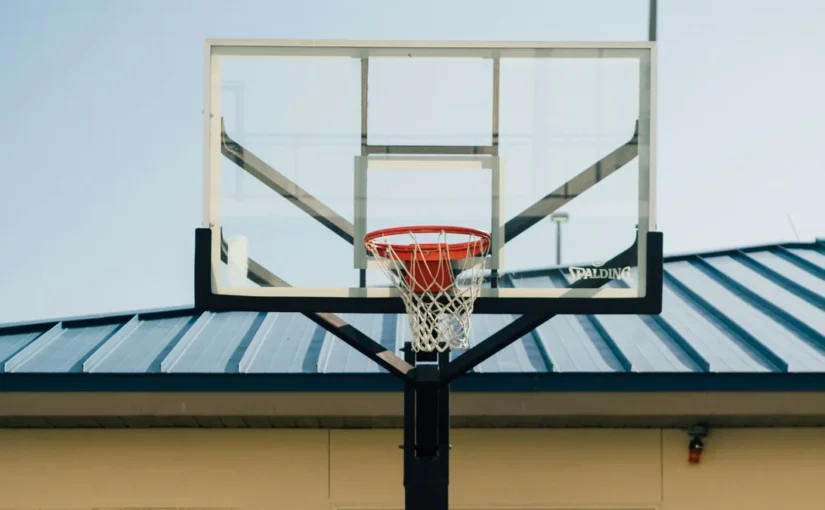
A regulation NBA basketball backboard measures 72 inches wide and 42 inches high (6 × 3.5 feet). However, not every basketball competition uses the same dimensions, and home backboards come in several smaller sizes.
If you’re buying a basketball hoop or replacing a backboard, understanding these measurements will help you choose equipment that suits your playing space.
What Are the Standard Basketball Backboard Dimensions?
Basketball backboard dimensions vary between governing bodies. Here are the main measurements:
| Organisation | Width | Height |
|---|---|---|
| NBA | 72 inches | 42 inches |
| NCAA men’s | 72 inches | 42 or 48 inches |
| FIBA | 1,800 mm | 1,050 mm |
These are competition specifications, not mandatory dimensions for home basketball hoops.
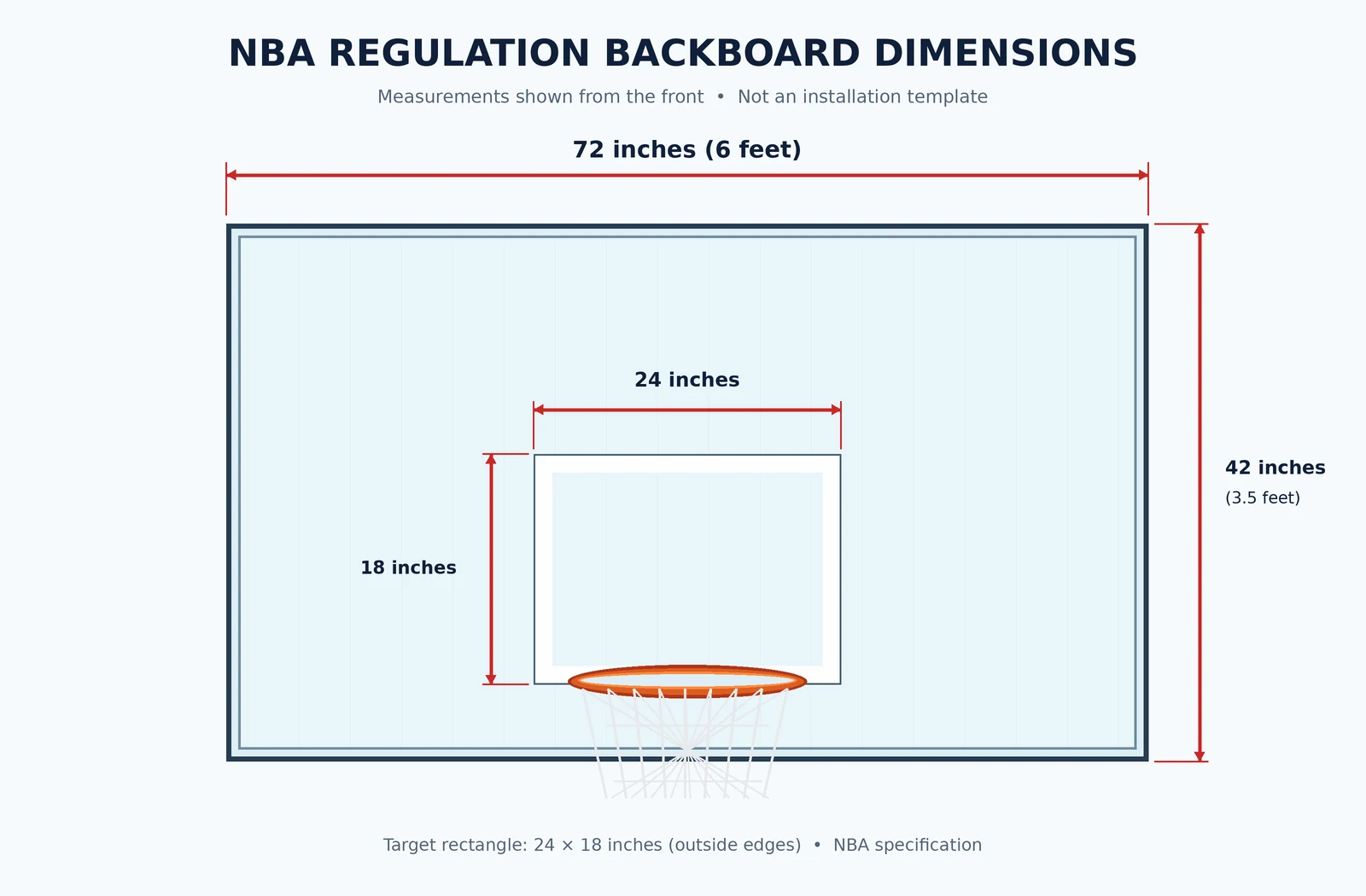
The NBA requires a rectangular, transparent backboard with a flat front surface. Its regulation size is 72 inches wide and 42 inches high.
NCAA men’s basketball permits both 72 × 42-inch and 72 × 48-inch backboards. The 72 × 42-inch version is recommended for new installations and replacements.
FIBA specifies metric dimensions, with permitted positive tolerances of 30 mm in width and 20 mm in height.
The listed dimensions describe the backboard itself. They shouldn’t be confused with the measurements of the entire basketball hoop system.
Common Basketball Backboard Dimensions for Home Use
The most common basketball backboard sizes for home use are 44, 48, 54, 60, and 72 inches wide. These smaller backboards and full-size options suit different playing spaces and practice needs.
| Width | Typical use |
|---|---|
| 44 inches | Compact home setups |
| 48 inches | Casual games and family practice |
| 54 inches | Regular recreational practice |
| 60 inches | Larger home playing areas |
| 72 inches | Regulation-width practice |
These are general buying guidelines rather than official categories.
One important detail: the advertised size usually refers to the backboard’s width, not its complete dimensions.
For example, residential models sold as 54-inch backboards may measure 54 × 33 inches or 54 × 34 inches. Always check both measurements before buying.
44-Inch and 48-Inch Backboards
A 44-inch backboard is worth considering when space is limited or basketball is mainly a casual activity.
Its smaller playing surface provides less room for bank shots than a wider backboard.
A 48-inch backboard offers slightly more space while remaining compact enough for many residential setups.
Both widths are available on adjustable home basketball systems. However, their suitability depends on the complete hoop, not just the backboard.
54-Inch and 60-Inch Backboards
A 54-inch backboard offers more surface area for bank shots than smaller residential models.
It can be a good choice for someone who practises shooting regularly without needing a full regulation-width system.
A 60-inch backboard is another option for players who want a larger target.
Neither size guarantees better rebound performance. The backboard material, rigidity, and mounting system also affect how the ball responds.
72-Inch Backboards
A 72-inch backboard matches the width required by the NBA.
This makes it useful for players who want to practise with a regulation-width target.
However, width alone doesn’t make a basketball hoop regulation-compliant.
The backboard height, rim position, and other equipment specifications must also match the relevant competition requirements.
Basketball Backboard Square Dimensions
The marked box behind the basketball rim is commonly called the backboard square, although it’s actually a rectangle. This inner rectangle provides a visual reference for players practising bank shots.
Under NBA rules, its outside dimensions are:
- Width: 24 inches
- Height: 18 inches
- Line width: 2 inches
The rectangle is centered horizontally behind the rim.
FIBA specifies a target rectangle measuring 590 mm wide and 450 mm high, with permitted tolerances.
Importantly, these measurements include the markings themselves. They don’t describe only the empty space inside the rectangle.
Where Should the Rim Sit on the Backboard?
For an NBA regulation basketball hoop, the top edge of the rim must be 10 feet above the playing surface.
The rim is positioned halfway between the backboard’s vertical edges.
The nearest point of the rim’s inside edge must be 6 inches from the plane of the backboard’s front face.
This is not a measurement to the rim’s center or its outer edge.
FIBA specifies a rim height of 3,050 mm and a distance of 151 mm from the backboard face to the nearest point of the rim’s inside circumference, with small tolerances.
For a home basketball hoop, follow the manufacturer’s instructions and use compatible components. Don’t change the rim mounting position to approximate regulation dimensions.
Our basketball hoop installation guide covers the wider installation process.
How to Choose the Right Basketball Backboard Size
Choosing the right backboard size depends on your available space, budget, and the basketball skills you want to practise. A wider backboard offers more surface area for bank shots, but it doesn’t automatically improve shooting performance.
If you mainly play casual basketball in a small driveway, a 44-inch or 48-inch model may be sufficient.
For regular shooting practice, a 54-inch or 60-inch backboard provides more room for bank shots.
A 72-inch model is worth considering when matching regulation width is important to you.
Before buying, check four things:
- Available space: Measure the playing area and check for nearby obstacles.
- Complete dimensions: Compare both backboard width and height.
- Mounting system: Confirm that the support is designed for the board’s size and weight.
- Overall quality: Consider the rim, backboard material, and system stability rather than width alone.
Portable, wall-mounted, and in-ground hoops can use different backboard sizes. The mounting type doesn’t determine whether a backboard is regulation-sized.
Tempered glass, acrylic, and polycarbonate are common backboard materials, each with different characteristics.
If you’re replacing an existing board, our basketball backboard replacement guide explains what to check before ordering.
Frequently Asked Questions
Is a 48-Inch Backboard Big Enough?
For casual basketball and general home practice, a 48-inch backboard can be sufficient.
However, it provides less surface area for bank shots than a regulation-width board. Players who want to replicate competition equipment should consider that difference.
Should I Get a 60 or 72-Inch Backboard?
Choose a 60-inch backboard if you want a large home practice target without needing regulation width.
A 72-inch board is the better choice when practising with a regulation-width backboard is a priority.
Compare the complete basketball systems before deciding, because a wider backboard isn’t automatically a better-quality one.
Is a 54-Inch Backboard Too Small?
No. A 54-inch backboard can be suitable for regular recreational basketball.
It won’t provide the same playing surface as a 72-inch board, but it offers more room for bank shots than common 44-inch and 48-inch options.
Are All Basketball Backboards the Same Size?
No. Competition organisations specify particular dimensions, while home basketball equipment is available in several widths and heights.
Even products advertised with the same width may have different overall dimensions.
Final Thoughts
Standard NBA basketball backboard dimensions are 72 × 42 inches, but smaller models are often more practical for home use.
A compact backboard can suit casual games, while larger models provide more space for bank shots and regulation-style practice.
The right choice depends on your playing space and goals, not simply buying the biggest backboard available.