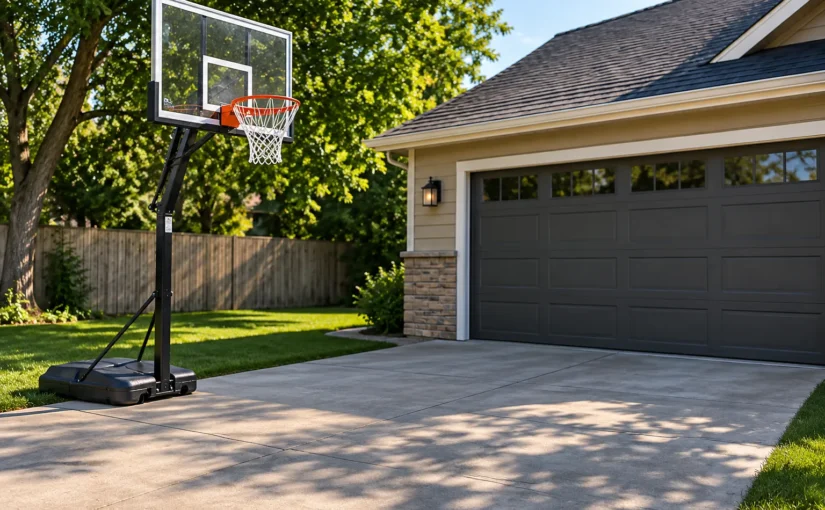
A driveway basketball hoop can turn an ordinary parking area into a place for shooting practice, family games, and outdoor play. But the right hoop depends on more than its backboard size or price.
For most driveways, a portable basketball hoop is the simplest starting point because it doesn’t require a concrete foundation. An in-ground hoop is worth considering if you want a permanent setup, while a wall-mounted hoop can save ground space when a suitable structure is available.
Before buying, measure your driveway, check its slope, consider where vehicles will park, and make sure players have enough room to move safely.
This guide explains how to choose a driveway basketball hoop, where to position it, and which features matter for different home setups.
BasketballRex has not physically tested the hoops mentioned here. Product examples are based on manufacturer specifications and documented installation requirements.
Which Type of Basketball Hoop Is Best for a Driveway?
The best basketball hoop for a driveway depends on whether you need to move it, how much space you have, and whether permanent installation is possible.
There are three main options.
| Hoop type | Main advantage | Main drawback | Suitable for |
|---|---|---|---|
| Portable | No permanent foundation required | Weighted base occupies driveway space | Families and flexible setups |
| In-ground | Permanent playing position without a portable base | Requires excavation and concrete | Homeowners planning long-term use |
| Wall-mounted | No freestanding pole or base | Requires a suitable supporting structure | Driveways with limited ground space |
Portable Basketball Hoops
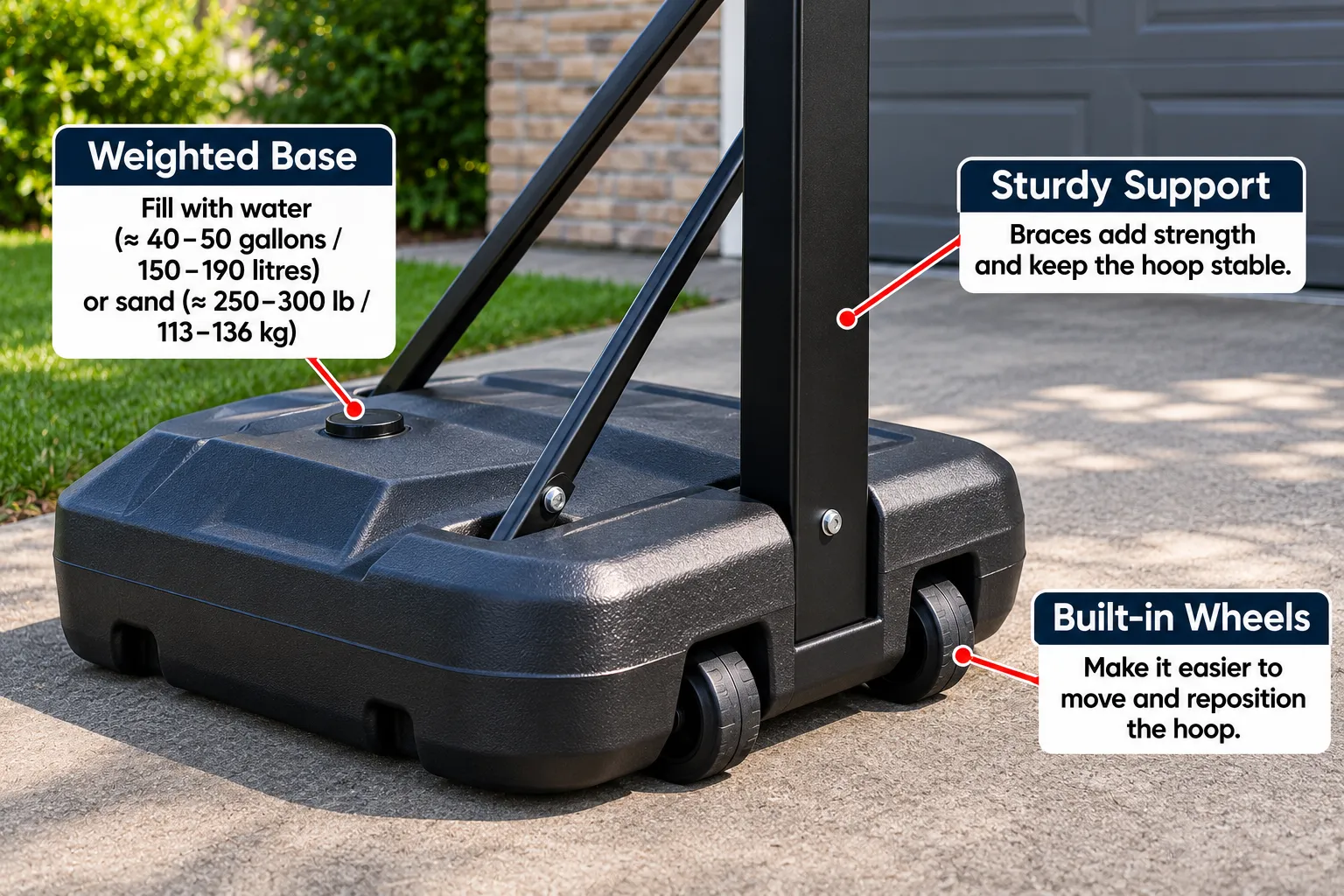
A portable basketball hoop uses a weighted base instead of a concrete foundation.
Most models have wheels and adjustable rims. You can position the hoop for practice and move it when you need the driveway for parking.
However, portable doesn’t mean lightweight.
Once filled with sand or water, the base can be difficult to move. Some models require two adults for safe repositioning.
Portable hoops are useful if you rent your home, cannot make permanent changes, or need flexibility.
Choose a portable hoop if: You want an outdoor basketball setup without committing to permanent installation.
For specific models, see our best portable basketball hoop guide.
In-Ground Basketball Hoops
An in-ground basketball hoop uses a pole secured in a concrete foundation.
Unlike a portable system, it doesn’t need a large weighted base sitting on the driveway.
This can leave more usable ground space for movement and parking.
Many in-ground hoops also feature tempered-glass backboards, adjustable rims, and substantial steel support structures.
The trade-off is installation.
You must account for excavation, concrete, curing time, assembly, and any professional labor.
Choose an in-ground hoop if: You own your property, want a permanent basketball setup, and have a suitable location for the foundation.
Our best in-ground basketball hoops guide compares nine models across different budgets.
Wall-Mounted Basketball Hoops
A wall-mounted basketball hoop attaches to a suitable building structure instead of using a freestanding pole.
This can be useful when a portable base would block parking or an in-ground foundation isn’t practical.
However, not every garage wall can safely support a basketball hoop.
The wall, mounting hardware, and supporting structure must meet the manufacturer’s requirements.
A wall-mounted system also projects outward, so you still need to measure its overhang.
Choose a wall-mounted hoop if: You have a suitable structural wall and want to preserve driveway ground space.
Never assume that ordinary siding, decorative brick, or garage fascia can support a full-size basketball hoop.
How to Choose a Basketball Hoop for Your Driveway
Different driveway layouts create different problems.
A basketball hoop that works well on a wide, level driveway may be unsuitable for a narrow, sloped, or shared one.
Small Driveways
For a small driveway, start by measuring the usable playing area rather than choosing a backboard size.
A 44-inch or 48-inch backboard may suit casual shooting, but the complete hoop still needs space.
For portable systems, check the base dimensions.
For in-ground systems, check the pole location, foundation requirements, and backboard overhang.
For wall-mounted hoops, measure how far the assembly projects from the building.
A smaller backboard doesn’t automatically mean the entire system takes up less room.
If the driveway only supports stationary shooting, that may still be useful. You don’t need enough space for full games to practice shooting.
However, avoid any arrangement that forces players into the road or against parked vehicles.
Narrow Driveways
A narrow driveway makes sideways movement especially important.
You might have enough room to shoot directly at the basket but not enough room to chase rebounds safely.
An in-ground hoop positioned beside the playing surface may preserve more pavement than a portable base.
A wall-mounted hoop could also work if the structure is suitable.
Before choosing either option, check the full installed dimensions and any required clearances.
Don’t assume that a 54-inch backboard is automatically suitable for every one-car driveway.
The correct choice depends on the actual space.
Sloped Driveways
A sloped driveway needs extra attention.
Portable basketball hoops generally require a suitable level surface. For example, Spalding’s Momentous product information describes its portable systems as designed for flat surfaces.
Don’t place blocks, improvised shims, or other supports underneath a portable base unless the manufacturer specifically approves that arrangement.
An in-ground hoop may be possible beside a sloped driveway, but the installation doesn’t remove the slope from the playing surface.
The ball can still roll downhill, and players may have difficulty stopping or changing direction.
If the slope creates a risk of running into the road, choose a different playing location.
A professional site assessment may be necessary before installing a permanent system.
Shared Driveways
Shared driveways create practical questions beyond basketball equipment.
You need to consider access, parking, storage, and permission.
A portable basketball hoop may be easier to accommodate because it can be moved.
However, a filled base can be heavy, and someone must be available to move it when access is needed.
Before buying, confirm that the hoop won’t obstruct another resident’s vehicle or walking route.
Check any relevant property agreements, lease conditions, or shared-access restrictions.
Permanent installation may require additional permission.
How Much Driveway Space Do You Need for a Basketball Hoop?
There is no single driveway size that guarantees a safe basketball setup.
The required space depends on the type of play, the hoop’s dimensions, and surrounding obstacles.
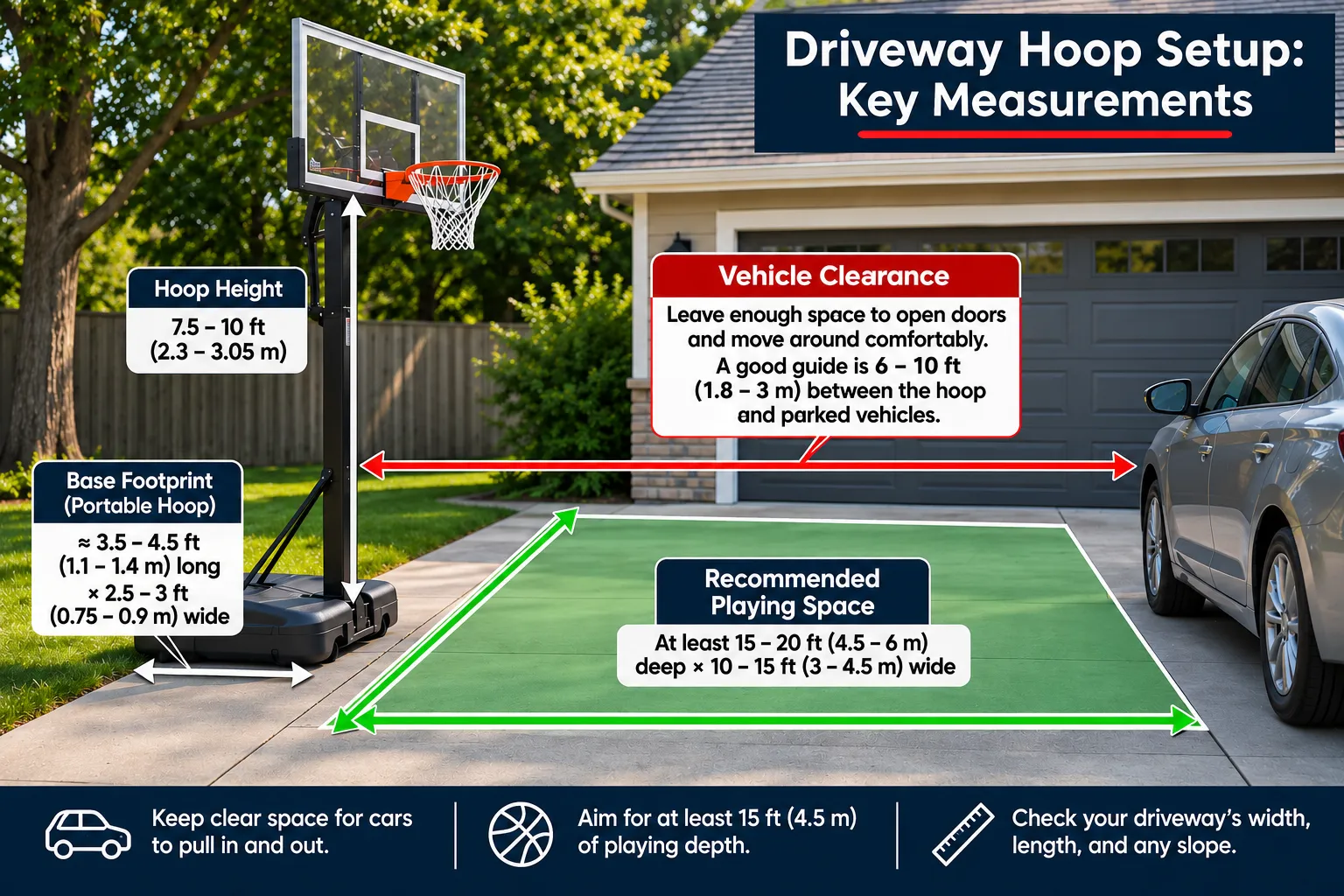
Goalrilla’s basketball hoop buying guide suggests at least 10 feet of concrete in front of the basket, preferably closer to 15 feet.
That’s manufacturer planning guidance, not a universal minimum safety standard.
Stationary shooting requires less room than layups, rebounding, or one-on-one games.
Measure the Playing Area
Measure the available width and depth after accounting for parked vehicles and other obstacles.
Consider where players will stand, move, and retrieve missed shots.
Check for:
- Garage doors and parked vehicles.
- Walls, windows, fences, and steps.
- Curbs, drains, and uneven pavement.
- Pedestrian routes and neighboring property.
- Nearby roads and traffic.
If the available area is too small for safe movement, limit the setup to activities that fit or choose another location.
Check the Portable Base Footprint
A portable hoop’s backboard width doesn’t tell you how much ground space it occupies.
The base may extend behind or beneath the pole.
For example, Spalding lists a 54 × 32-inch base for its researched Momentous portable system.
You can use those dimensions to understand how much pavement the base would occupy.
However, the actual footprint and movement requirements depend on the model.
Before ordering, check whether the base blocks a vehicle, garage door, or walkway.
Understand Basketball Hoop Overhang
Overhang describes how far the backboard extends from the supporting pole, using the manufacturer’s specified measurement points.
It affects how much space players have beneath the basket and where the pole must stand.
Some adjustable hoops change their overhang as the rim moves up or down.
For example, the Goalrilla GS54C advertises up to 2.5 feet of overhang, while its installation manual specifies 21¼ inches at a 10-foot rim height.
These measurements should not be treated as interchangeable.
Check the model’s diagram at your intended playing height before positioning a permanent foundation.
Check Vehicle Clearance
A driveway basketball hoop must also work when nobody is playing.
Consider the height of parked vehicles, roof racks, open rear hatches, and garage doors.
An adjustable basketball hoop can create different clearance problems at different rim heights.
A lowered backboard or support arm may project into the path of a vehicle.
Don’t assume that a 10-foot rim means a vehicle has 10 feet of clear space underneath the complete assembly.
Measure the entire structure and vehicle movement path.
Where Should You Position a Driveway Basketball Hoop?
The best position is one that provides a practical shooting area without creating unnecessary hazards.
Near the Garage
Positioning a basketball hoop near the garage may keep the playing area farther from the road.
However, check whether the backboard, pole, or base interferes with the garage door or vehicles.
A wall-mounted hoop also requires a suitable structure and approved attachment method.
Beside the Driveway
An in-ground pole beside the pavement may preserve more playing space.
However, the foundation must fit the property and comply with the manufacturer’s installation requirements.
Check underground utilities, landscaping, property boundaries, and the required space behind the pole.
Near the Street
Avoid positioning the hoop where playing or retrieving missed shots requires entering traffic.
Goalrilla advises against placing basketball hoops in or overhanging the street because of vehicle risks.
Local rules may also restrict equipment near sidewalks or curbs.
Consider Sunlight and Surface Conditions
Think about when your family will normally play.
Low sunlight behind the basket can make shooting uncomfortable because players must look toward the glare.
Also inspect the driveway for loose gravel, cracks, raised joints, slippery surfaces, and standing water.
A suitable playing surface matters as much as the hoop itself.
Four Driveway Basketball Hoop Examples
These four models illustrate different driveway needs.
They are not a new ranking of the best basketball hoops. For a broader product comparison, see our best basketball hoop guide.
| Basketball hoop | Type | Backboard | Main consideration |
|---|---|---|---|
| Lifetime 90040 | Portable | 44-inch HDPE | Compact budget setup |
| Silverback NXT 54 B7401W | Portable | 54 × 33-inch polycarbonate | Repositioning and playing space |
| Goalrilla GS54C B5003W-1 | In-ground | 54 × 34-inch tempered glass | Permanent foundation and overhang |
| Silverback NXT B8403W | Wall-mounted | 54 × 33-inch polycarbonate | Structural mounting requirements |
Lifetime 90040: Compact Portable Example
The Lifetime 90040 has a 44-inch HDPE Impact backboard and a 27-gallon portable base.
Its rim adjusts from 7.5 to 10 feet in six-inch increments.
The base accepts sand or water according to the manufacturer’s instructions.
This model illustrates a basic driveway basketball setup for casual shooting.
However, its smaller backboard provides less room for bank shots than larger systems.
It also has a standard rim rather than a premium breakaway assembly.
Check the complete dimensions and available space before purchasing.
Silverback NXT 54: Movable Driveway Example
The Silverback NXT 54 B7401W features a 54 × 33-inch polycarbonate backboard.
It adjusts from 7.5 to 10 feet and uses a wheelbarrow-style transport design.
The manufacturer advertises approximately 2.5 feet of overhang and separately identifies 26 inches of clear playing space.
Those figures describe different measurements.
The NXT may be worth investigating if you want a larger portable hoop but still need to clear the driveway.
However, moving a filled basketball hoop requires care and may need two adults.
Model warning: Silverback also sells an older NXT 54 version, B8401W. The versions have different adjustment mechanisms and listings, so confirm the exact model number.
Goalrilla GS54C: Permanent Driveway Example
The Goalrilla GS54C features a 54 × 34-inch tempered-glass backboard and a one-piece 5 × 5-inch steel pole.
It uses a concrete foundation and an anchor system.
The model illustrates how an in-ground hoop can avoid occupying the driveway with a portable weighted base.
However, installation requires careful planning.
The manufacturer’s manual specifies model-specific footing dimensions, concrete requirements, curing time, and assembly procedures.
Its overhang also changes with rim height.
This makes the GS54C a useful example of why homeowners should choose the hoop before marking the foundation location.
Silverback NXT Wall Mount: Space-Saving Example
The Silverback NXT Adjustable Wall Mount B8403W features a 54 × 33-inch polycarbonate backboard.
Its rim adjusts from 7.5 to 10 feet, and the manufacturer lists approximately 2.5 feet of overhang.
It doesn’t require a freestanding pole or portable base.
However, the manufacturer does not include mounting hardware and warns against attaching the system to brick surfaces or facades.
Before purchasing, confirm that the supporting structure and installation method are suitable.
Saving ground space is only an advantage when the wall can safely support the equipment.
Driveway Basketball Hoop Installation
Installation requirements depend on the hoop type.
Installing a Portable Basketball Hoop
Portable basketball hoops usually require assembling the base, pole, backboard, rim, and adjustment mechanism.
Follow the exact model’s assembly sequence.
Fill the base with the approved amount of water or sand at the instructed stage.
Never use an empty or incorrectly weighted basketball hoop.
Also avoid placing improvised weights on the outside of the base instead of using the manufacturer’s required ballast.
Installing an In-Ground Basketball Hoop
An in-ground basketball hoop requires a suitable foundation.
For example, the Goalrilla GS54C manual specifies a footing approximately 48 inches deep, with different top and bottom diameters.
It also specifies a minimum 72-hour concrete curing period before the relevant assembly stage.
These are GS54C-specific requirements, not instructions for every basketball hoop.
Before digging in the United States, contact 811 and follow your state’s utility-location procedures.
A professional installer may be the better option for heavy equipment or difficult ground conditions.
Our basketball hoop installation guide explains the full process.
Installing a Wall-Mounted Basketball Hoop
Wall-mounted basketball hoops require suitable structural support.
Follow the manufacturer’s instructions for attachment points, approved hardware, and required clearances.
Do not assume ordinary wall anchors or decorative exterior materials are adequate.
Professional structural advice may be necessary.
How Much Does a Driveway Basketball Hoop Cost?
The total cost depends on the equipment and installation.
A basic portable basketball hoop can cost considerably less than a premium permanent system.
However, the purchase price is only one part of the budget.
| Cost | Portable hoop | In-ground hoop | Wall-mounted hoop |
|---|---|---|---|
| Hoop hardware | Required | Required | Required |
| Assembly | Usually required | Required | Required |
| Concrete foundation | Not normally required | Usually required | Not normally required |
| Structural mounting work | Not normally required | Not normally required | May be required |
| Professional installation | Optional for some models | Often worth considering | May be necessary |
Research conducted on November 6, 2026, found manufacturer-listed prices of approximately $700 for the newer Silverback NXT 54 portable, $1,750 for the Goalrilla GS54C, and $440 for the Silverback NXT wall mount.
These are dated observations, not guaranteed current offers. Prices, availability, taxes, shipping, and installation charges can change.
For an in-ground system, ask whether a contractor’s quote includes excavation, concrete, anchor installation, assembly, and cleanup.
Don’t compare a portable hoop’s hardware price with an in-ground system’s fully installed price without accounting for the difference.
Driveway Basketball Hoop Stability and Safety
A quality basketball hoop still needs correct installation and maintenance.
Water vs. Sand for Portable Bases
Many portable hoops allow water or sand as ballast.
Follow the manufacturer’s approved filling procedure.
Sand doesn’t automatically make every basketball hoop safe in strong winds, and water-filled bases may require additional care in freezing conditions.
Check the exact model’s instructions.
Wind and Cold Weather
Outdoor basketball hoops face wind, rain, sunlight, and changing temperatures.
No universal safe wind-speed limit applies to every residential hoop.
Check the manufacturer’s instructions for adverse weather and storage.
Inspect metal components for corrosion, plastic bases for cracks, and connections for looseness.
If a hoop is damaged or unstable, stop using it until the problem is resolved.
Breakaway Rims and Dunking
A breakaway rim contains a mechanism that allows it to flex under certain loads.
However, that doesn’t automatically make the entire basketball hoop safe for hanging.
The backboard supports, pole, anchors, and manufacturer’s restrictions all matter.
Never assume that a spring-loaded rim means children or adults can hang from the basket.
Check Product Recalls
If you’re buying a used or older basketball hoop, check its model number and recall status.
On September 22, 2022, the US Consumer Product Safety Commission announced a recall of certain Spalding Momentous EZ portable basketball goals because support-arm welds could fail.
Affected owners were instructed to stop using the equipment and arrange the specified repair.
See the official CPSC recall notice.
The recall doesn’t mean every current Spalding Momentous model is affected.
Driveway Basketball Hoop Rules and HOA Restrictions
Before installing a basketball hoop, check the rules that apply to your property.
These may include:
- City or municipal restrictions.
- Homeowners association rules.
- Lease or rental agreements.
- Shared-driveway access rights.
- Building permits or installation requirements.
There is no single nationwide US rule covering every driveway basketball hoop location.
For example, South Bend, Indiana, restricts basketball hoops in streets and tree-lawn areas, while Portland, Oregon, describes circumstances where portable hoops may be permitted in public rights-of-way.
Always check your own jurisdiction rather than applying another city’s rules.
Driveway Basketball Hoop Buying Checklist
Before ordering, work through these checks.
- Measure the available playing area.
- Check the driveway’s slope and surface condition.
- Confirm where vehicles will park.
- Measure the complete hoop footprint and overhang.
- Check the rim’s minimum and maximum heights.
- Confirm the correct installation method.
- Review local rules and property restrictions.
- Check the manufacturer’s safety and maintenance instructions.
- Compare the total cost, including installation.
- Verify the exact model number, warranty, and any applicable recalls.
If the setup doesn’t leave enough safe playing space, reconsider the location before buying.
Frequently Asked Questions
Which Basketball Hoop Is Best for a Driveway?
A portable basketball hoop is a practical choice for many driveways because it doesn’t require permanent installation.
An in-ground hoop can suit homeowners wanting a dedicated long-term setup, while a wall-mounted system may save ground space when the supporting structure is suitable.
The best choice depends on your driveway and how you plan to use it.
Can I Put a Basketball Hoop in My Driveway?
Usually, a basketball hoop can be used on a suitable private driveway, subject to local rules, property restrictions, and safe placement.
Check the available space, surface condition, vehicle access, and any required permissions before installation.
How Much Does It Cost to Install a Basketball Hoop in Your Driveway?
Costs vary by hoop type and installation requirements.
A portable hoop may only require assembly and approved ballast. An in-ground system requires a foundation, concrete, and potentially professional labor.
Ask for a detailed quote rather than assuming the hardware price includes installation.
What Is the Best Basketball Net for a Driveway?
For most residential driveway hoops, a compatible outdoor-rated nylon or synthetic net is a practical choice.
A chain net may suit certain outdoor setups, but it can be louder and must be compatible with the rim.
Check the attachment points before buying a replacement.
Can You Put a Portable Basketball Hoop on a Sloped Driveway?
Only if the exact manufacturer’s instructions permit the intended surface and setup.
Many portable hoops are designed for level surfaces.
Don’t rely on improvised supports or extra weights to make an unsuitable slope safe.
Is a 54-Inch Backboard Big Enough for a Driveway?
A 54-inch backboard can be suitable for regular recreational basketball.
However, its width alone doesn’t establish whether the entire hoop fits your driveway.
Consider the base, pole, overhang, available playing area, and nearby obstacles.
For more detail, see our basketball backboard dimensions guide.
What Height Should a Driveway Basketball Hoop Be?
The standard basketball rim height is 10 feet.
Adjustable home basketball hoops may lower to 7.5 feet or another manufacturer-specified minimum.
Choose a height appropriate for the players and follow the adjustment instructions.
Our basketball hoop height guide explains regulation and youth basketball heights.
Final Thoughts
A driveway basketball hoop should fit both your playing needs and your everyday use of the property.
Portable hoops offer flexibility, in-ground systems provide a permanent setup, and wall-mounted hoops can preserve ground space.
Before comparing premium features, measure your driveway, check the playing surface, and plan for parking and safe movement.
Choose the setup that works for your actual driveway—not simply the biggest basketball hoop your budget allows.
3 thoughts on “Driveway Basketball Hoop | How to Choose the Right Setup”
Comments are closed.