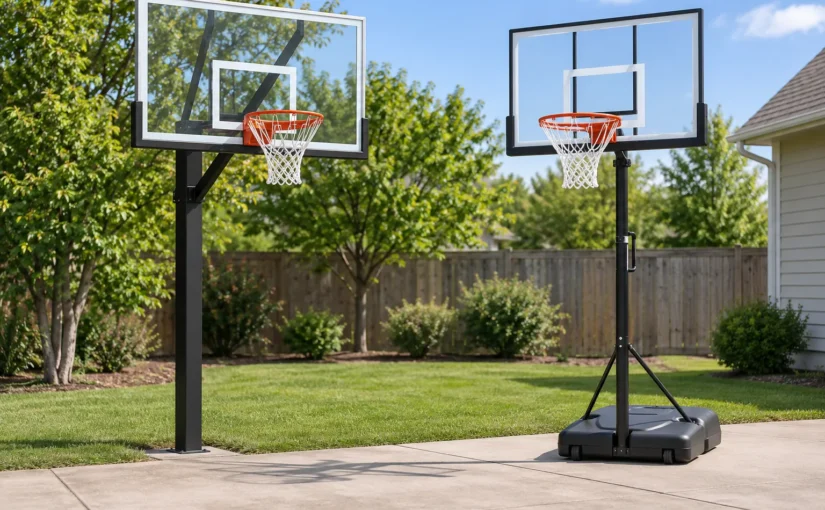
Choosing between an in-ground vs portable basketball hoop comes down to your budget, available space, and how you plan to use it.
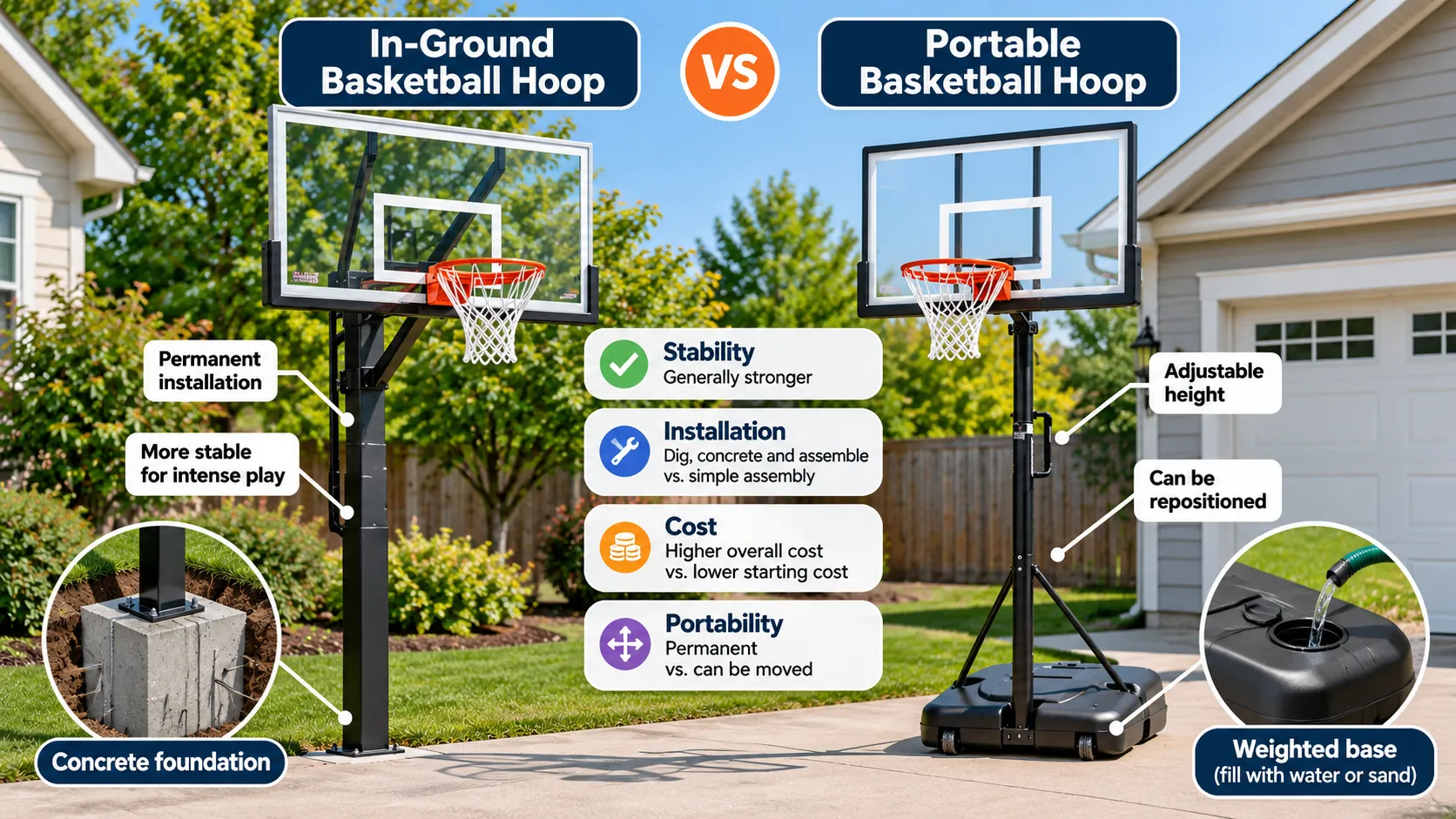
An in-ground basketball hoop is generally the better choice for a permanent home setup because its concrete foundation can provide stronger support. A portable basketball hoop is usually more practical for families who want a lower starting cost, easier setup, or the ability to move their hoop.
Neither option is automatically better for every player. Here’s how they compare.
In-Ground vs Portable Basketball Hoops at a Glance
Both types are available with adjustable rims, different backboard materials, and equipment designed for recreational basketball. Their main differences involve how they’re supported and installed.
| Feature | In-Ground Hoop | Portable Hoop |
|---|---|---|
| Support | Concrete foundation | Weighted base |
| Stability | Generally stronger foundation when properly installed | Depends on ballast and construction |
| Installation | Excavation, concrete, and assembly | Assembly and base filling |
| Starting cost | Equipment plus installation expenses | Budget-friendly options available |
| Portability | Permanent or difficult to relocate | Can be repositioned |
| Playing space | No large weighted base | Base occupies ground space |
| Maintenance | Hardware, corrosion, and structural inspections | Similar inspections plus ballast care |
| Best suited for | Long-term home installations | Families, renters, and flexible setups |
The right choice depends on the complete basketball hoop system, not just whether its pole sits in concrete or a portable base.
What’s the Difference Between In-Ground and Portable Basketball Hoops?
How In-Ground Basketball Hoops Work
An in-ground basketball hoop uses a concrete foundation to support its pole. Some models have poles embedded directly in concrete, while others attach to anchor systems installed in the ground.
This creates a fixed basketball setup without a large portable base occupying part of the playing surface.
However, installation requires careful positioning, excavation, and concrete curing. Some bolt-down models can eventually be relocated, but they aren’t designed for regular movement.
Our basketball hoop installation guide explains the process in more detail.
How Portable Basketball Hoops Work
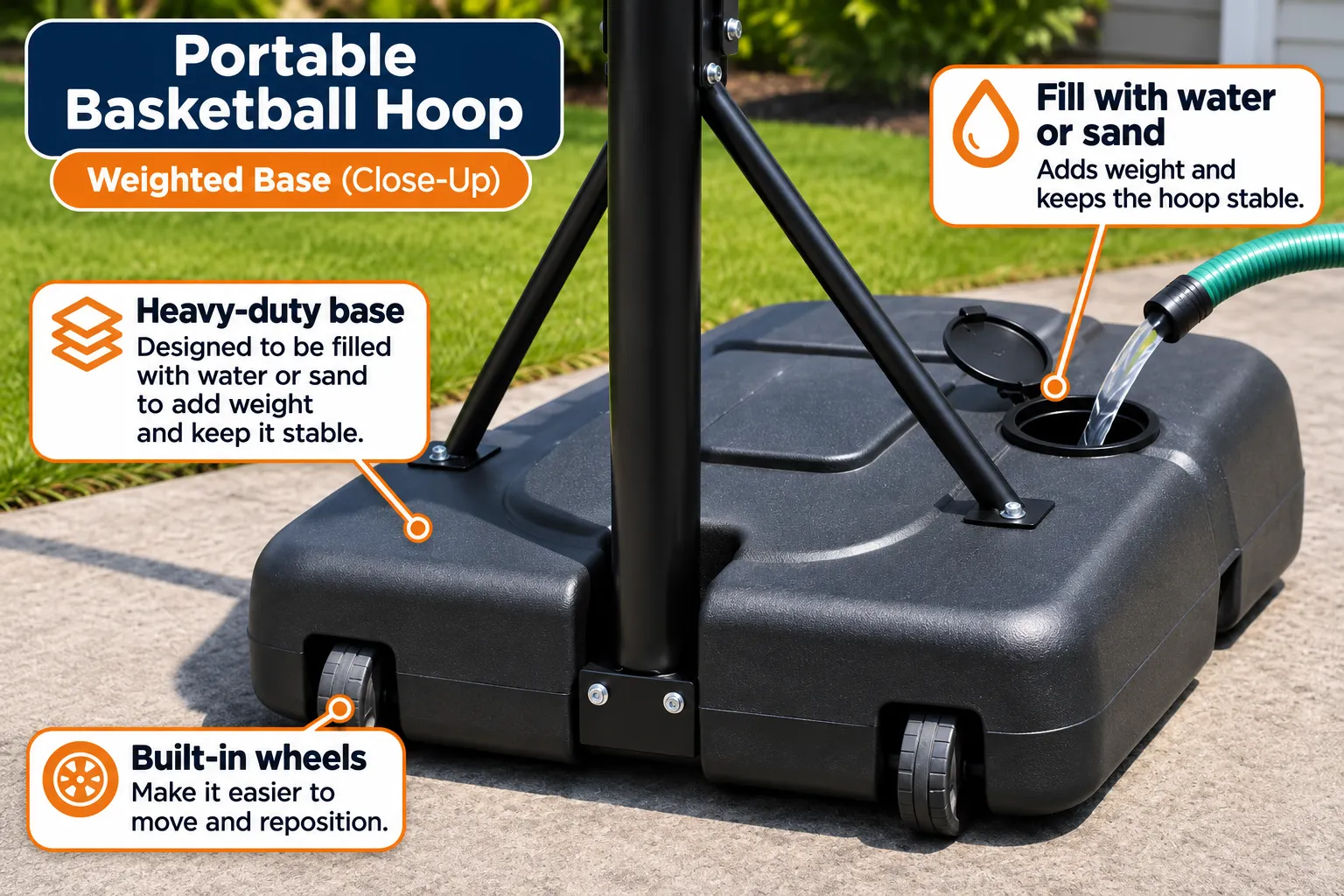
A portable basketball hoop uses a freestanding base filled with water or sand, according to the manufacturer’s instructions.
Many models include wheels that allow adults to reposition the system. Unlike in-ground hoops, they don’t normally require excavation or concrete.
However, portable doesn’t necessarily mean lightweight or easy to move. Some larger systems require two adults to reposition them safely.
See our best portable basketball hoops guide for examples of different designs.
Which Basketball Hoop Is More Stable?
A properly installed in-ground hoop generally provides a stronger foundation than a portable system that relies on a weighted base.
However, stability involves two different things: resisting tipping and reducing movement when the basketball hits the rim or backboard.
An in-ground hoop can still shake if its foundation or support structure is inadequate. Likewise, a well-built portable hoop can provide a substantial playing experience when correctly assembled and weighted.
Backboard construction also affects performance. Tempered glass is commonly associated with an indoor-style rebound, while acrylic and polycarbonate offer different combinations of durability, weight, and playing response.
Neither mounting type guarantees a particular backboard material. Some in-ground hoops use polycarbonate, while premium portable systems can use tempered glass.
Our basketball backboard materials guide explains these differences.
In-Ground vs Portable Basketball Hoop Costs
Portable basketball hoops generally offer a lower entry price, but premium models can cost more than some in-ground systems before installation.
For example, these US equipment prices were recorded on November 7, 2026:
| Basketball Hoop | Type | Observed Equipment Price |
|---|---|---|
| Lifetime Streamline 44-inch | Portable | $169.99 |
| Silverback NXT 54 B8401W | Portable | $609.95 |
| Silverback NXT 54 B8402W | In-ground | $569.95 |
| Goalrilla GS54C | In-ground | $1,749.95 |
These were observed prices, not guaranteed checkout prices. They may change and exclude applicable taxes, delivery, installation, and other expenses.
In-ground hoops also require foundation work. Goalrilla’s installation guidance suggests budgeting $400–$600 for professional installation. This is manufacturer guidance, not a guaranteed US-wide price. Actual quotes depend on the site and whether concrete, materials, and final assembly are included.
Portable systems avoid most foundation expenses but may still require purchased ballast or professional assembly.
Compare the total installed cost rather than the equipment price alone.
Installation and Assembly Differences
Portable hoops are usually quicker to set up because they don’t require a concrete foundation.
According to Lifetime’s assembly guidance, its portable basketball systems generally take one to four hours to assemble. Actual assembly time depends on the model and available help.
In-ground installation involves additional work, including:
- Choosing a suitable installation location.
- Checking underground utilities and local requirements.
- Excavating the specified foundation hole.
- Installing the pole or anchor assembly in concrete.
- Allowing the concrete to cure.
- Completing assembly and checking alignment.
Concrete curing can extend the project over several days. The required foundation dimensions, curing period, and number of helpers vary between products.
Before digging in the US, contact 811 or your state 811 center to arrange underground utility marking. Private underground lines may need separate identification.
Never substitute another manufacturer’s foundation measurements for the instructions supplied with your hoop.
Which Basketball Hoop Is Better for a Driveway?
Both hoop types can work well on a driveway, but they use the available space differently.
The in-ground vs portable basketball hoop choice often depends on whether you need to clear space for parking.
An in-ground hoop can keep a large weighted base out of the playing area. However, its permanent position must allow enough clearance for vehicles, players, and nearby obstacles.
A portable hoop can be repositioned when necessary, but its base takes up space and moving it may require adult assistance.
Measure the complete system, including the backboard, pole, base, and overhang. Don’t assume that a portable hoop will fit inside a garage simply because its rim height can be lowered.
For detailed positioning and clearance advice, read our driveway basketball hoop guide.
Durability, Weather Resistance, and Maintenance
Both in-ground and portable basketball hoops need regular inspection and maintenance.
Check for loose hardware, corrosion, damaged components, and unusual movement. A powder-coated steel pole can resist corrosion, but it isn’t maintenance-free.
Wind and Tipping Risks
Portable basketball hoops depend on their weighted bases for support. A leaking base or incorrect ballast can create a tipping hazard.
Manufacturers also recommend precautions during severe weather, including moving compatible portable systems into an approved storage position or sheltered location.
Don’t assume that adding extra weight makes a portable hoop windproof. Follow the exact model’s instructions.
Water vs Sand for Portable Basketball Hoops
Some portable basketball hoops allow either water or sand inside the base.
Water can be easier to fill and drain, but leaks and freezing temperatures require attention. Sand avoids liquid leakage, although it can make emptying and repositioning the system less convenient.
The correct quantity depends on the specific product. Never estimate the required sand weight from the base’s advertised water capacity.
Winter Storage and Maintenance
Freezing temperatures can damage water-filled bases if the manufacturer’s winterization instructions aren’t followed.
Different manufacturers recommend different procedures. Follow your specific model’s instructions rather than using a generic antifreeze mixture or draining method. Spalding’s product FAQ illustrates why instructions must be checked by manufacturer.
In-ground hoops also require maintenance, including checking their hardware, pole, rim, and adjustment mechanism.
In-Ground vs Portable Basketball Hoops: Pros and Cons
In-Ground Basketball Hoop Pros and Cons
Advantages:
- Strong permanent foundation when installed correctly.
- No large portable base occupying the driveway.
- Suitable for long-term residential setups.
- Available with substantial poles and glass backboards.
Disadvantages:
- Requires excavation and concrete work.
- Higher potential installation expenses.
- Installation can take several days.
- Difficult to reposition or remove.
Portable Basketball Hoop Pros and Cons
Advantages:
- Lower-cost entry options.
- No ordinary concrete foundation required.
- Can be moved when necessary.
- Suitable for households that need flexibility.
Disadvantages:
- Weighted base occupies ground space.
- Ballast requires regular attention.
- Wind and freezing conditions need planning.
- Some models require two adults to move.
Which Type of Basketball Hoop Should You Choose?
When making an in-ground vs portable basketball hoop decision, consider your long-term plans as well as the upfront cost.
The best basketball hoop depends on your priorities.
| Your Situation | Recommended Starting Point |
|---|---|
| Beginner or family on a limited budget | Portable hoop |
| Renter or planning to move | Portable hoop, subject to property rules |
| Long-term homeowner wanting a fixed setup | In-ground hoop |
| Serious player prioritizing rebound performance | Compare backboard and support construction across both types |
| Driveway that must regularly be cleared | Portable hoop, if movement is practical |
| Permanent playing area with suitable installation space | In-ground hoop |
If you’re still deciding between specific systems, compare our best in-ground basketball hoops with our portable recommendations.
Frequently Asked Questions
Are In-Ground Basketball Hoops Worth It?
They can be worth the additional installation expense for homeowners who want a permanent basketball setup. However, the equipment, installation quality, and available playing space all affect the final result.
Can You Dunk on a Portable Basketball Hoop?
Only if the manufacturer explicitly permits the intended use. Some residential hoops prohibit dunking or hanging, including certain in-ground models with breakaway rims. Always check the exact product manual.
Can You Move an In-Ground Basketball Hoop?
Some bolt-down systems can be removed from their anchors and relocated to another suitable foundation. Direct-burial systems are generally more difficult to move.
How Long Does Basketball Hoop Installation Take?
Portable assembly can often be completed in one day. In-ground installation usually takes longer because excavation, concrete work, and curing must be completed before the hoop is ready for use.
Can You Install an In-Ground Hoop on an Existing Driveway?
Possibly, but an ordinary driveway slab shouldn’t automatically be considered a suitable foundation. The installation must meet the hoop manufacturer’s requirements and any applicable local conditions.
Final Verdict: In-Ground or Portable Basketball Hoop?
Choose an in-ground basketball hoop if you want a permanent setup, have suitable installation space, and can afford the additional foundation work.
Choose a portable basketball hoop if you want a more flexible option, prefer to avoid permanent construction, or need a lower starting price.
Whichever type you choose, pay attention to the backboard, pole construction, stability, and installation requirements. A well-matched basketball hoop is more useful than simply choosing the biggest or most expensive model.
5 thoughts on “In-Ground vs Portable Basketball Hoop | Which Is Better?”
Comments are closed.