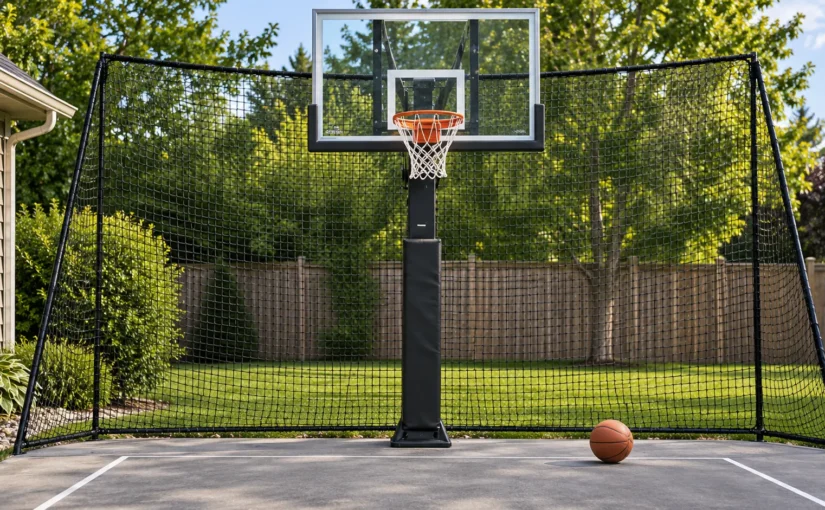
A basketball backstop net catches many missed shots before they roll into the street, neighboring yards, or landscaping. It sits behind or around your basketball hoop and helps you spend less time chasing balls.
Backstop nets come in several designs, including portable barriers, hoop-mounted attachments, and permanent netting systems. The best choice depends on your available space, basketball system, and where missed shots usually go.
This guide explains the different types, recommended sizes, materials, costs, and installation options for a backyard or driveway basketball court.
What Is a Basketball Backstop Net?
A basketball backstop net is a large mesh barrier designed to stop basketballs from traveling beyond a playing area.
Unlike the small net attached to a basketball rim, a backstop net usually stands behind the hoop. When a missed shot hits the barrier, the net absorbs some of the impact and prevents the ball from traveling farther.
Some basketball backstop nets also redirect balls toward the court. However, they are primarily designed for ball containment, not controlled passing or shooting practice.
A backstop can be useful when your basketball hoop is near:
- A street or driveway entrance.
- A neighbor’s property.
- Windows, vehicles, or landscaping.
- A fence that missed shots frequently clear.
Backstop nets reduce the need to retrieve basketballs, but they cannot guarantee that every missed shot stays within your yard.
Types of Basketball Backstop Nets
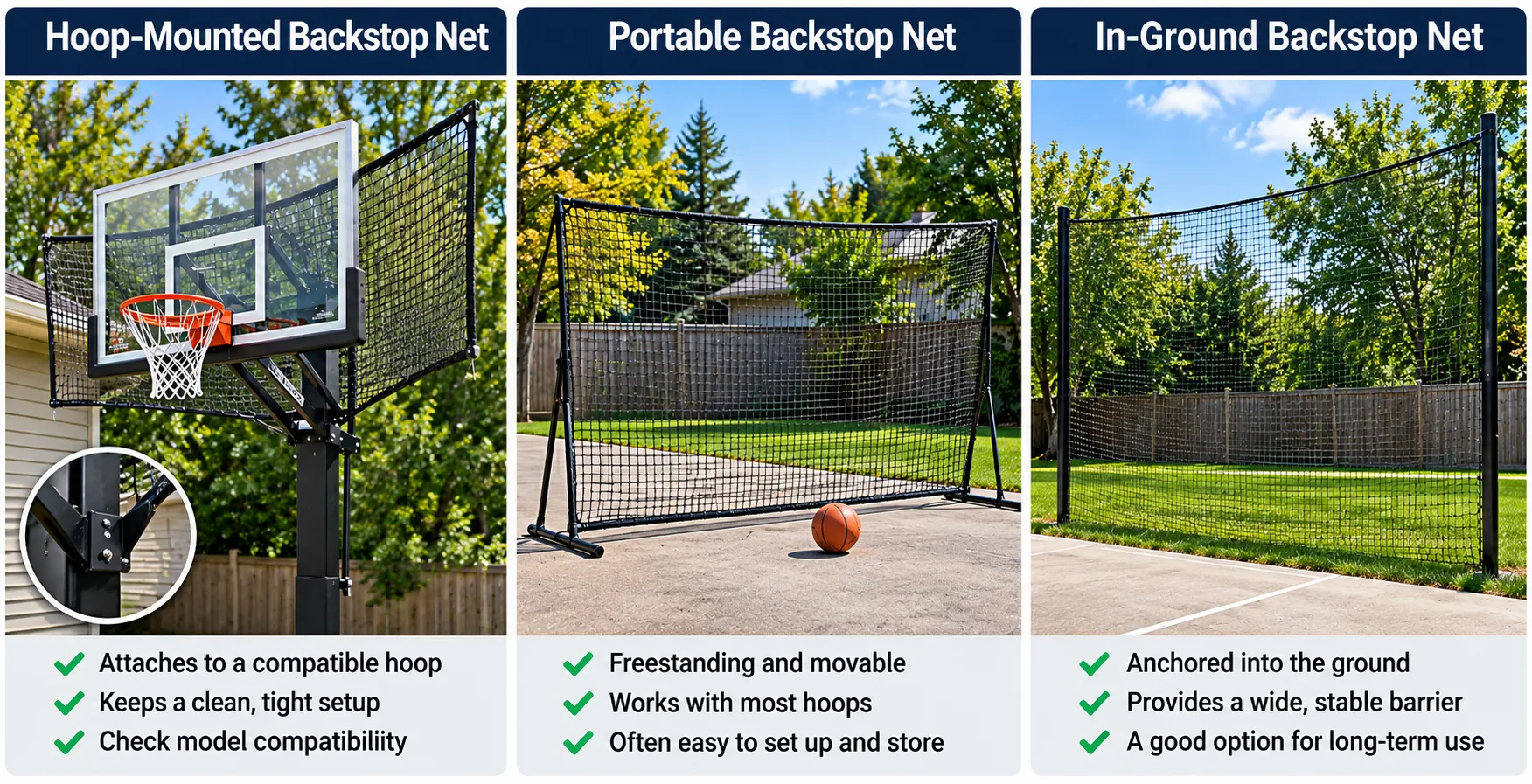
There are four main types of basketball backstop systems. Each offers different benefits depending on your basketball hoop and available space.
1. Hoop-Mounted Basketball Backstop Nets
Hoop-mounted backstop nets attach directly to compatible basketball systems.
They usually use brackets, support rods, and a mesh barrier positioned behind the backboard.
For example, the Goalrilla Yard Guard attaches to selected Goalrilla basketball systems. Its installed width is approximately 12 feet 9 inches, with a height ranging from 7 to 9 feet.
These systems are convenient because they work alongside an existing basketball hoop.
However, compatibility is essential. Some attachments only fit specific pole dimensions or basketball hoop models.
Before ordering, check your hoop’s manufacturer, model, and pole dimensions.
2. Portable Basketball Backstop Nets
Portable backstop nets use freestanding frames that can be positioned behind a basketball hoop.
They are useful for driveways, backyard basketball courts, and temporary practice areas.
The GoSports Portable Sports Barrier Net comes in 12 × 9-foot and 20 × 10-foot sizes.
Its manufacturer supplies stakes for grass or dirt and sandbags for hard surfaces.
Portable systems offer several advantages:
- They do not require a compatible basketball hoop.
- They can be moved between locations.
- Many can be disassembled for storage.
- They may be suitable for multiple sports.
Their main limitation is stability. Always follow the manufacturer’s anchoring and weather instructions.
3. In-Ground Basketball Backstop Nets
In-ground basketball backstop nets use supports anchored into natural ground.
They can provide a wider barrier behind a backyard basketball hoop.
For example, QUICKPLAY’s In-Ground Barrier Net System offers 10-foot-high configurations with different widths.
These systems are particularly useful when you have grass or another suitable natural-ground installation area.
However, they require appropriate ground conditions and installation according to the manufacturer’s instructions.
Check underground utilities before installing ground anchors.
4. Custom and Permanent Basketball Backstop Nets
Custom basketball backstop nets are designed for specific court layouts.
They may use independent posts, cables, walls, or other engineered support systems.
Suppliers such as West Coast Netting provide basketball netting for residential and commercial applications.
Custom systems may be appropriate when a standard net cannot provide enough coverage.
Larger permanent installations should be assessed by a qualified specialist, particularly where wind exposure, structural attachments, or nearby hazards are involved.
Basketball Backstop Net Comparison
| Type | Best for | Main consideration |
|---|---|---|
| Hoop-mounted | Compatible driveway hoops | Model compatibility |
| Portable | Temporary backyard use | Anchoring and storage |
| In-ground | Natural-ground installations | Soil and ground anchors |
| Custom/permanent | Larger or unusual courts | Professional design and installation |
What Size Basketball Backstop Net Do You Need?
The correct basketball backstop net size depends on your hoop’s position, the available space, and where missed basketballs travel.
There is no universal required height or width for residential basketball backstop nets.
Basketball Backstop Net Height
Consumer backstop nets commonly include products with heights between approximately 7 and 10 feet.
For example:
- Pro Dunk: 7-foot-high attachment.
- Silverback Yard Guard: Approximately 8 feet high.
- Goalrilla Yard Guard: 7–9 feet high, depending on the section.
- QUICKPLAY: 10-foot-high barrier configurations.
These are product specifications, not official basketball backstop height standards.
West Coast Netting recommends approximately 10 feet of height as a residential starting point.
A taller net may intercept more high misses, but its support structure must also be suitable for the installation.
Basketball Backstop Net Width
The net should cover the area where basketballs usually escape.
West Coast Netting suggests a residential starting width of approximately 12–15 feet.
However, a narrow driveway may need different coverage from a large backyard basketball court.
Measure the available space and consider shots that travel diagonally past the backboard.
Do not assume that a net’s advertised maximum height applies across its entire width.
Where Should You Position the Net?
Position the backstop where it can intercept missed basketballs without creating an obstacle for players.
Consider:
- The basketball hoop’s location.
- The court boundaries and player movement.
- The net’s width and height.
- Support posts, anchors, and frame feet.
- Space behind the net for movement when struck.
Avoid placing hard supports where players may run or land.
For additional court measurements, see our basketball court dimensions guide.
Basketball Backstop Net Materials
Basketball backstop nets are commonly manufactured from nylon, polyester, or polyethylene.
Each material can work for ball containment, depending on its construction and intended use.
| Material | Common applications | What to check |
|---|---|---|
| Nylon | Hoop-mounted and custom nets | UV treatment and durability |
| Polyester | Portable and commercial barriers | Mesh construction and weather care |
| Polyethylene | Outdoor modular barriers | UV treatment and product warranty |
The material alone does not determine which net is strongest or most durable.
Compare the actual product specifications, including mesh construction, border reinforcement, and weather instructions.
What Mesh Size Is Best for Basketball?
Mesh size describes the openings between the net’s strands.
Gourock offers 4-inch mesh specifically for basketball barriers, alongside smaller openings such as 2 inches and 1¾ inches.
Smaller openings may be more suitable when the barrier must also contain smaller sports balls.
There is no single mandatory mesh size for every residential basketball backstop.
Choose a net designed for the balls and activities you intend to use.
How Much Does a Basketball Backstop Net Cost?
Basketball backstop net prices vary depending on size, construction, mounting method, and manufacturer.
The following examples were recorded from US supplier listings in November 2026.
| Basketball backstop net | Size | Listed price |
|---|---|---|
| GoSports Portable Barrier | 12 × 9 ft | $119.99 |
| GoSports Portable Barrier | 20 × 10 ft | $179.99 |
| QUICKPLAY In-Ground Barrier | 10 × 10 ft | $149.99 |
| Silverback Yard Guard | Over 10 ft wide × 8 ft tall | $219.95 |
| Pro Dunk Backstop Net | 10 ft 6 in × 7 ft | $299.00 |
| Goalrilla Yard Guard | 153 in wide, variable height | $319.95 |
Sources: GoSports, QUICKPLAY, Silverback, Pro Dunk, and Goalrilla.
These are advertised equipment prices, not installed totals. Prices and availability may change.
Basketball Backstop Net Installation Costs
Portable basketball backstop nets are often designed for owner assembly.
A compatible hoop-mounted attachment may also be suitable for DIY installation when the manufacturer’s instructions are followed.
Custom permanent systems are different.
Installation costs can include:
- Support posts and cables.
- Anchors or concrete foundations.
- Ground preparation.
- Labor and equipment.
- Structural design where required.
There is no reliable single nationwide installation price for custom basketball backstop nets.
Request an itemized quote from a specialist for permanent installations.
How to Install a Basketball Backstop Net
The exact installation process depends on the system you purchase.
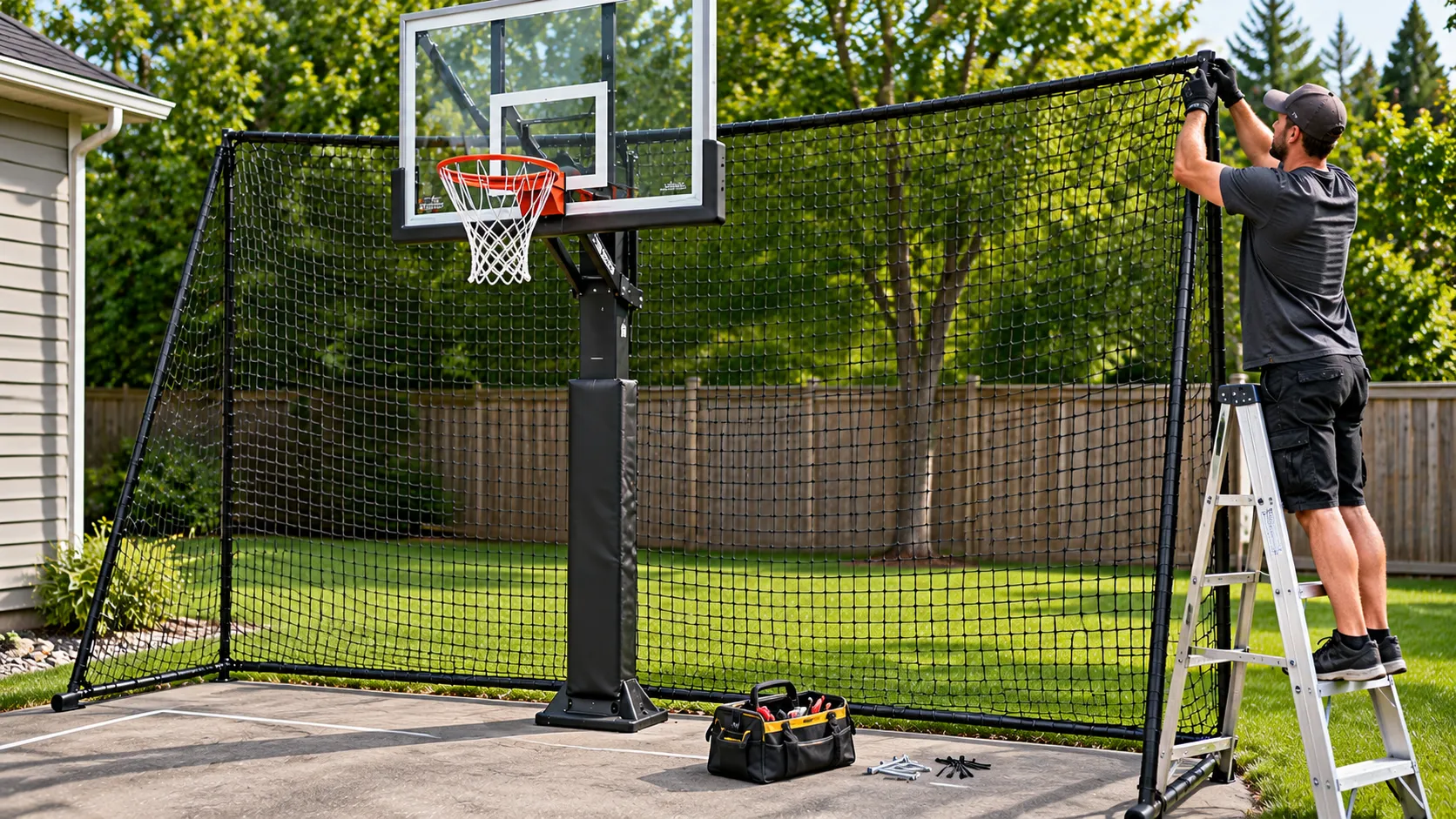
These steps provide a general planning guide. Always follow the manufacturer’s instructions for the actual installation.
Step 1: Measure the Area
Identify where missed shots normally travel.
Measure the available width and height behind the basketball hoop.
Check for nearby windows, property boundaries, landscaping, and roads.
Step 2: Choose a Compatible System
Decide whether you need a portable, hoop-mounted, in-ground, or permanent backstop.
For hoop-mounted systems, confirm your basketball hoop’s exact model and pole dimensions.
Do not assume that an attachment fits every basketball hoop.
Step 3: Check the Installation Surface
Portable nets may use stakes on natural ground or manufacturer-approved ballast on hard surfaces.
In-ground systems require suitable soil and anchors.
Before driving stakes or digging, follow your state’s 811 utility-location process.
Step 4: Assemble the Supports
Follow the manufacturer’s instructions for connecting the frame, brackets, rods, or posts.
Some systems require two adults and a stable ladder.
Do not modify your basketball hoop or improvise structural attachments.
Step 5: Attach and Position the Net
Secure the mesh using the supplied attachment components.
Check that the net is properly positioned and that its supports do not obstruct players.
Follow the manufacturer’s tensioning instructions.
Step 6: Inspect Before Playing
Check the assembled system for loose connections, instability, and damaged mesh.
Make sure the basketball hoop still operates correctly.
Do not use the backstop if any part appears unsafe.
Basketball Backstop Net Safety and Maintenance
A basketball backstop net should reduce ball escapes without introducing unnecessary hazards.
Inspect the net and its supporting components regularly.
Look for:
- Torn or fraying mesh.
- Loose brackets and connections.
- Rust or damaged supports.
- Moving or unstable anchors.
- Gaps that allow basketballs to escape.
Follow the manufacturer’s cleaning and storage instructions.
For example, Goalrilla’s Yard Guard manual requires storage when the product is not being used, during storms, and during aggressive play.
Do not assume that a net marketed for outdoor use can remain installed in every weather condition.
A basketball backstop is also not designed to catch falling players. Keep hard components outside the playing area.
Basketball Backstop Nets vs. Basketball Court Fencing
Basketball backstop nets and court fencing can both help contain missed basketballs, but they serve different purposes.
A backstop net usually covers a specific area behind or around a basketball hoop.
Court fencing typically forms a more permanent boundary around part or all of a basketball court.
A backstop net may be easier to remove or reposition, while fencing can provide a longer-lasting perimeter solution.
However, neither automatically guarantees complete ball containment.
If you need a larger court boundary, read our basketball court fencing guide for fence types, heights, costs, and installation.
Common Basketball Backstop Net Mistakes
Avoid these mistakes when choosing and installing a basketball backstop net.
Buying an incompatible attachment: Check the basketball system’s exact model before purchasing.
Choosing a net that is too narrow: Measure where missed shots actually travel rather than relying on the backboard’s width.
Ignoring the installation surface: Ground stakes and hard-surface ballast are not interchangeable.
Overlooking weather instructions: Outdoor-compatible materials do not guarantee that a portable system can remain outside permanently.
Installing supports too close to players: Keep frames, posts, and anchors outside the playing area.
Confusing a backstop with a rebounder: Some backstop nets redirect balls, but they are not necessarily designed to deliver controlled practice passes.
Frequently Asked Questions
Where Can I Find Backstop Nets for My Basketball Hoop?
You can find basketball backstop nets through basketball hoop manufacturers, sports-equipment retailers, and specialist netting suppliers.
Goalrilla, Silverback, and Pro Dunk sell attachments for compatible basketball systems. GoSports and QUICKPLAY offer separate barrier systems.
Check the product’s dimensions and compatibility before ordering.
Are Basketball Rebounders Worth It?
A basketball backstop with a ball-return function may be worthwhile if you regularly chase missed shots.
However, a backstop is different from a dedicated basketball rebound training system.
Choose based on whether you need ball containment, controlled passing practice, or both.
What Is the Best Basketball Net for a Driveway?
For a driveway with a compatible in-ground hoop, a manufacturer-approved hoop-mounted backstop can be convenient.
For other setups, a freestanding portable barrier designed for hard-surface use may be more suitable.
The best option depends on your hoop, driveway space, and anchoring requirements.
What Is a Backstop in Basketball?
A basketball backstop is a barrier that intercepts missed shots before they travel beyond the playing area.
It commonly consists of mesh netting supported by a frame, posts, or a compatible basketball hoop.
Can You Use a Backstop Net With a Portable Basketball Hoop?
Yes, a separately supported portable barrier can be positioned behind a portable basketball hoop.
However, do not assume that hoop-mounted attachments designed for in-ground basketball systems will fit a portable hoop.
Can a Basketball Backstop Net Stay Outdoors All Year?
That depends on the manufacturer’s instructions.
Some products use UV-treated materials, but portable systems may still require storage during storms or when not in use.
Check the exact product’s weather limitations and warranty.
Final Thoughts
A basketball backstop net can make backyard and driveway basketball more convenient by reducing the number of missed shots that leave the playing area.
For many homeowners, a compatible hoop-mounted attachment or portable barrier is a practical starting point. Larger courts may benefit from custom netting.
Before buying, focus on coverage, compatibility, anchoring, and player safety rather than choosing the largest net available.
The right backstop should suit your basketball court, stop balls where they usually escape, and remain safe throughout its intended use.
5 thoughts on “Basketball Backstop Net | Types, Sizes, Costs & Installation”
Comments are closed.