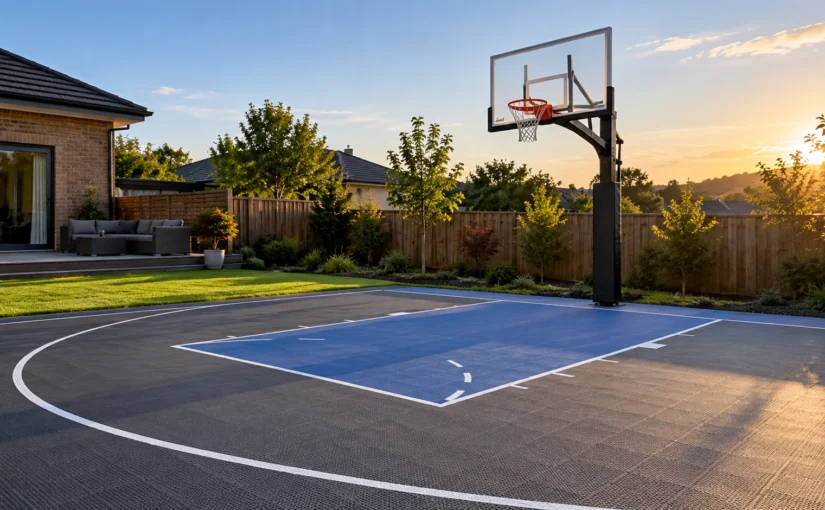
A backyard basketball court gives you a convenient place to practise shooting, improve your ball handling, or play games with family and friends. You don’t need a full-size court to enjoy basketball at home. Even a small shooting area can work well if you plan the space properly.
The right backyard basketball court depends on your available space, budget, playing needs, and preferred surface. Before choosing materials or buying a hoop, consider how you’ll use the court and what your property can realistically accommodate.
Backyard Basketball Court Options and Sizes
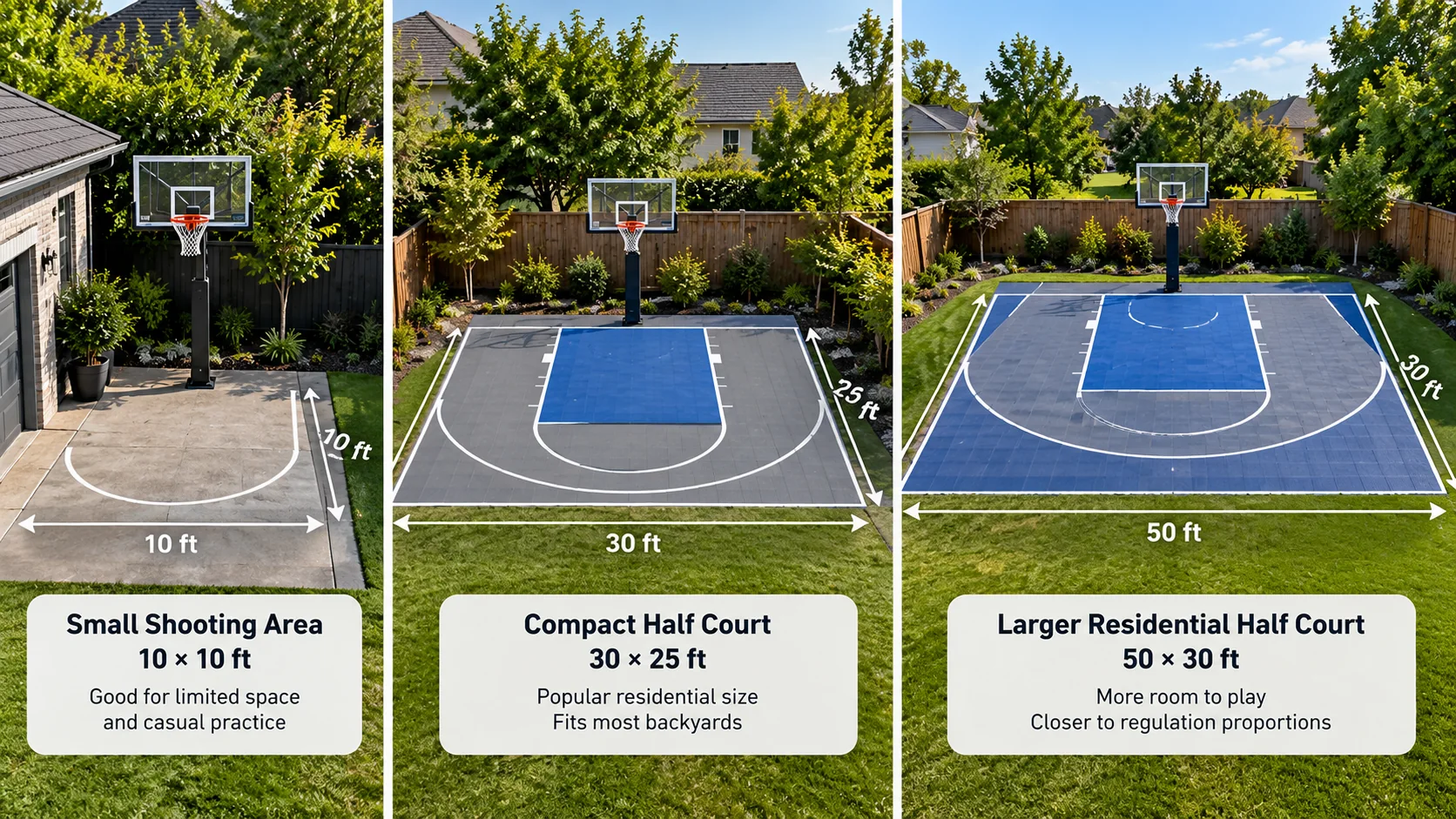
Backyard basketball courts come in different sizes and layouts. Some homeowners only need enough space to practise shooting, while others want a half court for one-on-one or three-on-three games.
| Court type | Best for | Main consideration |
|---|---|---|
| Shooting area | Individual practice and small backyards | Limited movement and shooting distance |
| Driveway court | Homes with an existing paved driveway | Vehicles, slopes, and nearby obstacles |
| Compact court | Shooting drills and casual games | May not fit regulation markings |
| Residential half court | Families and small-sided games | Needs enough width and clear space |
| Full court | Large properties and team games | Requires substantial space and clearance |
Small Shooting Areas and Driveway Courts
A small shooting area is often the easiest way to play basketball at home. It might consist of a single hoop and a hard surface large enough for close-range shots, free throws, and basic dribbling.
A driveway can also serve as a basketball area if its surface is suitable. Before installing a hoop, check for steep slopes, cracks, parked vehicles, garage doors, and nearby roads.
If you plan to add modular basketball court tiles, confirm that the existing pavement meets the manufacturer’s installation requirements. Not every tile system is suitable for vehicle traffic.
Compact Backyard Basketball Courts
A compact basketball court provides more room than a basic shooting pad without requiring a regulation half court.
You can include a free-throw line, part of the key, and selected shooting spots. A full three-point line may not fit, particularly when the available space is narrow.
Focus on the basketball activities you enjoy most. If you mainly practise layups and mid-range shots, a wider playing area may be more useful than a long, narrow court.
Backyard Half Courts
A backyard half court is a popular choice for families and players who want enough space for shooting, rebounding, and small-sided games.
There is no single official size for a residential half court. Commercial court packages are available in different dimensions, including approximately 30 × 30 feet and 50 × 30 feet.
For example, a 30 × 30-foot court can support shooting and casual games, while a 30 × 40-foot layout offers more room for movement. These are examples of custom backyard dimensions, not official half-court standards.
For comparison, half of an NBA-sized 94 × 50-foot playing rectangle measures 47 × 50 feet. That measurement does not include additional space for safe movement, hoop supports, or other obstacles.
The best size depends on the shots, drills, and games you want to play, plus the clearance available around the court.
Full-Size Basketball Courts
A full basketball court has two hoops and enough space for end-to-end play.
Official playing-court dimensions include:
- NBA: 94 × 50 feet.
- NCAA men’s basketball: 94 × 50 feet.
- FIBA: 28 × 15 metres.
- NFHS high school: An ideal court size of 84 × 50 feet.
These dimensions describe the playing area, not the complete space required for a backyard installation.
A full court also needs room for equipment, access, drainage, and appropriate clearance around the playing area.
For a closer look at official measurements, see our guide to basketball court dimensions.
Backyard Basketball Court Design Ideas
A good backyard basketball court design should make the most of your available space while keeping the playing area practical and safe.
Small Backyard Layouts
For a small backyard, position one hoop at the end of a rectangular playing surface.
You may only need a free-throw reference, a few shooting spots, and enough room to approach the basket.
If balls could reach windows, neighbouring gardens, or roads, consider adding suitable containment netting behind the hoop.
Family Half-Court Layouts
A residential half court can include a key, free-throw line, and three-point arc where space permits.
An adjustable basketball hoop is particularly useful for families with children of different ages.
You can also use temporary shooting markers for younger players instead of permanently painting shorter distances onto the surface.
Full-Court and Multi-Sport Designs
If your backyard is large enough, a full court allows more realistic basketball games and conditioning drills.
Some homeowners also design their courts for other sports, such as volleyball or badminton.
For a multi-sport court, choose compatible flooring and removable equipment. Use different line colours so the basketball markings remain easy to follow.
Court Markings, Colours, and Accessories
Basketball court lines help players practise shooting distances and understand positioning.
A compact court doesn’t need every regulation marking. A clearly marked free-throw line and a few shooting references may be more useful than squeezing an entire court diagram into a small space.
Court colours can also improve the appearance of your backyard. Choose contrasting colours that make the lines easy to see.
Other practical design features include ball storage, fencing, lighting, and seating outside the playing area.
If you plan to play at night, outdoor LED court lighting can improve visibility. Position and angle the lights to illuminate the playing area without shining into neighbouring homes.
Pole padding can also help reduce injury risks where players might contact a hoop support, although it does not replace adequate clearance.
Our basketball court diagram guide explains the main lines and markings if you want to plan your layout.
Choosing the Best Location for an Outdoor Basketball Court
The best location for an outdoor basketball court is not necessarily the flattest-looking part of your backyard.
Start by measuring the available space and identifying obstacles such as trees, walls, fences, steps, and overhead cables.
Consider these factors before settling on a location:
- Ground conditions: Soft soil, existing fill, or unstable ground may require additional preparation.
- Drainage: Rainwater needs somewhere suitable to go without collecting on the court or affecting neighbouring property.
- Sunlight: Check whether the sun will shine directly into your eyes during the hours you normally play.
- Nearby obstacles: Keep the playing area away from windows, roads, exposed posts, and other hazards.
- Access: Contractors and delivery vehicles may need room to transport materials and equipment.
- Neighbours: Basketball noise, lighting, and balls crossing boundaries can cause problems.
Remember that the marked court is only part of the space you need. Hoop supports, fencing, surface edges, and safe movement around the playing area also require room.
There is no universal clearance measurement for every residential court. The appropriate space depends on the layout, equipment, and surrounding obstacles.
Best Backyard Basketball Court Surfaces
Your basketball court surface affects how the ball bounces, how the court feels underfoot, and how much maintenance it needs.
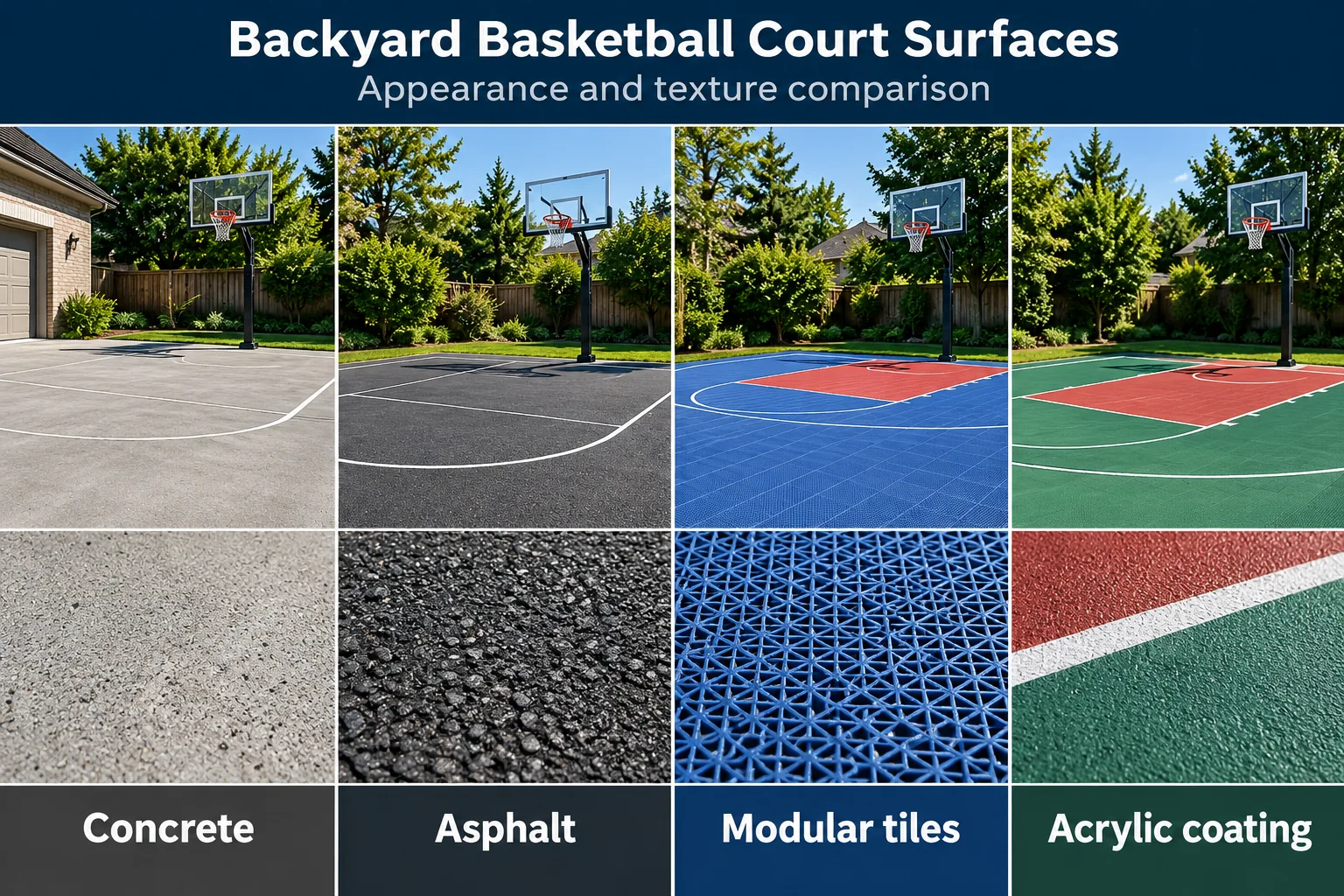
The main options include concrete, asphalt, acrylic coatings, and modular basketball court tiles.
For a step-by-step look at preparing the ground, installing the surface, and hiring a contractor, read our basketball court installation guide.
For further guidance on outdoor court planning, see FIBA’s outdoor basketball court recommendations.
| Surface | Main advantages | Main limitations |
|---|---|---|
| Engineered foundation panels | Some systems offer alternatives to conventional paving | Product-specific ground preparation and restrictions |
| Concrete | Firm surface with predictable ball bounce | Hard underfoot and may develop cracks |
| Asphalt | Suitable for outdoor basketball and compatible coatings | Can deteriorate with weather and ground movement |
| Modular tiles | Replaceable sections and product-specific drainage features | Need a suitable foundation and correct installation |
| Acrylic coating | Coloured, textured playing finish | Requires a properly prepared base and periodic maintenance |
Concrete and Asphalt
Concrete is a common foundation for backyard basketball courts. A properly finished slab provides a firm playing surface with consistent ball bounce.
However, concrete is hard underfoot and may crack because of ground movement, drainage problems, or other conditions.
Asphalt is another outdoor basketball surface. It can be used on its own or covered with a compatible sports coating.
Both materials require appropriate ground preparation and drainage. Neither should be considered maintenance-free.
Modular Basketball Court Tiles
Modular basketball court tiles connect to create a finished playing surface.
Depending on the product, they may offer drainage openings, textured grip, different colours, and replaceable sections.
However, most modular tiles require a flat, stable foundation such as suitable concrete or asphalt.
Do not assume basketball court tiles can be installed directly on grass or dirt. Some manufacturers offer engineered alternative foundation systems, but these require their own approved preparation methods.
The ball bounce, traction, and impact characteristics also vary between tile products.
Acrylic Coatings and Alternative Foundations
Acrylic sports coatings provide a coloured, textured finish over properly prepared concrete or asphalt.
They can improve the appearance and playing texture of a court, but a standard acrylic coating does not repair structural cracks or automatically provide cushioning.
Some manufacturers also offer engineered foundation panels as alternatives to conventional concrete or asphalt bases.
These systems are not interchangeable with ordinary modular tiles. Check the complete manufacturer’s specifications before choosing one.
Choosing a Basketball Hoop for Your Backyard
The right basketball hoop depends on the available space, who will use it, and whether you want a permanent installation.
Portable basketball hoops are useful for driveways and temporary playing areas. They can be moved, but their bases occupy space and must be filled or weighted according to the manufacturer’s instructions.
In-ground basketball hoops are better suited to permanent courts. They generally provide greater stability, although they require an appropriate foundation and careful positioning.
Wall-mounted basketball hoops can save ground space when a suitable structural wall is available. Always check whether the wall and mounting system are approved for the intended installation.
Adjustable basketball hoops are useful for families. USA Basketball and the NBA recommend lower baskets for younger players where possible, including 8 feet for ages 7–8 and 9 feet for ages 9–11.
Before buying a hoop, check its adjustment range, support footprint, backboard overhang, and installation requirements.
Planning Your Backyard Basketball Court
Before building a backyard basketball court, confirm that the project is practical for your property.
Start with these decisions:
- Measure your space. Allow for the playing surface, hoop support, access, and surrounding obstacles.
- Choose the main purpose. Decide whether you want shooting practice, family games, or more competitive basketball.
- Check the location. Review drainage, ground conditions, sunlight, and access.
- Select a suitable surface. Make sure the foundation and playing surface are compatible.
- Choose your hoop. Confirm its dimensions and installation requirements before finalising the court layout.
- Check local requirements. Planning permission, building permits, property setbacks, drainage rules, and homeowners’ association restrictions vary by location.
- Plan the budget. Account for site preparation, surfacing, hoop installation, and optional accessories.
Some projects are suitable for DIY work, particularly when installing an approved modular surface over an existing sound foundation.
Larger projects involving excavation, concrete slabs, drainage, or structural hoop foundations may need professional assistance.
For detailed construction instructions, see our DIY basketball court guide. If you’re comparing project expenses, our guide to basketball court construction costs explains the main factors.
Backyard Basketball Court Maintenance and Common Mistakes
Regular maintenance helps keep a backyard basketball court usable and reduces the chance of small problems becoming larger repairs.
Sweep away leaves, dirt, and loose debris. Keep drains clear and check the surface for cracks, movement, or standing water.
Overhanging branches can drop leaves and other debris onto the court, so trim them where appropriate and safe. Clean the playing surface using methods approved by its manufacturer, and inspect cracks before they develop into larger problems.
Avoid sealing every crack without checking whether it indicates movement in the underlying foundation.
Inspect the basketball hoop for loose hardware, corrosion, damaged parts, and stability problems. Follow the manufacturer’s maintenance instructions for your specific equipment.
For modular surfaces, check for loose tiles, raised edges, and blocked drainage openings.
Common planning mistakes include:
- Choosing a court size without allowing room for safe movement.
- Ignoring drainage until construction begins.
- Buying modular tiles before checking foundation requirements.
- Positioning the hoop too close to obstacles.
- Using unsuitable materials or coatings.
- Overlooking neighbours, lighting, and noise.
- Assuming every basketball court needs regulation markings.
A well-planned smaller court is often more useful than a larger court with poor positioning or limited clearance.
Backyard Basketball Court FAQs
How Small Can a Backyard Basketball Court Be?
There is no official minimum size for a residential basketball court. A small shooting pad can work if it provides enough room for the shots and movements you want to practise.
Is a 30 × 30-Foot Basketball Court Big Enough?
A 30 × 30-foot court can provide a useful one-basket area for shooting, free throws, and some casual games. However, it is not a regulation half court and cannot accommodate every official marking.
Can You Put a Basketball Court on Grass?
You can practise casual shooting on grass, but it doesn’t provide the consistent bounce needed for normal basketball dribbling. Most modular basketball court tiles also require an approved foundation rather than direct installation on grass.
Can Basketball Court Tiles Go Over a Driveway?
Yes, some modular basketball court tiles can be installed over suitable concrete or asphalt driveways. The pavement must meet the manufacturer’s requirements for condition, flatness, and drainage. Check separately whether the finished surface can handle vehicle traffic.
Do Backyard Basketball Courts Need Permits?
Sometimes. Requirements depend on your location and may involve groundworks, drainage, fencing, lighting, property boundaries, and other factors. Check with your local authority before starting construction.
How Can You Reduce Backyard Basketball Court Noise?
Position the hoop away from neighbouring homes where possible. Use appropriate containment netting to prevent balls from striking walls and fences, keep loose equipment, and avoid playing at disruptive hours.
Is a Half Court Enough for Basketball Practice?
Yes. A well-designed half court can support shooting, ball handling, layups, rebounding, and small-sided games. A full court is mainly necessary when you want end-to-end basketball.
Final Thoughts
A backyard basketball court doesn’t need to be full-size or expensive to be useful.
Start with the space you have and the type of basketball you want to play. Then choose a suitable layout, surface, and hoop while allowing for drainage, safe movement, and nearby obstacles.
Whether you create a small shooting area or a larger family half-court, thoughtful planning will make your backyard basketball court more enjoyable and practical for years to come.
3 thoughts on “Backyard Basketball Court | Sizes, Surfaces & Design Ideas”
Comments are closed.