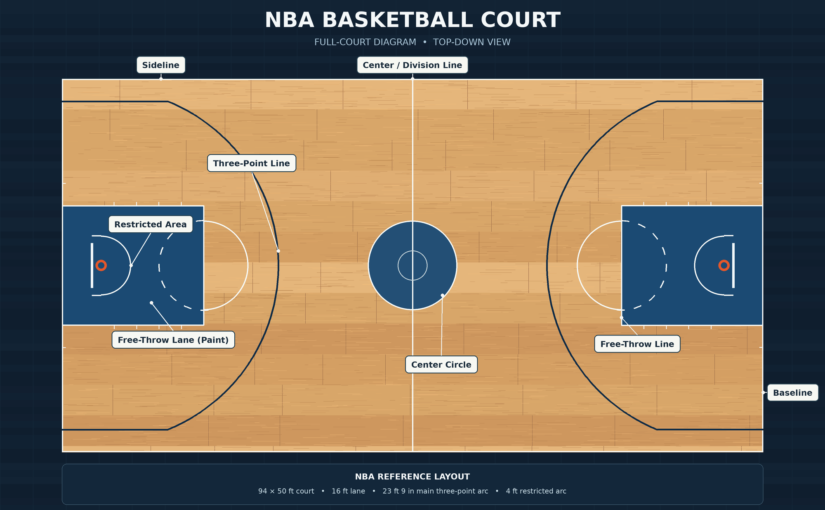
A basketball court diagram shows the baskets, boundary lines, and marked playing areas. It helps beginners understand the court, coaches explain positioning, and players recognize where different rules apply.
Below, you’ll find full-court and half-court layouts, explanations of the main markings, and a comparison of NBA, NCAA, FIBA, and high school courts.
Full-Court Basketball Diagram
A full-court basketball diagram shows the entire playing surface, including both baskets, sidelines, baselines, center line, center circle, three-point lines, and free-throw lanes.
The center line divides the court into two halves. Each end contains a basket, a free-throw area, and a three-point arc. The basket’s height is another important measurement, which we explain in our basketball hoop height guide.
Official diagrams may also show measurements, lane-space marks, bench areas, and the scorer’s table. These extra details are useful when comparing league rules or planning court markings.
Half-Court Basketball Diagram
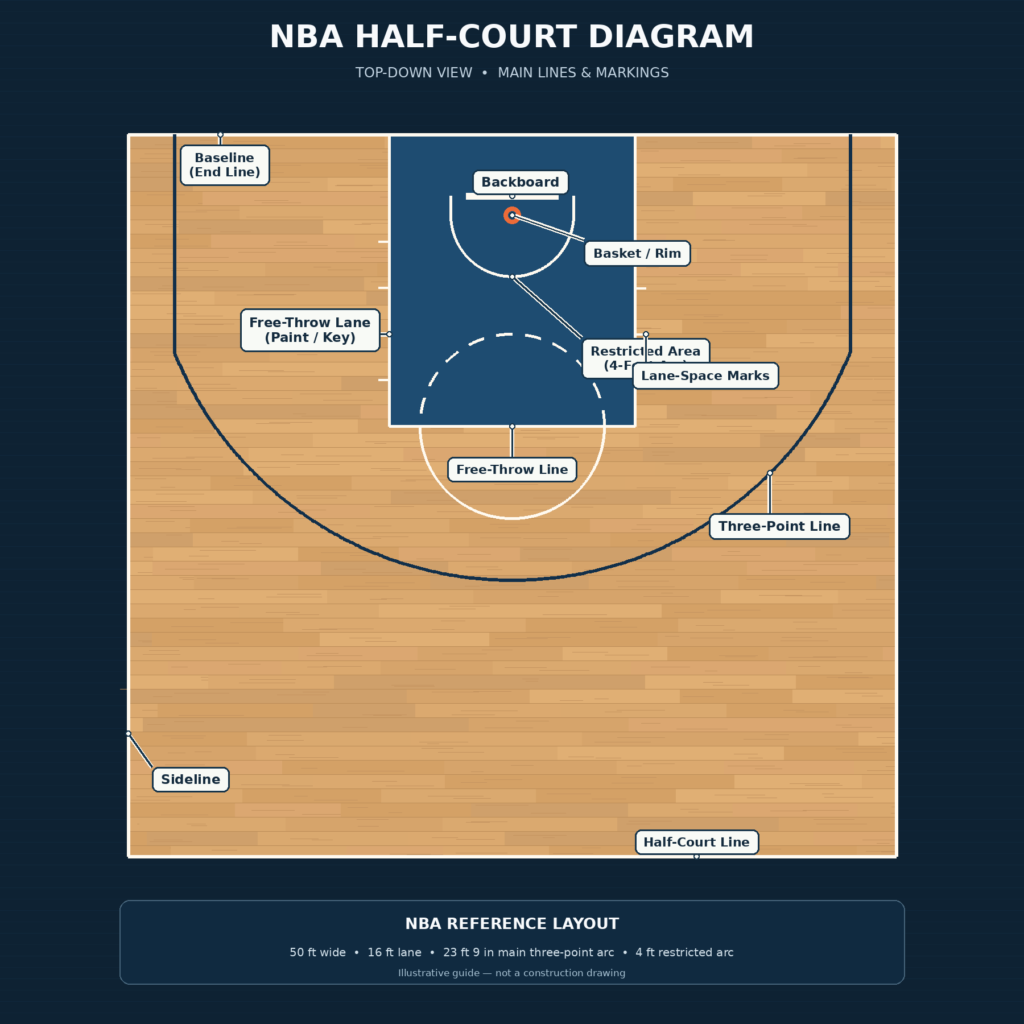
A half-court diagram gives you a closer look at one basket and the surrounding playing area.
Starting near the hoop and moving outward, you can identify the small restricted-area or no-charge arc, the painted free-throw lane, the free-throw line, and the three-point line.
Coaches also use blank half-court diagrams to draw basketball plays, explain player movement, and plan drills.
A half-court diagram is usually a simplified view of one end of a full court, rather than a separate set of official rules.
Basketball Court Lines and Markings Explained
Sidelines and Baselines
The sidelines are the long boundary lines along each side of the court. The shorter boundaries behind the baskets are called end lines or baselines.
A player touching one of these boundary lines is out of bounds. The lines help officials determine whether the ball or a player has left the playing area.
Center Line and Center Circle
The center line, also called the division line, separates the court into two halves.
The center circle marks the location of the opening jump ball. On NBA and NCAA courts, it has a 6-foot radius and a 12-foot diameter.
The division line also helps distinguish a team’s frontcourt from its backcourt.
Three-Point Line
The three-point line separates the areas used to determine whether a successful field goal counts for two or three points.
On NBA courts, the main arc measures 23 feet 9 inches from the center of the basket. Corner three-pointers are shorter because the line runs parallel to the sidelines.
The shooter’s feet must be outside the three-point line when the shot is released for a successful basket to count as three points. A foot touching the line makes it a two-point attempt.
Free-Throw Line and Lane
The free-throw line marks where a player stands to attempt free throws.
On NBA courts, it’s 15 feet from the plane of the front face of the backboard.
The rectangular area extending toward the baseline is commonly called the paint, key, or free-throw lane.
Small lane-space marks identify where players line up during free throws. The free-throw circle, centered on the free-throw line, is another feature shown on official diagrams.
Restricted Area and No-Charge Arc
The small arc beneath the basket is important in certain charging and blocking decisions. To understand the equipment above this area, see our guide to the parts of a basketball hoop.
In the NBA, it’s called the restricted area and has a 4-foot radius measured from the center of the basket ring.
FIBA uses the term no-charge semicircle for its smaller 1.30-meter arc.
However, FIBA calls the larger rectangular paint the restricted area. This is why the same term can point to different markings on NBA and FIBA diagrams.
NBA, NCAA, FIBA, and High School Court Diagrams
Basketball courts share a similar layout, but their measurements and markings vary between leagues.
| League | Court size | Three-point distance | Lane width |
|---|---|---|---|
| NBA | 94 × 50 ft | 23 ft 9 in (main arc) | 16 ft |
| NCAA | 94 × 50 ft | 22 ft 1¾ in | 12 ft |
| FIBA | 28 × 15 m | 6.75 m | 4.90 m |
| NFHS high school | Typically 84 × 50 ft | 19 ft 9 in | 12 ft |
These are useful reference measurements, not complete construction specifications.
One important NCAA difference concerns the restricted-area arc. The men’s court includes a marked 4-foot arc, while NCAA women’s rules no longer require that painted marking.
FIBA diagrams use metric measurements, while NBA, NCAA, and NFHS diagrams generally use feet and inches.
For a more detailed comparison, read our basketball court dimensions guide.
How to Read a Basketball Court Diagram
Start by checking which rules the diagram follows. An NBA layout shouldn’t automatically be used as a guide for marking an NCAA or FIBA court.
Then identify the main features:
- Find the sidelines and baselines to establish the court boundaries.
- Locate the center line and center circle to understand the full-court layout.
- Find the basket and free-throw lane at each end.
- Follow the three-point line around the basket to identify the shooting area.
- Check the smaller markings, including restricted arcs and free-throw rebound spaces.
Pay attention to measurement arrows. Official diagrams may measure to the inside or outside edge of a painted line. That difference matters because court markings have width.
A recreational driveway or backyard court may use fewer markings or a smaller playing area. Don’t assume every diagram shows a regulation court.
Printable Basketball Court Diagrams
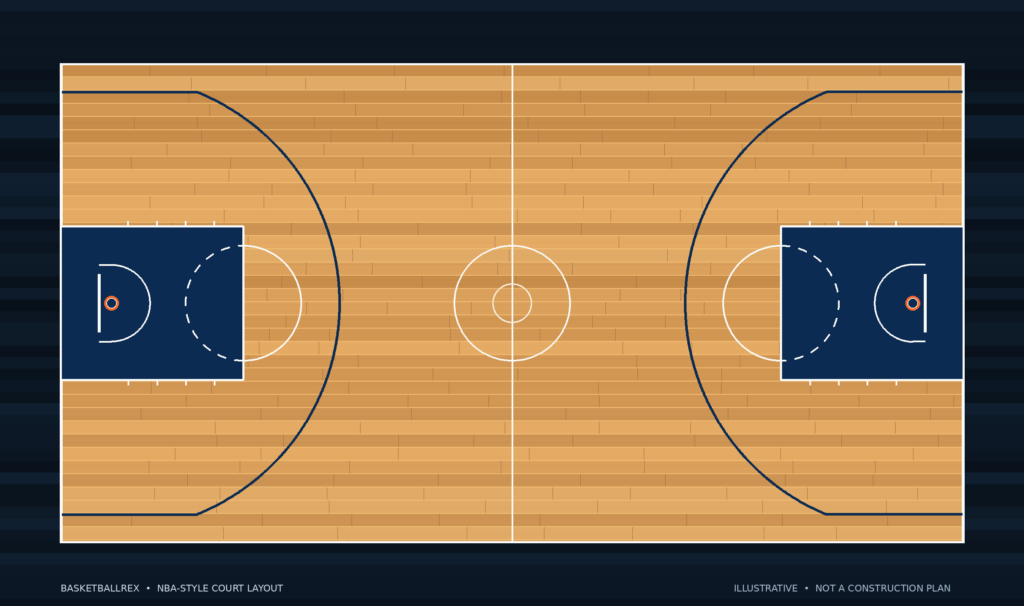
You can find official basketball court diagrams through the organizations responsible for each set of rules.
- NBA court rules and diagram — Professional court markings and measurements.
- FIBA Official Basketball Rules 2026 (PDF) — Full-court and detailed area diagrams.
- NCAA men’s basketball rules and court diagram — Current men’s court resources.
- NCAA women’s basketball rules and court diagram — Women’s court resources.
- NFHS high school basketball court diagram — Official high-school reference.
For coaching, blank full-court and half-court templates are also useful for drawing plays, planning drills, and explaining player positions.
Basketball Court Diagram FAQs
What’s the difference between a full-court and half-court diagram?
A full-court diagram shows both baskets and the entire playing surface. A half-court diagram focuses on one end, making individual markings easier to see.
What is the key on a basketball court?
The key is a common name for the painted free-throw lane near the basket. Its width and official terminology depend on the league.
Why do some basketball courts have multiple three-point lines?
Some gyms are used for different competitions, so they may have separate three-point markings for high school, college, or international basketball.
Are all basketball court diagrams the same?
No. NBA, NCAA, FIBA, and high school courts share basic features, but their measurements and some markings differ.
One thought on “Basketball Court Diagram | Lines, Markings & Layout Explained”
Comments are closed.