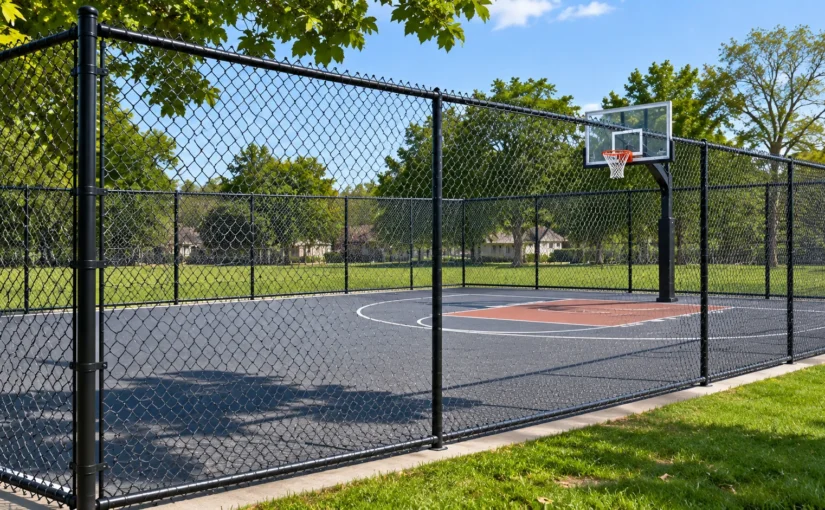
Basketball court fencing helps keep stray balls inside the playing area, control access, and reduce the chance of balls reaching roads or neighboring properties. It is used around backyard courts, schools, parks, and commercial sports facilities.
Chain-link fencing is a practical starting point for many outdoor basketball courts. Available options range from low 4-foot barriers to 10-foot or taller systems, depending on the court and its surroundings. There is no single regulation fence height for every basketball court.
This guide explains fencing types, heights, installation costs, safety considerations, and how to choose a suitable fence for your court.
What Is Basketball Court Fencing?
Basketball court fencing is a barrier installed around all or part of a basketball court. Its main purpose is usually to contain stray balls, although some systems also help control access to the facility.
A court fence can serve several purposes:
- Ball containment: Reduces the number of balls leaving the playing area.
- Access control: Helps manage entry to schools, parks, and private facilities.
- Property protection: Helps limit balls reaching neighboring properties, buildings, or vehicles.
- Court separation: Creates boundaries between nearby sports facilities.
Not every basketball court needs a complete enclosure. A backyard hoop may only need netting behind the basket, while a public sports facility may benefit from a full perimeter fence with gates.
The right design depends on the court’s location, available space, and intended use.
Does a Basketball Court Need a Fence?
Not every basketball court requires fencing. Whether a fence is necessary depends on local regulations, the surrounding environment, and the risks associated with stray balls. ASTM F3729-25 provides guidance for assessing fencing around outdoor sport and recreation areas, but it does not impose one national basketball fencing rule.
A fence is particularly useful when a court is close to:
- Roads or parking areas.
- Neighboring properties.
- Buildings and windows.
- Other sports courts.
- Areas where spectators gather.
For a backyard basketball court, partial fencing behind the hoop may provide useful ball containment for casual play. Schools and public sports facilities may prefer full-perimeter fencing to manage access and reduce interruptions from stray balls.
However, an ordinary court fence is not a certified vehicle-impact barrier or a guarantee that every ball will remain inside.
Planning a home setup? Our backyard basketball court guide covers layout and space considerations.
Types of Basketball Court Fencing
Several fencing materials are available. Each has different benefits, costs, and maintenance requirements.
Chain-Link Fencing
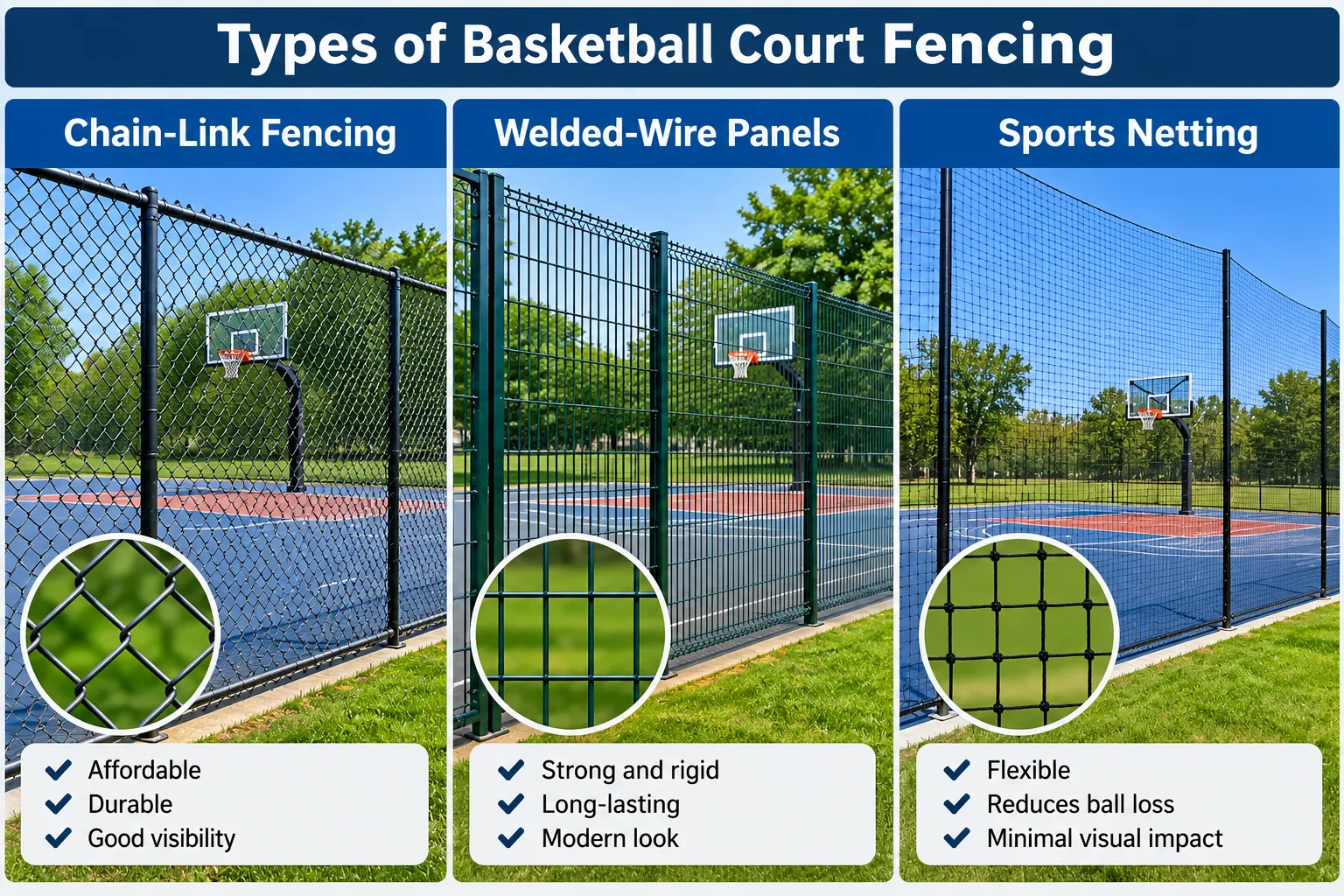
Chain-link fencing is a common choice for outdoor sports courts because it provides a durable barrier while allowing visibility through the mesh.
Two common finishes are available:
- Galvanized chain-link: Steel wire protected by a zinc coating to resist corrosion.
- Vinyl-coated chain-link: Steel wire with an additional polymer coating, commonly available in black or green.
Chain-link fencing can be used around residential courts, schools, parks, and commercial facilities.
When comparing products, check the wire gauge, mesh opening, coating, posts, and wire-end finish. The Chain Link Fence Manufacturers Institute’s product manual recommends knuckled wire ends for additional safety in playfields and parks.
Welded-Wire Sports Fencing
Welded-wire fencing uses rigid steel panels with wires joined at their intersections. Unlike flexible chain-link mesh, welded panels maintain a fixed shape.
Purpose-designed sports panels may suit courts where a rigid barrier and a particular appearance are preferred. However, ordinary garden fencing should not automatically be considered suitable for repeated ball impacts.
Ask the supplier about impact suitability, panel connections, exposed edges, and replacement parts.
Basketball Court Netting
Basketball netting provides a flexible barrier designed primarily to stop or slow stray balls. It can be installed behind a hoop, along one court boundary, or around a larger playing area.
Netting is useful when a full chain-link enclosure is unnecessary. Suppliers offer different mesh openings, heights, and materials. Outdoor netting should be suitable for sunlight and weather exposure.
Important: Ball-containment netting is not automatically suitable for security, child containment, or vehicle protection.
Other Fencing Options
Other possibilities include ornamental metal fencing, wood screening, and solid barriers. These options may suit certain properties, but their appearance alone does not establish their suitability for basketball.
Consider visibility, collision hazards, ball containment, and structural requirements. Indoor basketball facilities may instead use divider nets or retractable curtains to separate courts.
Basketball Court Fencing Comparison
| Fence type | Main advantage | Main limitation |
|---|---|---|
| Galvanized chain-link | Durable, visible barrier | Can corrode if its protection is damaged |
| Vinyl-coated chain-link | Coating and color options | Coating can wear or become damaged |
| Welded-wire sports panels | Rigid construction | Requires a suitable sports-fencing design |
| Sports netting | Flexible ball containment | Usually not a security barrier |
| Wood or solid screening | Privacy and visual screening | Visibility, impact, and wind-load concerns |
For many outdoor courts, chain-link offers a practical balance of durability, visibility, and ball containment.
How High Should Basketball Court Fencing Be?
Basketball court fencing comes in several heights, but there is no universal regulation height that applies to every basketball court in the United States.
The appropriate height depends on how much ball containment is needed and what lies beyond the fence.
| Fence height | Possible application |
|---|---|
| 4–6 feet | Lower residential boundaries where some ball escape is acceptable |
| 8 feet | Taller ball-containment options for residential courts |
| 10 feet | Residential or commercial sites needing greater containment |
| 11 feet or more | Project-specific public or commercial installations |
These are planning examples, not mandatory minimum heights. A 6-foot fence may stop some stray balls but cannot guarantee full containment. An 8- or 10-foot barrier may catch more shots, particularly behind baskets.
For example, a 2025 court project in Beacon, New York, specified 11-foot vinyl-coated chain-link fencing. That does not make 11 feet a national requirement.
If a court is near a busy road or another serious hazard, height alone may not be enough. A designer may recommend additional containment or a different layout.
How Far Should a Fence Be From a Basketball Court?
Basketball fencing should be positioned beyond the playing boundaries so players have room to move without immediately encountering a hard obstruction. This surrounding space is often called the run-off area.
For reference:
- NCAA men’s basketball rules: At least 3 feet of unobstructed space outside the sidelines, preferably 10 feet.
- FIBA basketball rules: At least 2 meters (approximately 6 feet 7 inches) of unobstructed space surrounding the court.
These figures apply within their respective playing-rule contexts. They are not universal backyard-fencing laws or interchangeable construction standards. See the NCAA men’s rules and FIBA Official Basketball Rules 2026 for their exact requirements.
When planning a fence, account for posts, gate hardware, braces, and other protruding components. Do not assume protective padding makes inadequate clearance acceptable.
Our basketball court dimensions guide explains the playing area before you plan the surrounding space.
How Much Does Basketball Court Fencing Cost?
Basketball court fencing costs depend on material, height, fence length, ground conditions, gates, and installation requirements.
Published US pricing provides the following examples:
| Fencing system | Published price per linear foot |
|---|---|
| 6-foot commercial chain-link, installed (9-gauge) | $20–$31 |
| 8-foot commercial chain-link, installed (9-gauge) | $26–$40 |
| 10-foot commercial chain-link, installed (6-gauge) | $38–$60 |
| Court-builder chain-link allowance; height unspecified | $50–$75 |
| Court-builder soft-netting allowance; scope unspecified | $25–$30 |
The first three ranges come from a 2026 commercial chain-link pricing guide. The last two come from Austin Courts & Floors’ published court-building allowances.
These figures are not directly interchangeable. The Austin allowances do not specify fence height or all installation inclusions. None of the figures is a guaranteed local quotation.
Example Basketball Court Fencing Cost
Suppose a hypothetical rectangular enclosure measures 40 × 60 feet. Its perimeter is 200 linear feet.
Using the published $38–$60 installed rate for one specified 10-foot commercial chain-link configuration:
- Lower estimate: 200 × $38 = $7,600.
- Higher estimate: 200 × $60 = $12,000.
The illustrative fencing subtotal is $7,600–$12,000, before any work excluded from the base pricing. Gate openings and gate charges may be measured separately.
This is an arithmetic example, not a regulation basketball court layout or contractor quote.
What Affects Basketball Court Fencing Costs?
Several factors can increase the final price:
- Taller or heavier fencing materials.
- Difficult excavation or rocky ground.
- Larger foundations.
- Pedestrian and maintenance gates.
- Removing existing fencing.
- Engineering and permits.
- Surface repairs and drainage work.
- Windscreens or other accessories.
Request an itemized quotation identifying the fence specifications, labor, gates, foundations, and any exclusions. If you are building the playing surface too, our basketball court installation guide explains the wider construction process.
How to Install Basketball Court Fencing
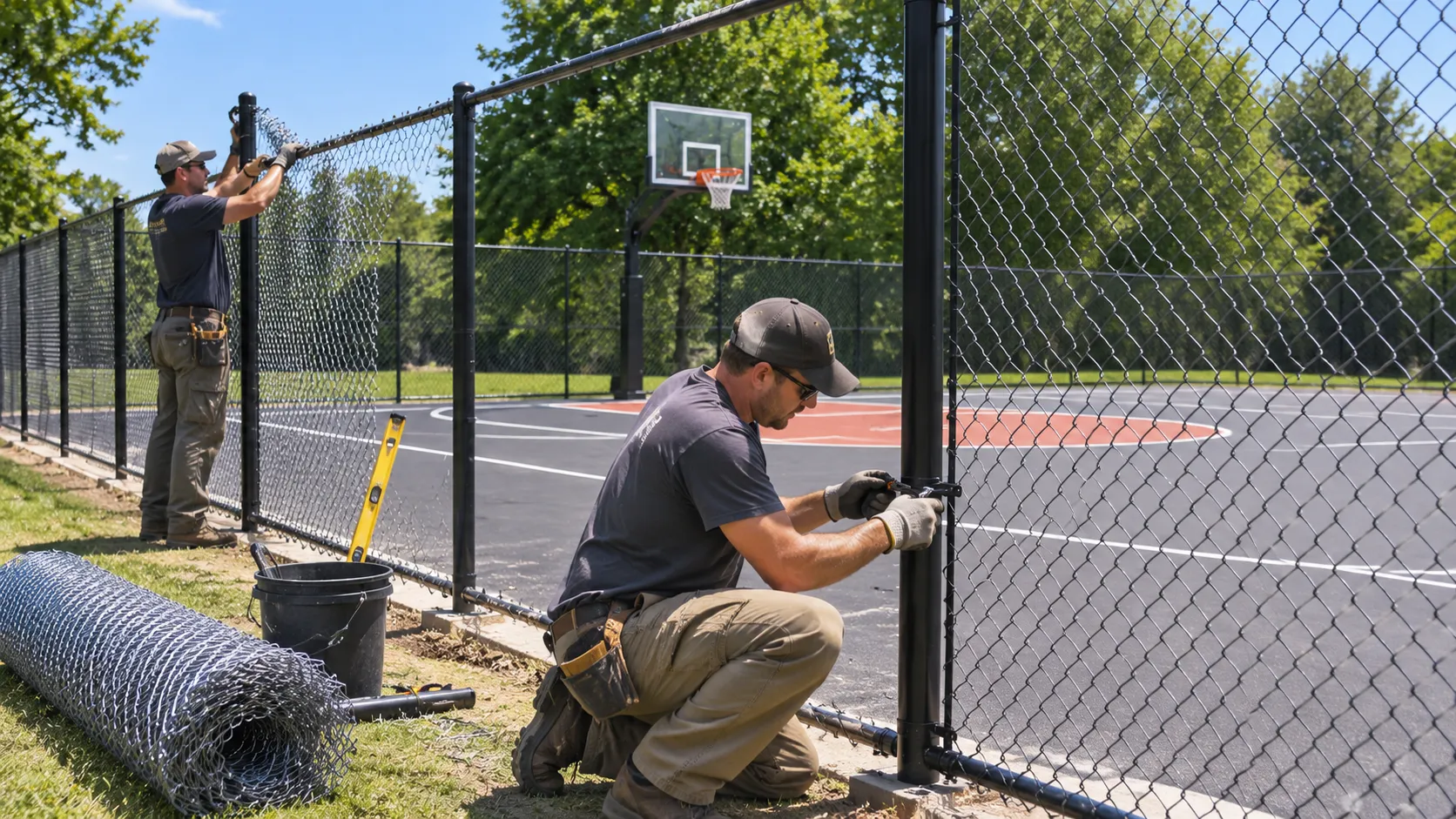
Installing basketball court fencing involves more than attaching mesh to posts. The layout, foundations, drainage, and structural requirements must be considered before construction begins.
Step 1: Plan the Layout and Check Local Rules
Measure the proposed fence perimeter and identify the playing boundaries. Allow appropriate player clearance and decide where gates will be installed.
Check local requirements covering fence height, setbacks, permits, and property boundaries.
Step 2: Locate Underground Utilities
Before digging, arrange for underground utilities to be located. In the United States, contact the relevant 811 service and follow your state’s notification requirements.
Do not assume the same notice period applies everywhere.
Step 3: Prepare the Ground and Drainage
Clear the installation area and confirm the finished ground level. Identify existing drainage routes.
Fence foundations, bottom rails, and gate thresholds should not block water from leaving the court.
Step 4: Install Posts and Foundations
Install the specified posts and foundations according to the approved design. Concrete-set posts are common, although other systems may be available.
Post spacing and foundation depth depend on fence height, soil, wind exposure, and structural loads. There is no single foundation depth suitable for every basketball court fence.
Step 5: Fit the Fencing and Gates
Attach the selected chain-link fabric, rigid panels, or netting system. Install the specified rails, tension components, fasteners, and gates.
Check that wire ends, connections, and gate hardware do not create unnecessary contact hazards.
Step 6: Inspect the Completed Fence
Before allowing play, check that:
- Posts and connections are secure.
- Gates open and latch correctly.
- Mesh or panels have no dangerous exposed edges.
- Planned player clearance remains unobstructed.
- Drainage paths are clear.
Tall fences, challenging ground conditions, and public facilities are good reasons to use qualified professional installers.
Basketball Court Fence Gates and Access
A basketball court enclosure needs suitable access for players and, where necessary, maintenance equipment.
A pedestrian gate may be sufficient for a small private court. Larger facilities may also need wider service gates for resurfacing equipment and other maintenance work.
Gate placement should avoid interfering with the playing area or player run-off space. Public facilities may also need to meet accessibility requirements.
For covered facilities, the ADA accessibility standards generally require at least a 32-inch clear opening at an accessible gate; openings more than 24 inches deep require 36 inches. Route width, hardware, and maneuvering space have separate requirements.
Local authorities should confirm applicable emergency access and exit requirements.
Basketball Court Fencing Safety and Maintenance
Even durable sports fencing needs regular inspection. Look for:
- Rust or damaged protective coatings.
- Loose bolts, ties, and fasteners.
- Broken wires or sharp edges.
- Leaning or unstable posts.
- Damaged gates and hinges.
- Sagging or torn netting.
Clean chain-link fencing when needed using manufacturer-recommended methods. Repair damaged components before they become a hazard.
Can You Add a Windscreen?
Windscreens can provide privacy and reduce visibility through a fence. However, they also increase the area exposed to wind.
A fence designed for open chain-link mesh may not be suitable for an added privacy screen. Have the structure and attachments assessed before installing windscreens, privacy slats, or large banners. The CLFMI wind-load guide explains why fence height, exposure, and configuration matter.
Common Basketball Court Fencing Mistakes
- Choosing a fence based only on height. Consider ball escape routes, surrounding hazards, and local rules.
- Installing fencing too close to the playing area. Allow appropriate unobstructed space for players.
- Comparing incomplete prices. A materials-only kit is not equivalent to a fully installed fence.
- Ignoring wind loads. Tall fences and attached screens can require additional structural design.
- Using unsuitable fencing materials. Choose systems appropriate for sports facilities rather than assuming any residential fence will work.
- Forgetting gates and maintenance access. Plan entrances before foundations and posts are installed.
Frequently Asked Questions
What Is the Recommended Fence Height for a Basketball Court?
There is no single recommended height for every basketball court. Lower 4–6-foot fences may suit some residential situations, while 8–10-foot systems offer taller ball-containment options. Public facilities may use taller fencing depending on the project.
Choose the height based on ball containment needs, nearby hazards, and local requirements.
What Is the Best Fencing for an Outdoor Basketball Court?
Chain-link fencing is a practical starting point because it offers visibility, durable construction, and different height and coating options. However, flexible netting or purpose-designed welded-wire panels may be better for particular sites.
Can You Install Fencing Around an Existing Basketball Court?
Yes, fencing can be added to an existing court if the available space, ground conditions, and foundations allow it. An installer should assess the proposed mounting method and whether player clearance and drainage will be affected.
Can Basketball Netting Replace Chain-Link Fencing?
Netting can replace chain-link for some ball-containment purposes. However, it should not automatically replace fencing needed for security, access control, or other specific safety requirements.
Do You Need a Permit for Basketball Court Fencing?
Possibly. Permit requirements depend on location, fence height, property classification, and local regulations. Contact your local planning or building department before construction.
Can You Install Basketball Court Fencing Yourself?
Some smaller fencing projects may suit experienced DIY installers. However, tall sports fencing requires careful consideration of foundations, wind loads, and player safety. Professional installation is advisable when structural requirements are complex.
Final Thoughts
Basketball court fencing helps contain stray balls, manage access, and separate the playing area from nearby hazards.
Chain-link fencing is a practical starting point for many outdoor courts, while sports netting and welded-wire panels provide alternatives.
Before choosing a system, confirm the fence height, available player clearance, local requirements, and complete installation costs. The right fence fits the site, provides the required containment, and allows players to use the court safely.