In-Ground vs Portable Basketball Hoop | Which Is Better?

Choosing between an in-ground vs portable basketball hoop comes down to your budget, available space, and how you plan to use it.

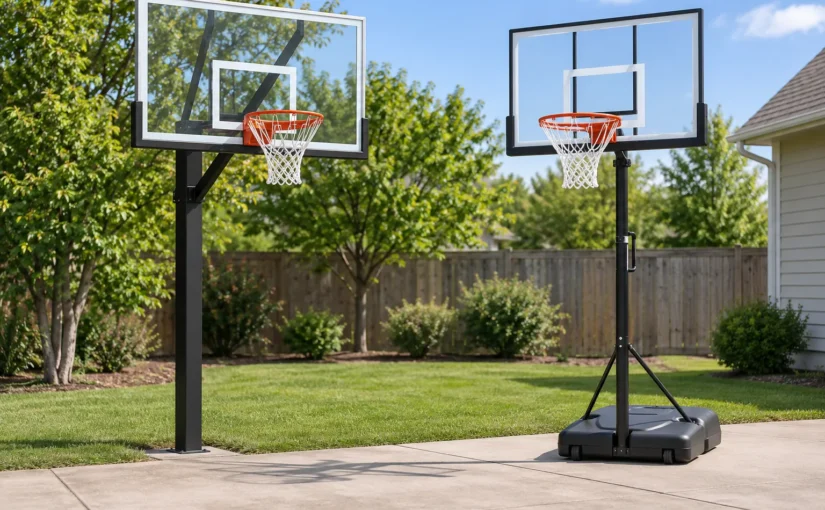
An in-ground basketball hoop is generally the better choice for a permanent home setup because its concrete foundation can provide stronger support. A portable basketball hoop is usually more practical for families who want a lower starting cost, easier setup, or the ability to move their hoop.

Neither option is automatically better for every player. Here’s how they compare.

In-Ground vs Portable Basketball Hoops at a Glance

Both types are available with adjustable rims, different backboard materials, and equipment designed for recreational basketball. Their main differences involve how they’re supported and installed.

Feature In-Ground Hoop Portable Hoop
Support Concrete foundation Weighted base
Stability Generally stronger foundation when properly installed Depends on ballast and construction
Installation Excavation, concrete, and assembly Assembly and base filling
Starting cost Equipment plus installation expenses Budget-friendly options available
Portability Permanent or difficult to relocate Can be repositioned
Playing space No large weighted base Base occupies ground space
Maintenance Hardware, corrosion, and structural inspections Similar inspections plus ballast care
Best suited for Long-term home installations Families, renters, and flexible setups

The right choice depends on the complete basketball hoop system, not just whether its pole sits in concrete or a portable base.
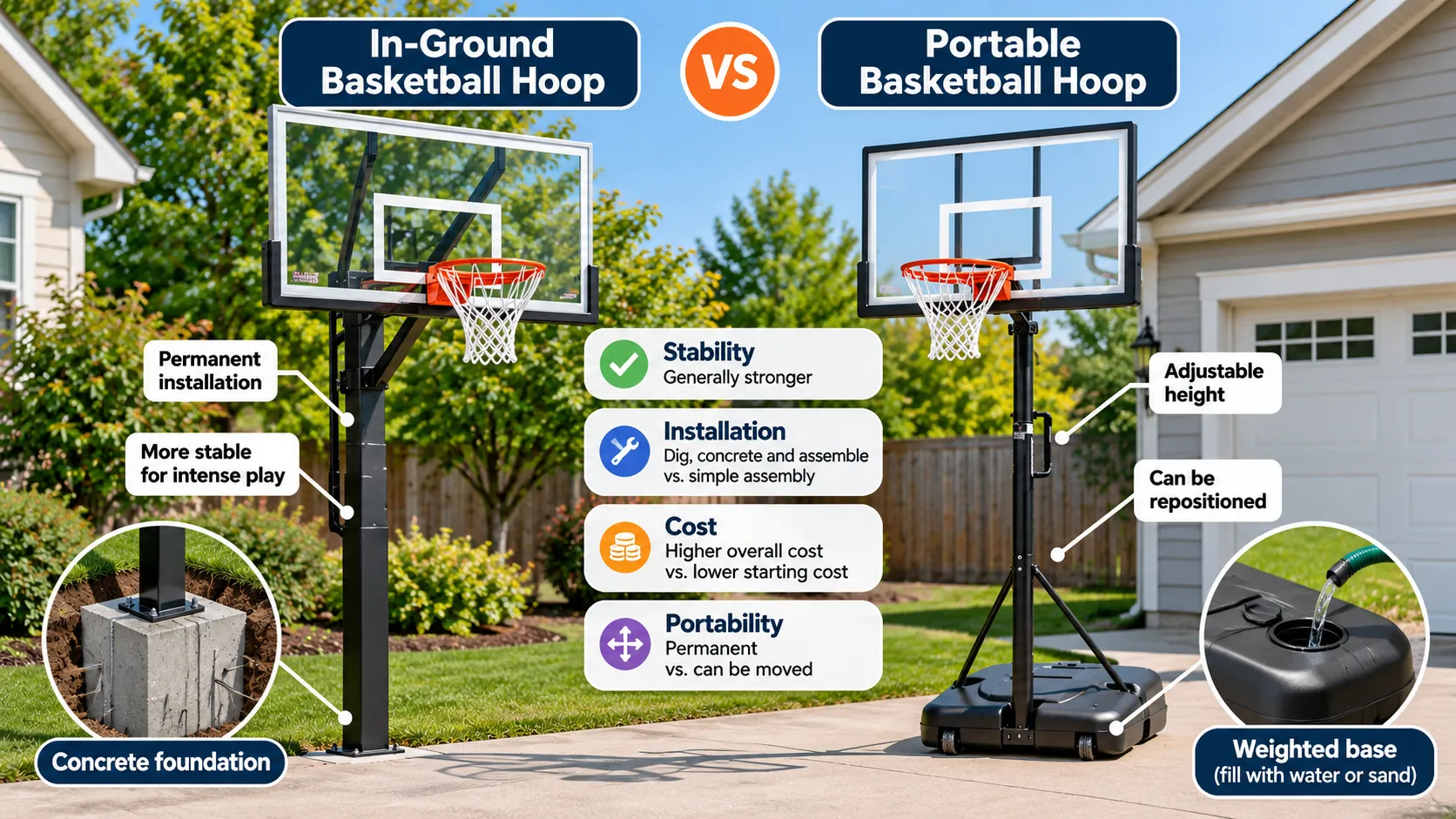
In-ground vs portable basketball hoop infographic comparing stability, installation, cost, and portability.
Key differences between in-ground and portable basketball hoops.

What’s the Difference Between In-Ground and Portable Basketball Hoops?

How In-Ground Basketball Hoops Work

An in-ground basketball hoop uses a concrete foundation to support its pole. Some models have poles embedded directly in concrete, while others attach to anchor systems installed in the ground.

This creates a fixed basketball setup without a large portable base occupying part of the playing surface.

However, installation requires careful positioning, excavation, and concrete curing. Some bolt-down models can eventually be relocated, but they aren’t designed for regular movement.

Our basketball hoop installation guide explains the process in more detail.

How Portable Basketball Hoops Work

A portable basketball hoop uses a freestanding base filled with water or sand, according to the manufacturer’s instructions.

Many models include wheels that allow adults to reposition the system. Unlike in-ground hoops, they don’t normally require excavation or concrete.

However, portable doesn’t necessarily mean lightweight or easy to move. Some larger systems require two adults to reposition them safely.

See our best portable basketball hoops guide for examples of different designs.

Which Basketball Hoop Is More Stable?

A properly installed in-ground hoop generally provides a stronger foundation than a portable system that relies on a weighted base.

However, stability involves two different things: resisting tipping and reducing movement when the basketball hits the rim or backboard.

An in-ground hoop can still shake if its foundation or support structure is inadequate. Likewise, a well-built portable hoop can provide a substantial playing experience when correctly assembled and weighted.

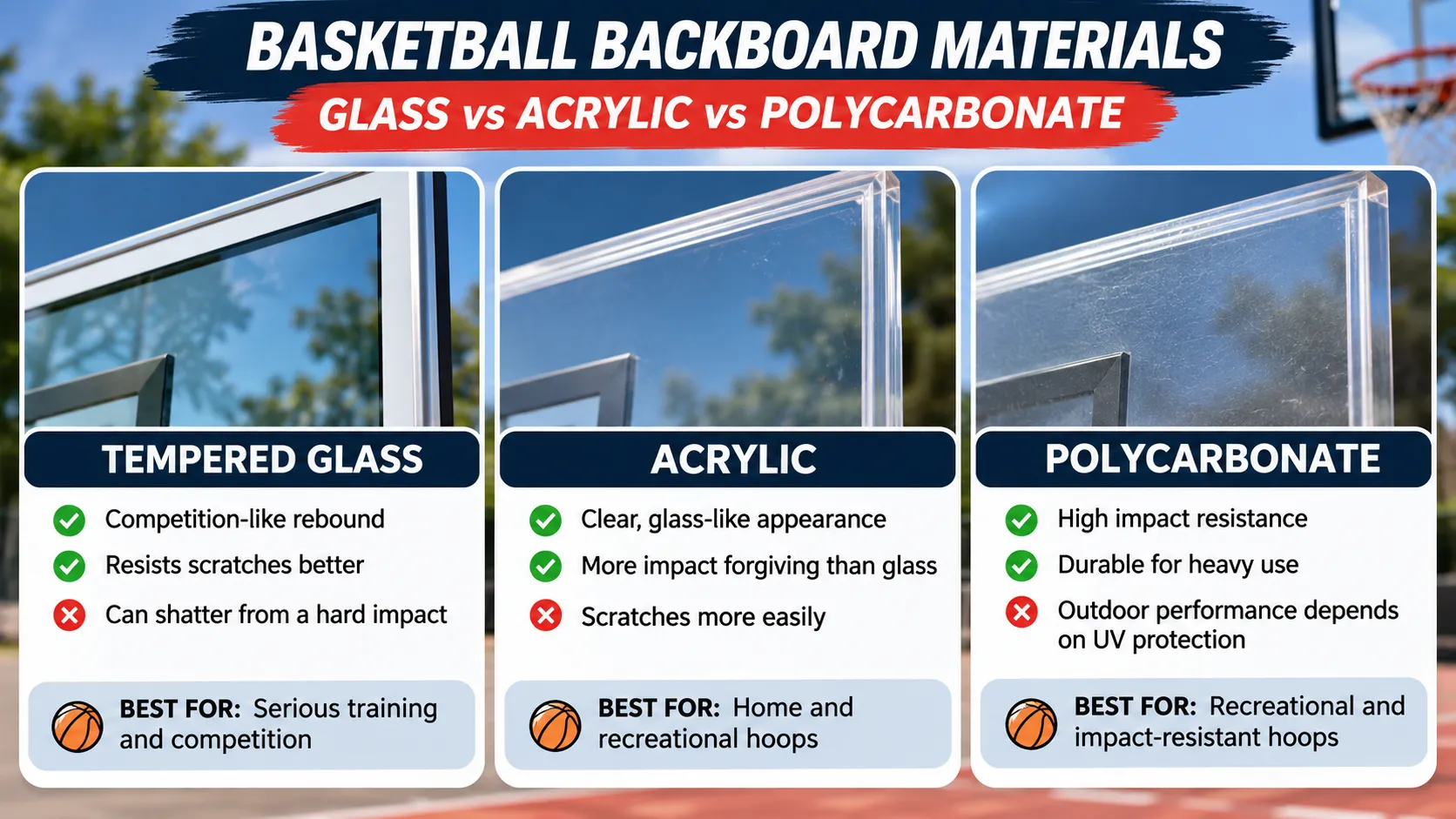
Backboard construction also affects performance. Tempered glass is commonly associated with an indoor-style rebound, while acrylic and polycarbonate offer different combinations of durability, weight, and playing response.

Neither mounting type guarantees a particular backboard material. Some in-ground hoops use polycarbonate, while premium portable systems can use tempered glass.

Our basketball backboard materials guide explains these differences.
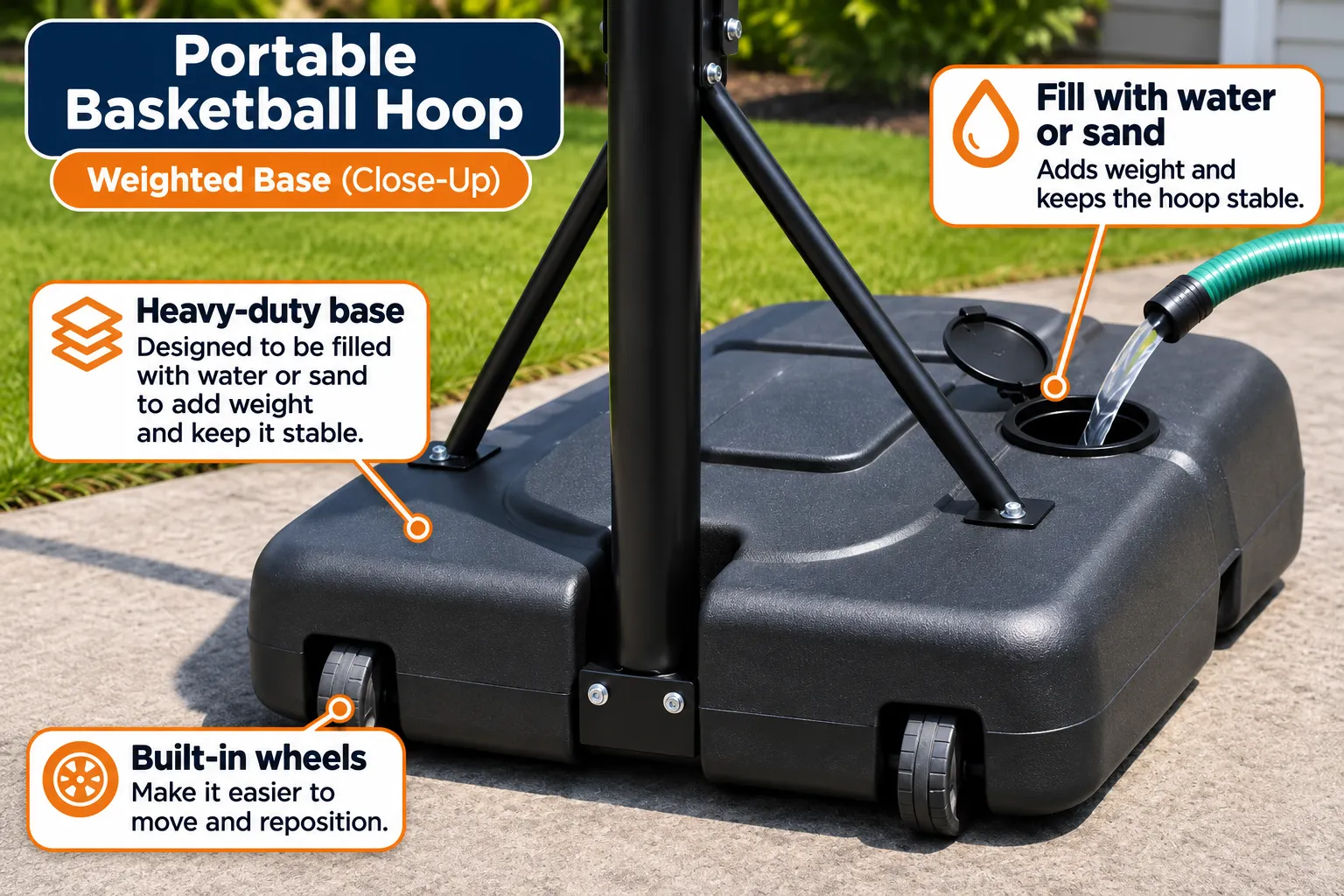
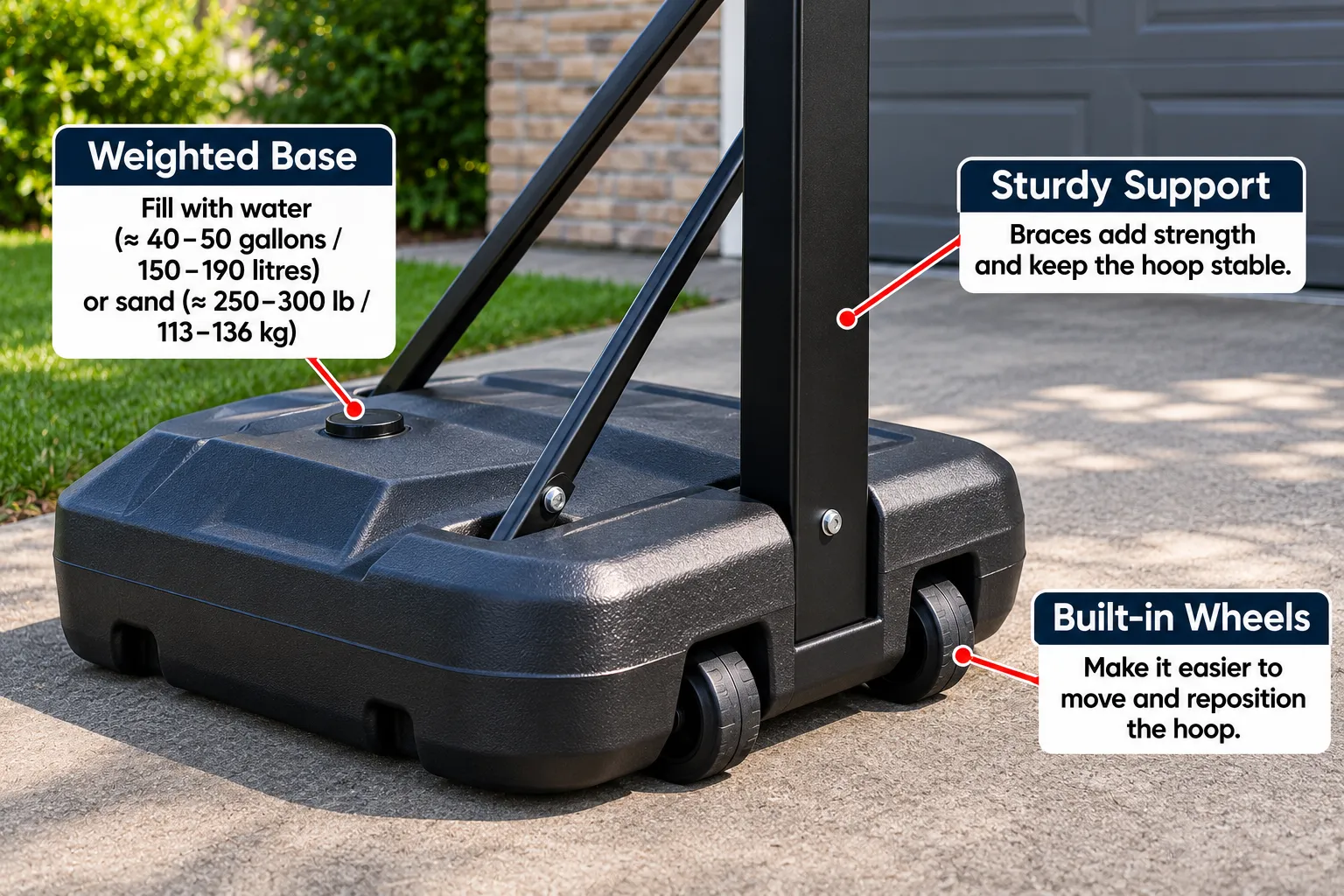
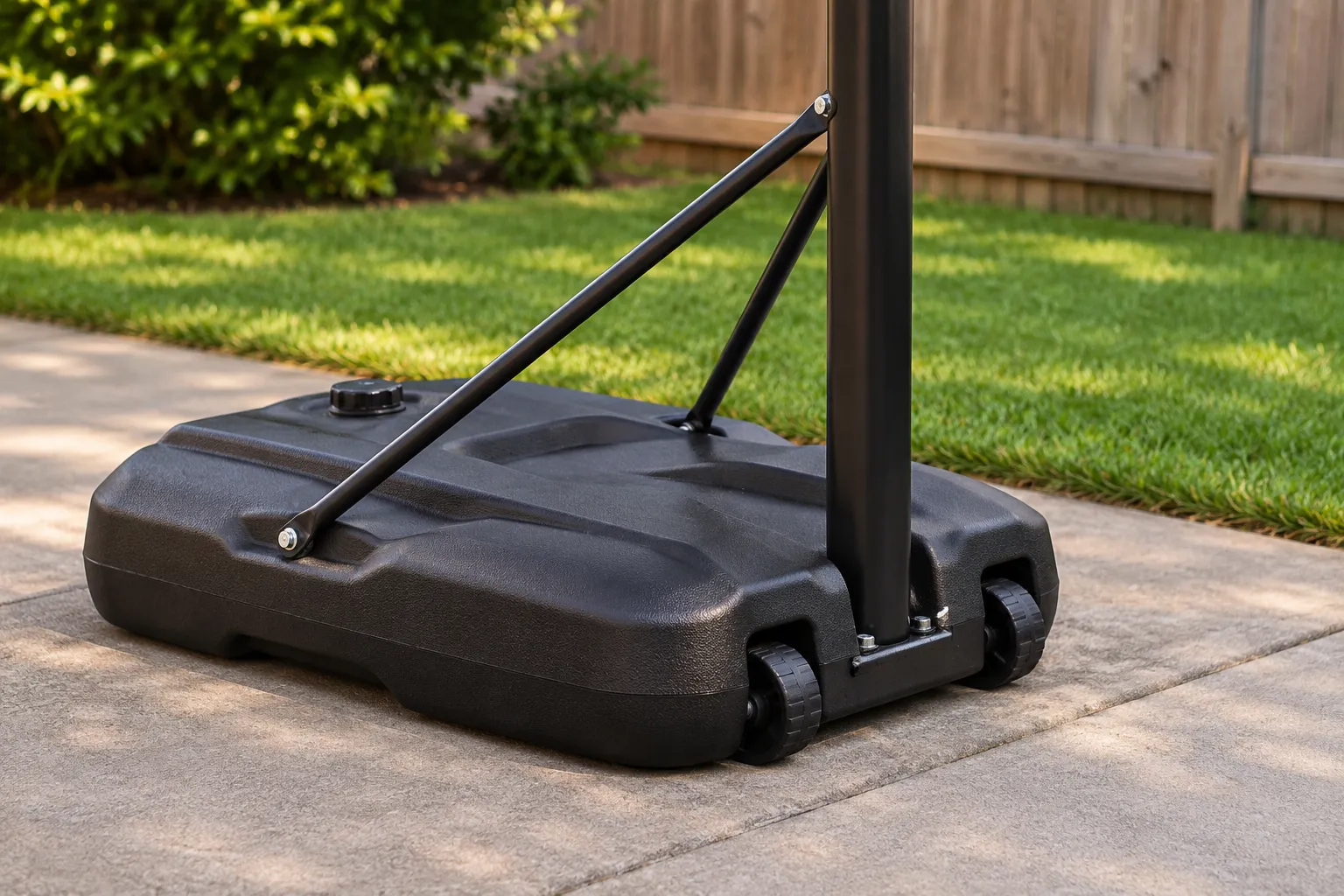
Portable basketball hoop weighted base being filled with water, showing support braces and wheels.
A portable basketball hoop uses a water- or sand-filled base for stability.

In-Ground vs Portable Basketball Hoop Costs

Portable basketball hoops generally offer a lower entry price, but premium models can cost more than some in-ground systems before installation.

For example, these US equipment prices were recorded on November 7, 2026:

Basketball Hoop Type Observed Equipment Price
Lifetime Streamline 44-inch Portable $169.99
Silverback NXT 54 B8401W Portable $609.95
Silverback NXT 54 B8402W In-ground $569.95
Goalrilla GS54C In-ground $1,749.95

These were observed prices, not guaranteed checkout prices. They may change and exclude applicable taxes, delivery, installation, and other expenses.

In-ground hoops also require foundation work. Goalrilla’s installation guidance suggests budgeting $400–$600 for professional installation. This is manufacturer guidance, not a guaranteed US-wide price. Actual quotes depend on the site and whether concrete, materials, and final assembly are included.

Portable systems avoid most foundation expenses but may still require purchased ballast or professional assembly.

Compare the total installed cost rather than the equipment price alone.

Installation and Assembly Differences

Portable hoops are usually quicker to set up because they don’t require a concrete foundation.

According to Lifetime’s assembly guidance, its portable basketball systems generally take one to four hours to assemble. Actual assembly time depends on the model and available help.

In-ground installation involves additional work, including:

  1. Choosing a suitable installation location.
  2. Checking underground utilities and local requirements.
  3. Excavating the specified foundation hole.
  4. Installing the pole or anchor assembly in concrete.
  5. Allowing the concrete to cure.
  6. Completing assembly and checking alignment.

Concrete curing can extend the project over several days. The required foundation dimensions, curing period, and number of helpers vary between products.

Before digging in the US, contact 811 or your state 811 center to arrange underground utility marking. Private underground lines may need separate identification.

Never substitute another manufacturer’s foundation measurements for the instructions supplied with your hoop.

Which Basketball Hoop Is Better for a Driveway?

Both hoop types can work well on a driveway, but they use the available space differently.

The in-ground vs portable basketball hoop choice often depends on whether you need to clear space for parking.

An in-ground hoop can keep a large weighted base out of the playing area. However, its permanent position must allow enough clearance for vehicles, players, and nearby obstacles.

A portable hoop can be repositioned when necessary, but its base takes up space and moving it may require adult assistance.

Measure the complete system, including the backboard, pole, base, and overhang. Don’t assume that a portable hoop will fit inside a garage simply because its rim height can be lowered.

For detailed positioning and clearance advice, read our driveway basketball hoop guide.

Durability, Weather Resistance, and Maintenance

Both in-ground and portable basketball hoops need regular inspection and maintenance.

Check for loose hardware, corrosion, damaged components, and unusual movement. A powder-coated steel pole can resist corrosion, but it isn’t maintenance-free.

Wind and Tipping Risks

Portable basketball hoops depend on their weighted bases for support. A leaking base or incorrect ballast can create a tipping hazard.

Manufacturers also recommend precautions during severe weather, including moving compatible portable systems into an approved storage position or sheltered location.

Don’t assume that adding extra weight makes a portable hoop windproof. Follow the exact model’s instructions.

Water vs Sand for Portable Basketball Hoops

Some portable basketball hoops allow either water or sand inside the base.

Water can be easier to fill and drain, but leaks and freezing temperatures require attention. Sand avoids liquid leakage, although it can make emptying and repositioning the system less convenient.

The correct quantity depends on the specific product. Never estimate the required sand weight from the base’s advertised water capacity.

Winter Storage and Maintenance

Freezing temperatures can damage water-filled bases if the manufacturer’s winterization instructions aren’t followed.

Different manufacturers recommend different procedures. Follow your specific model’s instructions rather than using a generic antifreeze mixture or draining method. Spalding’s product FAQ illustrates why instructions must be checked by manufacturer.

In-ground hoops also require maintenance, including checking their hardware, pole, rim, and adjustment mechanism.

In-Ground vs Portable Basketball Hoops: Pros and Cons

In-Ground Basketball Hoop Pros and Cons

Advantages:

  • Strong permanent foundation when installed correctly.
  • No large portable base occupying the driveway.
  • Suitable for long-term residential setups.
  • Available with substantial poles and glass backboards.

Disadvantages:

  • Requires excavation and concrete work.
  • Higher potential installation expenses.
  • Installation can take several days.
  • Difficult to reposition or remove.

Portable Basketball Hoop Pros and Cons

Advantages:

  • Lower-cost entry options.
  • No ordinary concrete foundation required.
  • Can be moved when necessary.
  • Suitable for households that need flexibility.

Disadvantages:

  • Weighted base occupies ground space.
  • Ballast requires regular attention.
  • Wind and freezing conditions need planning.
  • Some models require two adults to move.

Which Type of Basketball Hoop Should You Choose?

When making an in-ground vs portable basketball hoop decision, consider your long-term plans as well as the upfront cost.

The best basketball hoop depends on your priorities.

Your Situation Recommended Starting Point
Beginner or family on a limited budget Portable hoop
Renter or planning to move Portable hoop, subject to property rules
Long-term homeowner wanting a fixed setup In-ground hoop
Serious player prioritizing rebound performance Compare backboard and support construction across both types
Driveway that must regularly be cleared Portable hoop, if movement is practical
Permanent playing area with suitable installation space In-ground hoop

If you’re still deciding between specific systems, compare our best in-ground basketball hoops with our portable recommendations.

Frequently Asked Questions

Are In-Ground Basketball Hoops Worth It?

They can be worth the additional installation expense for homeowners who want a permanent basketball setup. However, the equipment, installation quality, and available playing space all affect the final result.

Can You Dunk on a Portable Basketball Hoop?

Only if the manufacturer explicitly permits the intended use. Some residential hoops prohibit dunking or hanging, including certain in-ground models with breakaway rims. Always check the exact product manual.

Can You Move an In-Ground Basketball Hoop?

Some bolt-down systems can be removed from their anchors and relocated to another suitable foundation. Direct-burial systems are generally more difficult to move.

How Long Does Basketball Hoop Installation Take?

Portable assembly can often be completed in one day. In-ground installation usually takes longer because excavation, concrete work, and curing must be completed before the hoop is ready for use.

Can You Install an In-Ground Hoop on an Existing Driveway?

Possibly, but an ordinary driveway slab shouldn’t automatically be considered a suitable foundation. The installation must meet the hoop manufacturer’s requirements and any applicable local conditions.

Final Verdict: In-Ground or Portable Basketball Hoop?

Choose an in-ground basketball hoop if you want a permanent setup, have suitable installation space, and can afford the additional foundation work.

Choose a portable basketball hoop if you want a more flexible option, prefer to avoid permanent construction, or need a lower starting price.

Whichever type you choose, pay attention to the backboard, pole construction, stability, and installation requirements. A well-matched basketball hoop is more useful than simply choosing the biggest or most expensive model.
Driveway Basketball Hoop | How to Choose the Right Setup

A driveway basketball hoop can turn an ordinary parking area into a place for shooting practice, family games, and outdoor play. But the right hoop depends on more than its backboard size or price.

For most driveways, a portable basketball hoop is the simplest starting point because it doesn’t require a concrete foundation. An in-ground hoop is worth considering if you want a permanent setup, while a wall-mounted hoop can save ground space when a suitable structure is available.

Before buying, measure your driveway, check its slope, consider where vehicles will park, and make sure players have enough room to move safely.

This guide explains how to choose a driveway basketball hoop, where to position it, and which features matter for different home setups.

BasketballRex has not physically tested the hoops mentioned here. Product examples are based on manufacturer specifications and documented installation requirements.

Which Type of Basketball Hoop Is Best for a Driveway?

The best basketball hoop for a driveway depends on whether you need to move it, how much space you have, and whether permanent installation is possible.

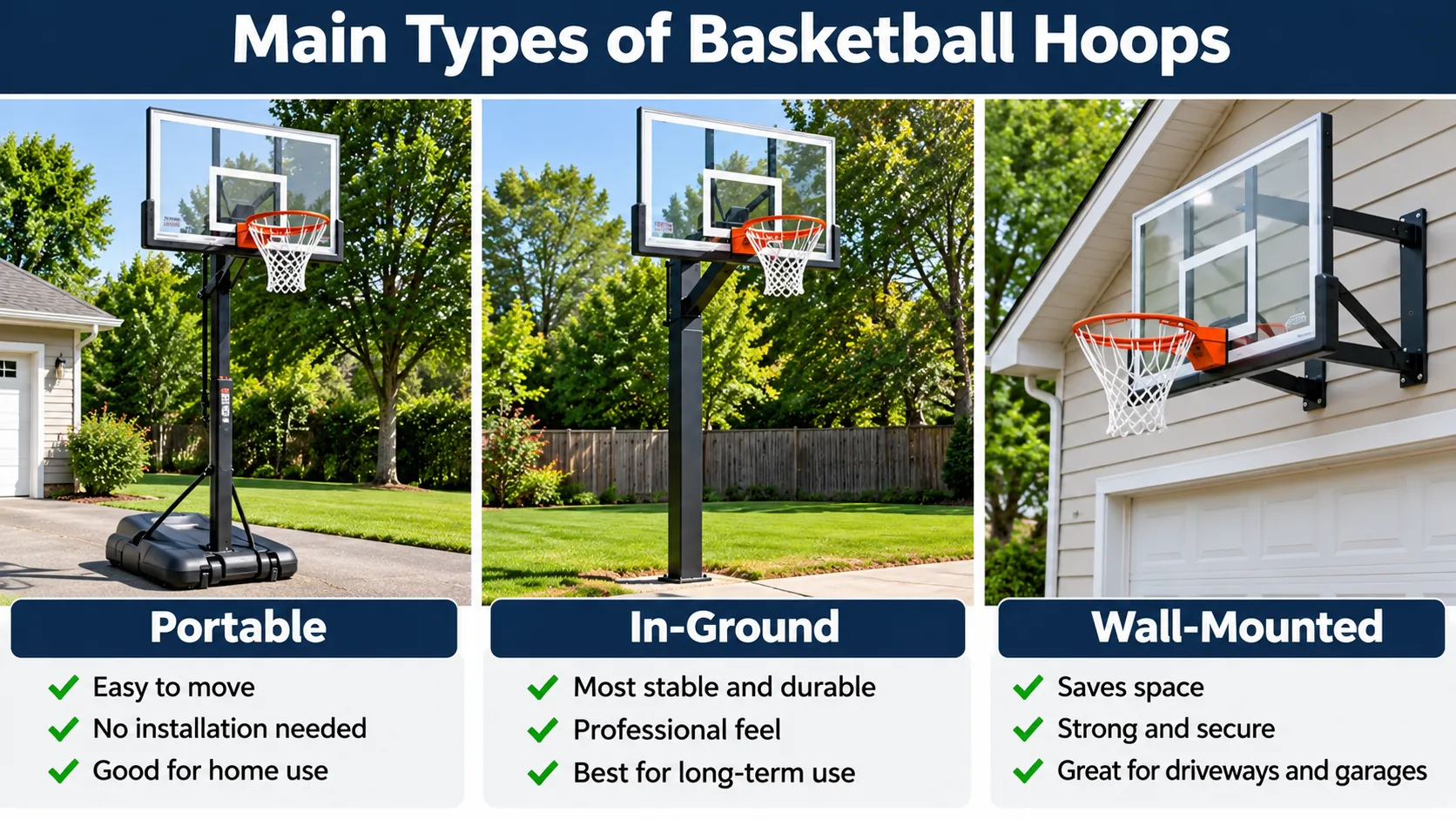
There are three main options.

Hoop type Main advantage Main drawback Suitable for
Portable No permanent foundation required Weighted base occupies driveway space Families and flexible setups
In-ground Permanent playing position without a portable base Requires excavation and concrete Homeowners planning long-term use
Wall-mounted No freestanding pole or base Requires a suitable supporting structure Driveways with limited ground space

For a closer look at both options, read our in-ground vs portable basketball hoop comparison to understand the differences in stability, installation, and cost.

Portable Basketball Hoops

A portable basketball hoop uses a weighted base instead of a concrete foundation.

Most models have wheels and adjustable rims. You can position the hoop for practice and move it when you need the driveway for parking.

However, portable doesn’t mean lightweight.

Once filled with sand or water, the base can be difficult to move. Some models require two adults for safe repositioning.

Portable hoops are useful if you rent your home, cannot make permanent changes, or need flexibility.

Choose a portable hoop if: You want an outdoor basketball setup without committing to permanent installation.

For specific models, see our best portable basketball hoop guide.

In-Ground Basketball Hoops

An in-ground basketball hoop uses a pole secured in a concrete foundation.

Unlike a portable system, it doesn’t need a large weighted base sitting on the driveway.

This can leave more usable ground space for movement and parking.

Many in-ground hoops also feature tempered-glass backboards, adjustable rims, and substantial steel support structures.

The trade-off is installation.

You must account for excavation, concrete, curing time, assembly, and any professional labor.

Choose an in-ground hoop if: You own your property, want a permanent basketball setup, and have a suitable location for the foundation.

Our best in-ground basketball hoops guide compares nine models across different budgets.

Wall-Mounted Basketball Hoops

A wall-mounted basketball hoop attaches to a suitable building structure instead of using a freestanding pole.

This can be useful when a portable base would block parking or an in-ground foundation isn’t practical.

However, not every garage wall can safely support a basketball hoop.

The wall, mounting hardware, and supporting structure must meet the manufacturer’s requirements.

A wall-mounted system also projects outward, so you still need to measure its overhang.

Choose a wall-mounted hoop if: You have a suitable structural wall and want to preserve driveway ground space.

Never assume that ordinary siding, decorative brick, or garage fascia can support a full-size basketball hoop.

How to Choose a Basketball Hoop for Your Driveway

Different driveway layouts create different problems.

A basketball hoop that works well on a wide, level driveway may be unsuitable for a narrow, sloped, or shared one.

Small Driveways

For a small driveway, start by measuring the usable playing area rather than choosing a backboard size.

A 44-inch or 48-inch backboard may suit casual shooting, but the complete hoop still needs space.

For portable systems, check the base dimensions.

For in-ground systems, check the pole location, foundation requirements, and backboard overhang.

For wall-mounted hoops, measure how far the assembly projects from the building.

A smaller backboard doesn’t automatically mean the entire system takes up less room.

If the driveway only supports stationary shooting, that may still be useful. You don’t need enough space for full games to practice shooting.

However, avoid any arrangement that forces players into the road or against parked vehicles.

Narrow Driveways

A narrow driveway makes sideways movement especially important.

You might have enough room to shoot directly at the basket but not enough room to chase rebounds safely.

An in-ground hoop positioned beside the playing surface may preserve more pavement than a portable base.

A wall-mounted hoop could also work if the structure is suitable.

Before choosing either option, check the full installed dimensions and any required clearances.

Don’t assume that a 54-inch backboard is automatically suitable for every one-car driveway.

The correct choice depends on the actual space.

Sloped Driveways

A sloped driveway needs extra attention.

Portable basketball hoops generally require a suitable level surface. For example, Spalding’s Momentous product information describes its portable systems as designed for flat surfaces.

Don’t place blocks, improvised shims, or other supports underneath a portable base unless the manufacturer specifically approves that arrangement.

An in-ground hoop may be possible beside a sloped driveway, but the installation doesn’t remove the slope from the playing surface.

The ball can still roll downhill, and players may have difficulty stopping or changing direction.

If the slope creates a risk of running into the road, choose a different playing location.

A professional site assessment may be necessary before installing a permanent system.

Shared Driveways

Shared driveways create practical questions beyond basketball equipment.

You need to consider access, parking, storage, and permission.

A portable basketball hoop may be easier to accommodate because it can be moved.

However, a filled base can be heavy, and someone must be available to move it when access is needed.

Before buying, confirm that the hoop won’t obstruct another resident’s vehicle or walking route.

Check any relevant property agreements, lease conditions, or shared-access restrictions.

Permanent installation may require additional permission.

How Much Driveway Space Do You Need for a Basketball Hoop?

There is no single driveway size that guarantees a safe basketball setup.

The required space depends on the type of play, the hoop’s dimensions, and surrounding obstacles.

Goalrilla’s basketball hoop buying guide suggests at least 10 feet of concrete in front of the basket, preferably closer to 15 feet.

That’s manufacturer planning guidance, not a universal minimum safety standard.

Stationary shooting requires less room than layups, rebounding, or one-on-one games.

Measure the Playing Area

Measure the available width and depth after accounting for parked vehicles and other obstacles.

Consider where players will stand, move, and retrieve missed shots.

Check for:

  • Garage doors and parked vehicles.
  • Walls, windows, fences, and steps.
  • Curbs, drains, and uneven pavement.
  • Pedestrian routes and neighboring property.
  • Nearby roads and traffic.

If the available area is too small for safe movement, limit the setup to activities that fit or choose another location.

Check the Portable Base Footprint

A portable hoop’s backboard width doesn’t tell you how much ground space it occupies.

The base may extend behind or beneath the pole.

For example, Spalding lists a 54 × 32-inch base for its researched Momentous portable system.

You can use those dimensions to understand how much pavement the base would occupy.

However, the actual footprint and movement requirements depend on the model.

Before ordering, check whether the base blocks a vehicle, garage door, or walkway.

Understand Basketball Hoop Overhang

Overhang describes how far the backboard extends from the supporting pole, using the manufacturer’s specified measurement points.

It affects how much space players have beneath the basket and where the pole must stand.

Some adjustable hoops change their overhang as the rim moves up or down.

For example, the Goalrilla GS54C advertises up to 2.5 feet of overhang, while its installation manual specifies 21¼ inches at a 10-foot rim height.

These measurements should not be treated as interchangeable.

Check the model’s diagram at your intended playing height before positioning a permanent foundation.

Check Vehicle Clearance

A driveway basketball hoop must also work when nobody is playing.

Consider the height of parked vehicles, roof racks, open rear hatches, and garage doors.

An adjustable basketball hoop can create different clearance problems at different rim heights.

A lowered backboard or support arm may project into the path of a vehicle.

Don’t assume that a 10-foot rim means a vehicle has 10 feet of clear space underneath the complete assembly.

Measure the entire structure and vehicle movement path.

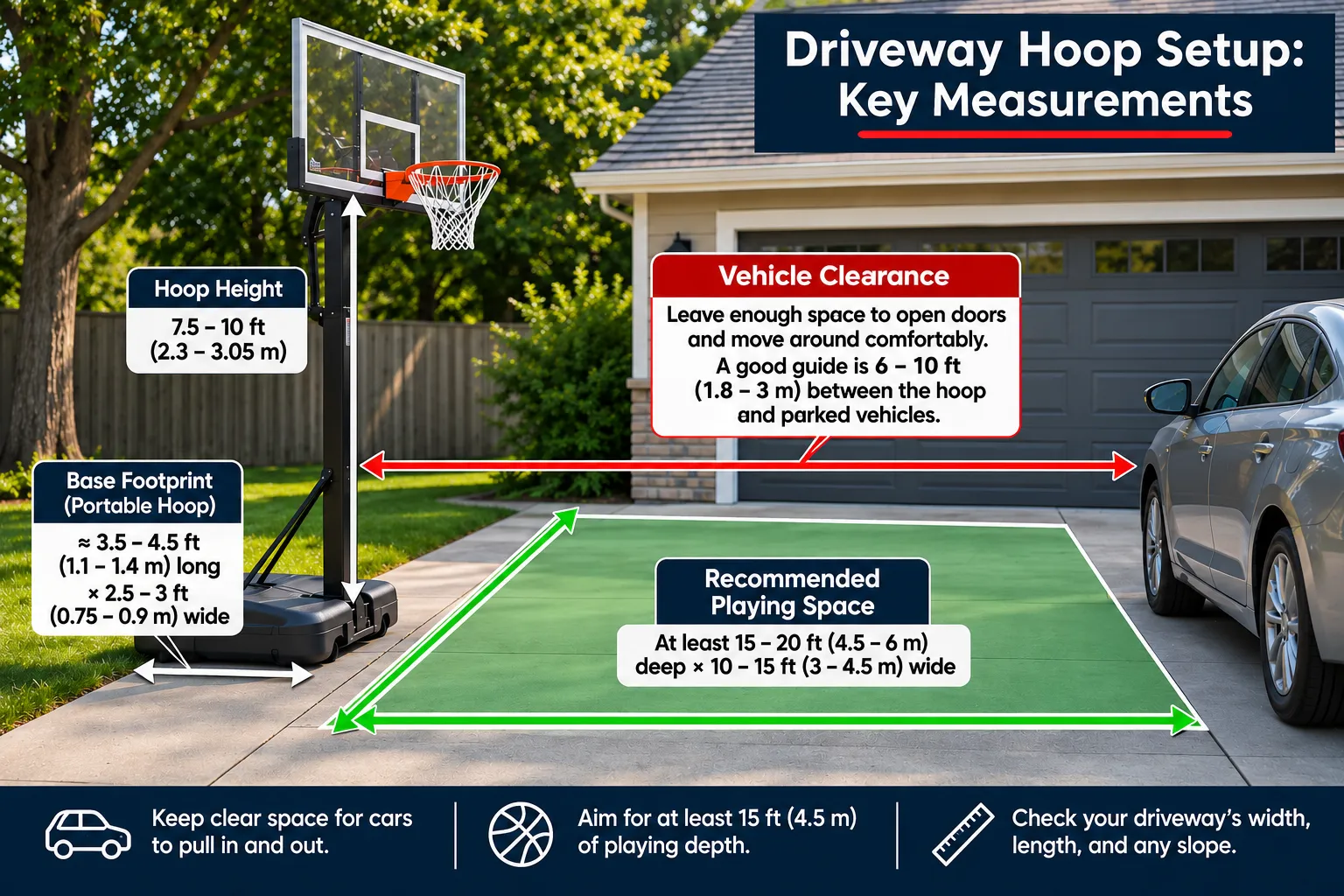
Driveway basketball hoop diagram showing playing space, base footprint, hoop height, and vehicle clearance
Example driveway basketball hoop layout. Measurements are illustrative and vary by hoop model and driveway.

Where Should You Position a Driveway Basketball Hoop?

The best position is one that provides a practical shooting area without creating unnecessary hazards.

Near the Garage

Positioning a basketball hoop near the garage may keep the playing area farther from the road.

However, check whether the backboard, pole, or base interferes with the garage door or vehicles.

A wall-mounted hoop also requires a suitable structure and approved attachment method.

Beside the Driveway

An in-ground pole beside the pavement may preserve more playing space.

However, the foundation must fit the property and comply with the manufacturer’s installation requirements.

Check underground utilities, landscaping, property boundaries, and the required space behind the pole.

Near the Street

Avoid positioning the hoop where playing or retrieving missed shots requires entering traffic.

Goalrilla advises against placing basketball hoops in or overhanging the street because of vehicle risks.

Local rules may also restrict equipment near sidewalks or curbs.

Consider Sunlight and Surface Conditions

Think about when your family will normally play.

Low sunlight behind the basket can make shooting uncomfortable because players must look toward the glare.

Also inspect the driveway for loose gravel, cracks, raised joints, slippery surfaces, and standing water.

A suitable playing surface matters as much as the hoop itself.

Four Driveway Basketball Hoop Examples

These four models illustrate different driveway needs.

They are not a new ranking of the best basketball hoops. For a broader product comparison, see our best basketball hoop guide.

Basketball hoop Type Backboard Main consideration
Lifetime 90040 Portable 44-inch HDPE Compact budget setup
Silverback NXT 54 B7401W Portable 54 × 33-inch polycarbonate Repositioning and playing space
Goalrilla GS54C B5003W-1 In-ground 54 × 34-inch tempered glass Permanent foundation and overhang
Silverback NXT B8403W Wall-mounted 54 × 33-inch polycarbonate Structural mounting requirements

Lifetime 90040: Compact Portable Example

The Lifetime 90040 has a 44-inch HDPE Impact backboard and a 27-gallon portable base.

Its rim adjusts from 7.5 to 10 feet in six-inch increments.

The base accepts sand or water according to the manufacturer’s instructions.

This model illustrates a basic driveway basketball setup for casual shooting.

However, its smaller backboard provides less room for bank shots than larger systems.

It also has a standard rim rather than a premium breakaway assembly.

Check the complete dimensions and available space before purchasing.

Silverback NXT 54: Movable Driveway Example

The Silverback NXT 54 B7401W features a 54 × 33-inch polycarbonate backboard.

It adjusts from 7.5 to 10 feet and uses a wheelbarrow-style transport design.

The manufacturer advertises approximately 2.5 feet of overhang and separately identifies 26 inches of clear playing space.

Those figures describe different measurements.

The NXT may be worth investigating if you want a larger portable hoop but still need to clear the driveway.

However, moving a filled basketball hoop requires care and may need two adults.

Model warning: Silverback also sells an older NXT 54 version, B8401W. The versions have different adjustment mechanisms and listings, so confirm the exact model number.

Goalrilla GS54C: Permanent Driveway Example

The Goalrilla GS54C features a 54 × 34-inch tempered-glass backboard and a one-piece 5 × 5-inch steel pole.

It uses a concrete foundation and an anchor system.

The model illustrates how an in-ground hoop can avoid occupying the driveway with a portable weighted base.

However, installation requires careful planning.

The manufacturer’s manual specifies model-specific footing dimensions, concrete requirements, curing time, and assembly procedures.

Its overhang also changes with rim height.

This makes the GS54C a useful example of why homeowners should choose the hoop before marking the foundation location.

Silverback NXT Wall Mount: Space-Saving Example

The Silverback NXT Adjustable Wall Mount B8403W features a 54 × 33-inch polycarbonate backboard.

Its rim adjusts from 7.5 to 10 feet, and the manufacturer lists approximately 2.5 feet of overhang.

It doesn’t require a freestanding pole or portable base.

However, the manufacturer does not include mounting hardware and warns against attaching the system to brick surfaces or facades.

Before purchasing, confirm that the supporting structure and installation method are suitable.

Saving ground space is only an advantage when the wall can safely support the equipment.

Driveway Basketball Hoop Installation

Installation requirements depend on the hoop type.

Installing a Portable Basketball Hoop

Portable basketball hoops usually require assembling the base, pole, backboard, rim, and adjustment mechanism.

Follow the exact model’s assembly sequence.

Fill the base with the approved amount of water or sand at the instructed stage.

Never use an empty or incorrectly weighted basketball hoop.

Also avoid placing improvised weights on the outside of the base instead of using the manufacturer’s required ballast.

Installing an In-Ground Basketball Hoop

An in-ground basketball hoop requires a suitable foundation.

For example, the Goalrilla GS54C manual specifies a footing approximately 48 inches deep, with different top and bottom diameters.

It also specifies a minimum 72-hour concrete curing period before the relevant assembly stage.

These are GS54C-specific requirements, not instructions for every basketball hoop.

Before digging in the United States, contact 811 and follow your state’s utility-location procedures.

A professional installer may be the better option for heavy equipment or difficult ground conditions.

Our basketball hoop installation guide explains the full process.

Installing a Wall-Mounted Basketball Hoop

Wall-mounted basketball hoops require suitable structural support.

Follow the manufacturer’s instructions for attachment points, approved hardware, and required clearances.

Do not assume ordinary wall anchors or decorative exterior materials are adequate.

Professional structural advice may be necessary.

How Much Does a Driveway Basketball Hoop Cost?

The total cost depends on the equipment and installation.

A basic portable basketball hoop can cost considerably less than a premium permanent system.

However, the purchase price is only one part of the budget.

Cost Portable hoop In-ground hoop Wall-mounted hoop
Hoop hardware Required Required Required
Assembly Usually required Required Required
Concrete foundation Not normally required Usually required Not normally required
Structural mounting work Not normally required Not normally required May be required
Professional installation Optional for some models Often worth considering May be necessary

Research conducted on November 6, 2026, found manufacturer-listed prices of approximately $700 for the newer Silverback NXT 54 portable, $1,750 for the Goalrilla GS54C, and $440 for the Silverback NXT wall mount.

These are dated observations, not guaranteed current offers. Prices, availability, taxes, shipping, and installation charges can change.

For an in-ground system, ask whether a contractor’s quote includes excavation, concrete, anchor installation, assembly, and cleanup.

Don’t compare a portable hoop’s hardware price with an in-ground system’s fully installed price without accounting for the difference.

Driveway Basketball Hoop Stability and Safety

A quality basketball hoop still needs correct installation and maintenance.

Water vs. Sand for Portable Bases

Many portable hoops allow water or sand as ballast.

Follow the manufacturer’s approved filling procedure.

Sand doesn’t automatically make every basketball hoop safe in strong winds, and water-filled bases may require additional care in freezing conditions.

Check the exact model’s instructions.

Wind and Cold Weather

Outdoor basketball hoops face wind, rain, sunlight, and changing temperatures.

No universal safe wind-speed limit applies to every residential hoop.

Check the manufacturer’s instructions for adverse weather and storage.

Inspect metal components for corrosion, plastic bases for cracks, and connections for looseness.

If a hoop is damaged or unstable, stop using it until the problem is resolved.

Breakaway Rims and Dunking

A breakaway rim contains a mechanism that allows it to flex under certain loads.

However, that doesn’t automatically make the entire basketball hoop safe for hanging.

The backboard supports, pole, anchors, and manufacturer’s restrictions all matter.

Never assume that a spring-loaded rim means children or adults can hang from the basket.

Check Product Recalls

If you’re buying a used or older basketball hoop, check its model number and recall status.

On September 22, 2022, the US Consumer Product Safety Commission announced a recall of certain Spalding Momentous EZ portable basketball goals because support-arm welds could fail.

Affected owners were instructed to stop using the equipment and arrange the specified repair.

See the official CPSC recall notice.

The recall doesn’t mean every current Spalding Momentous model is affected.

Portable basketball hoop weighted base with support braces and wheels on a concrete driveway
A weighted base helps stabilize a portable hoop. Follow the manufacturer’s filling instructions.

Driveway Basketball Hoop Rules and HOA Restrictions

Before installing a basketball hoop, check the rules that apply to your property.

These may include:

  • City or municipal restrictions.
  • Homeowners association rules.
  • Lease or rental agreements.
  • Shared-driveway access rights.
  • Building permits or installation requirements.

There is no single nationwide US rule covering every driveway basketball hoop location.

For example, South Bend, Indiana, restricts basketball hoops in streets and tree-lawn areas, while Portland, Oregon, describes circumstances where portable hoops may be permitted in public rights-of-way.

Always check your own jurisdiction rather than applying another city’s rules.

Driveway Basketball Hoop Buying Checklist

Before ordering, work through these checks.

  • Measure the available playing area.
  • Check the driveway’s slope and surface condition.
  • Confirm where vehicles will park.
  • Measure the complete hoop footprint and overhang.
  • Check the rim’s minimum and maximum heights.
  • Confirm the correct installation method.
  • Review local rules and property restrictions.
  • Check the manufacturer’s safety and maintenance instructions.
  • Compare the total cost, including installation.
  • Verify the exact model number, warranty, and any applicable recalls.

If the setup doesn’t leave enough safe playing space, reconsider the location before buying.

Frequently Asked Questions

Which Basketball Hoop Is Best for a Driveway?

A portable basketball hoop is a practical choice for many driveways because it doesn’t require permanent installation.

An in-ground hoop can suit homeowners wanting a dedicated long-term setup, while a wall-mounted system may save ground space when the supporting structure is suitable.

The best choice depends on your driveway and how you plan to use it.

Can I Put a Basketball Hoop in My Driveway?

Usually, a basketball hoop can be used on a suitable private driveway, subject to local rules, property restrictions, and safe placement.

Check the available space, surface condition, vehicle access, and any required permissions before installation.

How Much Does It Cost to Install a Basketball Hoop in Your Driveway?

Costs vary by hoop type and installation requirements.

A portable hoop may only require assembly and approved ballast. An in-ground system requires a foundation, concrete, and potentially professional labor.

Ask for a detailed quote rather than assuming the hardware price includes installation.

What Is the Best Basketball Net for a Driveway?

For most residential driveway hoops, a compatible outdoor-rated nylon or synthetic net is a practical choice.

A chain net may suit certain outdoor setups, but it can be louder and must be compatible with the rim.

Check the attachment points before buying a replacement.

Can You Put a Portable Basketball Hoop on a Sloped Driveway?

Only if the exact manufacturer’s instructions permit the intended surface and setup.

Many portable hoops are designed for level surfaces.

Don’t rely on improvised supports or extra weights to make an unsuitable slope safe.

Is a 54-Inch Backboard Big Enough for a Driveway?

A 54-inch backboard can be suitable for regular recreational basketball.

However, its width alone doesn’t establish whether the entire hoop fits your driveway.

Consider the base, pole, overhang, available playing area, and nearby obstacles.

For more detail, see our basketball backboard dimensions guide.

What Height Should a Driveway Basketball Hoop Be?

The standard basketball rim height is 10 feet.

Adjustable home basketball hoops may lower to 7.5 feet or another manufacturer-specified minimum.

Choose a height appropriate for the players and follow the adjustment instructions.

Our basketball hoop height guide explains regulation and youth basketball heights.

Final Thoughts

A driveway basketball hoop should fit both your playing needs and your everyday use of the property.

Portable hoops offer flexibility, in-ground systems provide a permanent setup, and wall-mounted hoops can preserve ground space.

Before comparing premium features, measure your driveway, check the playing surface, and plan for parking and safe movement.

Choose the setup that works for your actual driveway—not simply the biggest basketball hoop your budget allows.

Best In-Ground Basketball Hoops | 9 Picks for Every Budget

The Silverback SB60 is our best overall in-ground basketball hoop for homeowners who want a 60-inch tempered glass backboard without spending over $2,000.

For a smaller budget, the Lifetime 71525 offers an adjustable 54-inch backboard. If you want a regulation-width backboard and heavier construction, the Goalrilla FT72 and Mega Slam 72 are worth considering.

The best choice depends on your budget, driveway size, backboard material, and how seriously you play.

This guide compares nine in-ground basketball hoops using manufacturer specifications, installation manuals, and published prices. These are research-based recommendations, not products we’ve personally tested.

Prices are in US dollars and were researched November 6–7, 2026. Confirm current prices, availability, and included accessories before buying.

Best In-Ground Basketball Hoops at a Glance

Basketball hoop Backboard Observed price Best for
Silverback SB60 60″ glass $1,099.95 Overall value
Lifetime 71525 54″ polycarbonate $469.99 Tight budgets
Silverback NXT 54 54″ polycarbonate $569.95 Affordable direct burial
Silverback SB54 54″ glass $969.95 Smaller driveways
Goalrilla GS60C 60″ glass $2,049.95 Stronger construction
Goalrilla FT72 72″ glass $2,949.95 Serious players
Goalsetter All-American 60 60″ glass $2,599.99 Family use
Mega Slam 72 72″ glass $2,799 Premium home courts
Pro Dunk THOR Gold 60″ glass $2,399 Heavy-duty 60″ setup

These prices exclude installation, tax, and any additional delivery charges.

The 9 Best In-Ground Basketball Hoops

1. Silverback SB60 — Best Overall Value

Model B5402W · Observed price: $1,099.95

The Silverback SB60 offers a useful balance between price, backboard size, and permanent installation.

It has a 60 × 33-inch tempered glass backboard, a 4 × 4-inch two-piece steel pole, and 2.5 feet of published overhang.

The glass measures 5/16 inch thick. Although thinner than the glass used on several premium systems, it gives buyers a glass playing surface without requiring a premium budget.

Its crank adjustment allows the rim to move between 7.5 and 10 feet.

The SB60 also includes backboard and pole padding, which can cost extra on other basketball goals.

Advantages: Large glass backboard, included padding, anchor-mounted construction, and a lower price than premium systems.

Limitations: Sectional pole, thinner glass than higher-end models, and a 7.5-foot minimum rim height.

The manufacturer’s current product information lists a five-year limited warranty, while some older documentation states seven years. Confirm the applicable warranty before purchasing.

Best for: Families and recreational players who want a permanent glass-backboard hoop at a reasonable price.

2. Lifetime 71525 — Best Budget Option

Model 71525 · Observed retail price: $469.99

The Lifetime 71525 is an affordable option for homeowners who want to move beyond a portable basketball hoop.

Its 54-inch steel-framed polycarbonate backboard is designed for recreational use.

Polycarbonate is impact-resistant and generally lighter than tempered glass. However, it doesn’t provide the same rebound characteristics as a rigid, premium glass system.

The Power Lift adjustment mechanism lets players change the rim height between 7.5 and 10 feet.

It also includes a Slam-It Pro rim with a spring mechanism.

Advantages: Affordable price, adjustable height, impact-resistant backboard, and an established manufacturer.

Limitations: Smaller plastic backboard, less premium construction, and limited verified information about some structural specifications.

The exact foundation and assembly requirements should be checked against the manual supplied with the product.

Best for: Casual driveway basketball and families working with a limited budget.

3. Silverback NXT 54 — Best Affordable Direct-Burial Hoop

Model B8402W · Observed price: $569.95

The Silverback NXT 54 provides a step up from basic recreational equipment without reaching glass-backboard prices.

It features a 54 × 33-inch polycarbonate backboard, a 3.5-inch round sectional steel pole, and 2 feet of overhang.

Its height adjusts from 7.5 to 10 feet using a steel crank.

The main difference is installation.

Unlike anchor-mounted basketball hoops, the NXT uses a direct-burial design. Its lower pole section is installed in concrete.

This can make future removal or relocation more difficult.

Advantages: Affordable price, adjustable height, useful overhang, and a five-year limited warranty.

Limitations: Polycarbonate rather than glass, sectional pole, and permanent direct-burial installation.

The manufacturer’s documentation identifies polycarbonate as the backboard material, although some retailer descriptions have differed.

Best for: Homeowners who want an affordable in-ground hoop and don’t expect to relocate it.

4. Silverback SB54 — Best Compact Glass Backboard

Model B5401W · Observed price: $969.95

The Silverback SB54 is worth considering when a 60-inch backboard would be unnecessarily large.

It uses a 54 × 33-inch tempered glass backboard measuring 5/16 inch thick.

The supporting structure includes a 4 × 4-inch two-piece steel pole and 2 feet of overhang.

Its crank adjustment covers 7.5 to 10 feet.

Unlike the NXT, the SB54 uses an anchor-mounted installation. This allows the upper system to be removed from its foundation, although relocating it still requires substantial work.

Advantages: Glass backboard, compact dimensions, anchor-mounted design, and included backboard padding.

Limitations: Smaller playing surface than the SB60 and a sectional support pole.

At the observed prices, the SB60 costs approximately $130 more. That makes the larger model worth comparing if your space allows it.

Best for: Smaller driveways where glass rebound matters more than maximum backboard width.

5. Goalrilla GS60C — Best Mid-Premium Upgrade

Model B5002W-1 · Observed price: $2,049.95

The Goalrilla GS60C offers heavier construction than the Silverback systems.

It has a 60 × 36-inch tempered glass backboard measuring 3/8 inch thick.

The system also uses a one-piece steel pole, rather than a sectional pole, and provides up to 2.5 feet of overhang.

A one-piece support removes the joints found in multi-section poles. However, this doesn’t prove a particular amount of improvement in stability.

The manufacturer’s published pole dimensions have conflicted between 5 × 5 inches and 5.5 × 5.5 inches. Confirm the exact specification before buying.

Advantages: Thicker glass, one-piece pole, adjustable height, and limited lifetime warranty.

Limitations: Considerably more expensive than the SB60, with unresolved pole-dimension information.

Best for: Regular players who want a stronger supporting structure without purchasing a full 72-inch system.

6. Goalrilla FT72 — Best for Serious Players

Model B3017W-1 · Current manufacturer listing: $2,949.95

The Goalrilla FT72 is designed for players who want a regulation-width backboard at home.

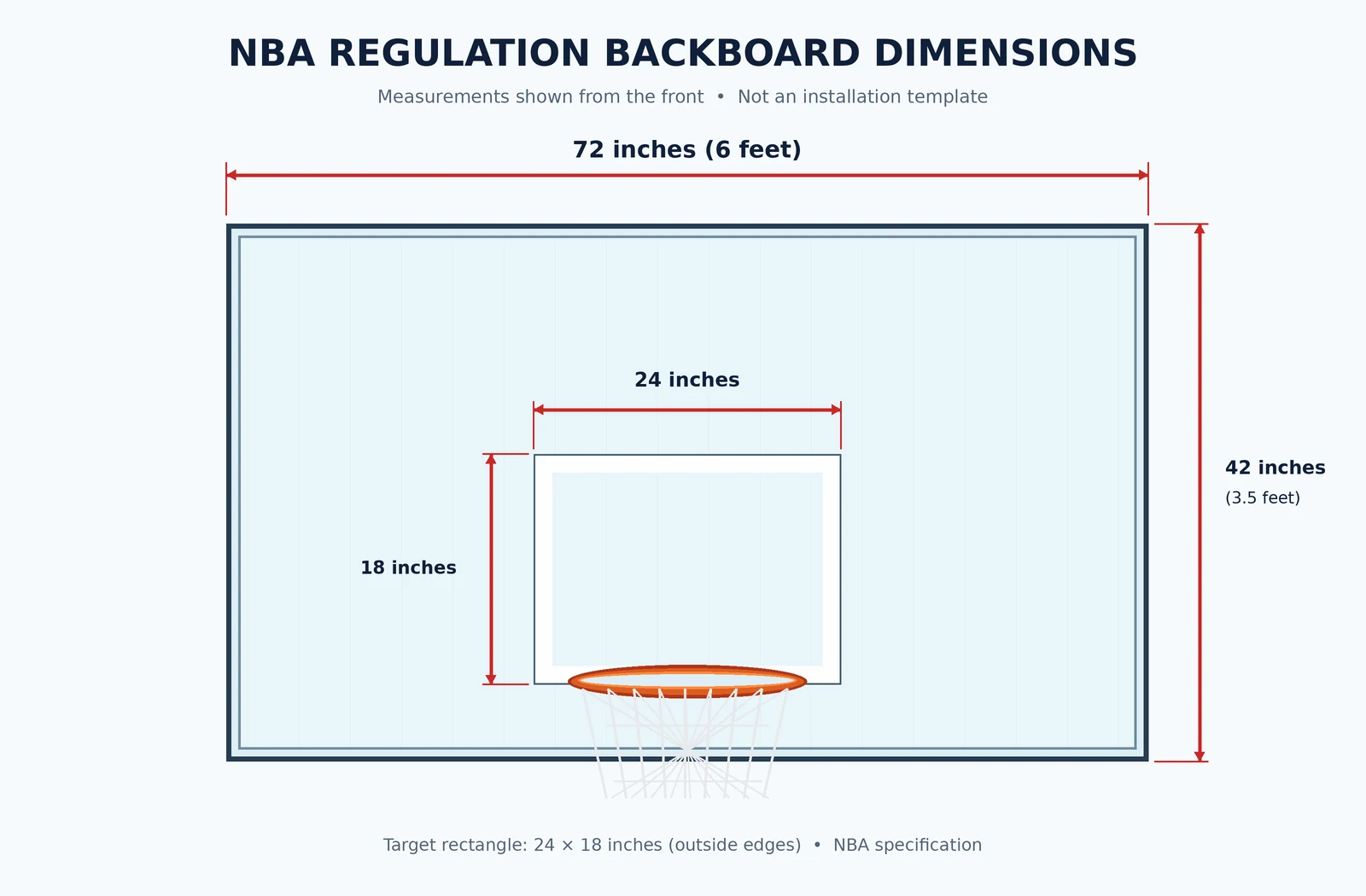
Its 72 × 42-inch tempered glass backboard matches the NBA’s standard backboard dimensions.

The glass measures 3/8 inch thick.

The supporting structure uses a 6 × 6-inch one-piece steel pole, dual extension arms, and reinforced connections.

Goalrilla describes this arrangement as its Three-Point Technology.

goalrilla.com

The rim adjusts between 7.5 and 10 feet, and the manufacturer publishes a maximum overhang of 4 feet. The actual distance depends on the selected height.

Advantages: Regulation-width backboard, one-piece pole, substantial overhang, and limited lifetime warranty.

Limitations: High price, demanding installation, and a minimum height of 7.5 feet.

Its 3/8-inch glass is thinner than the 1/2-inch glass found on the Mega Slam 72.

Best for: Serious recreational players with enough space and budget for a regulation-width basketball goal.

7. Goalsetter All-American 60 — Best for Families

Model SS45560G3 · Observed glass configuration: $2,599.99

The Goalsetter All-American 60 stands out for its adjustable height range.

Many in-ground basketball hoops only lower to 7.5 feet. The All-American adjusts from 6 to 10 feet.

That extra adjustment can make a difference for younger players who are still developing their shooting technique.

The glass configuration includes a 60 × 38-inch backboard with 3/8-inch tempered glass.

It also uses a 5 × 5-inch offset one-piece steel pole and provides 3 feet of overhang.

Its internal compression crank helps adjust the height.

Advantages: Lower minimum rim height, glass or acrylic options, one-piece pole, and substantial overhang.

Limitations: Premium price, padding sold separately, and different rim configurations with different warranty terms.

The acrylic configuration was listed at $2,649.99, slightly more than the researched glass configuration.

Best for: Families who want one permanent hoop to accommodate younger children and older players.

8. Mega Slam 72 — Best Premium 72-Inch Hoop

Observed US sale price: $2,799

The Mega Slam 72 combines a regulation-width backboard with heavy-duty construction.

Its 72 × 42-inch backboard uses 1/2-inch tempered glass.

The supporting structure includes an 8 × 6-inch steel pole, reinforced base, and substantial extension arms.

The system provides 4 feet of overhang at regulation rim height.

Its adjustable rim can be lowered to 5 feet, giving it a wider adjustment range than many competing premium hoops.

The package includes pole, base, and backboard padding, along with an anchor kit.

Mega Slam also uses galvanized steel and stainless steel hardware for corrosion resistance. However, this doesn’t make the system maintenance-free.

Advantages: Thick glass, large steel pole, extensive padding, low minimum height, and substantial overhang.

Limitations: High total weight, expensive installation, and warranty exclusions for certain components and environmental damage.

The manufacturer specifies different overhang distances at different rim heights. Check the full adjustment clearance before choosing an installation position.

megaslamhoops.uk

Best for: Larger home courts and buyers who want premium construction without sacrificing height adjustment.

9. Pro Dunk THOR Gold — Best Heavy-Duty 60-Inch Hoop

Observed displayed price: $2,399

The Pro Dunk THOR Gold is an alternative to premium 72-inch systems.

It features a 60 × 36-inch tempered glass backboard measuring 1/2 inch thick.

Its support structure includes a 6 × 6-inch one-piece steel pole with reinforced construction.

At regulation height, the published overhang is 4 feet.

The height adjustment covers 5 to 10 feet, making the system suitable for different playing levels.

Pole and backboard padding are included.

Advantages: Thick glass, heavy-duty steel construction, substantial overhang, and a wide adjustment range.

Limitations: Expensive installation, substantial weight, and manufacturer restrictions on rim use.

An optional Rust Armor upgrade was advertised for $129. Confirm its current price and written coverage before purchasing.

The THOR’s breakaway rim does not mean players can hang from it without restrictions. Follow the manufacturer’s instructions.

Best for: Players who want premium construction but prefer a 60-inch backboard over a 72-inch model.

How to Choose the Best In-Ground Basketball Hoop

Backboard Size and Material

Three common sizes are 54, 60, and 72 inches.

A 54-inch backboard is suitable for many smaller residential setups. A 60-inch board provides more space for bank shots, while a 72-inch board matches NBA regulation width.

Backboard material also matters.

Tempered glass is commonly used on premium basketball goals because it provides a rigid, responsive playing surface.

Acrylic offers a clear surface with different weight and durability characteristics.

Polycarbonate is impact-resistant and commonly found on lower-priced recreational hoops.

Material alone doesn’t determine rebound quality. Backboard thickness, framing, and mounting rigidity also affect how the basketball responds.

For a detailed comparison, see our basketball backboard materials guide.

Pole Strength and Stability

A basketball pole supports the backboard, rim, and extension arms.

Steel gauge describes the thickness of the steel. A lower gauge number generally means thicker steel. For example, 5-gauge steel is thicker than 7-gauge steel. However, pole dimensions, reinforcement, and installation also affect stability.

Look beyond the pole’s advertised width.

Important factors include steel thickness, whether the pole uses one or several sections, reinforcement, and the foundation.

A one-piece pole eliminates joints between pole sections, but no independent testing in this research establishes exact differences in wobble between these nine models.

Square poles can provide better resistance to twisting than comparable round poles, depending on their construction. One-piece poles also eliminate the joints found in sectional designs. These features can improve rigidity, but they don’t guarantee a basketball hoop will remain completely still during play.

A larger pole is not automatically proof of better overall performance.

Adjustable Height and Overhang

Most in-ground basketball hoops adjust to the regulation rim height of 10 feet.

Many adjustable in-ground hoops use a hand crank to raise or lower the rim. Other systems use assisted mechanisms, including pneumatic designs. The adjustment method affects how the hoop operates, so check the manufacturer’s instructions before buying.

However, minimum heights vary.

Some models only lower to 7.5 feet, while the Goalsetter All-American reaches 6 feet and the Mega Slam 72 and THOR Gold reach 5 feet.

This can matter when children share the hoop with adults.

Overhang is the horizontal distance that places the basket away from its supporting pole.

More overhang can create additional playing space beneath the rim, but it also affects the installation position and required clearance.

Check overhang at the heights you actually intend to use.

Direct Burial vs Anchor-Mounted Hoops

Not all in-ground basketball hoops are installed the same way.

A direct-burial hoop has part of its supporting pole embedded in concrete.

An anchor-mounted hoop uses bolts and a dedicated anchor assembly installed in a concrete foundation.

Anchor-mounted systems can sometimes be disassembled and relocated, but moving them still requires a suitable foundation at the new location.

Neither design is portable in the usual sense.

If you need to move your basketball setup regularly, see our guide to the best portable basketball hoops.

Rim Quality, Padding, and Dunking

Most of the hoops in this guide include a breakaway rim.

A breakaway rim flexes under certain loads, helping manage force through the basket assembly.

However, a breakaway rim does not automatically make hanging from the hoop safe.

Check each manufacturer’s dunking and hanging restrictions.

Pole pads and backboard padding are also worth comparing. Some systems include them, while others charge extra.

How Much Does an In-Ground Basketball Hoop Cost?

The basketball hoop itself is only part of the total cost.

Based on the researched models, equipment prices range from approximately $470 to nearly $3,000.

Professional installation costs vary depending on location, ground conditions, foundation requirements, and the installer.

Manufacturer guidance commonly places installation in the several-hundred-dollar range, but these figures are not guaranteed national prices.

Here are two illustrative examples:

Basketball hoop Hardware Example installation Estimated subtotal
Silverback SB60 $1,099.95 $400–$600 $1,499.95–$1,699.95
Goalsetter All-American 60 $2,599.99 $325–$450 $2,924.99–$3,049.99

These estimates exclude tax, possible delivery charges, extra accessories, and difficult groundwork.

The Goalsetter example also excludes optional padding.

Before buying, ask whether the installation quote includes excavation, concrete, reinforcement, assembly, and removal of excess material.

In-Ground Basketball Hoop Installation

Installing an in-ground basketball hoop requires more preparation than assembling a portable system.

The main steps are:

  1. Choose a suitable position with enough playing and overhead clearance.
  2. Check underground utilities and local requirements.
  3. Prepare the foundation specified for your exact model.
  4. Install the anchor assembly or direct-burial pole.
  5. Allow the concrete to cure for the required period.
  6. Assemble, raise, and secure the basketball system according to its manual.

Foundation dimensions and curing times vary between manufacturers.

For example, the Silverback SB60 manual specifies a different foundation from the much heavier Mega Slam 72.

Do not copy one model’s concrete instructions for another hoop.

Heavy basketball systems may also require several adults or professional installation equipment.

Our basketball hoop installation guide explains the wider process and safety considerations.

Are In-Ground Basketball Hoops Worth It?

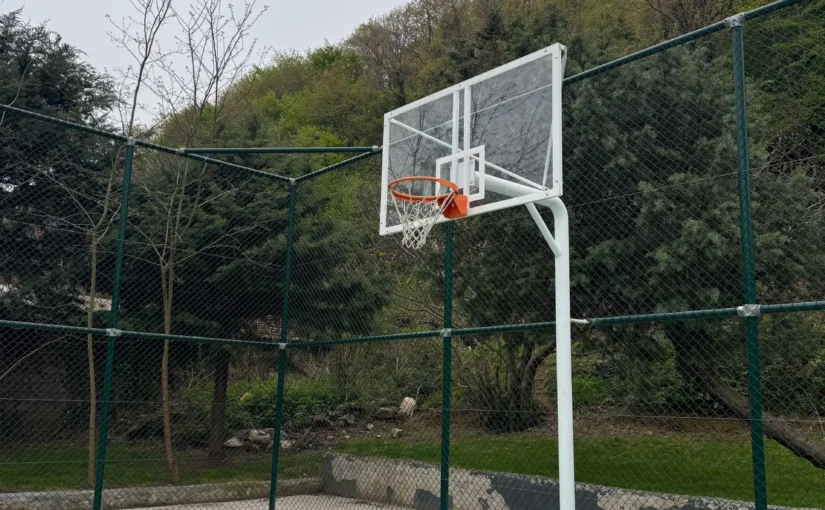
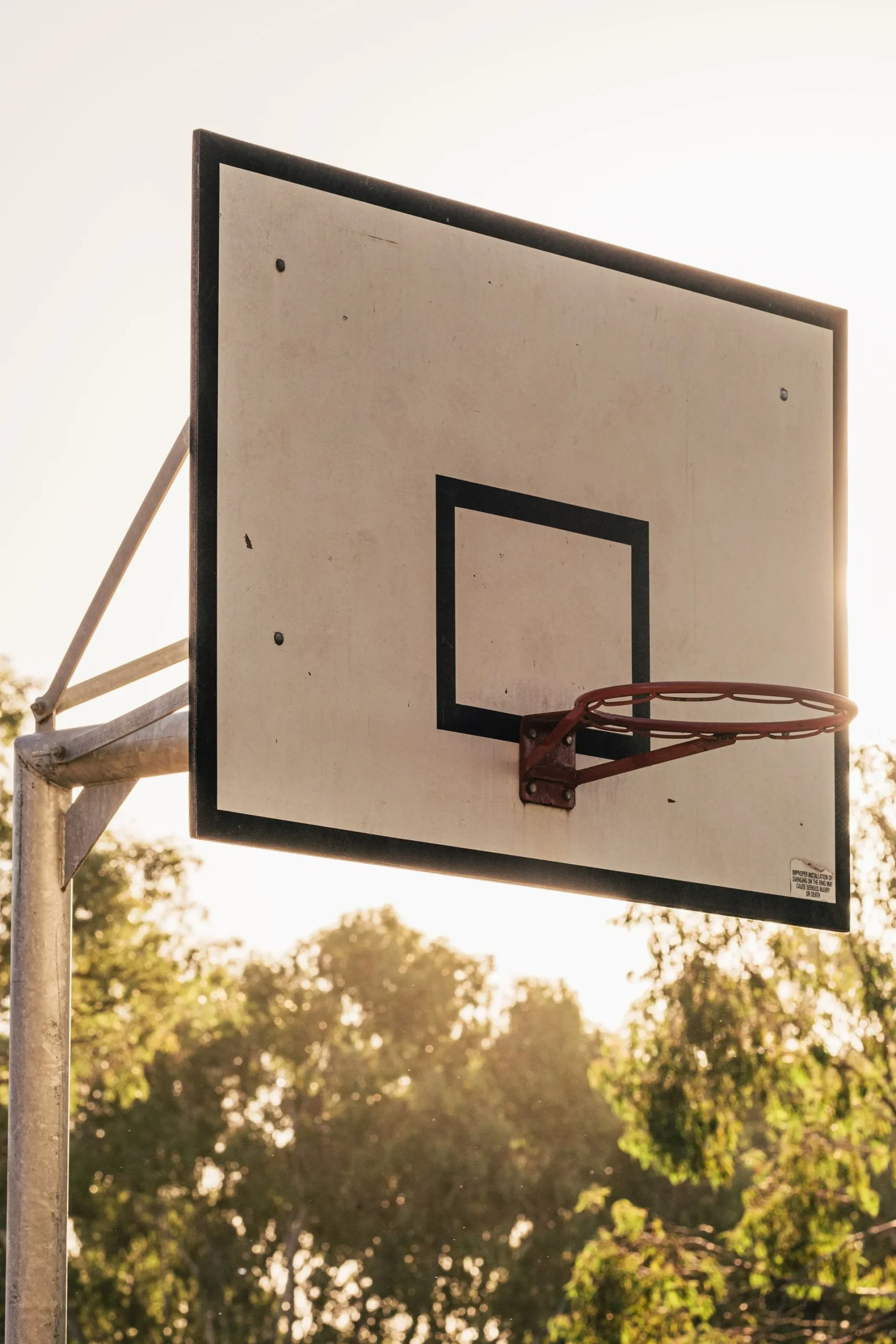
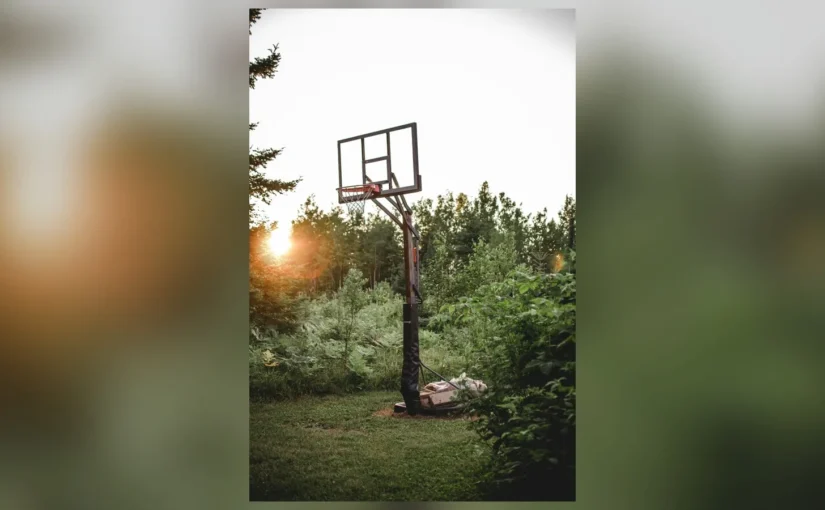
Outdoor basketball hoop with white backboard at sunset
Outdoor basketball hoop photographed at sunset.


An in-ground basketball hoop can be worth the investment if you play regularly and want a permanent home setup.

Compared with portable basketball hoops, permanent systems can provide stronger supporting structures, larger backboards, and more overhang.

However, performance still depends on the model and installation quality.

In-ground systems also have disadvantages.

They require a suitable foundation, cost more to install, and are difficult to relocate.

For casual basketball or rented properties, a portable hoop may be more practical.

Not sure which type suits you? Read our in-ground vs portable basketball hoop comparison to compare stability, installation, and cost.

If you own your home, have suitable space, and expect to use the hoop for years, a well-chosen in-ground system can be a worthwhile purchase.

In-Ground Basketball Hoop Maintenance and Warranty

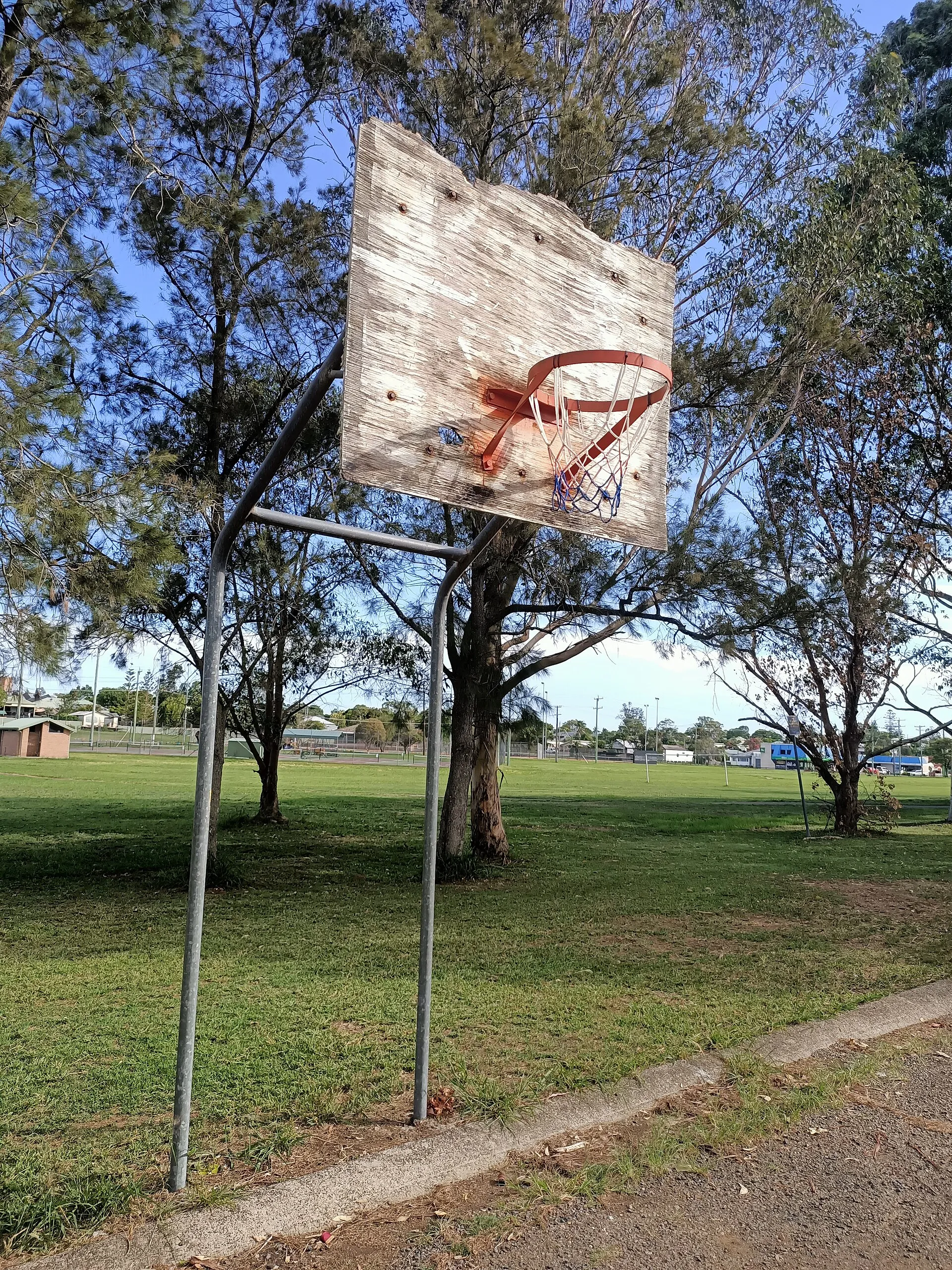
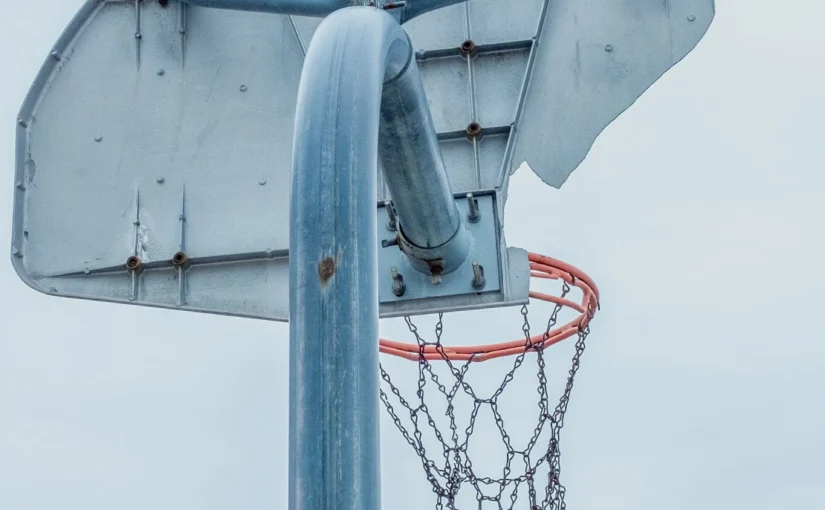
Weathered outdoor basketball hoop in a public park
An outdoor basketball hoop showing signs of weather exposure.

Even premium outdoor basketball hoops need regular inspections.

Check the supporting pole, accessible bolts, rim, padding, and backboard for damage.

Look for rust, loose connections, cracked components, or unusual movement.

Follow the manufacturer’s cleaning instructions and address damaged protective coatings before corrosion becomes more serious.

Warranty coverage also varies considerably.

Some models have five-year limited warranties, while premium systems advertise limited lifetime coverage.

However, lifetime coverage rarely means every component and repair cost is included.

Glass, rims, labor, shipping, environmental damage, and improper use may have separate exclusions.

Before buying, read the warranty for the exact model and check whether replacement parts remain available.

Frequently Asked Questions

What Are the Best In-Ground Basketball Hoops?

The Silverback SB60 is our best overall value pick because it combines a 60-inch tempered glass backboard, adjustable height, and included padding at a relatively accessible price.

The Lifetime 71525 is a cheaper option, while the Goalrilla FT72 and Mega Slam 72 offer larger backboards and heavier construction.

Which Basketball Hoop Is Best for a Driveway?

For many residential driveways, a 54-inch or 60-inch adjustable in-ground basketball hoop is a practical choice.

The Silverback SB54 and SB60 are worth comparing.

Measure the available playing space and check the hoop’s overhang before choosing a model. For more advice on positioning, clearance, and setup, read our driveway basketball hoop guide.

Is an In-Ground Basketball Hoop Worth It?

Yes, if you want a permanent basketball setup and expect to use it regularly.

However, installation costs and relocation difficulties can make a portable basketball hoop more suitable for occasional players.

What Is the Best Freestanding Basketball Hoop?

The term freestanding can refer to different basketball systems.

If you mean a hoop with a movable weighted base, look for a portable basketball hoop rather than an in-ground model.

Our portable basketball hoop buying guide compares eight options.

Can You Move an In-Ground Basketball Hoop?

Sometimes.

Anchor-mounted systems can often be disassembled, but relocating them generally requires a new compatible foundation and substantial labor.

Direct-burial hoops are usually harder to remove because part of the pole is embedded in concrete.

Can You Dunk on an In-Ground Basketball Hoop?

Some in-ground basketball hoops are designed to withstand dunking.

However, this doesn’t mean players can hang from the rim.

Always check the exact model’s safety instructions and warranty restrictions.

Is a 72-Inch Basketball Backboard Necessary?

No.

A 72-inch backboard matches NBA regulation width, but smaller 54-inch and 60-inch backboards can work well for home basketball.

The right size depends on your space, budget, and playing needs.

Final Verdict

The Silverback SB60 is our best overall in-ground basketball hoop for homeowners who want a permanent glass-backboard system without premium pricing.

Choose the Lifetime 71525 if keeping costs low is your priority.

The Goalsetter All-American 60 is worth considering for families who need a lower minimum rim height, while the Goalrilla FT72 suits serious players who want regulation-width practice.

For a premium home court, the Mega Slam 72 offers thick tempered glass, heavy-duty construction, extensive padding, and a wide adjustment range.

Whichever model you choose, compare the total installed cost, confirm the exact specifications, and follow the manufacturer’s installation requirements.


Best Portable Basketball Hoop | 8 Options for Every Budget

The best portable basketball hoop depends on your budget, driveway space, and how you plan to use it. Some models suit casual shooting and younger players. Others offer larger backboards, easier height adjustment, and stronger support structures.

For a budget-friendly option, the Lifetime ProCourt 90040 offers a 44-inch backboard and adjustable height. The Silverback NXT 54 is worth considering if you want a larger backboard and steel chassis construction. For buyers who want a tempered-glass backboard without installing an in-ground hoop, the Spalding Beast 60 is a premium alternative.

However, a higher price does not automatically mean better performance. Backboard construction, base stability, assembly requirements, and safety restrictions all matter.

This guide compares eight portable basketball hoops using manufacturer specifications, product manuals, retailer information, and available owner feedback. BasketballRex has not physically tested these models. Recommendations are based on documented features and suitable use cases, not firsthand performance measurements.

Best Portable Basketball Hoops at a Glance

The table below compares eight portable basketball hoop systems across different price ranges.

Basketball Hoop Backboard Height Adjustment Best For Reference Price
Lifetime ProCourt 90040 44-inch polyethylene 7.5–10 ft Budget driveway shooting $189.99
Lifetime 90491 48-inch Fusion 8–10 ft Affordable upgrade $349.99
Lifetime 90271 50-inch Fusion 8–10 ft Budget 50-inch option $299.99
Silverback NXT 50 (B7400W) 50-inch polycarbonate 7.5–10 ft Midrange shooting practice $499.95 sale
Silverback NXT 54 (B7401W) 54-inch polycarbonate 7.5–10 ft Larger midrange system $599.95 sale
M54 54-inch acrylic 8–10 ft Easier assembly $699.99
M60 60-inch acrylic 8–10 ft Larger acrylic backboard $899.99
Spalding Beast 60 60-inch tempered glass 7.5–10 ft Premium portable setup $2,299.99

US reference prices observed during November 6–7, 2026 research. Prices are not guaranteed checkout quotes. Silverback sale prices may change, and different sellers may display different offers. Taxes, delivery, and additional equipment are excluded.

Important: Silverback NXT model numbers and adjustment mechanisms vary by generation. Confirm the exact product number before ordering.

Our Top Portable Basketball Hoop Picks

1. Lifetime ProCourt 90040 — Best Budget Portable Basketball Hoop

The Lifetime ProCourt 90040 is a practical starting point for families wanting an inexpensive basketball hoop for casual driveway shooting.

Its 44-inch polyethylene backboard is smaller than those found on more expensive systems. That makes it better suited to basic shooting practice than players who want a larger target for bank shots.

The hoop adjusts from 7.5 to 10 feet using a telescoping pole. Height changes occur in six-inch steps, making adjustment less convenient than a crank-operated system.

Its base holds 27 gallons of water. The manual also specifies a 280-pound sand-filling option. Owners must follow the exact filling instructions rather than add arbitrary quantities.

The rim uses a conventional fixed steel design rather than a breakaway mechanism.

What we like:

  • Affordable entry price.

  • Adjustable height for different players.

  • Simple construction with a documented assembly manual.

  • Five-year limited factory warranty.

What to consider:

  • Smaller backboard.

  • Basic fixed rim.

  • Less convenient height adjustment.

  • Hanging from the rim is not permitted.

Lifetime estimates approximately one to two hours for assembly and recommends at least two people.

Best for: Beginners, younger players, and families wanting an affordable driveway basketball hoop.

Skip it if: You want a larger backboard, spring-action rim, or easier height adjustment.

2. Lifetime 90491 — Best Affordable Upgrade

The Lifetime 90491 offers several upgrades over the ProCourt 90040.

Its 48-inch Fusion backboard combines a polycarbonate playing surface with a polyethylene frame. The larger board provides more surface area for practicing bank shots.

The Strong Arm mechanism uses a locking bar to adjust the rim from 8 to 10 feet.

It also includes an 18-inch Slam-It rim with horizontal springs. This offers a different rim design from the fixed steel rim on the 90040, although it does not automatically permit dunking or hanging.

Retailer specifications identify a 31-gallon wheeled base.

What we like:

  • Larger backboard than the ProCourt.

  • Spring-action rim.

  • Strong Arm height adjustment.

  • Wheeled base for repositioning.

What to consider:

  • Minimum height is 8 feet.

  • Some retailer descriptions contain conflicting specifications.

  • Current warranty and assembly requirements need confirmation.

Lifetime’s listed price during the research check was approximately $349.99. Retailer offers may differ, so confirm the exact 90491 model before buying.

Best for: Families wanting an affordable upgrade from a basic portable basketball hoop.

Skip it if: You need a rim that lowers to 7.5 feet or prefer a model with more fully verified specifications.

3. Lifetime 90271 — Best Budget 50-Inch Portable Basketball Hoop

The Lifetime 90271 is worth considering if backboard size matters but you want to remain around the $300 price range.

It features a 50-inch Shatterproof Fusion backboard, a Slam-It rim, and a 31-gallon portable base.

Its Speed Shift mechanism adjusts the rim from 8 to 10 feet in six-inch increments.

Compared with the Lifetime 90040, you get a larger backboard and a spring-action rim. However, the 90271 does not adjust as low as the 90040.

A larger board provides more surface area for layups and bank shots, but board width alone does not establish better rebound performance.

What we like:

  • 50-inch backboard at a relatively affordable price.

  • Speed Shift height adjustment.

  • Slam-It rim.

  • Portable base.

What to consider:

  • Eight-foot minimum rim height.

  • No verified head-to-head performance advantage over other Lifetime models.

  • Exact warranty and assembly details require confirmation.

Best for: Families wanting a larger backboard without spending midrange prices.

Skip it if: You need a lower starting height or a more substantial steel-chassis design.

4. Silverback NXT 50 — Best Midrange 50-Inch Option

The Silverback NXT 50 offers a different construction approach from basic budget portable basketball hoops.

The researched B7400W version features a 50-inch polycarbonate backboard, a 3.5-inch round pole, and approximately two feet of overhang.

Its Stabili-Frame construction connects the steel chassis directly to the pole. This is a meaningful structural difference from simpler portable systems, although it does not prove superior stability without controlled testing.

The hoop adjusts from 7.5 to 10 feet using an improved actuator mechanism.

Silverback advertises assembly in approximately 90 minutes, helped by partially assembled components.

What we like:

  • Steel chassis-to-pole connection.

  • 50-inch polycarbonate backboard.

  • 7.5-foot minimum height.

  • Partially assembled components.

What to consider:

  • More expensive than comparable-size Lifetime systems.

  • Exact base capacity needs confirmation.

  • Important operating restrictions apply.

Safety note: The researched B7400W manual describes intended use as shooting practice and restricts hanging from the rim. Suitability for competitive games has not been confirmed. Buyers should check the exact manual before purchasing.

The manufacturer’s sale price observed during research was approximately $499.95, compared with a regular listed price around $589.95.

Best for: Home shooting practice where construction features matter more than maximum backboard width.

Skip it if: You need a hoop specifically approved for competitive games or unrestricted dunking.

5. Silverback NXT 54 — Best Larger Midrange Portable Hoop

The Silverback NXT 54 is a strong candidate for families wanting a larger portable basketball system without paying for a premium glass backboard.

The researched B7401W version features a 54-by-33-inch polycarbonate backboard with folded edges designed to increase rigidity.

It also includes a 3.5-inch round pole, steel chassis connection, and standard breakaway rim.

The hoop adjusts from 7.5 to 10 feet using an improved actuator.

Its ErgoMove system uses large wheels and a wheelbarrow-style movement method. However, the manufacturer specifies two-person movement. This is not an effortlessly movable one-person system.

Silverback distinguishes between its 2.5-foot overhang and approximately 26 inches of clear playing space beneath the goal.

What we like:

  • Larger 54-inch backboard.

  • Steel chassis connection.

  • Lower 7.5-foot rim setting.

  • Dedicated movement mechanism.

What to consider:

  • More expensive than budget models.

  • Requires two people for movement.

  • Exact model generation matters.

Model warning: B7401W and B8401W are not interchangeable specifications. The B7401W uses the newer actuator, while B8401W listings describe six-inch stepped adjustment.

The B7401W manufacturer’s sale price observed during research was approximately $599.95, compared with a regular listed price of $699.95.

Best for: Families and recreational shooters wanting a larger portable hoop with more substantial construction.

Skip it if: You need frequent solo movement or expect a portable hoop to behave like a permanently installed system.

6. Spalding Momentous 54 — Best for Easier Assembly

The Spalding Momentous EZ Assembly 54 is designed to reduce setup time.

It uses a 54-inch acrylic backboard rather than the polycarbonate material found on the Silverback NXT models.

Spalding advertises assembly in 30 minutes or less. This is a manufacturer estimate, not an independently verified assembly time from BasketballRex.

The Momentous offers an 8-to-10-foot height adjustment range with a crank-operated lift.

Its acrylic backboard gives buyers another material option between basic plastic systems and more expensive tempered-glass equipment.

What we like:

  • 54-inch acrylic backboard.

  • Assembly-focused design.

  • Crank height adjustment.

  • Breakaway rim.

What to consider:

  • Minimum height is 8 feet.

  • Actual assembly time may vary.

  • Warranty terms require checking.

  • Historical recall information matters.

Important recall: On September 22, 2022, the US Consumer Product Safety Commission announced a recall involving certain Spalding Momentous EZ portable basketball goals because support-arm welds could fail.

The recall involved specified older 50- and 54-inch systems, not every Momentous product currently sold.

Before buying used equipment or older stock, check the exact identifiers against the official CPSC recall notice.

Best for: Buyers prioritizing simpler assembly and an acrylic backboard.

Skip it if: You need a lower rim setting or do not want the additional checks associated with older stock.

7. Spalding Momentous 60 — Best Larger Acrylic Alternative

The Spalding Momentous 60 offers a larger acrylic backboard while retaining the assembly-focused design of the Momentous series.

Its 60-inch board provides a wider target than the 54-inch version, which may appeal to players who regularly practice bank shots.

Spalding’s 2026 catalog identifies the 6E2014 model with an 8-to-10-foot crank adjustment, spring-action breakaway rim, 36-gallon base, and two wheels.

The manufacturer also advertises quick assembly.

However, a larger backboard does not automatically establish greater stability. Board support, ballast, pole construction, and overall system geometry all affect performance.

What we like:

  • Larger 60-inch acrylic backboard.

  • Crank height adjustment.

  • 36-gallon portable base.

  • Two wheels for repositioning.

  • Less expensive than the premium Beast glass system.

What to consider:

  • More expensive than the 54-inch Momentous.

  • Eight-foot minimum height.

  • Assembly claims are manufacturer estimates.

  • Exact carton, manual, and warranty should be matched before purchase.

Best for: Buyers wanting a larger acrylic portable hoop without paying premium glass-system prices.

Skip it if: Your driveway is small or a 54-inch board already meets your needs.

8. Spalding Beast 60 — Best Premium Glass Portable Basketball Hoop

The Spalding Beast 60 targets buyers who want a tempered-glass backboard but cannot install a permanent basketball hoop.

Its 60-inch glass backboard is the main difference from the acrylic and polycarbonate systems in this guide.

The Beast also includes a Screw Jack mechanism that adjusts the rim from 7.5 to 10 feet.

Tempered glass is commonly used on higher-end basketball systems because of its rigid playing surface. However, backboard material alone cannot establish the performance of the entire portable system.

Pole construction, base movement, support geometry, and proper ballast remain important.

What we like:

  • 60-inch tempered-glass backboard.

  • Screw Jack height adjustment.

  • Portable alternative to a permanent glass system.

What to consider:

  • Substantially more expensive.

  • Heavy components can complicate assembly.

  • Exact current base capacity and transport details need confirmation.

  • Current warranty coverage requires verification.

Owner feedback includes concerns about assembly difficulty and handling heavy components. These are useful warnings, but they do not establish a verified defect rate.

Best for: Serious recreational shooters who specifically want a glass backboard but cannot install an in-ground hoop.

Skip it if: You mainly want casual family shooting or a lightweight system that is easy to move.

Portable basketball hoop base with wheels, support braces, and fill cap
Illustration of a portable basketball hoop’s weighted base and wheels.

How to Choose a Portable Basketball Hoop

A good portable basketball hoop should suit the players, available space, and amount of work you are willing to put into setup and maintenance.

Backboard Size and Material

Portable basketball hoops commonly use polyethylene, polycarbonate, acrylic, or tempered glass backboards.

Polyethylene: Often found on inexpensive beginner systems. It is generally used in smaller, basic backboards.

Polycarbonate: Common on budget and midrange hoops. It provides a clear playing surface and is used in systems such as the Silverback NXT.

Acrylic: Found on models such as the Spalding Momentous. It offers a different playing surface from polycarbonate, although actual rebound depends on the complete system.

Tempered glass: Used on premium hoops such as the Spalding Beast 60. It is associated with higher-end basketball equipment but adds cost and weight.

A 44-inch backboard may be enough for basic shooting practice. A 50- or 54-inch board offers more surface area. A 60-inch board can be attractive for players who frequently practice bank shots.

The right size also depends on your driveway.

For a broader explanation, see our guide to basketball backboard dimensions.

Height Adjustment

Most adjustable portable basketball hoops reach the standard 10-foot rim height.

However, their lowest settings differ.

The Lifetime 90040 and Silverback NXT systems discussed here can lower to 7.5 feet. The Lifetime 90491, Lifetime 90271, and Momentous systems start at 8 feet.

That difference may matter when younger players use the hoop.

Adjustment mechanisms also vary:

  • Telescoping: Usually requires manual repositioning and locking.

  • Lever-operated: Designed for quicker changes between preset heights.

  • Actuator: Raises or lowers the rim using a mechanical adjustment system.

  • Crank: Allows controlled height changes by turning a handle.

Choose a system that adults can adjust safely and conveniently.

For more information, read our guide to basketball hoop height.

Base Stability: Sand vs. Water

A portable basketball hoop relies on its filled base for stability.

Most bases accept water or sand, but you must follow the manufacturer’s instructions for the exact model.

Water is usually easier to add and remove. However, leaks, evaporation, and freezing conditions can create problems.

Sand is denser and does not evaporate. It can provide more ballast for a given volume, but it is harder to fill, empty, and move.

Lifetime generally favors sand in its filling guidance, although the correct amount depends on the system.

Never assume that a base is safe because it feels heavy.

Inspect it for leaks, cracks, damaged hardware, and signs of instability.

Do not add improvised external weights unless the manufacturer explicitly allows them.

Moving and Storage

Portable does not mean lightweight.

A fully assembled basketball hoop can be difficult to reposition, especially after the base has been filled.

Before buying, consider:

  • Whether one or two adults are required to move it.

  • Whether the driveway is level.

  • Whether wheels can pass over thresholds or uneven surfaces.

  • Whether the hoop fits through your intended storage route.

  • Whether the manufacturer allows the proposed storage position.

The Silverback NXT 54, for example, uses a wheelbarrow-style movement system but still requires two people.

The total height of the hoop is also greater than the rim height. A hoop lowered to 7.5 feet is not necessarily short enough to fit inside a garage.

Measure the entire storage route before purchasing.

Assembly and Maintenance

Assembly time varies considerably between portable basketball hoops.

The Lifetime 90040 manual estimates one to two hours. Silverback advertises approximately 90 minutes for its NXT models, while Spalding advertises 30 minutes or less for the Momentous series.

These are not controlled, independently verified comparisons.

Actual assembly depends on experience, tools, component weight, and whether another person is helping.

After installation, maintenance remains important.

Check the base, wheels, pole, bolts, rim, and backboard regularly.

Inspect metal components for corrosion and follow the manufacturer’s instructions for replacement parts.

A portable hoop should never be considered maintenance-free.

Rim Type and Dunking Restrictions

Portable basketball hoops use different rim designs.

A fixed rim is simple and usually found on lower-priced models.

Spring-action and breakaway rims can flex under certain forces, but their presence does not automatically mean dunking or hanging is permitted.

Some portable basketball hoop manuals specifically prohibit hanging from the rim.

Before buying for teenagers or adults who want to dunk, check the exact model’s intended-use restrictions.

Do not rely on marketing phrases such as breakaway rim or heavy-duty construction as proof that hanging is safe.

Common Portable Basketball Hoop Buying Mistakes

Choosing a portable basketball hoop based only on price or backboard size can lead to disappointment.

1. Buying a backboard that’s too large for the driveway

A bigger backboard is not always useful if the playing area is cramped.

Measure the space available for shooting, moving, and parking. For help planning your setup, read our driveway basketball hoop guide.

2. Ignoring the lowest rim height

An adjustable hoop may still be too tall for younger players.

Check the actual adjustment range rather than assuming all portable hoops lower to the same height.

3. Underestimating assembly

Large portable hoops can have heavy components and complicated assembly steps.

Read the manual before ordering and check whether two adults are needed.

4. Assuming portable means easy to move

A filled base can make relocation difficult.

Check the manufacturer’s movement instructions and consider how often you realistically need to reposition the hoop.

5. Ignoring wind and weather

No verified universal safe wind-speed limit exists for the systems compared here.

Follow the manufacturer’s weather warnings. Do not assume a sand-filled base is storm-proof.

6. Forgetting about replacement parts

Bases, wheels, adjustment mechanisms, rims, and backboards can wear or become damaged.

Check whether the manufacturer supports the exact model and whether replacement components are available.

7. Buying used equipment without checking recalls

Older basketball hoop systems may have been recalled.

Check model numbers against official recall notices before purchasing secondhand equipment.

Portable basketball hoop with a weighted base on a residential driveway
Illustration of a portable basketball hoop positioned on a spacious driveway.

Frequently Asked Questions

Are Portable Basketball Hoops Any Good?

Yes. Portable basketball hoops can be suitable for home shooting practice, casual games, and family use, depending on the exact model’s operating restrictions.

Their biggest advantage is that they do not require a permanent concrete foundation.

However, performance varies. Smaller budget systems may have more noticeable movement or less rigid backboards than heavier models.

For buyers who want a permanent home court, an in-ground basketball hoop may be a better long-term option.

For a detailed comparison, read our in-ground vs portable basketball hoop guide to compare stability, costs, and installation.

See our broader guide to the best basketball hoops for other system types.

What Is a Good Small Portable Basketball Hoop?

The Lifetime ProCourt 90040 is a reasonable small portable option for beginners.

Its 44-inch backboard takes up less width than larger models, and its rim adjusts from 7.5 to 10 feet.

However, it is still a full-size portable basketball system with a substantial base and pole.

Check its complete dimensions before assuming it will fit a small driveway or garage.

Should I Buy a 54-Inch or 60-Inch Basketball Hoop?

A 54-inch portable basketball hoop is often a sensible choice for family driveway play.

It offers a useful backboard size without necessarily requiring the cost and space associated with a larger 60-inch system.

A 60-inch hoop may appeal to players who want more backboard surface for bank shots.

However, size alone does not determine rebound quality, stability, or durability.

Compare the materials, support structure, base, and price before deciding.

Is Spalding or Lifetime a Better Basketball Hoop Brand?

Neither brand is automatically better for every buyer.

Lifetime offers several affordable portable basketball hoops with different backboard sizes and adjustment systems.

Spalding offers models such as the Momentous and Beast, including acrylic and tempered-glass options.

For a tight budget, Lifetime may offer a more suitable model. For buyers prioritizing a larger acrylic or glass backboard, Spalding may have more relevant options.

Compare individual products rather than choosing by brand alone.

Is Sand Better Than Water for a Portable Basketball Hoop?

Sand can provide more ballast because it is denser than water.

It also avoids the evaporation and freezing issues associated with water.

However, sand is more difficult to add, remove, and transport.

The best choice depends on the exact model and the manufacturer’s instructions.

Can You Leave a Portable Basketball Hoop Outside?

Many portable basketball hoops are designed for outdoor residential use.

However, outdoor construction does not mean the system can safely remain exposed to every weather condition.

Wind, freezing temperatures, corrosion, and damaged ballast bases can create hazards.

Follow the exact manual for maintenance and severe-weather precautions.

Can You Dunk on a Portable Basketball Hoop?

Do not assume so.

A breakaway rim does not automatically make a portable basketball hoop safe for dunking or hanging.

Some manufacturers restrict these activities, even on systems equipped with spring-action rims.

Check the exact model’s manual before attempting to dunk.

Final Verdict: Which Portable Basketball Hoop Should You Buy?

For affordable family shooting, the Lifetime ProCourt 90040 is a sensible starting point. It offers adjustable height, simple construction, and a relatively low purchase price.

If you want a larger backboard without spending midrange prices, consider the Lifetime 90271.

The Silverback NXT 54 is worth comparing if you prioritize a larger polycarbonate board, steel chassis connection, and dedicated movement system. Check the exact model generation and operating restrictions.

The Spalding Momentous 54 is attractive for buyers who value easier assembly and an acrylic backboard. Remember to check recall identifiers when buying older stock.

Finally, the Spalding Beast 60 offers a premium tempered-glass option for buyers who cannot install a permanent hoop.

The best portable basketball hoop is the one that fits your playing space, budget, and intended use. Choose the right system first, then verify its specifications, safety instructions, warranty, and total ownership costs before purchasing.

Best Basketball Hoop | Top Picks for Every Home and Budget

The best basketball hoop depends on your budget, playing space, and whether you want a portable or permanent setup.

For affordable driveway play, the Lifetime 1269 is a practical starting point. The Silverback SB60 offers a tempered-glass backboard for homeowners ready to install a permanent hoop. For a premium home court, the Mega Slam 72 offers a larger backboard and a wider height-adjustment range.

But no single basketball hoop is the right choice for every home.

This guide compares portable, in-ground, wall-mounted, and fixed-height basketball goals. We reviewed manufacturer specifications, US product listings, safety information, and independent testing where available.

BasketballRex has not personally tested these hoops. The recommendations reflect documented features and intended use, not invented testing scores or durability rankings.

Best Basketball Hoops at a Glance

Best for Basketball hoop Approx. hardware price
Budget portable Lifetime 1269 $230
Midrange portable Silverback NXT 54 (B7401W) $600
Budget in-ground Lifetime 71281 $440
Value glass in-ground Silverback SB60 $1,100
Family height adjustment Goalsetter All-American From around $2,600, depending on configuration
Premium adjustable home court Mega Slam 72 $2,799 promotional price
Wall-mounted Silverback NXT 54 Wall Mount $440

Prices are US research observations from November 6, 2026. They may change, especially during promotions. Taxes, shipping, installation, concrete, and other materials can add to the total cost.

Best Budget Basketball Hoop: Lifetime 1269

The Lifetime 1269 is a sensible starting point for families who want an affordable basketball hoop without permanent installation.

It has a 44-inch polycarbonate backboard, an 18-inch solid-steel rim, a 27-gallon portable base, and a three-piece steel pole.

The rim adjusts from 7.5 to 10 feet in six-inch increments, allowing players to change the height for casual games and shooting practice.

At approximately $230, it is one of the least expensive full-size-rim systems in this comparison.

The compromise is its basic construction. Its smaller backboard provides less room for bank shots than larger models, and its standard rim does not have a spring-action breakaway mechanism.

It also needs to be assembled and filled with the approved ballast before use.

Best for: Beginners, families, and casual driveway basketball.

Skip it if: You want a larger backboard, a breakaway rim, or a more substantial permanent setup.

Best Midrange Portable Basketball Hoop: Silverback NXT 54

The Silverback NXT 54 Portable is a more substantial alternative to a basic budget basketball hoop.

The B7401W listing describes a 54-inch polycarbonate backboard with folded edges, a steel support structure, and an adjustable actuator that changes the rim height from 7.5 to 10 feet.

It also uses a wheelbarrow-style transport design. The hoop can be tilted onto its wheels for repositioning, although moving a filled portable basketball hoop still requires care and effort.

Independent testing of a Silverback NXT sample reported positive impressions of stability and rebound. However, the exact tested version could not be matched confidently to every current listing.

Check the model number before ordering. The B8401W and B7401W versions share the NXT name but describe different height-adjustment mechanisms.

At around $600, this is a considerable step up from the Lifetime 1269.

Best for: Families who want a larger portable hoop without installing concrete.

Skip it if: You need a lightweight hoop that can be moved frequently or want tempered glass.

Best Budget In-Ground Basketball Hoop: Lifetime 71281

The Lifetime 71281 is worth considering if you want a permanent basketball hoop but cannot justify the price of premium glass systems.

It features a 52-inch polycarbonate backboard, an 18-inch Slam-It spring-action rim, and a Power Lift adjustment mechanism.

The rim adjusts continuously from 7.5 to 10 feet.

Its three-piece steel pole is an important difference from more expensive in-ground hoops that use one-piece poles and heavier support structures.

At approximately $440 for the hardware, the 71281 offers an affordable entry into permanent basketball goal installation.

However, the price does not include the foundation. You still need to account for excavation, concrete, curing time, and final assembly.

Use the installation instructions for the exact model rather than applying foundation measurements from another basketball hoop.

Best for: Homeowners who want an adjustable in-ground basketball hoop on a tighter budget.

Skip it if: You want a tempered-glass backboard or a premium one-piece support structure.

Best Value Glass In-Ground Basketball Hoop: Silverback SB60

The Silverback SB60 is one of the strongest value options for buyers who want a permanent tempered-glass basketball hoop.

It features a 60 × 33-inch backboard with 5/16-inch tempered glass, a 4 × 4-inch steel pole, and a breakaway rim.

The height adjusts from 7.5 to 10 feet using an all-steel actuator. The system also provides approximately 2.5 feet of overhang and includes pole and backboard padding.

Its anchor-mounted design allows the goal to be unbolted, but moving it to another property still requires a suitable new foundation.

At around $1,100 before installation, the SB60 sits between budget polycarbonate hoops and much more expensive premium glass systems.

There is one warranty detail to check. The current product page advertises a five-year limited warranty, while an older manufacturer-authored manual lists seven years. Confirm the coverage that applies to your purchase.

Best for: Homeowners seeking a permanent glass basketball hoop without spending several thousand dollars on hardware.

Skip it if: You cannot install a concrete foundation or need a hoop that can move around the driveway.

Best Basketball Hoop for Family Height Adjustment: Goalsetter All-American

The Goalsetter All-American offers an important advantage for families with children of different ages: its rim adjusts from 6 to 10 feet.

Many other full-size systems in this comparison only lower to 7.5 feet.

The All-American uses a 60 × 38-inch backboard, a one-piece steel pole, and an internal height-adjustment mechanism.

It also offers different backboard materials and rim configurations, including acrylic or tempered glass.

That flexibility can help buyers choose a system for their household, but it makes price comparisons more complicated.

Before ordering, confirm the exact backboard material, rim, model configuration, and included accessories. Do not assume the advertised starting price covers every option.

A lower rim can be useful for developing players, but it does not replace supervision or proper installation.

Best for: Families wanting one permanent hoop that can accommodate younger children, teenagers, and adults.

Skip it if: You only need a basic outdoor hoop for occasional games.

Best Premium Adjustable Basketball Hoop: Mega Slam 72

The Mega Slam 72 is designed for homeowners building a dedicated outdoor basketball setup.

It has a 72-inch-wide tempered-glass backboard with half-inch glass, an 8 × 6-inch steel pole, and a substantial support structure.

Its published product information describes height adjustment from 5 to 10 feet, with lift-assist components to help raise and lower the goal.

It also includes an anchor system, padding, and a standard Collegiate Flex breakaway rim. A different 180-degree rim is available as an upgrade.

These are useful specifications for a premium home court. However, the research did not find controlled testing proving the Mega Slam 72 has the best rebound, lowest vibration, or longest service life of every basketball hoop.

The researched promotional price was approximately $2,799, with a higher regular price. Check the current offer before using that figure in your budget.

Also review the warranty carefully. Limited lifetime structural coverage does not mean every component, including glass and padding, is covered for life.

Best for: Homeowners committed to a premium adjustable basketball hoop for regular outdoor play.

Skip it if: Your space is limited, you cannot install a substantial foundation, or a smaller hoop already meets your needs.

Best Wall-Mounted Basketball Hoop: Silverback NXT 54 Wall Mount

The Silverback NXT 54 Wall Mount provides a full-size-rim option without a portable base or freestanding in-ground pole.

It features a 54 × 33-inch polycarbonate backboard, a breakaway rim, and height adjustment from 7.5 to 10 feet.

The manufacturer lists approximately 2.5 feet of overhang.

At around $440 for the system, it can appear inexpensive compared with premium in-ground basketball goals.

However, installation depends on the supporting structure. The manufacturer excludes wall-mounting fasteners and warns against attaching the system to brick surfaces or facades.

Do not assume a garage wall or exterior wall can safely support the hoop without checking its construction and the manufacturer’s requirements.

Best for: Homes with a suitable structural wall and limited ground space.

Skip it if: You cannot confirm the wall is suitable or need a hoop that can be repositioned.

Comparison of portable, in-ground, and wall-mounted basketball hoops
Three main basketball hoop types for home use.

Other Basketball Hoops Worth Considering

Four additional models may suit more specific needs. They are alternatives rather than separate overall winners.

Spalding Momentous 54: Acrylic Portable With Easier Assembly

The Spalding Momentous 54 offers an acrylic backboard, a crank-adjustable rim, and a 36-gallon base. Independent testing reported assembly taking approximately 30 minutes for the tested sample.

Important recall warning: Certain older Spalding Momentous EZ portable systems were recalled in September 2022 because a support-arm weld could fail and allow the backboard to fall.

Check the product identifiers and the official CPSC recall notice. If a unit is affected, stop using it and follow the manufacturer’s repair instructions. Do not assume that every Momentous unit is affected or that an individual unit is exempt without checking.

Spalding Beast 60: Premium Glass Without Excavation

The Spalding Beast 60 combines a 60-inch tempered-glass backboard, breakaway rim, and 55-gallon portable base. It adjusts from 7.5 to 10 feet and uses four wheels for movement.

At roughly $2,300 in the research, it is a specialist choice for buyers who want glass without a permanent foundation. Compare that expense with a fully installed in-ground system before deciding.

Goalrilla FT60: Premium 60-Inch In-Ground Alternative

The Goalrilla FT60 features a 60 × 38-inch backboard with 3/8-inch tempered glass, a breakaway rim, and a one-piece support pole.

It offers up to 3.5 feet of overhang and adjusts from 7.5 to 10 feet. Prices around $2,350–$2,650 appeared in the research, depending on the offer.

Its published pole dimensions are inconsistent, so confirm the exact specification with Goalrilla before ordering.

Mega Slam FX 72: Fixed-Height Home Court

The Mega Slam FX 72 is designed for players who always use a 10-foot rim.

It features a 72-inch-wide, half-inch tempered-glass backboard, a large steel pole, and a breakaway rim.

Unlike the adjustable Mega Slam 72, the FX 72 stays at regulation height. It makes more sense for a dedicated adult home court than for families wanting to lower the basket for children.

Portable vs. In-Ground vs. Wall-Mounted Basketball Hoops

Choose the type of basketball hoop before comparing premium features.

Type Main advantage Main drawback
Portable Does not require a permanent concrete foundation Base occupies space and can be difficult to move once filled
In-ground Creates a permanent home basketball setup Requires suitable ground conditions, excavation, and installation
Wall-mounted Preserves ground-level space Depends on the supporting wall and correct structural attachment

For a closer look at these two options, read our in-ground vs portable basketball hoop comparison.

When to Choose a Portable Basketball Hoop

A portable basketball hoop makes sense when you cannot make permanent changes to the property or may need to reposition the goal.

However, a base filled with water or sand can be heavy. Wheels do not mean every model is easy to move, especially across rough ground.

For outdoor driveway play, measure where the base will sit and check whether it interferes with vehicles, doors, or nearby obstacles.

For more options, see our guide to the best portable basketball hoops.

When to Choose an In-Ground Basketball Hoop

An in-ground basketball hoop makes sense for a homeowner planning a permanent playing area. For specific recommendations, see our best in-ground basketball hoops guide.

The foundation, pole, joints, support arms, and backboard all affect the system’s behavior. Permanent installation does not guarantee a completely motionless hoop.

Check the exact installation requirements before buying. Foundation dimensions and concrete curing times are not universal across manufacturers.

When to Choose a Wall-Mounted Basketball Hoop

Wall-mounted systems are useful when an appropriate building structure is available and you want to keep the ground clear.

They still need correct placement and secure structural attachment. A wall-mounted hoop is not automatically suitable for every garage, house, or workshop.

What to Look for When Buying a Basketball Hoop

Backboard Size

A larger backboard gives you a wider surface for bank shots.

Budget home basketball hoops often have backboards around 44–54 inches wide. Larger residential models commonly use 60- or 72-inch backboards.

However, the widest board is not always the best purchase. Consider the available playing area, nearby structures, pole placement, and your budget.

A 72-inch system may be unnecessary for casual driveway shooting.

Backboard Material

There are three common backboard materials:

  • Polycarbonate: Impact-resistant and common on budget and midrange home hoops.
  • Acrylic: A clear alternative used on some portable and permanent systems.
  • Tempered glass: Common on premium basketball hoops and competition-oriented equipment.

Material alone does not determine how the basketball rebounds. Backboard thickness, framing, support arms, and mounting construction also matter.

For a closer look at the equipment, read our parts of a basketball hoop guide.

Height Adjustment

Most full-size basketball hoops reach a standard rim height of 10 feet, but their minimum settings differ.

Some models lower to 7.5 feet. The Goalsetter All-American reaches 6 feet, while the Mega Slam 72 is advertised with a lower adjustment range.

Also consider the mechanism. Budget hoops may require manual changes, while others use a crank or lift-assist system.

For age-specific guidance, see our basketball hoop height guide.

Rim Type and Dunking

A breakaway rim can move under certain loads, but that does not automatically make an entire basketball hoop safe for dunking or hanging.

The pole, backboard supports, anchors, and manufacturer’s instructions all matter.

Never assume a portable hoop is safe to hang from just because it has a spring-loaded rim.

Stability and Durability

For a portable basketball hoop, check the base, ballast requirements, pole construction, and approved playing surface.

For an in-ground system, check the foundation requirements, steel structure, joints, and support arms.

No controlled test in the available research established a complete stability or long-term durability ranking across these 11 hoops.

Look for documented construction details rather than unsupported claims such as “zero vibration” or “storm-proof.”

Warranty and Replacement Parts

A longer warranty sounds attractive, but the details matter more than the headline.

Some limited lifetime warranties cover structural parts while excluding glass, nets, padding, rust, labor, or installation.

Check the applicable terms, the manufacturer’s replacement-part support, and what happens if a major component needs repair.

How Much Does a Basketball Hoop Cost?

The researched hardware prices range from roughly $230 for a basic portable hoop to several thousand dollars for premium permanent systems.

But the price of the basketball hoop is not always the final cost.

A portable model may require suitable ballast and assembly. An in-ground model can require excavation, concrete, curing time, and professional installation.

Goalrilla publishes a professional installation guideline of approximately $400–$600. That is a manufacturer estimate, not a guaranteed nationwide quote.

For example, combining an approximately $1,100 Silverback SB60 with that installation benchmark gives an illustrative total of about $1,500–$1,700 before taxes and any additional unquoted costs.

Ask installers whether their quote includes concrete, materials, foundation work, assembly, and site cleanup.

If you are planning a larger playing area, our basketball court installation guide explains the wider construction process.

Common Basketball Hoop Buying Mistakes

The biggest mistake is buying a basketball hoop before checking whether it fits your property.

Before ordering:

  • Measure the playing area and check the available overhang.
  • Make sure a portable base will not block vehicle access.
  • Check whether the ground is level and suitable for the selected model.
  • Confirm the total installation cost, not just the hardware price.
  • Read the manufacturer’s dunking, hanging, and weather instructions.
  • Check the exact model number and current warranty.
  • Review recall information when purchasing a used basketball hoop.

For in-ground installation in the United States, contact 811 before digging so underground utilities can be identified. Follow local requirements and the exact manufacturer’s installation instructions.

Basketball hoop mounted above a residential garage with a driveway in front
A garage-mounted basketball hoop with driveway playing space.

Frequently Asked Questions

What Is the Best Basketball Hoop for Home Use?

The best choice depends on your space and budget. The Lifetime 1269 is a practical budget portable option, while the Silverback SB60 is a strong candidate for homeowners wanting a permanent tempered-glass setup.

Is a Portable or In-Ground Basketball Hoop Better?

Portable basketball hoops are useful when permanent installation is unsuitable. In-ground hoops make more sense for a dedicated home playing area. Neither type guarantees better performance without considering the exact model and installation.

Is a 54-Inch or 60-Inch Backboard Better?

A 60-inch backboard provides a wider target for bank shots, but a 54-inch model may be enough for casual home play. Support construction and available space matter alongside width.

What Is the Best Basketball Hoop for Kids?

Look for an adjustable basketball hoop that can reach an appropriate height for the child’s age and ability. Check its minimum setting, safety requirements, and whether an adult should operate the adjustment mechanism.

Are Expensive Basketball Hoops Worth It?

They can be worthwhile if you want a larger glass backboard, heavier support construction, or a dedicated permanent court. However, a higher price does not automatically mean better shooting performance or longer durability.

How Long Does an In-Ground Basketball Hoop Take to Install?

Installation depends on the model, ground conditions, weather, and contractor. Excavation, concrete curing, and final assembly may take several days. Follow the model-specific manual rather than assuming every system uses the same schedule.

Final Verdict

The best basketball hoop is the one that fits where and how you play.

For affordable driveway basketball, the Lifetime 1269 is a sensible budget starting point.

For a permanent tempered-glass system at a more moderate hardware price, consider the Silverback SB60.

For families wanting a lower adjustable rim, the Goalsetter All-American offers a useful 6–10-foot range.

And for a premium adjustable home court, the Mega Slam 72 offers a substantial equipment package, provided you have the space and installation budget.

Choose your hoop type first. Then compare backboard size, material, adjustment, installation needs, safety limits, and total ownership cost.

Basketball Backboard Materials | Glass vs Acrylic vs Polycarbonate

The main basketball backboard materials are tempered glass, acrylic, and polycarbonate. Tempered glass generally provides the most competition-like rebound, acrylic offers a balance of performance and durability, and polycarbonate is known for its high impact resistance.

However, the material alone doesn’t determine how well a basketball backboard performs. Its thickness, frame, and mounting system also affect how the ball bounces.

Here’s how the materials compare and which one makes the most sense for your basketball hoop.

What Are Basketball Backboards Made Of?

Most transparent basketball backboards use tempered glass, acrylic, or polycarbonate. Other options include steel, aluminum, fiberglass, and high-density polyethylene (HDPE).

The playing surface and frame aren’t necessarily made from the same material. For example, a polycarbonate basketball backboard may have a steel frame. You can learn how these components fit together in our guide to the parts of a basketball hoop.

Material Main Advantage Main Drawback Typical Use
Tempered glass Competition-like rebound Can shatter Serious training and competition
Acrylic Balance of appearance and durability Scratches more easily than glass Home and recreational hoops
Polycarbonate High impact resistance Outdoor performance depends on UV protection Recreational and impact-resistant hoops

Comparison of tempered glass, acrylic and polycarbonate basketball backboards, showing their advantages and drawbacks
Tempered glass, acrylic and polycarbonate offer different rebound, durability and impact-resistance characteristics.

Tempered Glass Backboards

Tempered glass is a strong choice for players who want a basketball backboard with a firm, lively rebound. Its rigidity helps provide the ball response associated with competition equipment.

High-level basketball systems use safety glass, although FIBA’s equipment rules allow both tempered glass and laminated safety glass for Level 1 competition.

Glass also resists scratching better than standard acrylic. However, it can still shatter when struck by a hard object. Suitable framing, mounting, and handling are important.

Tempered glass isn’t limited to indoor courts. Manufacturers such as Goalrilla sell glass basketball hoops specifically designed for outdoor home use.

Acrylic Backboards

Acrylic is a clear plastic material that provides a glass-like appearance without using glass. It is common on recreational basketball hoops and can be a sensible choice for home courts, especially for families who want a transparent board without paying for a higher-end glass system.

Compared with tempered glass, acrylic is generally more forgiving of impacts from hard objects. However, it scratches more easily, and the rebound may feel less lively, depending on the board’s thickness and support structure.

Acrylic also requires suitable cleaning products. ACRYLITE recommends mild soap, lukewarm water, and a soft cloth. Ordinary window-cleaning sprays can damage some acrylic surfaces.

Acrylic can also perform well outdoors when the board is designed for outdoor use. However, its appearance and lifespan still depend on the material grade, surface condition, and overall construction.

For casual players who want a transparent basketball backboard without prioritizing professional-style rebound, a well-supported acrylic model is worth considering.

Polycarbonate Backboards

Polycarbonate is another clear plastic, but it isn’t the same material as acrylic. Its main advantage is exceptional impact resistance, making it useful where resistance to hard impacts matters.

Polycarbonate basketball backboards are available in lightweight residential designs and thicker, reinforced versions intended for demanding recreational environments.

One major consideration is exposure to UV light. Poorly protected polycarbonate can deteriorate outdoors, affecting its appearance and physical properties. However, UV-protected grades exist, as demonstrated by Plaskolite’s TUFFAK UV material.

This doesn’t mean every polycarbonate basketball backboard uses that particular grade. Always check the manufacturer’s outdoor rating and warranty rather than assuming the board will resist yellowing indefinitely.

Polycarbonate’s impact resistance also doesn’t guarantee a competition-like bounce. A thin, flexible board may respond differently from a thicker model with strong framing.

Acrylic vs Polycarbonate: Which Is Better?

Neither is automatically the best choice. Acrylic can provide a useful balance of appearance, weathering performance, and recreational rebound. Polycarbonate is particularly attractive when resistance to hard impacts is the priority.

Both clear plastic materials are sold in different thicknesses and constructions, so comparing two complete basketball hoops is more useful than comparing material names alone.

For example, a thick, strongly framed polycarbonate backboard may perform differently from a thin, flexible model made from the same material.

For competition-like bank shots, a rigid tempered glass system remains the stronger starting point. First Team also favors tempered glass for lively ball response, although its performance claims should not be treated as universal measurements.

Other Basketball Backboard Materials

Steel backboards are used in some parks, schools, and unsupervised recreational courts. Their reinforced construction can provide a robust playing surface, although protective coatings need maintenance where rust becomes a concern.

Aluminum is another outdoor option, offering corrosion resistance and, in some designs, perforations that reduce wind exposure.

Fiberglass boards are available for recreational facilities, while HDPE is used in some inexpensive family basketball systems. Wood is also possible, but outdoor wooden boards need suitable weather protection and upkeep.

These alternatives are useful for particular settings, but they don’t all produce the same ball response.

Which Basketball Backboard Material Is Best?

For serious basketball practice: Choose tempered glass on a rigid, stable system if you want a rebound closer to competition equipment.

For casual home basketball: Consider acrylic when you want a clear board with balanced recreational performance.

For impact resistance: Consider a well-supported polycarbonate model, particularly when repeated hard impacts are a concern. Check its outdoor suitability if necessary.

For public courts: Steel, aluminum, and purpose-built reinforced plastic boards may be practical where vandal resistance and maintenance matter.

Whatever material you choose, check the complete hoop’s stability, construction, and intended use. Our basketball backboard dimensions guide can help you understand the available sizes.

If you’re changing an existing board, confirm compatibility with the manufacturer before purchasing. Different materials can require different supports and mounting arrangements. See our basketball backboard replacement guide for more information.

Frequently Asked Questions

Can a Tempered Glass Backboard Shatter?

Yes. Tempered glass is stronger than ordinary glass, but it isn’t unbreakable. A hard-object impact can cause it to shatter, so suitable installation and safe use are essential.

Do Polycarbonate Backboards Turn Yellow?

Some polycarbonate backboards can yellow or deteriorate after prolonged outdoor exposure. However, UV protection and material grade affect weather resistance, so yellowing isn’t inevitable within a fixed number of years.

Can You Use a Glass Backboard Outdoors?

Yes. Tempered glass basketball backboards can be used outdoors when the complete hoop is designed for that environment. Check the manufacturer’s specifications, mounting requirements, and warranty before buying.

Basketball Backboard Dimensions | Regulation & Home Sizes

A regulation NBA basketball backboard measures 72 inches wide and 42 inches high (6 × 3.5 feet). However, not every basketball competition uses the same dimensions, and home backboards come in several smaller sizes.

If you’re buying a basketball hoop or replacing a backboard, understanding these measurements will help you choose equipment that suits your playing space.

What Are the Standard Basketball Backboard Dimensions?

Basketball backboard dimensions vary between governing bodies. Here are the main measurements:

Organisation Width Height
NBA 72 inches 42 inches
NCAA men’s 72 inches 42 or 48 inches
FIBA 1,800 mm 1,050 mm
NBA basketball backboard dimensions showing 72 × 42-inch backboard and 24 × 18-inch target rectangle
NBA regulation backboard dimensions and target rectangle measurements.

These are competition specifications, not mandatory dimensions for home basketball hoops.

The NBA requires a rectangular, transparent backboard with a flat front surface. Its regulation size is 72 inches wide and 42 inches high.

NCAA men’s basketball permits both 72 × 42-inch and 72 × 48-inch backboards. The 72 × 42-inch version is recommended for new installations and replacements.

FIBA specifies metric dimensions, with permitted positive tolerances of 30 mm in width and 20 mm in height.

The listed dimensions describe the backboard itself. They shouldn’t be confused with the measurements of the entire basketball hoop system.

Common Basketball Backboard Dimensions for Home Use

The most common basketball backboard sizes for home use are 44, 48, 54, 60, and 72 inches wide. These smaller backboards and full-size options suit different playing spaces and practice needs.

Width Typical use
44 inches Compact home setups
48 inches Casual games and family practice
54 inches Regular recreational practice
60 inches Larger home playing areas
72 inches Regulation-width practice

These are general buying guidelines rather than official categories.

One important detail: the advertised size usually refers to the backboard’s width, not its complete dimensions.

For example, residential models sold as 54-inch backboards may measure 54 × 33 inches or 54 × 34 inches. Always check both measurements before buying.

44-Inch and 48-Inch Backboards

A 44-inch backboard is worth considering when space is limited or basketball is mainly a casual activity.

Its smaller playing surface provides less room for bank shots than a wider backboard.

A 48-inch backboard offers slightly more space while remaining compact enough for many residential setups.

Both widths are available on adjustable home basketball systems. However, their suitability depends on the complete hoop, not just the backboard.

54-Inch and 60-Inch Backboards

A 54-inch backboard offers more surface area for bank shots than smaller residential models.

It can be a good choice for someone who practises shooting regularly without needing a full regulation-width system.

A 60-inch backboard is another option for players who want a larger target.

Neither size guarantees better rebound performance. The backboard material, rigidity, and mounting system also affect how the ball responds.

72-Inch Backboards

A 72-inch backboard matches the width required by the NBA.

This makes it useful for players who want to practise with a regulation-width target.

However, width alone doesn’t make a basketball hoop regulation-compliant.

The backboard height, rim position, and other equipment specifications must also match the relevant competition requirements.

Basketball Backboard Square Dimensions

The marked box behind the basketball rim is commonly called the backboard square, although it’s actually a rectangle. This inner rectangle provides a visual reference for players practising bank shots.

Under NBA rules, its outside dimensions are:

  • Width: 24 inches
  • Height: 18 inches
  • Line width: 2 inches

The rectangle is centered horizontally behind the rim.

FIBA specifies a target rectangle measuring 590 mm wide and 450 mm high, with permitted tolerances.

Importantly, these measurements include the markings themselves. They don’t describe only the empty space inside the rectangle.

Where Should the Rim Sit on the Backboard?

For an NBA regulation basketball hoop, the top edge of the rim must be 10 feet above the playing surface.

The rim is positioned halfway between the backboard’s vertical edges.

The nearest point of the rim’s inside edge must be 6 inches from the plane of the backboard’s front face.

This is not a measurement to the rim’s center or its outer edge.

FIBA specifies a rim height of 3,050 mm and a distance of 151 mm from the backboard face to the nearest point of the rim’s inside circumference, with small tolerances.

For a home basketball hoop, follow the manufacturer’s instructions and use compatible components. Don’t change the rim mounting position to approximate regulation dimensions.

Our basketball hoop installation guide covers the wider installation process.

How to Choose the Right Basketball Backboard Size

Choosing the right backboard size depends on your available space, budget, and the basketball skills you want to practise. A wider backboard offers more surface area for bank shots, but it doesn’t automatically improve shooting performance.

If you mainly play casual basketball in a small driveway, a 44-inch or 48-inch model may be sufficient. Our driveway basketball hoop guide explains how to choose a suitable hoop and plan your playing space.

To compare different backboard sizes on complete systems, see our guide to the best portable basketball hoops.

For regular shooting practice, a 54-inch or 60-inch backboard provides more room for bank shots.

A 72-inch model is worth considering when matching regulation width is important to you.

For permanent home setups, compare our picks for the best in-ground basketball hoops, including models with 54-inch, 60-inch, and 72-inch backboards.

Before buying, check four things:

  1. Available space: Measure the playing area and check for nearby obstacles.
  2. Complete dimensions: Compare both backboard width and height.
  3. Mounting system: Confirm that the support is designed for the board’s size and weight.
  4. Overall quality: Consider the rim, backboard material, and system stability rather than width alone.

Portable, wall-mounted, and in-ground hoops can use different backboard sizes. The mounting type doesn’t determine whether a backboard is regulation-sized.

Tempered glass, acrylic, and polycarbonate are common backboard materials, each with different characteristics. Our basketball backboard materials guide compares their rebound performance, durability, and suitability for different basketball hoops.

If you’re replacing an existing board, our basketball backboard replacement guide explains what to check before ordering.

Frequently Asked Questions

Is a 48-Inch Backboard Big Enough?

For casual basketball and general home practice, a 48-inch backboard can be sufficient.

However, it provides less surface area for bank shots than a regulation-width board. Players who want to replicate competition equipment should consider that difference.

Should I Get a 60 or 72-Inch Backboard?

Choose a 60-inch backboard if you want a large home practice target without needing regulation width.

A 72-inch board is the better choice when practising with a regulation-width backboard is a priority.

Compare the complete basketball systems before deciding, because a wider backboard isn’t automatically a better-quality one.

Is a 54-Inch Backboard Too Small?

No. A 54-inch backboard can be suitable for regular recreational basketball.

It won’t provide the same playing surface as a 72-inch board, but it offers more room for bank shots than common 44-inch and 48-inch options.

Are All Basketball Backboards the Same Size?

No. Competition organisations specify particular dimensions, while home basketball equipment is available in several widths and heights.

Even products advertised with the same width may have different overall dimensions.

Final Thoughts

Standard NBA basketball backboard dimensions are 72 × 42 inches, but smaller models are often more practical for home use.

A compact backboard can suit casual games, while larger models provide more space for bank shots and regulation-style practice.

The right choice depends on your playing space and goals, not simply buying the biggest backboard available.

How to Put a Net on a Basketball Hoop (7 Easy Steps)

Learning how to put a net on a basketball hoop is straightforward once you know how the net attaches.

Most standard basketball nets fit onto hooks underneath the rim. You can usually install them by hand, although some hoops use different attachment systems.

Close-up of a white basketball net attached to red rim hooks

What You Need to Install a Basketball Net

You’ll need a replacement basketball net that fits your rim. Check the attachment system and number of upper loops before starting.

If the rim is out of reach, lower an adjustable hoop using its intended mechanism or arrange suitable, stable access equipment. Never climb or lean on the basketball hoop.

How to Put a Net on a Basketball Hoop: 7 Steps

These instructions cover a standard basketball rim with exposed hooks.

Step 1: Check the rim and net.

Inspect the hooks for damage. Make sure your replacement net is compatible with the rim.

Step 2: Prepare the hoop.

Clear the area and check that the hoop is stable. If it’s portable, make sure the base is properly weighted.

Step 3: Remove the old net.

Carefully release the old net’s upper loops from the hooks. Remove any leftover cord before installing the replacement.

Step 4: Find the upper loops.

Hold the new net with its longer attachment loops at the top. Straighten any twisted strands.

Step 5: Attach the first loop.

Six-step illustration showing how to attach basketball net loops to rim hooks
Illustration of how a basketball net attaches to standard rim hooks.

Pinch an upper loop and feed it through the first rim hook. Guide it around the hook’s retaining shape, then gently pull it down until seated.

Step 6: Attach the remaining loops.

Work around the rim, matching each upper loop to the next hook. Avoid crossing loops or skipping attachment points.

Step 7: Check the installation.

Check that every loop is properly seated and the net hangs freely. Remove any access equipment before playing.

How to Install a Basketball Net Without Hooks

Some basketball hoops use concealed rings, cables, clips, or continuous net locks instead of traditional hooks.

Identify your rim’s attachment system and follow the manufacturer’s instructions. Avoid cable ties, wire, or other improvised attachments.

How to Put a Chain Net on a Basketball Hoop

Chain basketball nets use metal connectors that must fit the rim’s attachment points.

Follow the chain net’s instructions to secure each connector. Some designs require pliers to close their hooks.

Never bend the rim’s permanent hooks to force a chain net into place.

Common Basketball Net Installation Problems

Problem What to Check
Net keeps falling off Check for loose loops, damaged hooks, or an incorrect fit.
Net hangs unevenly Look for skipped hooks or crossed upper loops.
Net doesn’t fit Check the rim size, loop count, and attachment system.
Net gets tangled Release the affected loops, untwist the net, and reattach them.

If a rim hook is broken or missing, stop and obtain appropriate replacement parts or professional assistance.

Frequently Asked Questions

Can You Install a Basketball Net Without Tools?

Yes. Standard cord nets often attach by hand. Chain nets and specialist attachment systems may require tools.

How Long Does It Take to Install a Basketball Net?

A simple replacement may take around 10 minutes. Removing an old net or arranging safe access can take longer.

Can You Replace a Net Without Removing the Rim?

Yes. With conventional rim hooks, you can normally replace the net without removing the rim from the backboard.

Do All Basketball Nets Fit Every Hoop?

No. Check the attachment system, net size, and number of loops. Mini hoops and specialist rims may require specific nets.

Final Thoughts

Installing a basketball net is mostly about choosing a compatible replacement and securing each upper loop correctly.

Once it’s installed, discover why basketball hoops have nets and how they help during play.


Why Do Basketball Hoops Have Nets?

Basketball hoops have nets mainly to slow the ball briefly as it passes through the basket. Nets also make successful shots easier to recognise because they move when the ball goes in. Although you can play casual basketball without a net, nets are required equipment in major organised competitions.

Basketball passing through a white net on an outdoor hoop

What Is the Purpose of a Basketball Net?

A basketball net has two main practical functions: slowing the ball after a successful shot and making the result easier to see.

Slowing the Ball

When a basketball goes through the hoop, it pushes against the net’s strands. The contact briefly slows the ball before it falls through the open bottom.

This is the clearest purpose supported by official basketball rules. The NBA specifically requires nets to check the ball momentarily as it passes through the basket.

The net isn’t supposed to stop the ball completely or hold it inside the hoop.

Making Successful Shots Easier to Recognise

A moving net provides a visual cue that the ball has passed through the basket.

That can help players, referees and spectators identify a successful shot, especially when the ball goes through cleanly without touching the rim.

A clean shot can also produce the familiar swish sound. This makes the result easier to recognise and can be satisfying during practice.

However, visibility and sound are practical benefits, not purposes explicitly stated in the official equipment rules reviewed.

How Does a Basketball Net Work?

A basketball net hangs beneath the rim, attached at several points around the ring.

When a made shot passes through the hoop, the ball spreads the hanging strands apart. Their contact briefly slows its downward movement.

The ball then exits through the open bottom, allowing play to continue without someone retrieving it from the basket.

A properly designed net should also avoid interfering with the basketball.

For example, FIBA requires the upper section of a competition net to be semi-rigid. This helps prevent the net from flipping over the rim, becoming tangled or trapping the ball.

Some manufacturers sell anti-whip nets with reinforced upper loops for this purpose.

Can You Play Basketball Without a Net?

Yes. You can play casual basketball on a driveway or playground even if the hoop has no net.

A shot still counts in a casual game when the basketball passes through the ring from above.

However, without a net, you lose the visible movement that helps confirm successful shots. The ball also falls without being slowed by the hanging strands.

A missing net doesn’t make the hoop unusable, but it can make clean shots harder to recognise.

If your hoop is missing a net, see our guide on how to put a net on a basketball hoop for installation instructions.

Official competitions are different. Major basketball organisations specify nets as part of their required basket equipment.

Does a Basketball Net Affect Your Shot?

A net affects the ball after it enters the basket, but there’s no strong evidence in the research reviewed that simply having a net improves shooting accuracy.

The net doesn’t teach you how to aim, position your feet or release the ball.

Instead, it provides feedback after a successful shot.

Seeing the net move or hearing a swish can make practice more enjoyable. However, that doesn’t prove the net improves shooting mechanics or muscle memory.

Improving your shooting still depends on practising your technique consistently.

Why Are Basketball Nets Made From Different Materials?

Basketball nets come in different materials because courts have different needs.

Nylon and Polyester Nets

Nylon and polyester are common materials used for basketball nets.

These flexible synthetic cords allow the ball to pass through while slowing it briefly.

Cord nets are familiar on indoor courts, although outdoor-rated versions are also available.

The durability of a particular net depends on its construction and how well it’s suited to the environment.

Chain Nets

Chain basketball nets are often used on outdoor courts where heavy use and durability are important.

Outdoor basketball hoop with a metal chain net


They produce a different sound from traditional cord nets and are commonly sold as heavy-duty alternatives.

However, chain isn’t automatically the best choice for every outdoor hoop. Weather-resistant cord nets are another option.

When choosing a net, consider the playing environment, maintenance needs and whether the product suits your hoop.

Are Basketball Nets Required in Official Games?

Yes. Major basketball organisations have specific net requirements for official games.

Organisation Net requirements
NBA White cord net, 18 inches long
FIBA White cord net, 400–450 mm long
NCAA women’s basketball White cord net, 15–18 inches long

All three rule sets require the net to slow the basketball momentarily as it passes through the basket.

These specifications aren’t identical, so there isn’t one universal net length for every competition.

Frequently Asked Questions

Why Do Basketball Nets Have an Open Bottom?

An open bottom allows the basketball to pass through after a successful shot. Early basketball used closed peach baskets, which held the ball instead.

Why Are Basketball Nets Usually White?

Major organisations, including the NBA and FIBA, require white cord nets for official competition. The research doesn’t establish why white was originally chosen.

Which Is Better: a Chain or Cord Basketball Net?

Cord nets are common indoors and are also available for outdoor use. Chain nets are often chosen for demanding outdoor environments. Neither is universally better.

Do Basketball Hoops Need Nets?

Not for casual play. However, official competitions governed by rules requiring nets must use the specified equipment.

Conclusion

Basketball hoops have nets primarily to slow the ball briefly as it passes through the basket. They also provide visual feedback that makes successful shots easier to recognise.

You can still enjoy casual basketball without a net, but properly designed nets remain an important part of official basketball equipment.


Basketball Backboard Replacement | How to Replace Yours

You can replace the backboard on many basketball hoops without buying a completely new system. However, basketball backboard replacement depends on finding a compatible part and checking that the rest of the hoop is safe to use.

A backboard with the same width as your old one may still have different mounting brackets, bolt positions or rim connections.

This guide explains how to find a replacement, what the installation process involves, how much it costs and when professional help is the better choice.

Can You Replace Just the Basketball Backboard?

Yes. Manufacturers such as Spalding sell individual replacement backboards for certain basketball hoops.

Depending on the model, you may need a bare panel, a framed backboard assembly or a backboard-and-rim combination.

Before buying, identify the exact model and confirm which replacement parts the manufacturer approves.

When Should You Replace a Backboard?

Replacement may be necessary when:

  • An acrylic backboard is cracked.
  • A tempered-glass backboard is broken.
  • The frame or mounting points are damaged.
  • The manufacturer recommends replacing the assembly rather than repairing it.

Stop using a cracked or structurally damaged backboard. Cracked acrylic can break unexpectedly, while damaged glass presents additional handling risks.

Not every problem requires replacement. Faded markings may be restored with an approved marking kit. Some manufacturers also provide specific repairs for panels separating from their frames.

These are not general-purpose crack repairs.

If the pole, brackets or supporting structure are damaged, replacing the backboard alone will not solve the problem.

How to Find a Compatible Replacement Backboard

The safest option is a replacement part approved for your exact basketball hoop model.

Transparent basketball backboard with a metal frame, orange rim and white net

1. Identify Your Basketball Hoop Model

Look for the manufacturer’s label, model number or product ID on the pole, base, frame or original paperwork.

Record the following details:

  • Manufacturer and model number
  • Product ID or serial number, if available
  • Backboard width and height
  • Mounting bracket arrangement
  • Rim attachment details
  • Photographs of the front and rear of the hoop

Use this information to locate the manufacturer’s parts list or installation manual.

If you cannot identify the model, contact the manufacturer’s customer service team with photographs.

2. Check the Mounting Brackets and Rim

Two 54-inch backboards may have different mounting-hole positions, frames and support connections.

Check the complete dimensions, bracket arrangement, required fasteners and rim compatibility.

Also confirm what comes with the replacement.

For example, Spalding’s 54-inch acrylic replacement backboard, part 9391564C, does not include the rim, net, mounting hardware or board pads.

You may need to order these components separately.

3. Are Universal Basketball Backboards Really Universal?

No. The term universal usually refers to compatibility within a specified range of mounting arrangements or products.

A universal mounting kit does not automatically make every backboard compatible with every hoop.

Lifetime provides an important example. Its backboard-and-rim combinations can be installed using specified mounting kits, but the company warns that these products are not direct replacement parts for damaged backboards on existing complete Lifetime systems.

See Lifetime’s official 54-inch backboard-and-rim product guidance.

Confirm the exact replacement with the manufacturer before ordering. Do not drill new holes or improvise brackets to force an incompatible board to fit.

Basketball Backboard Materials Compared

Basketball backboards are available in several materials. Your choice should begin with what your existing hoop supports.

Material Main Characteristics Important Considerations
Tempered glass Clear surface with authentic rebound on suitable systems Heavy assemblies require careful handling
Acrylic Clear material used on many residential hoops Cracks can create a breakage risk
Polycarbonate Impact-resistant material available in outdoor-rated products Rebound and UV protection depend on the product
Steel or aluminium Opaque options used in recreational and institutional systems Weight, mounting and weather protection vary
Fibreglass or plywood Available for certain specialist systems Check indoor/outdoor approval and compatibility

Tempered glass is often chosen for its rebound characteristics. Acrylic and polycarbonate are also used in residential basketball equipment.

However, the material alone does not determine the performance, weight or safety of a complete backboard assembly.

For a more detailed comparison, read our basketball backboard materials guide, which explains the differences between tempered glass, acrylic, and polycarbonate.

Only change materials when the manufacturer approves the alternative for your system.

How to Replace a Basketball Backboard

Replacing a backboard generally involves checking the existing structure, supporting the assembly, removing the damaged components and fitting the approved replacement.

The exact procedure depends on the hoop model.

The steps below are a planning guide, not a substitute for the manufacturer’s removal and installation instructions.

Indoor basketball backboard with white metal support arms, orange rim and net

Step 1: Confirm the Replacement and Inspect the Hoop

Before removing anything, verify that the new backboard, rim, brackets and hardware are compatible.

Inspect the existing pole, support arms, anchors and mounting points.

Look for corrosion, cracks, loose connections or other structural damage.

Check whether your equipment is covered by a warranty or safety recall.

If the supporting structure is unsafe, address that problem before installing a new backboard.

Step 2: Prepare Your Tools and Work Area

Check your manufacturer’s manual for the required equipment.

Depending on the system, you may need:

  • Correct wrenches, sockets and screwdrivers
  • Tape measure and spirit level
  • Suitable ladders or access equipment
  • Protective gloves and safety glasses
  • Replacement bolts, washers and spacers
  • Enough capable adults to support and position the backboard

The number of helpers matters.

For example, reviewed Silverback and Goalrilla installation manuals require at least three and five capable adults respectively for particular glass-backboard attachment stages.

These figures apply to those specific models, not every basketball hoop.

Keep other people clear of the work area during removal and installation.

Step 3: Remove the Existing Backboard Safely

Follow the manufacturer’s service or removal instructions.

The existing assembly must be properly supported before releasing any load-bearing connections.

Some hoops require the rim or other components to be removed separately. Others use integrated brackets or complete framed assemblies.

Do not assume that reversing the original assembly instructions provides a safe removal procedure.

If the manual does not explain how to remove an installed backboard, contact the manufacturer.

Do not attempt unsupported removal of a heavy backboard or broken glass positioned overhead.

Step 4: Install the Replacement Backboard

Position the approved replacement according to the manufacturer’s instructions.

Use the specified brackets, bolts, washers, bushings and spacers.

If reusing the existing rim, confirm that it is compatible and in good condition.

Follow the correct rim mounting arrangement. Incorrect assembly can damage a glass backboard.

Tighten hardware as directed, taking care around adjustable joints that must continue moving freely.

Step 5: Complete the Safety Checks

Before playing, check that:

  • The backboard is properly supported.
  • The rim is correctly attached and aligned.
  • The required padding and protective covers are installed.
  • Connections are secure according to the manual.
  • No visible instability or structural damage remains.

Do not hang from the rim to test the installation.

If you cannot complete the manufacturer’s safety checks, keep the hoop out of use until the problem is resolved.

Does Replacement Differ by Hoop Type?

Yes. The mounting arrangement affects how a backboard can be replaced.

Portable basketball hoops: The backboard, pole, adjustment mechanism and weighted base are designed to work together. A larger or heavier replacement may not be suitable.

In-ground basketball hoops: The existing pole and foundation may remain if they are structurally sound and compatible. Heavy assemblies still require careful lifting.

Wall-mounted and garage-mounted hoops: The wall, mounting brackets and anchors must safely support the system. Structural assessment may be necessary.

Roof-mounted basketball hoops: Access, lifting and roof attachment make these replacements more complex. Professional assessment is strongly advisable.

How Much Does Basketball Backboard Replacement Cost?

The cost depends on the backboard size, material, manufacturer, included components and installation requirements.

The following examples were recorded during research in October 2026. They are advertised product prices, not national averages or guaranteed current prices.

Product Example Advertised Price What to Know
Lifetime 48-inch polycarbonate backboard-and-rim combo (US) $199.99 Combo product, not a bare replacement panel
Lifetime 54-inch polycarbonate combo (US) $299.97 Mounting brackets sold separately
Spalding 60-inch glass replacement backboard (US) $320.14 Exact model compatibility required
Sure Shot replacement backboard (UK) £125 Check product specifications and mounting requirements
Sure Shot marine-plywood backboards (UK) From £157.89 Starting price varies by model
Sure Shot tempered-glass backboard (UK) £1,890 Specialist product, not a typical portable-hoop replacement

These examples are not directly comparable. Some include rims, while others are backboards only. Specialist gym equipment can also cost substantially more than residential products.

The prices should be checked again before purchasing.

Additional Replacement Costs

The total project cost may also include:

  • Mounting brackets and hardware
  • A replacement rim or padding
  • Delivery charges
  • Professional installation
  • Access or lifting equipment
  • Disposal of the damaged backboard
  • Repairs to the existing structure

The research did not establish a reliable nationwide labour price for basketball backboard replacement in either the US or UK.

For an accurate estimate, ask a local installer for an itemised quotation based on your hoop model and mounting arrangement.

Is Replacing the Backboard Cheaper Than Buying a New Hoop?

It can be.

Replacement makes sense when a compatible part is available and the remaining equipment is in good condition.

A complete new hoop may be more practical when several components are damaged, replacement parts are obsolete or the full repair cost approaches the price of a suitable new system.

Compare the total cost of both options, including installation and delivery.

If replacing the entire system makes more sense, see our guide to the best basketball hoops to compare suitable options for your home and budget.

DIY vs Professional Basketball Backboard Replacement

DIY replacement may be suitable when you have:

  • A manufacturer-approved replacement
  • Clear service instructions
  • A structurally sound hoop
  • Safe access and suitable tools
  • The required number of capable helpers

However, DIY does not necessarily mean working alone.

Professional assistance is strongly recommended when the backboard is heavy, broken glass remains overhead or the supporting structure is damaged.

You should also consider professional help for roof-mounted systems, difficult garage installations and situations where the correct removal procedure is unclear.

If you’re installing an entirely new hoop rather than replacing just the backboard, read our basketball hoop installation guide.

Important Safety Recall for Some Goalsetter Hoops

On October 27, 2022, the US Consumer Product Safety Commission announced a recall of specified Goalsetter wall-mounted basketball goals because they could detach from the wall.

The recall covers certain Adjustable and Fixed Wall Mount Series and GS Baseline Series systems in 48-, 54-, 60- and 72-inch sizes sold between November 1999 and June 2022.

Owners of affected systems should stop using them and follow the official remedy.

Read the CPSC Goalsetter basketball hoop recall notice.

Replacing the backboard alone does not resolve the recalled mounting hazard.

Common Basketball Backboard Replacement Mistakes

Avoid these mistakes before and during replacement.

Buying by width alone: A matching backboard size does not guarantee compatible mounting brackets or rim connections.

Assuming hardware is included: Some replacement boards exclude bolts, brackets, padding and even the rim.

Ignoring structural damage: A new backboard cannot make an unsafe pole or wall attachment secure.

Using improvised hardware: Unapproved brackets and fasteners may not safely support the assembly.

Removing the board without support: Releasing connections before securing the backboard can create a serious falling-object hazard.

Overtightening connections: Follow the manufacturer’s instructions, particularly for adjustable systems with moving joints.

Trying to glue structural cracks: Manufacturer-specific adhesive products should not be treated as universal repairs for broken backboards.

Frequently Asked Questions

Can You Buy Just a Basketball Backboard?

Yes. Some manufacturers sell individual replacement boards or complete backboard assemblies.

However, availability depends on the model, and mounting hardware may need to be purchased separately.

Can You Replace a Spalding or Lifetime Basketball Backboard?

Sometimes.

Spalding sells model-specific replacement backboards. Lifetime provides replacement-parts assistance, but its retail backboard-and-rim combos are not automatically suitable for replacing parts on existing complete Lifetime systems.

Contact the manufacturer with your model details before ordering.

Can You Replace a Broken Glass Backboard With Acrylic?

Only if the manufacturer approves a compatible acrylic assembly.

Changing materials may affect the weight, mounting requirements and performance of the system.

How Long Does Basketball Backboard Replacement Take?

There is no reliable standard replacement time.

The duration depends on the hoop type, access, damage, required helpers and installation procedure.

Ask your installer or manufacturer for an estimate.

Can You Replace a Portable Basketball Hoop Backboard?

Yes, on some models.

However, the replacement must be approved for the complete portable system, including its base, pole and adjustment mechanism.

Does a Replacement Backboard Come With a Rim?

Not always.

Some products are backboards only, while others include a rim and net. Check the manufacturer’s contents list before purchasing.

Final Thoughts

Basketball backboard replacement can save you from buying a completely new hoop.

Start by identifying your exact model, checking the supporting structure and finding an approved replacement part.

Follow the manufacturer’s service instructions, and use professional help when the weight, access or condition of the equipment makes the job unsafe.