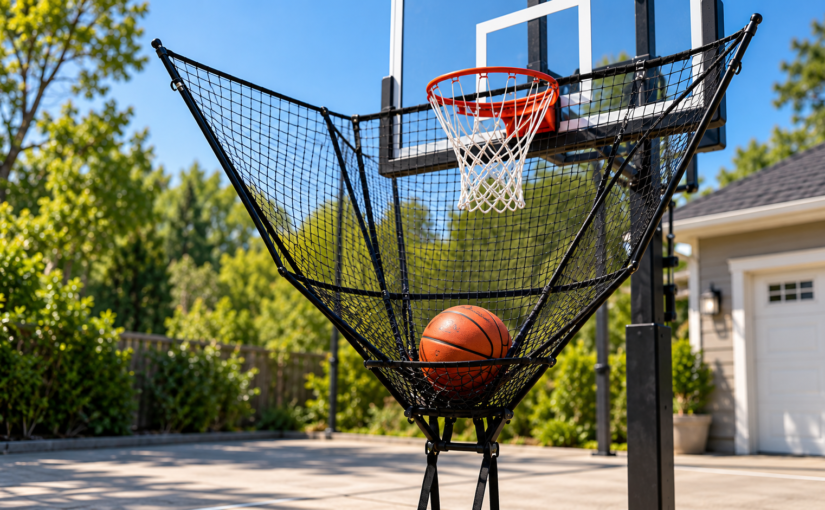
A basketball rebounder can save a lot of time when you practice alone, but the name covers several different products.
For a broader look at useful training tools, see our guide to basketball training equipment.
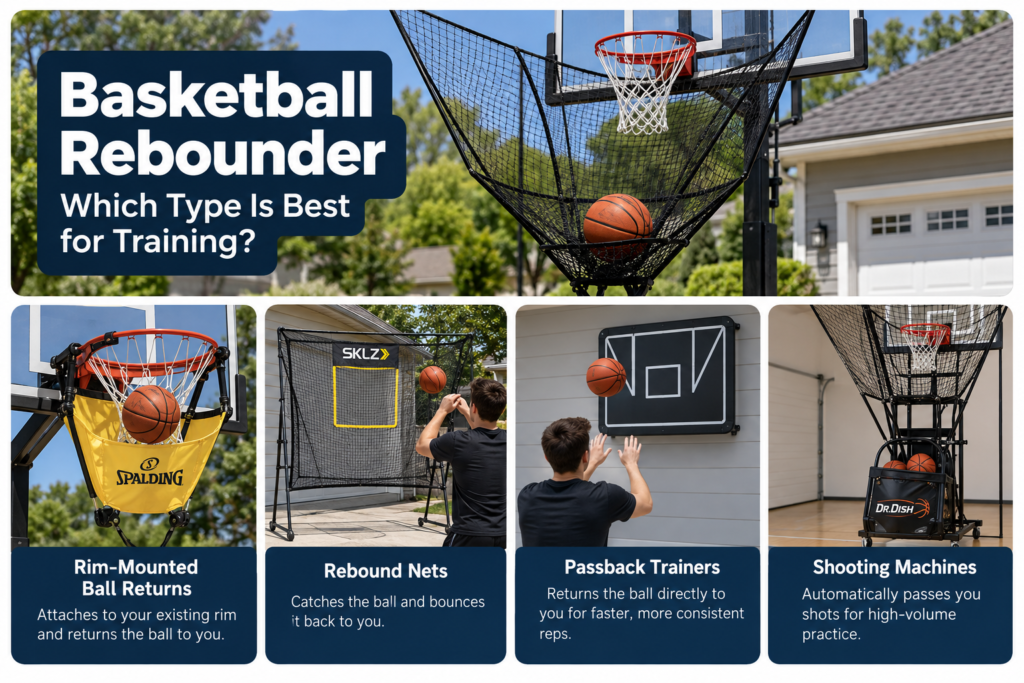
Some return only made shots. Others catch missed shots too. Passback nets are mainly for passing practice, while a powered machine can catch the ball and send passes back to different spots on the court.
That difference matters more than almost anything else.
If you buy a cheap rim-mounted return expecting it to catch missed shots, you will probably be disappointed. If you buy a passback net expecting it to sit under the hoop and return shots, you have bought the wrong type entirely.
For most people, the right basketball rebounder depends on how often you train alone, how much you miss, the type of hoop you own, and how much you want to spend.
On a home court or driveway, the right return system can make consistent reps easier because you spend less time chasing the ball. That does not mean faster practice is always better. Shooting form still matters, especially for a beginner who may simply repeat the same mistake more often.
What Is a Basketball Rebounder?
A basketball rebounder is a training tool that returns, redirects, or collects the ball during practice.
The term can describe:
- rim-mounted return chutes
- hoop return nets
- elevated shot trainers
- passback nets
- rebounding trainers
- powered shooting machines
These products do very different jobs, so always check what a basketball return system actually does before buying it.
Types of Basketball Return Systems
Rim-Mounted Ball Return Chutes
These attach underneath the rim and send the ball back after a made shot.
They are cheap, simple, and useful for repetitive shooting.
The main weakness is that they do nothing for missed shots. If you miss most of your attempts, you will still spend plenty of time chasing the ball.
Hoop Return Nets
A hoop return net covers a larger area around the basket.
It can collect made shots and many misses before guiding the basketball back toward the player.
This can work well on a driveway where missed shots are the biggest interruption.
The trade-off is more space and stricter compatibility with the hoop, backboard, or pole.
Elevated Shot Trainers
Products such as the Dr. Dish iC3 place a large net above and around the hoop.
They catch makes and most misses before feeding the ball into a rotating return chute.
This gives a solo player far more continuous shooting practice than a basic rim attachment.
The iC3 costs around $500, so it makes more sense for someone who practices regularly than for casual shooting.
Passback Rebounder Nets
A passback net sits on the ground.
You throw the ball into the net, and it rebounds back toward you.
These are useful for:
- chest passes
- bounce passes
- catching before a shot
- footwork
- catch-and-shoot drills
They do not collect shots from the hoop.
Rebounding Trainers
Some products called rebounders are designed for actual rebounding drills.
A rim cover blocks the ball from going through the basket, so it bounces away for players to catch.
These are mainly useful for coaches working on boxing out and rebounding.
Powered Shooting Machines
A shooting machine catches the basketball and mechanically passes it back.
Some machines can direct passes around the court and support very high-volume shooting sessions.
They are also expensive.
Home machines can cost from roughly $1,300 to more than $4,000 and may require power, storage space, and sometimes a subscription.
Best Basketball Return Options to Consider
Best Cheap Option: Spalding Back Atcha
The Spalding Back Atcha is one of the cheapest ways to try a basketball return system.
Research found prices around $17 to $35 at the lower end.
It uses a 90-degree return arc and is designed for simple made-shot practice.
Compatibility is the main concern. Spalding lists several of its own rim designs as incompatible, so check your exact hoop before buying.
Best Adjustable Chute: SKLZ Kick-Out
The SKLZ Kick-Out costs roughly $42 to $50 at some retailers.
Its main advantage is a 360-degree rotating chute, which lets you adjust where the basketball returns.
It still only works with made shots.
Owner reviews also mention broken clips, loose straps, warped plastic, and unwanted movement, so it is not perfect.
Best Budget Option for Catching Misses: Goalrilla/Goaliath Hoop Return Net
The Goalrilla/Goaliath Hoop Return Net costs roughly $100 to $120.
Unlike a basic chute, it is designed to catch made and missed shots.
It can also work as a backstop.
It is mainly designed for in-ground hoops, and owner reviews mention stitching, Velcro, and hook failures.
Best Serious Solo Option: Dr. Dish iC3
The Dr. Dish iC3 sits between basic rebounders and powered machines.
It catches makes and most misses and then rolls the ball back through a 180-degree chute.
Its main advantages include:
- no electricity
- no subscription
- catches many misses
- adjustable return direction
- wheels
- folding frame
It costs around $500.
Compatibility matters. The manual includes restrictions involving the rim, rear crossbars, chain nets, and hoop support.
It also says the iC3 is not intended for children under 14 and calls for two adults during installation.
For a serious player who shoots alone several times a week, it can make sense.
For casual practice, it is harder to justify.
Best Passback Net Value: GoSports Basketball Rebounder
The GoSports Basketball Rebounder costs around $80.
It has an adjustable frame and can be used for passing and catch-and-shoot practice.
Remember that this is not a shot-return system.
It will not sit under the hoop and collect your shots.
What to Look for Before Buying
Does It Return Missed Shots?
This is the biggest difference between rebounders.
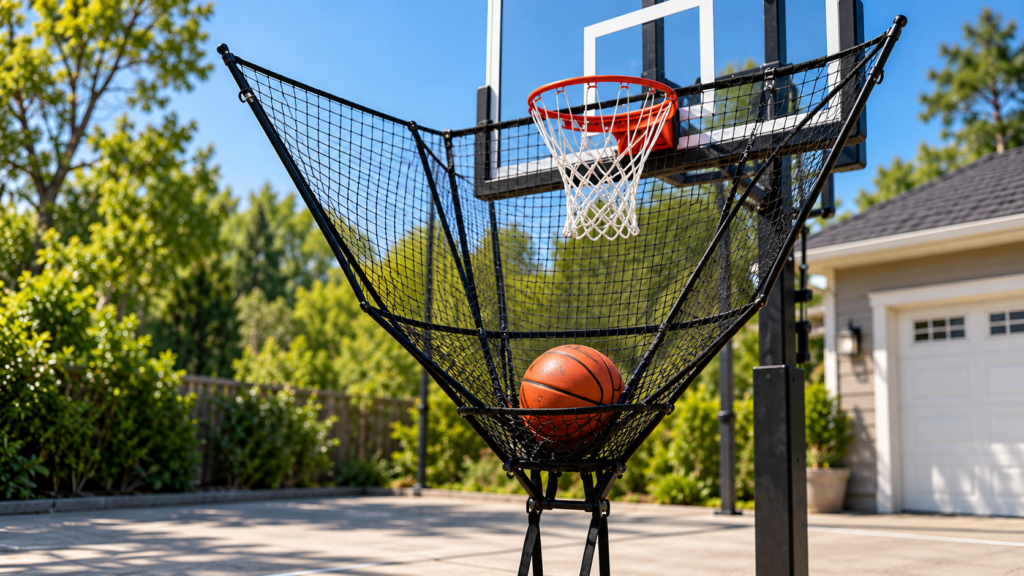
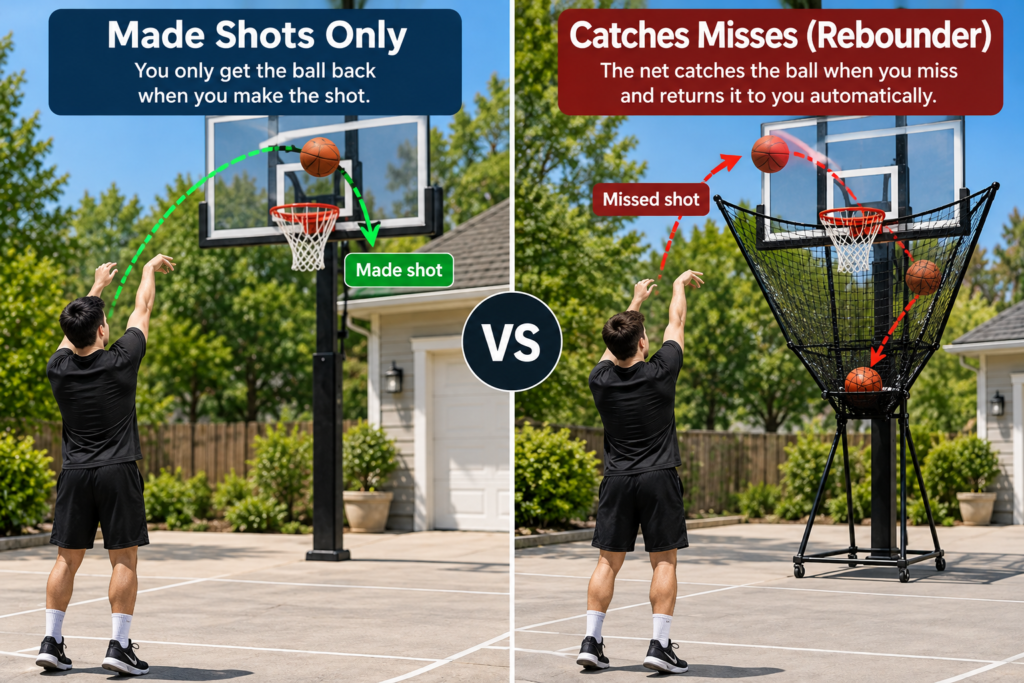
A cheap chute may return the ball after a make, but if you miss most shots, you still have to retrieve the basketball yourself.
A larger net or elevated trainer makes more sense if catching misses is your priority.
Will It Fit Your Hoop?
Never assume a basketball rebounder fits every hoop.
Check:
- rim type
- breakaway mechanism
- spring box
- backboard size
- pole size and shape
- rear support bars
- chain nets
- portable vs in-ground hoop
If you’re setting up or checking your basket, our basketball hoop height guide explains the correct rim height and how to measure it.
Compatibility problems are one of the most common issues with these products.
Where Does the Ball Return?
Some products return the ball in one direction.
Others rotate through 180 or 360 degrees.
A powered machine can send passes to multiple positions.
Think about where you actually shoot from before paying more for extra adjustment.
Can You Leave It Outside?
Do not assume a basketball rebounder is weatherproof.
Owner reports mention rust, corrosion, sun damage, and damaged fabric.
If possible, store larger equipment in a garage, shed, or dry indoor space when you finish practice.
How Difficult Is Assembly?
A plastic rim attachment may take only a few minutes.
A larger trainer can be completely different.
For example, the iC3 requires two adults for installation and has specific hoop requirements.
Check the manual before buying.
Is a Basketball Rebounder Worth It?
A rebounder can be worth buying if chasing the ball is reducing the amount of useful practice you get.
The biggest benefit is simple: more time shooting and less time retrieving the basketball.
The goal is not just more volume. A good return system should make practice more efficient without reducing your focus on shooting quality.
But it is not automatically better than practicing with another person.
A partner can rebound, make realistic passes, change positions, and give feedback.
For a beginner, that may be more useful than buying an expensive machine.
A sensible progression is:
- cheap chute for basic made-shot returns
- larger return net for catching misses
- iC3-style trainer for frequent solo shooting
- powered machine for serious high-volume practice
Common Basketball Rebounder Buying Mistakes
Avoid these:
- buying a makes-only chute when you miss most shots
- assuming it fits your rim
- confusing a passback net with a shot-return system
- leaving equipment outside permanently
- paying a large marketplace markup
- buying an expensive machine before you know you will use it regularly
Basketball Rebounder FAQ
Do Basketball Rebounders Return Missed Shots?
Some do.
Basic rim chutes usually return made shots only.
Larger nets, elevated shot trainers, and powered machines can catch at least some misses.
Can Kids Use Basketball Rebounders?
It depends on the product.
Check the manufacturer’s age and safety instructions.
For example, the Dr. Dish iC3 manual says it is not intended for children under 14.
Can You Use One With a Portable Basketball Hoop?
Sometimes.
Other rebounders require an in-ground pole, certain backboard dimensions, or specific rim clearance.
Check compatibility before ordering.
Can You Leave a Basketball Rebounder Outside?
Some can be used outside, but that does not mean they should stay outside permanently.
Weather can damage plastic, metal, straps, and nets.
Is a Basketball Rebounder Better Than a Partner?
Not necessarily.
A rebounder is most useful when you regularly practice alone.
A partner can still provide more realistic passes, feedback, and variety.
Final Answer
There is no single best basketball rebounder because different products solve different problems.
For a cheap starting point, a Spalding Back Atcha or SKLZ Kick-Out can work if your rim is compatible.
If you want to catch missed shots, look at a larger return net or a system such as the Dr. Dish iC3.
If your goal is passing practice, choose a passback net.
And if you are considering a powered machine, make sure you practice enough to justify the cost, storage, and setup.
The most important question is simple:
What do you need the rebounder to return?
One thought on “Basketball Rebounder | Which Type Is Best for Training?”
Comments are closed.