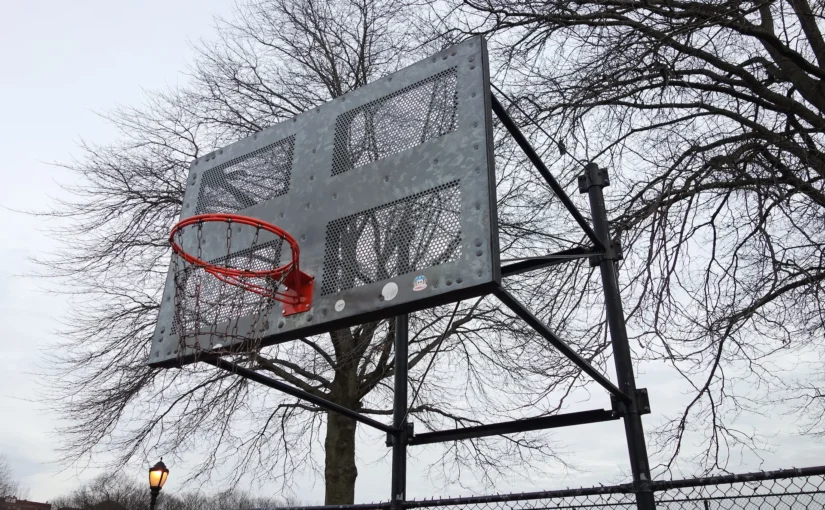
A basketball chain net is a metal alternative to a traditional nylon or polyester basketball net. It is commonly used on outdoor courts where durability, weather resistance, and resistance to vandalism are important.
Chain nets can be a practical choice for public parks and recreational courts. However, traditional cord nets are generally preferable for indoor basketball, organized games, and residential courts where noise is a concern.
This guide explains the advantages and disadvantages of basketball chain nets, how to choose the right material, and what to check before buying one.
What Is a Basketball Chain Net?
A basketball chain net consists of interconnected metal chains that hang underneath a basketball rim.
Like a traditional basketball net, it helps slow the ball momentarily as it passes through the basket. Our guide to why basketball hoops have nets explains this function in more detail.
Most full-size chain nets have 12 attachment points and measure approximately 18 to 22 inches long.
Common construction materials include galvanized steel, stainless steel, and coated steel.
Unlike a traditional cord net, a chain net produces a distinctive metallic sound when the basketball passes through it.
Basketball Chain Net vs Nylon and Polyester Nets
Chain and cord basketball nets offer different advantages depending on where you play.
| Feature | Chain net | Nylon or polyester net |
|---|---|---|
| Construction | Metal chain links | Woven synthetic cord |
| Outdoor durability | Designed for demanding outdoor use | Depends on material and thickness |
| Corrosion | Can rust or corrode | Does not rust |
| Noise | Metallic rattling sound | Quieter swishing sound |
| Cutting resistance | Generally harder to cut | Easier to cut |
| Weight | Generally heavier | Generally lighter |
| Player contact | Hard metal links | Softer material |
| Competition use | Not suitable under major competition rules | White cord nets are specified |
Although manufacturers frequently promote chain nets as more durable, independent comparison tests establishing their lifespan advantage were not identified during research.
Pros and Cons of Basketball Chain Nets
Advantages
The metal itself does not degrade from UV exposure, although protective finishes can deteriorate. Resistance to cutting and tearing makes chain nets worth considering for unattended outdoor basketball courts. Some recreational players also enjoy their distinctive metallic sound.
Disadvantages
Chain nets can cost more than basic cord nets. Noise, corrosion, finger entrapment, and compatibility with rims and training equipment are also important considerations.
Some retailers also suggest that metal nets can increase basketball cover wear. However, independent testing establishing the extent of this wear was not identified.
Are Basketball Chain Nets Safe?
Basketball chain nets can present safety concerns because of their hard metal links and attachment hardware.
Open hooks, damaged links, and sharp edges may create opportunities for fingers or jewelry to become caught.
Some manufacturers offer welded chain links and enclosed attachment designs intended to reduce these risks. However, these design claims should not be treated as guarantees against injury.
FIBA’s basketball equipment rules address finger entrapment by specifying requirements for net attachment fittings on competition rims. These requirements do not automatically apply to every recreational basketball hoop.
No reliable injury statistics specific to basketball chain nets were identified during research.
For younger players, lower basketball hoops, and environments where players frequently dunk, a compatible nylon or polyester net is generally the more cautious choice.
Never hang from a basketball net, regardless of its material.
Types of Basketball Chain Nets
The material and protective finish affect how well a chain net withstands outdoor conditions.
Galvanized Steel Chain Nets
Galvanized basketball chain nets use steel with a protective zinc coating.
The coating helps protect the underlying steel against corrosion.
Galvanized steel is commonly used in affordable outdoor basketball chain nets.
According to the American Galvanizers Association, zinc coating thickness influences its protective service life. However, manufacturers do not always disclose the galvanizing process or coating thickness. Two products described as galvanized may therefore offer different levels of corrosion resistance.
Galvanized steel is not completely rustproof.
Stainless Steel Chain Nets
Stainless steel contains chromium, which helps provide corrosion resistance.
Some basketball chain net manufacturers advertise products made from grade 304 stainless steel.
Grade 304 is suitable for many outdoor applications, while grade 316 generally provides better resistance to chloride exposure in coastal environments, as explained in stainless steel selection guidance.
However, no consumer basketball chain net specifically advertised as grade 316 was identified during research.
Stainless steel can still develop corrosion or discoloration under certain conditions.
Coated Chain Nets
Some chain basketball nets feature additional protective or decorative coatings.
These coatings may provide corrosion protection and allow manufacturers to offer different colors.
Their durability depends on the coating material, application process, and exposure conditions.
Independent testing establishing how long these coatings last on basketball chain nets was not identified.
Basketball Chain Net Material Comparison
| Material | Main advantage | Main consideration |
|---|---|---|
| Galvanized steel | Affordable corrosion protection | Coating thickness varies |
| Stainless steel | Good corrosion resistance | Steel grade and environment matter |
| Coated steel | Additional finish and color options | Coating durability varies |
| Welded steel chain | Reinforced link construction | Corrosion protection depends on the finish |
Welded chain describes the construction of the links rather than a separate corrosion-resistant material.
Are Chain Nets Allowed in Official Basketball Games?
Major basketball governing bodies specify white cord nets for competition rather than metal chain nets.
| Governing body | Required net material | Net length |
|---|---|---|
| NBA | White cord | 18 inches |
| NCAA men’s basketball | White cord | 15–18 inches |
| FIBA | White cord | 400–450 mm |
Sources: NBA official equipment rules, NCAA men’s basketball rules, and FIBA basketball equipment rules.
Although these rules do not explicitly mention chain nets, metal nets do not meet the specified cord-net requirements. Confirm the current season’s requirements with your governing body before purchasing competition equipment.
Chain nets are primarily intended for recreational basketball rather than regulated competition.
Where Should You Use a Basketball Chain Net?
Public Parks and Playgrounds
Public basketball courts often experience frequent use, weather exposure, and deliberate equipment damage.
A heavy-duty chain net may be a practical option where conventional cord nets require frequent replacement.
For example, a 2017 City of Durham basketball court procurement document included chain nets as an optional feature for playground basketball goals.
However, facility operators should consider attachment safety, player age, maintenance requirements, and local purchasing specifications.
Schools and Recreation Centers
Chain nets may be suitable for certain outdoor school basketball courts.
However, traditional cord nets are generally preferable for organized games, supervised youth basketball, and lower hoops used by younger children.
Schools should confirm that replacement nets are approved for their existing basketball equipment.
Residential Basketball Hoops
A chain net can be used on a compatible driveway or backyard basketball hoop.
However, its metallic sound may disturb nearby neighbors, particularly in densely populated residential areas.
For most residential basketball hoops, a heavy-duty outdoor nylon net is a practical starting point.
Indoor Basketball Courts
Chain nets are generally unnecessary for indoor basketball courts.
Indoor facilities do not experience the same weather exposure as outdoor courts, and traditional cord nets provide quieter play while meeting major competition requirements.
Recommended Net Type by Location
| Location | Recommended starting point |
|---|---|
| Unattended public park | Compatible heavy-duty chain net |
| Outdoor school court | Heavy-duty cord or approved chain net |
| Residential driveway | Outdoor nylon or polyester net |
| Backyard basketball court | Outdoor cord net |
| Indoor gymnasium | White cord net |
| Organized competition | Net approved under applicable rules |
Basketball Chain Net Sizes and Rim Compatibility
Not every basketball chain net fits every basketball hoop.
Before purchasing, check the rim dimensions, attachment design, and manufacturer requirements.
Net Length and Attachment Points
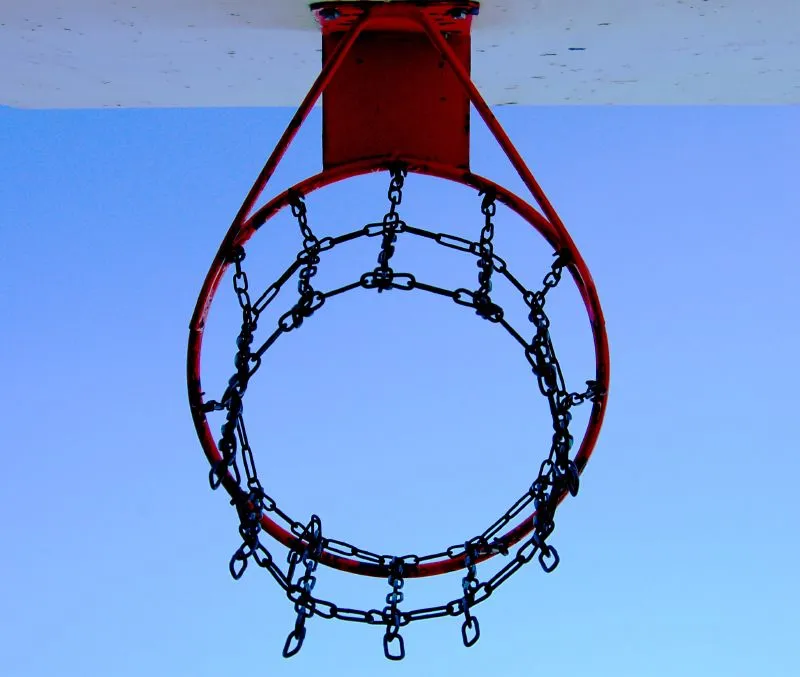
Most full-size basketball chain nets are designed for an 18-inch basketball rim with 12 attachment points.
Common advertised net lengths range from 18 to 22 inches.
However, matching the rim diameter and number of attachment points does not guarantee compatibility.
Some basketball rims use specialized net attachment systems.
Fixed and Breakaway Rims
Chain nets may be compatible with certain fixed and breakaway basketball rims.
The attachment design is more important than whether the rim contains a breakaway mechanism.
Some rims use traditional hooks, while others use enclosed fittings, continuous attachment strips, or proprietary cable systems.
Check the instructions for your exact rim before purchasing a replacement net.
Double Rims
Double-rim basketball hoops are commonly found at outdoor recreational courts.
Some chain nets are designed specifically for certain rim attachment systems. For example, Gared’s WCN specification identifies double-bump net attachments, including the Gared 140 goal.
However, not every chain net is compatible with every double rim.
Check the net attachment arrangement rather than assuming compatibility based on the number of steel rings.
Mini Basketball Hoops
Mini basketball hoops often have smaller rims and fewer net attachment points.
Specialized mini chain nets are available with six, eight, or ten attachment loops.
A standard 12-loop basketball chain net may not fit these smaller hoops.
Basketball Rebounders
Some basketball rebounders and shooting trainers are incompatible with metal nets.
For example, the Dr. Dish IC3 instruction manual requires nylon or polyester basketball nets and prohibits metal nets.
Always check the training equipment manufacturer’s compatibility requirements.
How to Install a Basketball Chain Net
Installing a chain net differs slightly from installing a traditional cord net because many chain nets use metal attachment hooks or clips.
Follow the manufacturer’s instructions for your specific net and rim.
The general installation process involves:
- Lower the basketball hoop or arrange safe access to the rim.
- Remove the existing basketball net.
- Inspect the rim and its attachment points for damage.
- Connect each chain attachment to the corresponding rim fitting.
- Secure the supplied hooks or connectors according to the manufacturer’s instructions.
- Check that the net hangs evenly and all connections are secure.
Some chain nets use S-hooks that require pliers to close them securely. Others use clips or carabiners.
Do not bend the rim’s permanent attachment hooks or modify its structure to force an incompatible net into place.
For more general installation guidance, see our guide to how to put a net on a basketball hoop.
How Much Does a Basketball Chain Net Cost?
Published US basketball chain net prices range from approximately $10 to $105.
The price depends on the chain material, link construction, attachment hardware, and intended application.
Budget Chain Nets
Budget basketball chain nets typically cost approximately $10 to $20.
These products commonly use zinc-coated steel chains and traditional attachment hooks.
They may suit compatible residential and recreational basketball hoops.
Mid-Range Chain Nets
Mid-range chain nets generally cost approximately $20 to $60.
This category includes heavier-duty steel nets, products advertised as stainless steel, and alternative attachment systems.
A higher price does not necessarily guarantee better corrosion resistance or durability.
Heavy-Duty Playground Chain Nets
Specialized welded playground chain nets can cost approximately $48 to $105.
These products are often marketed toward schools, parks, and recreational facilities where equipment experiences demanding use.
Some manufacturers use welded links or specialized link shapes intended to reduce loose connections and exposed edges.
Basketball Chain Net Price Comparison
The following products were researched using published manufacturer and retailer specifications. BasketballRex has not physically tested these products.
| Product | Listed feature | Published price |
|---|---|---|
| Champion Sports Steel Chain Net 410 | Heavy-gauge steel | $13.82 (MSRP; manufacturer lists out of stock) |
| Wilson NBA Forge Chain Net | Standard-rim design | $14.99 |
| Cannon Sports 616 Chain Net | 13-gauge galvanized steel | $15.99 |
| Gopher Steel Chain Net | Galvanized steel, 18 inches | $16.95 |
| Porter Heavy-Duty Chain Net | Zinc-plated steel | $42.00 |
| Super-Net Playground SN-12P | Welded steel links | $48.00 |
| Bison BA50 Premium Steel Playground Safety Net | Welded closed-loop chain | $74.00 (MSRP) |
| Gared Welded Steel Chain Net WCN | Zinc-plated welded chain | $88.69 |
Prices were recorded during research in November 2026. The table includes manufacturer suggested retail prices (MSRP) and retailer prices, some of which were promotional. Availability, delivery charges, and prices may change.
Prioritize compatibility, attachment quality, and suitability for the intended environment rather than price alone.
Basketball Chain Net Maintenance
Although basketball chain nets do not experience the same types of deterioration as cord nets, they still require inspection and occasional replacement.
Regularly check for:
- Rust and corrosion.
- Broken or separated chain links.
- Sharp edges.
- Loose attachment hooks.
- Damaged protective coatings.
- Damage to the rim’s attachment points.
Remove a damaged chain net from use until it can be safely replaced.
Facilities exposed to coastal air, frequent rainfall, or road salt may require more frequent inspections.
Follow any cleaning and maintenance instructions provided by the manufacturer.
Basketball Chain Net Buying Checklist
Before purchasing a chain basketball net, confirm the following:
| Buying consideration | What to check |
|---|---|
| Rim diameter | Compatibility with your basketball rim |
| Attachment count | Matching number of attachment points |
| Attachment design | Compatible hooks, clips, or fittings |
| Material | Galvanized, stainless, or coated steel |
| Link construction | Secure links without exposed sharp edges |
| Environment | Outdoor exposure and corrosion concerns |
| Noise | Suitability for nearby residents |
| Intended users | Player age and type of basketball activity |
| Training equipment | Compatibility with rebounders and shooting trainers |
For public facilities, also confirm that the manufacturer approves the net for the intended commercial or recreational environment.
Frequently Asked Questions
Do Chain Nets Damage Basketballs?
Metal chain links may contribute to basketball cover wear, particularly when the links are rough, damaged, or corroded.
However, independent comparative testing establishing how quickly chain nets wear basketballs was not identified.
If preserving the condition of an expensive basketball is a priority, a traditional cord net is a reasonable choice.
Do Basketball Chain Nets Rust?
Yes. Steel basketball chain nets can rust when their protective coating deteriorates or is damaged.
Galvanized and stainless steel offer corrosion resistance, but neither guarantees complete protection in every outdoor environment.
Are Chain Nets Louder Than Nylon Nets?
Chain nets produce a metallic rattling sound that is generally more noticeable than the swishing sound of a nylon net.
Reliable comparative decibel measurements were not identified during research.
A nylon net is generally preferable when minimizing basketball hoop noise is important.
How Long Do Basketball Chain Nets Last?
There is no reliable universal lifespan for basketball chain nets.
Durability depends on the metal, protective coating, link construction, weather exposure, frequency of use, and maintenance.
Claims that chain nets last a specific number of years should be supported by product-specific evidence.
Are Chain Nets Better for Outdoor Basketball?
Chain nets can be suitable for outdoor courts where resistance to cutting, tearing, and frequent use is important.
However, heavy-duty outdoor cord nets may be preferable where noise, player contact, or equipment compatibility is a concern.
Do Chain Nets Fit Every Basketball Hoop?
No. Basketball chain nets have different attachment counts, hook designs, and dimensions.
Always confirm compatibility with your exact basketball rim before purchasing.
Final Thoughts
A basketball chain net can be a practical choice for unattended public parks and outdoor recreational basketball courts.
For most residential basketball hoops, indoor courts, and organized basketball games, a compatible nylon or polyester net is generally the better starting point.
If you choose a chain net, prioritize compatible attachment hardware, corrosion resistance, and secure link construction over price alone.
Featured image: Tdorante10, via Wikimedia Commons, licensed under CC BY-SA 4.0. Resized and converted to WebP.
Supporting image: The Jamoker, via Wikimedia Commons, licensed under CC BY 2.0. Converted to WebP.
3 thoughts on “Basketball Chain Net | Pros, Cons & Buying Guide”
Comments are closed.