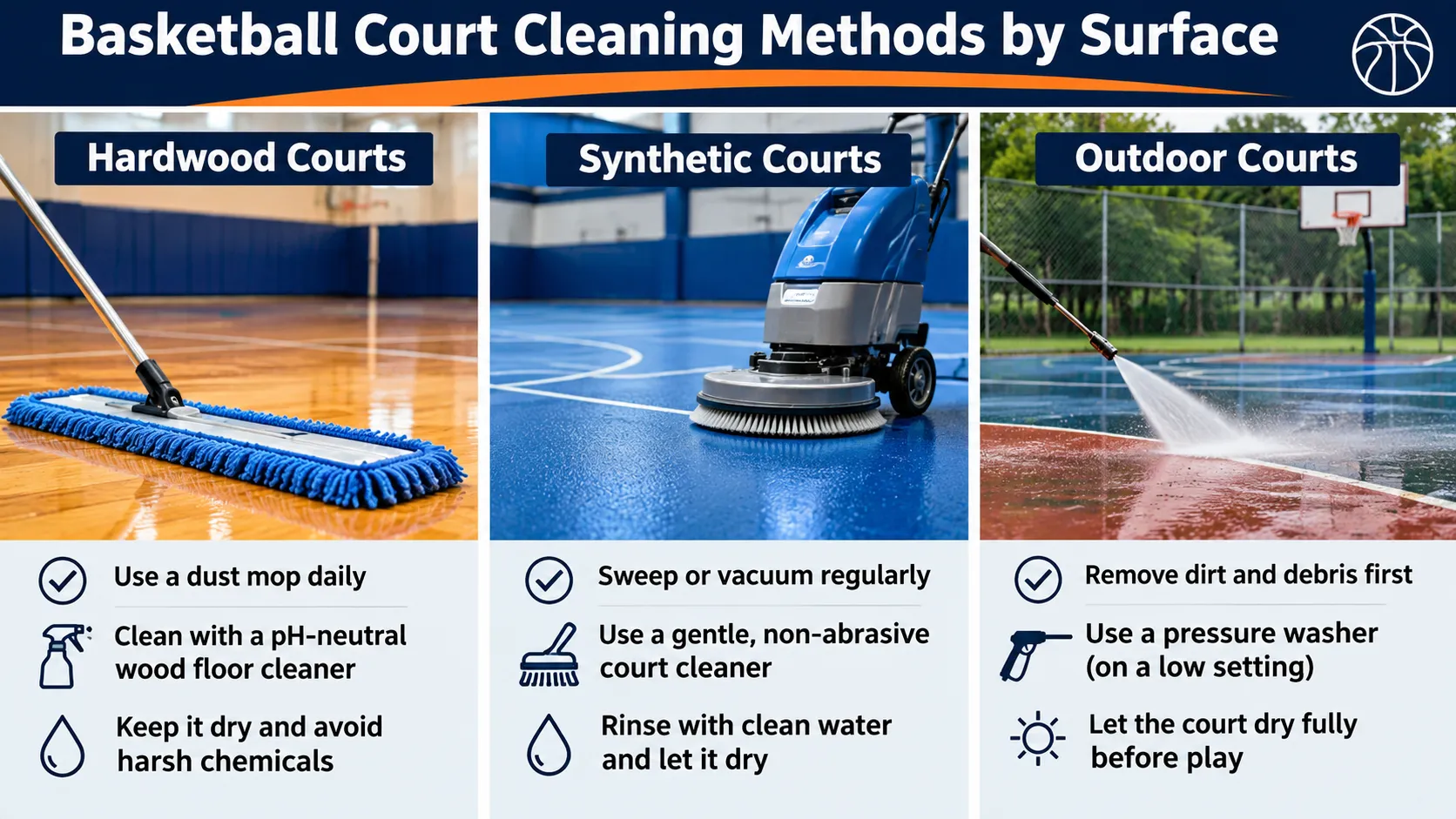
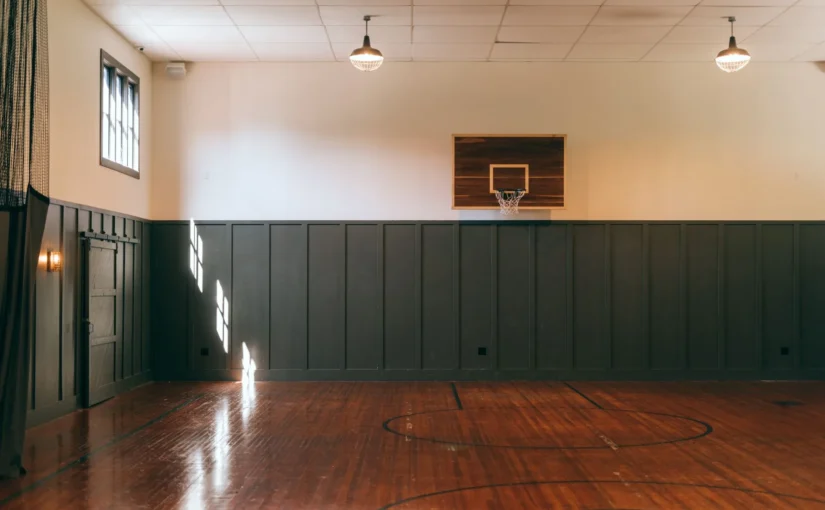
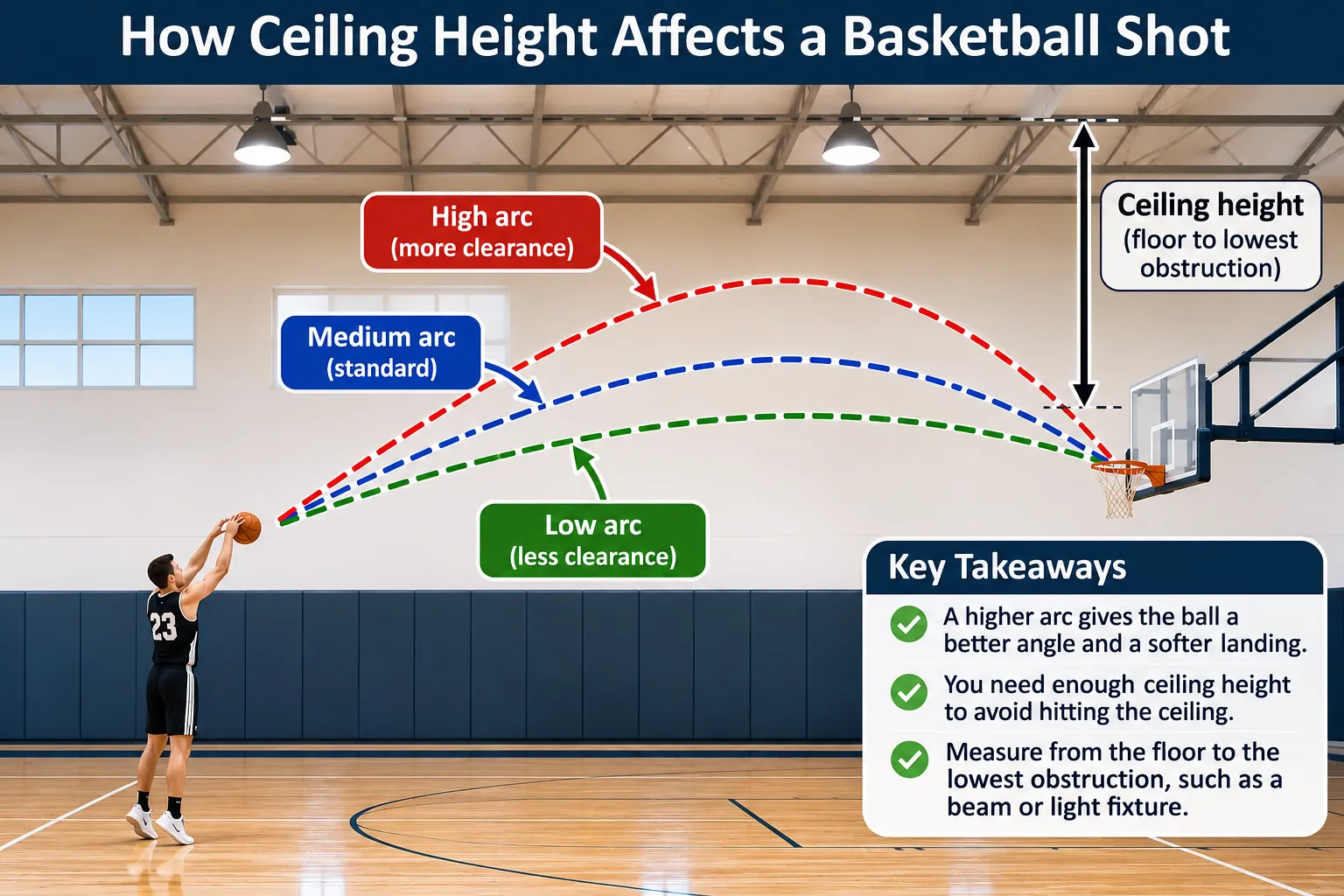
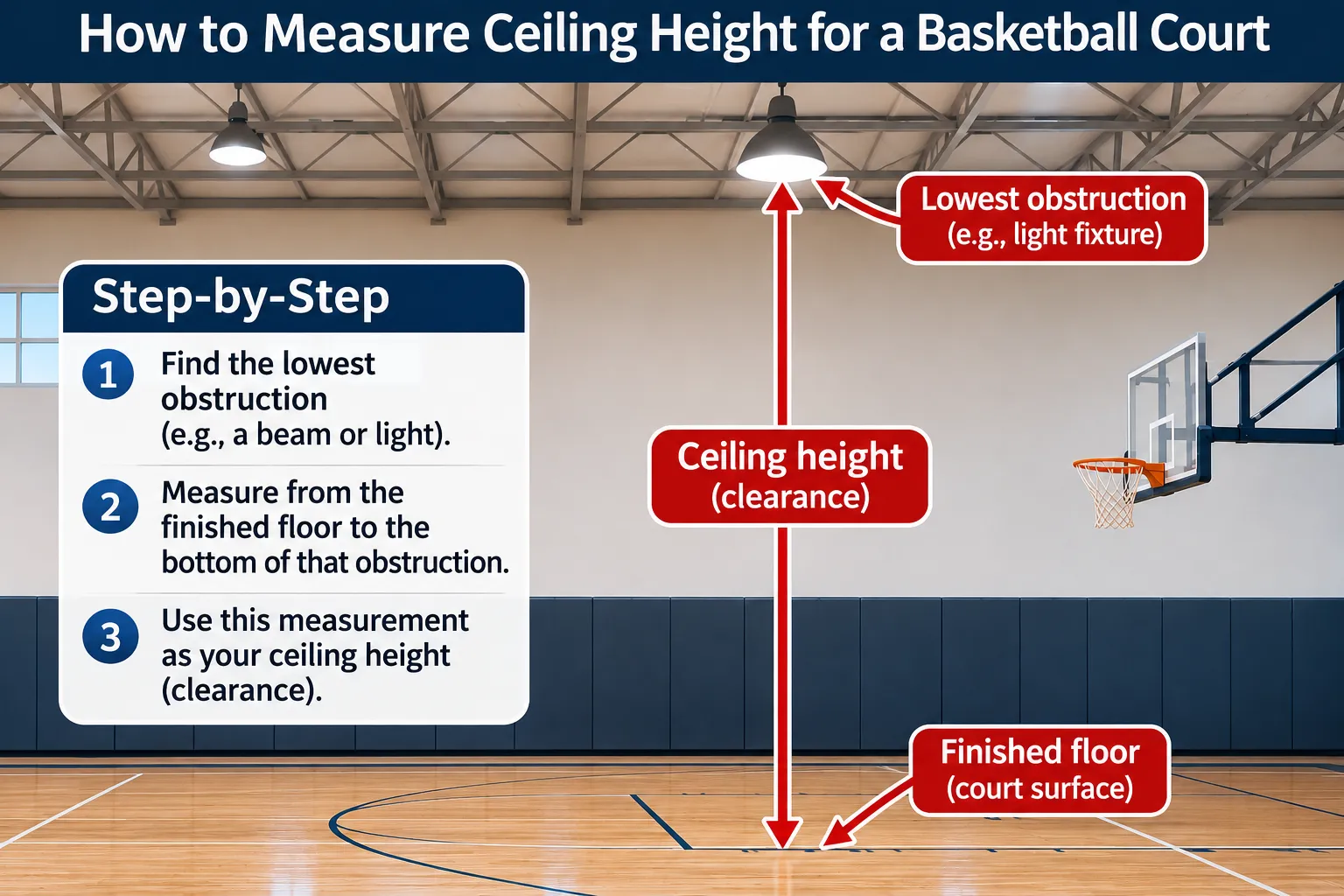
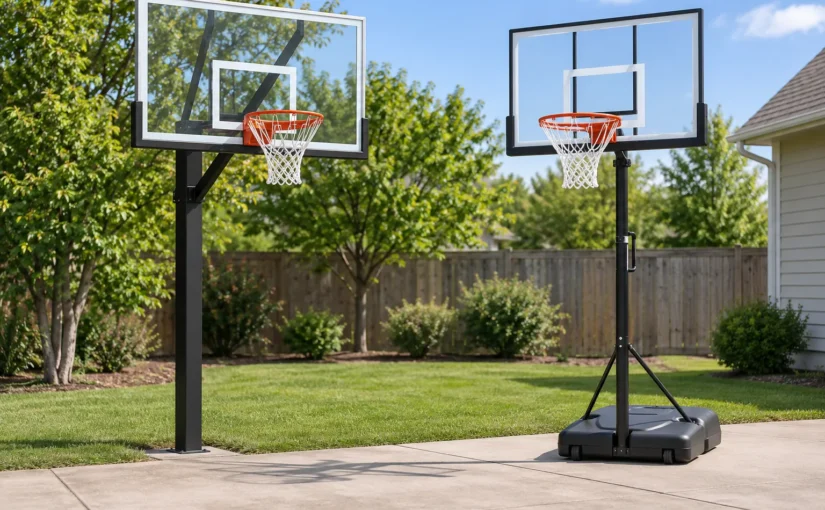
The best basketball court cleaner depends on the type of playing surface. Hardwood courts need an approved floor cleaner, a dust mop, and very little moisture. Synthetic courts may allow damp mopping or automatic scrubbers, while outdoor courts often need sweeping and controlled washing.
Using the wrong cleaning solution or equipment can damage the floor, leave slippery residue, or affect its playing surface.
This guide explains which basketball court cleaning products to use, how to clean different surfaces, and what the equipment costs.
What Is the Best Basketball Court Cleaner?
There is no single cleaner suitable for every basketball court.
A finished hardwood gym floor needs different care from a vinyl, rubber, or outdoor acrylic surface. Before buying cleaning supplies, identify the floor material and check its manufacturer’s maintenance instructions.
Synthetic flooring manufacturers may permit machines, but their instructions differ.
Types of Basketball Court Cleaning Products
Basketball court maintenance involves several tools. Some remove dust, while others remove marks, spills, or built-up dirt.
Basketball Court Floor Cleaners
Liquid floor cleaners remove dirt that dry mopping cannot collect.
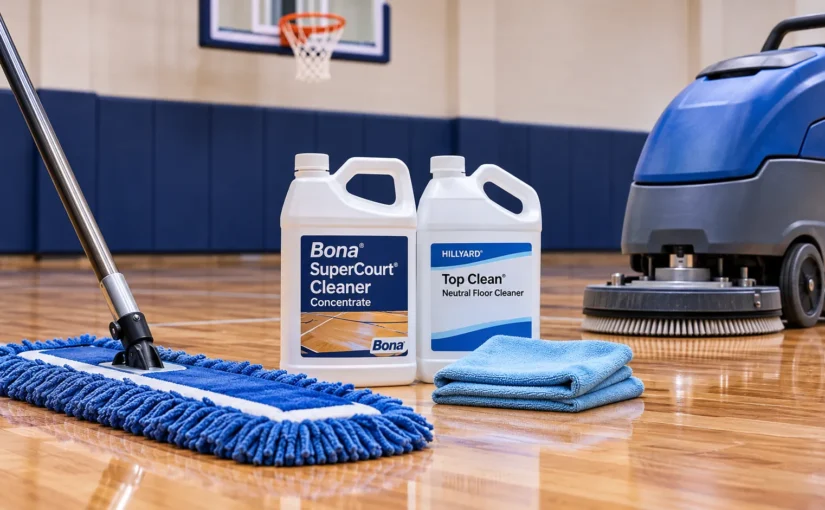
Bona SuperCourt Cleaner Concentrate is designed for unwaxed polyurethane wood floors. Bona specifies a dilution of one part concentrate to 128 parts water.
Hillyard Top Clean is a neutral floor cleaner listed among the maintenance options in Tarkett’s Omnisports guidance.
Neither product should be treated as suitable for every basketball court. Always confirm that the cleaner is approved for the installed floor and finish.
Dust Mops, Damp Mop, and Microfiber Systems
A dust mop is one of the most important tools for indoor basketball court cleaning.
Wide microfiber dust mops collect loose dirt, dust, and grit before these particles scratch the playing surface.
For large gyms, a 60-inch dust mop can cover more floor with each pass than a small household mop.
Some systems also include separate pads for damp cleaning.
Use the dust mop treatment recommended for the floor. Oil-treated mops, for example, are prohibited in Tarkett’s Omnisports maintenance guidance.
Basketball Court Cleaning Machines
An auto scrubber uses a rotating pad or brush to clean the floor and recover dirty cleaning solution.
These machines can make cleaning large synthetic courts easier, provided the flooring manufacturer approves their use.
Before using a machine, check its loaded weight, pad type, operating speed, water recovery, and floor compatibility.
Outdoor Court Cleaning Equipment
Outdoor basketball courts often need simpler equipment:
Soft-bristled brooms
Leaf blowers
Garden hoses
Approved cleaning solutions
Pressure washers, where permitted
Avoid assuming that a pressure washer is safe because the court is made from asphalt or concrete. Its acrylic coating may have separate cleaning restrictions.
Cleaning methods vary by court surface. Only pressure wash where the flooring manufacturer permits it.
How to Properly Clean a Basketball Court
The correct process starts with identifying the playing surface. If you are planning a new court, our basketball court installation guide explains the broader installation process.
How to Clean a Hardwood Basketball Court or Gym Floor
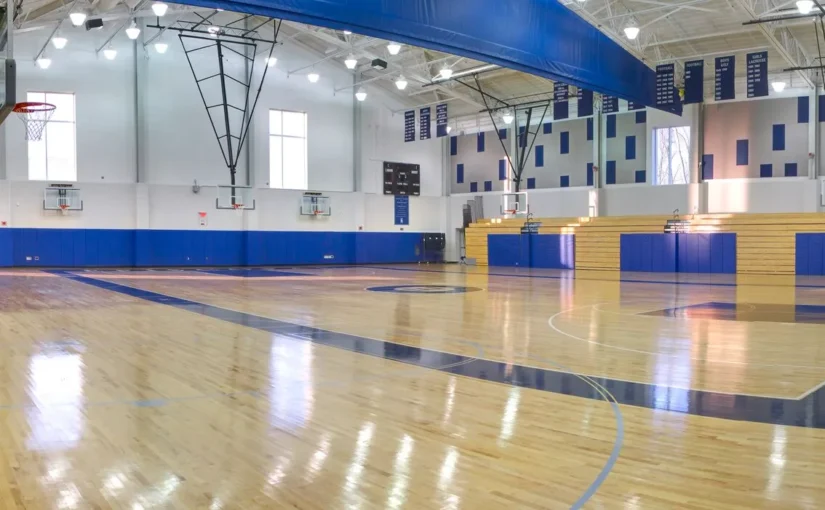
Indoor hardwood courts require delicate handling to preserve the finish.
Remove loose dirt using a properly treated dust mop.
Wipe up sweat, spills, and other moisture immediately so they do not soak in; this helps maintain a clean court, supports safety, and reduces the risk of slips for athletes.
Remove shoe marks with a finish-approved cleaner and soft cloth.
For more thorough cleaning, use the manufacturer’s approved low-moisture method.
Inspect the floor for remaining moisture or residue before allowing play.
MFMA describes a controlled method using a fine mist of approved cleaner and a microfiber T-frame mop. The solution is wiped up immediately rather than left soaking on the floor. Proper cleaning helps protect the finish and preserve durability. If dirt and moisture are left in place, they can break down the surface over time and lead to cracks and discoloration that shorten the floor’s life and extend repair needs.
Do not use a wet mop, bucket flooding, or routine power scrubbing on maple sports floors.
These methods can introduce excess moisture and damage the wood or finish, undermining a safe playing environment.
How to Clean a Synthetic Basketball Court
Synthetic basketball courts include vinyl, rubber, and poured polyurethane flooring.
Their cleaning requirements vary, and proper cleaning helps protect the surface, support durability, and preserve safety and performance.
For example, Gerflor’s sports sheetgoods guidance allows approved machine cleaning with controlled solution application, recovery, and rinsing.
Tarkett Omnisports specifies neutral detergent and a white nylon pad for routine machine washing.
Remove dust and debris daily to help create a safe playing environment for athletes.
Prepare the manufacturer-approved cleaning solution.
Use the permitted mop or cleaning machine.
Recover dirty water and rinse where required.
Allow the floor to dry before reopening, since the wrong machine setup can increase the risk of floor damage rather than make the job easier.
Never copy a machine pad, chemical dilution, or cleaning procedure from another synthetic flooring brand without checking compatibility.
How to Clean an Outdoor Basketball Court
Outdoor courts collect leaves, sand, dirt, and standing water, so regular cleaning helps protect the surface from moisture and grit that can gradually break it down.
For an acrylic-coated court:
Sweep away loose debris.
Remove leaves and other material that traps moisture.
Clean dirty areas with the coating manufacturer’s approved solution.
Use a soft brush where permitted.
Rinse according to the manufacturer’s instructions to help extend the court’s life and maintain playability.
Let the surface dry completely before playing.
Pressure washing requires particular care.
DecoTurf’s maintenance guidance permits pressure washing below 1,000 psi. Other manufacturers provide different instructions or warn against excessive pressure.
Do not treat 1,000 psi as a universal safe setting. Check the exact court coating first.
How to Clean Modular Basketball Court Tiles
Modular basketball courts often use interlocking plastic sports tiles.
Sport Court recommends regular dust mopping for indoor surfaces and permits brooms, blowers, or hoses for outdoor game courts.
Outdoor tiles may also collect debris underneath their playing surface.
Sport Court recommends annual inspection and cleaning by its CourtBuilder network, including the area beneath the tiles.
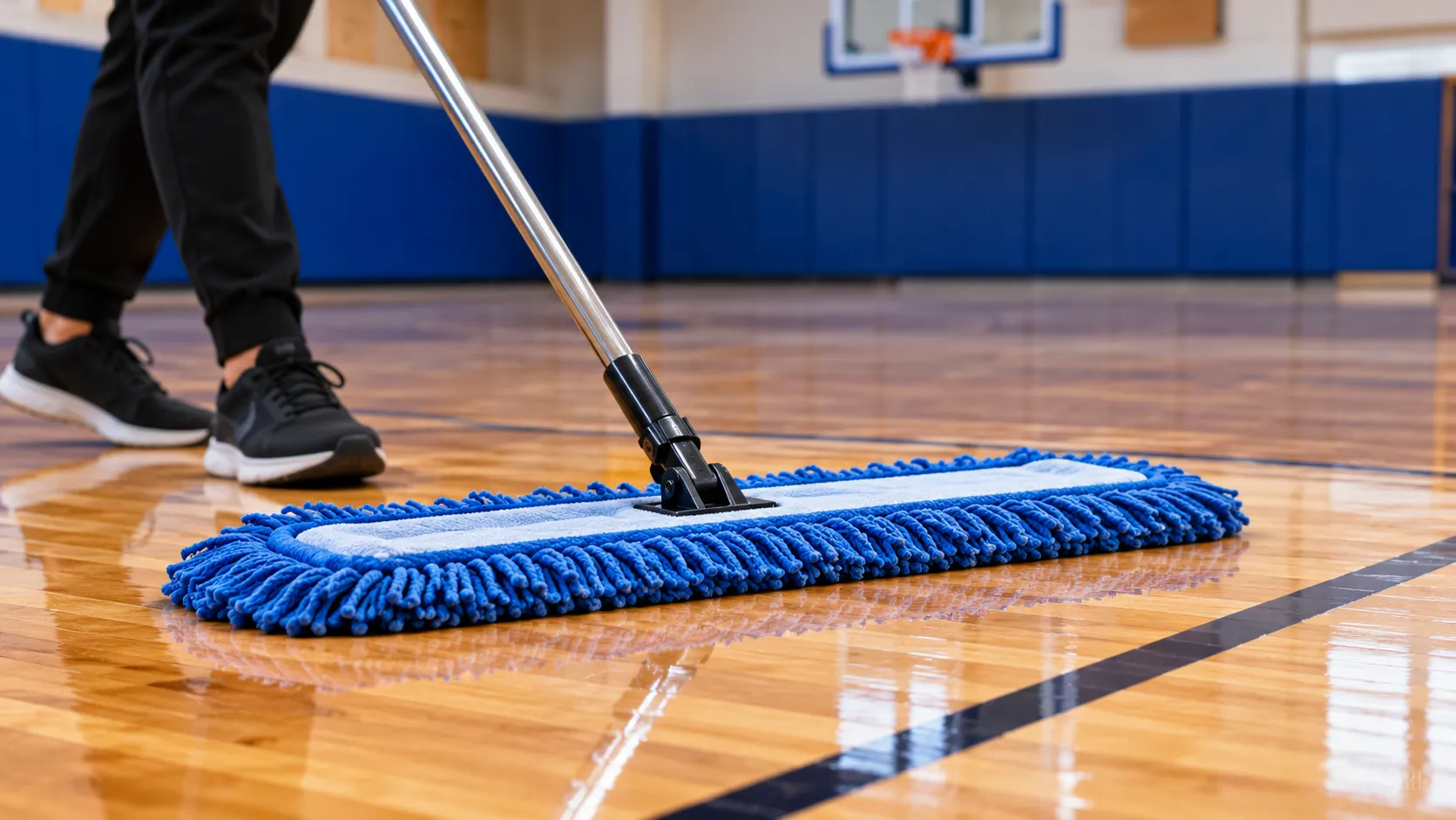
Dust mopping helps remove dirt and grit from hardwood basketball courts.
Basketball Court Cleaner Products and Prices
The following examples show the range of basketball court cleaning supplies available in the United States.
Prices are research observations from November 14, 2026. They may change.
Product
Approximate price
Main use
Bona SuperCourt Cleaner Concentrate, 1 gallon
$74
Compatible polyurethane wood finishes
Hillyard Top Clean, 1 gallon
$34
Compatible synthetic flooring
Bona SuperCourt Athletic Floor Care System, 60-inch
$208
Manual dusting and damp cleaning
CourtClean Damp Mop System
$999
Wide manual damp-cleaning system
Viper AS5160 Walk-Behind Scrubber
$6,067
Approved machine-cleanable surfaces
These products serve different purposes, so the cheapest item is not necessarily the best choice.
A floor cleaner needs a suitable mop or application system. A scrubber requires floor approval and ongoing equipment maintenance.
The Viper machine is included as a price example, not as a recommendation for hardwood courts.
How Often Should You Clean a Basketball Court?
Cleaning frequency depends on court traffic, floor material, and the manufacturer’s instructions.
Daily Cleaning
Busy indoor courts generally need daily dust removal because cleaning each day removes dust that settles overnight.
MFMA recommends dust mopping maple basketball courts daily, or up to three times daily during heavy use, to remove dust and dirt.
Sweat and spills should be removed immediately.
A school may also need additional cleaning between physical education classes, practices, and games.
Weekly Maintenance
Inspect the floor for dirt, residue, shoe marks, and areas needing additional attention.
Some synthetic surfaces permit weekly machine cleaning. Others specify different intervals.
Do not introduce weekly wet mopping to hardwood courts simply because it is part of a general gym cleaning schedule.
Periodic Deep Cleaning
Deep cleaning removes dirt that routine maintenance cannot address.
Robbins recommends monthly whole-floor cleaning with an approved cleaner for its hardwood systems.
Hardwood screening and recoating are separate maintenance operations. MFMA says most gym floors should be recoated annually, depending on use and condition.
How Much Does Basketball Court Cleaning Cost?
Basketball court cleaning costs depend on the surface, equipment, cleaning frequency, and labor.
Cleaning Solution Costs
Concentrated products can provide many gallons of diluted cleaning solution.
For example, a $73.58 gallon of Bona SuperCourt concentrate, budgeted at one fluid ounce per gallon of water, costs approximately $0.57 in concentrate per gallon of dilution water.
At $34 per gallon, Hillyard Top Clean costs approximately $0.27–$0.80 per gallon of dilution water when using one to three fluid ounces.
These figures exclude water, equipment, labor, and other expenses.
They also do not indicate how much liquid should be applied to a particular court.
Equipment and Labor Costs
For a large-floor maintenance job, manual cleaning systems may cost a few hundred dollars, while commercial scrubbers can cost several thousand.
Labor can be a larger expense than cleaning chemicals, and while machines may seem to make the job easier, equipment choice still depends on floor approval and damage risk.
For example, assume a worker spends 30 minutes cleaning once per week at a total labor cost of $25 per hour.
That equals $650 annually in labor.
This is an illustrative calculation, not a verified industry rate or recommended cleaning schedule.
Professional Basketball Court Cleaning
Professional cleaning prices vary with court size, floor condition, location, and the required procedure.
Ask contractors for an itemized quote that identifies the floor material, approved cleaning products, equipment, and any additional services.
Do not confuse routine cleaning costs with hardwood refinishing or outdoor court resurfacing. Our basketball court installation guide covers wider project costs.
Basketball Court Cleaning Mistakes to Avoid
Even regular cleaning can cause problems when the wrong products or methods are used.
Using excess water: Hardwood can absorb moisture, potentially causing swelling, cupping, or other damage.
Using household cleaning chemicals: Unapproved cleaners can damage finishes or leave residue. MFMA specifically warns against household products on maple floors.
Using the wrong scrubber pad: Different synthetic floors require different pads and brushes. An abrasive pad can damage the surface.
Adding too much cleaning solution: Stronger mixtures are not automatically better. Incorrect dilution or poor rinsing can leave residue.
Pressure washing too aggressively: High pressure can damage outdoor acrylic coatings and remove surface texture.
Ignoring equipment maintenance: Dirty scrubber tanks, worn pads, and damaged squeegees can reduce cleaning performance.
Always follow the floor manufacturer’s instructions rather than relying on a general cleaning tip.
Frequently Asked Questions
What Does the NBA Use to Clean Basketball Courts?
NBA arenas commonly use courtside mops or absorbent tools to soak up sweat during games before the surface gets slippery.
Routine hardwood floor cleaning is a separate task. The appropriate cleaners and equipment depend on the arena’s floor finish and maintenance instructions.
There is no verified single cleaning product used by every NBA arena.
Can You Mop a Basketball Court With Water?
It depends on the surface.
MFMA advises against wet mopping maple basketball courts. Some synthetic sports floors allow damp mopping or controlled machine washing.
Always follow the installed floor’s maintenance instructions.
Does Cleaning a Basketball Court Improve Grip?
Removing dust, dirt, moisture, and cleaning residue can help maintain the floor’s intended playing characteristics.
However, cleaning cannot guarantee improved traction when the finish is worn or damaged.
No specific grip improvement percentage is established for the products discussed here.
Can You Use Vinegar or Bleach on a Basketball Court?
Do not use vinegar or bleach as general basketball court cleaners.
Some outdoor acrylic manufacturers describe specific bleach treatments, but their instructions differ.
Never transfer those methods to hardwood or synthetic courts without approval. Never mix bleach with other cleaning products.
Can You Use an Auto Scrubber on a Hardwood Basketball Court?
MFMA does not recommend automatic power scrubbers for routine maple court maintenance.
Their weight and water use may damage the floor and affect warranties.
Use the approved manual cleaning method instead.
Final Thoughts
The right basketball court cleaner depends on the floor material, finish, and maintenance requirements.
For hardwood, start with a suitable dust mop and an approved low-moisture cleaner. Synthetic courts may allow automatic scrubbers, while outdoor courts need equipment compatible with their surface coating.
The safest approach is to identify the floor, follow its manufacturer’s cleaning instructions, and remove dirt and spills before they cause further problems.
A basketball gym floor covering protects an existing court during non-athletic events such as graduation ceremonies, assemblies, concerts, and trade shows.
The main options are reinforced vinyl rolls, carpet rolls, and large protective carpet tiles. Each offers different levels of convenience, durability, and protection.
For most schools and recreation centers, the right choice depends on event frequency, floor material, budget, and available storage space.
This guide compares gym floor covers, explains US costs, and shows how to protect your basketball court without damaging its playing surface.
What Is a Basketball Gym Floor Covering?
A basketball gym floor covering is a temporary protective layer placed over an existing hardwood or synthetic gymnasium floor.
It helps reduce scuff marks, scratches, and everyday wear from heavy foot traffic, tables, and chairs during non-athletic events.
Unlike permanent basketball flooring, protective gym floor coverings are removed before sports resume.
Important: Temporary event covers are generally not designed for basketball play. Remove them before athletic activities unless the manufacturer specifically approves the covering for that use.
The three main systems are vinyl gym floor covers, carpet rolls, and loose-laid carpet tiles.
Covering Type
Best Suited For
Main Consideration
Reinforced vinyl rolls
Schools hosting regular events
Requires overlapping sections and appropriate tape
Carpet rolls
Ceremonies, concerts, and formal events
Requires vacuuming and suitable storage
Protective carpet tiles
Multipurpose gyms needing flexible layouts
More individual pieces to handle
Courtside runners
Entrances and bench areas
Protects selected areas rather than the entire floor
1. Reinforced Vinyl Gym Floor Covers
Vinyl gym floor covers are among the most common temporary protection systems.
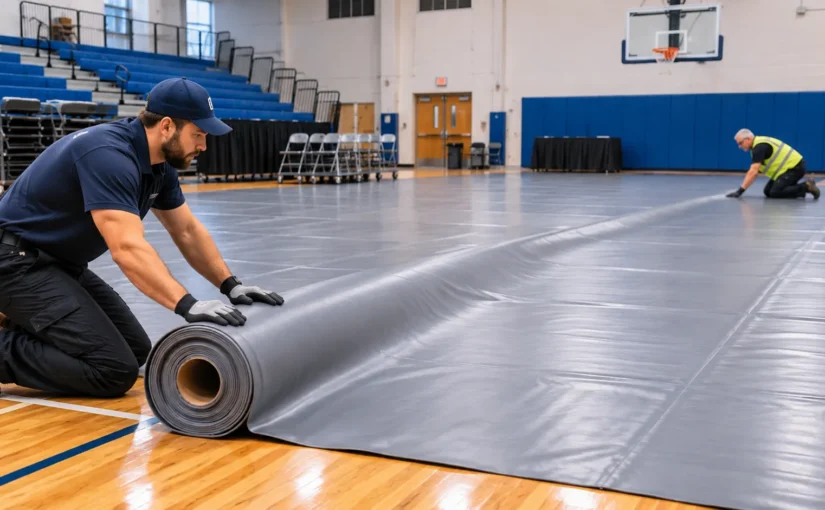
They typically use PVC-coated reinforced fabric supplied in large rolls. Staff unroll the material across the basketball court and connect sections according to the manufacturer’s instructions.
These gym floor tarps are useful for graduation ceremonies, assemblies, and events involving large numbers of chairs.
Advantages include straightforward spill cleanup, reusable construction, and different material weights.
However, waterproof vinyl material does not guarantee that liquid cannot pass through seams.
2. Carpet Rolls
Carpet rolls provide a softer, more finished appearance for concerts, banquets, and formal events.
They typically combine a carpet surface with a protective backing.
Carpet can also help reduce noise from footsteps and moving chairs.
Unlike vinyl covers, carpet rolls require vacuuming and may need deeper cleaning. They must dry completely before storage.
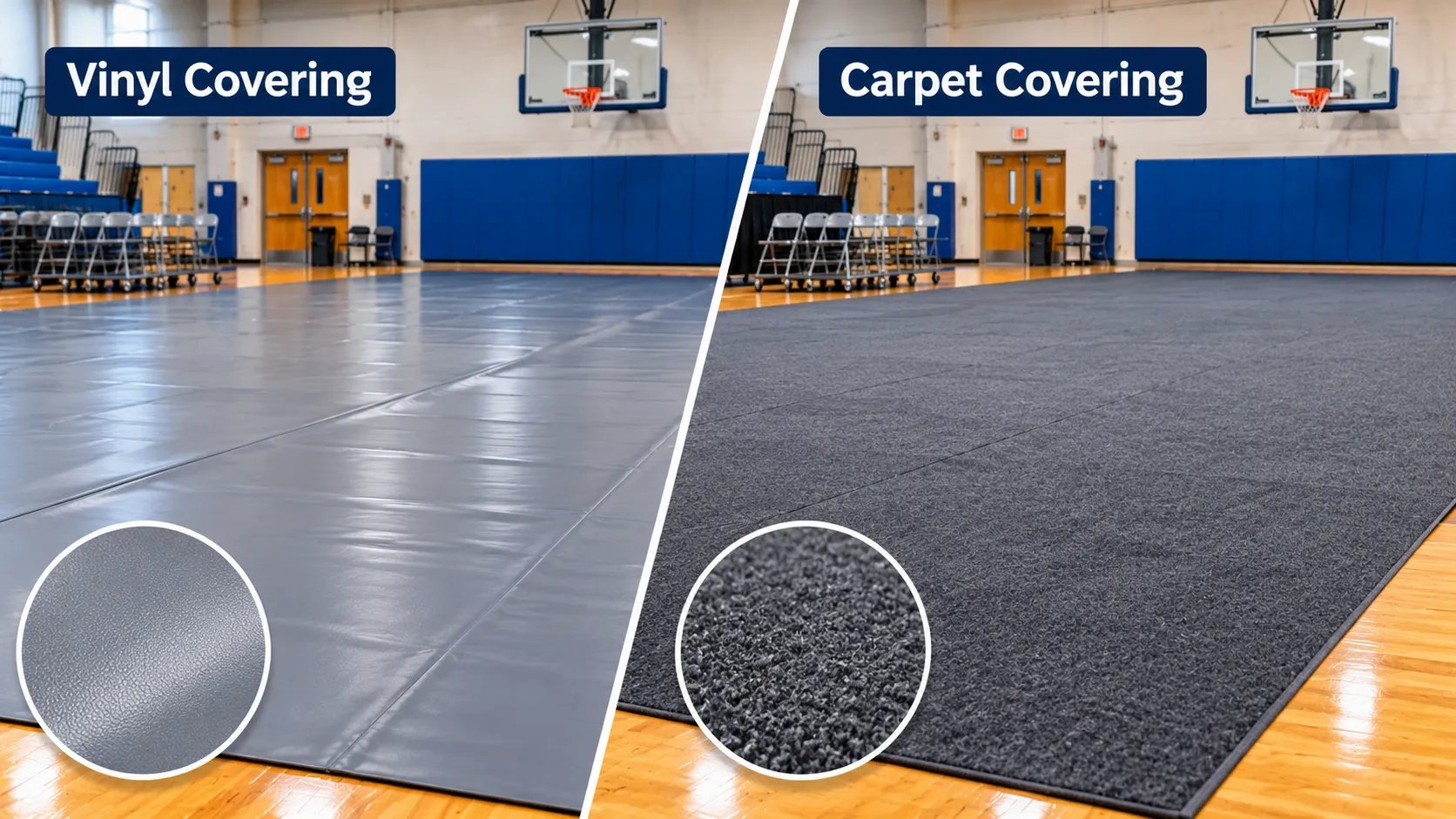
Vinyl and carpet coverings offer different surfaces for protecting basketball gym floors.
3. Protective Carpet Tiles
Large carpet tiles offer flexible floor protection without requiring long rolls.
These protective tiles are not necessarily interlocking gym floor tiles. Many have straight edges and require no adhesive.
They can be useful when a facility needs to protect different sections of its gymnasium for different events.
However, covering an entire basketball court may require hundreds of tiles and several storage carts.
4. Courtside Runners and Localized Protection
Courtside runners protect smaller areas, including entrances, bench areas, and frequently used walking routes.
They can be a practical option when full-floor coverage isn’t necessary.
However, runners won’t protect an unprotected floor elsewhere in the gym. Facility managers should consider where guests, furniture, and equipment will actually travel.
How to Choose the Right Basketball Gym Floor Covering
Start with the existing floor material.
For a hardwood floor, confirm that the covering’s backing and installation method are approved by the floor and finish manufacturers.
The MFMA also recommends waiting until a new floor finish has fully cured before placing protective covering over it.
Synthetic floors require separate checks. Some rubber-backed products can stain certain synthetic surfaces.
These are supplier recommendations, not universal durability ratings.
The ounce figures describe material weight per square yard, not thickness.
For frequent events and repeat deployment, compare tear resistance, backing compatibility, setup speed, and storage requirements rather than relying on weight alone.
How Much Do Basketball Gym Floor Coverings Cost?
Protective gym floor covering prices vary by material, weight, dimensions, and supplier.
The following US prices were documented in the research dossier on November 13, 2026.
Covering
Example Material Price
FlooringInc 18 oz vinyl, 10 × 100 ft
$1,352.99 per roll
FlooringInc 22 oz vinyl, 10 × 100 ft
$1,591.99 per roll
FlooringInc 32 oz vinyl, 10 × 100 ft
$2,028.99 per roll
FlooringInc Eco-Roll carpet
About $1.34/sq ft
FlooringInc Eco carpet tiles
$49.99 per tile
Greatmats carpet tiles
$69.99 per tile
These are product examples, not nationwide average prices. Check current prices and availability before ordering.
The covering itself is only part of the investment.
A facility may also need a storage rack, winding equipment, seam tape, cleaning supplies, and delivery arrangements.
For example, the research found a FlooringInc mobile storage rack listed at $4,161.99, although the exact configuration associated with that price wasn’t clear.
Labor costs also depend on the number of workers, the covering system, and how often the gym changes between basketball and other activities.
Always request a complete quote that includes accessories, freight, storage, and any custom branding.
How to Measure a Basketball Gym Floor for Covering
Measure the entire area needing protection, not just the basketball court markings.
Include seating areas, entrances, staging, and equipment routes where necessary.
For a rectangular area:
Length × Width = Floor Area
For example, a 60 × 100-foot event area measures 6,000 square feet.
However, ordering exactly 6,000 square feet of vinyl may not provide enough coverage.
Some vinyl systems require overlapping sections. With 10-foot-wide rolls and 6-inch overlaps, seven 100-foot strips would cover the example width.
That means purchasing 7,000 nominal square feet before any approved trimming.
Carpet rolls and tiles may use different seam arrangements. Ask the supplier for a layout plan before ordering.
Follow the instructions for your specific protective covering system.
Clean the court. Remove dust, grit, moisture, and debris using floor-approved cleaning methods. Our basketball court cleaner guide explains which products and methods suit different playing surfaces.
Inspect the covering. Check for tears, damaged backing, and worn accessories.
Position the material. Roll out vinyl or carpet sections, or place protective tiles according to the layout.
Secure the seams. Use only the approved joining method and tape.
Inspect the finished surface. Check for loose edges, wrinkles, trip hazards, and blocked exits.
Remove carefully. Clean and dry the covering before returning it to storage.
Never assume that ordinary adhesive tape is safe to apply directly to a finished hardwood basketball court.
If you’re planning a new court or renovating an existing one, our basketball court installation guide explains the wider construction process.
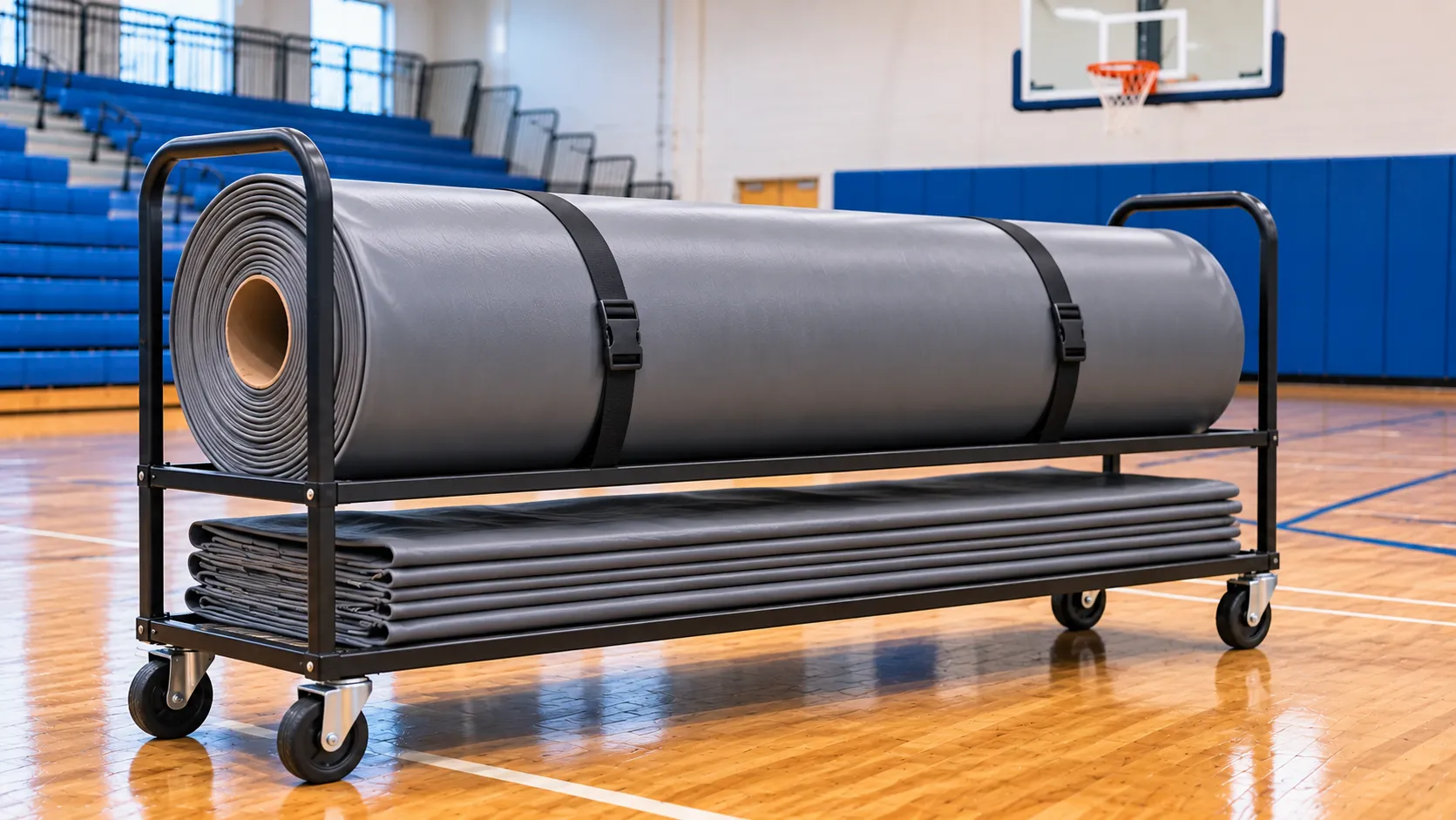
A wheeled storage rack holding protective vinyl gym floor covering.
Safety and Floor Protection
Gym floor protection involves more than preventing scratches.
Slips, Spills, and Trip Hazards
A covering should remain stable under normal event foot traffic.
Inspect seams, exposed edges, and entrances for slipping or tripping hazards.
Even when a vinyl product is described as waterproof, spills may reach the hardwood through poorly secured seams or edges.
The US Access Board also requires accessible walking surfaces to meet applicable stability and slip-resistance requirements.
Heavy Furniture and Equipment
A flexible protective covering cannot automatically prevent dents from heavy equipment.
Inspect chair legs, furniture caps, and cart wheels before events.
For stages, lifts, and other concentrated loads, consult the floor manufacturer about approved load-spreading protection.
Do not assume that a vinyl cover makes heavy equipment safe for every basketball floor.
Fire Safety
Ask suppliers for documented fire-test results and confirm which requirements apply to your building.
A product advertised as fire-retardant is not automatically approved for every school gym or event.
The relevant classification depends on the product, installation, local rules, and building use.
Cleaning and Storing Gym Floor Covers
Clean the covering after each event using the manufacturer’s recommended method.
Vinyl covers may allow surface wiping, while carpet systems generally require vacuuming.
Inspect for tears, damaged seams, and trapped moisture.
Roll flexible covers rather than folding them when the manufacturer recommends rolled storage. Store protective carpet tiles flat when specified.
Before returning the basketball court to athletic use, inspect the exposed floor for debris, moisture, and damage.
Avoid leaving hardwood covered for extended periods. The MFMA warns that prolonged covering can interfere with the wood’s natural moisture balance.
Common Gym Floor Covering Mistakes
Avoid these problems:
Buying a cover without checking floor compatibility
Confusing permanent vinyl gym flooring with temporary event protection
Ordering only the measured floor area without allowing for seams
Assuming protective carpet tiles always interlock
Applying unsuitable adhesive directly to hardwood
Dragging heavy staging or equipment across flexible coverings
Ignoring storage rack dimensions and door access
Storing wet carpet or vinyl
Leaving hardwood covered longer than recommended
A reliable protection system includes the covering, installation procedure, handling equipment, and maintenance plan.
Frequently Asked Questions
How Much Does a Basketball Gym Floor Cost?
A complete basketball gym floor can cost substantially more than temporary floor protection because it involves the playing surface, subfloor, installation, and potentially structural preparation.
Temporary protective coverings are a separate purchase. Documented examples include vinyl rolls costing approximately $1,353–$2,029 per 1,000-square-foot roll, depending on the selected weight.
What to Cover a Gym Floor With?
Use a temporary covering specifically approved for your existing gym floor.
Reinforced vinyl rolls are a practical option for regular events. Carpet rolls suit formal occasions, while large protective carpet tiles offer flexible layouts.
What Material Is Used for NBA Court Flooring?
NBA basketball courts commonly use hardwood playing surfaces, particularly hard maple.
This is different from a temporary basketball gym floor covering, which protects an existing playing surface during non-athletic events.
What Is the Best Flooring to Put in a Gym?
The best flooring depends on the gym’s intended activities.
A dedicated basketball court may benefit from a properly engineered hardwood sports floor. A multipurpose facility may consider hardwood or an approved synthetic sports flooring system.
If the gym already has a suitable basketball floor, a temporary protective covering is generally more relevant than replacing the playing surface just to host occasional events.
Final Thoughts
The best basketball gym floor covering depends on the existing court, event frequency, and storage requirements.
Reinforced vinyl rolls are a practical starting point for regular school events. Carpet rolls offer a more formal appearance, while protective carpet tiles provide flexible coverage.
Before buying, confirm compatibility with the basketball floor, calculate the required coverage, and include storage equipment and installation costs in your budget.
A properly selected and maintained covering can help protect the court while allowing the facility to host other activities.
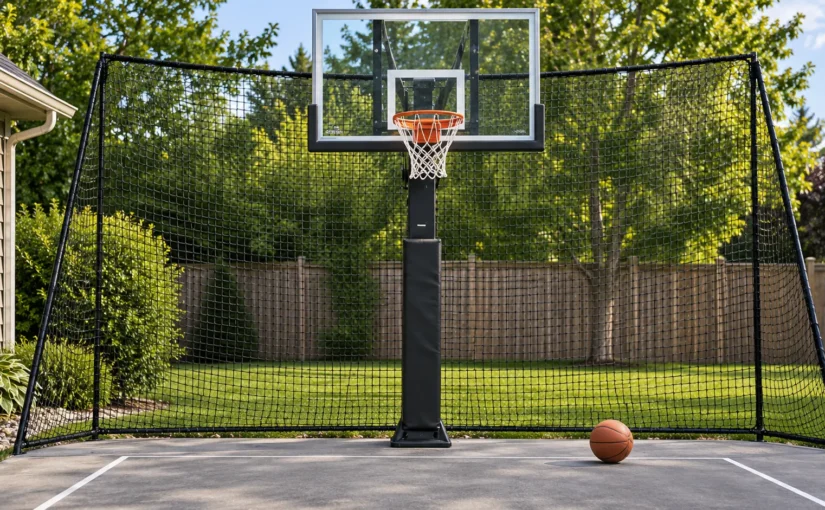
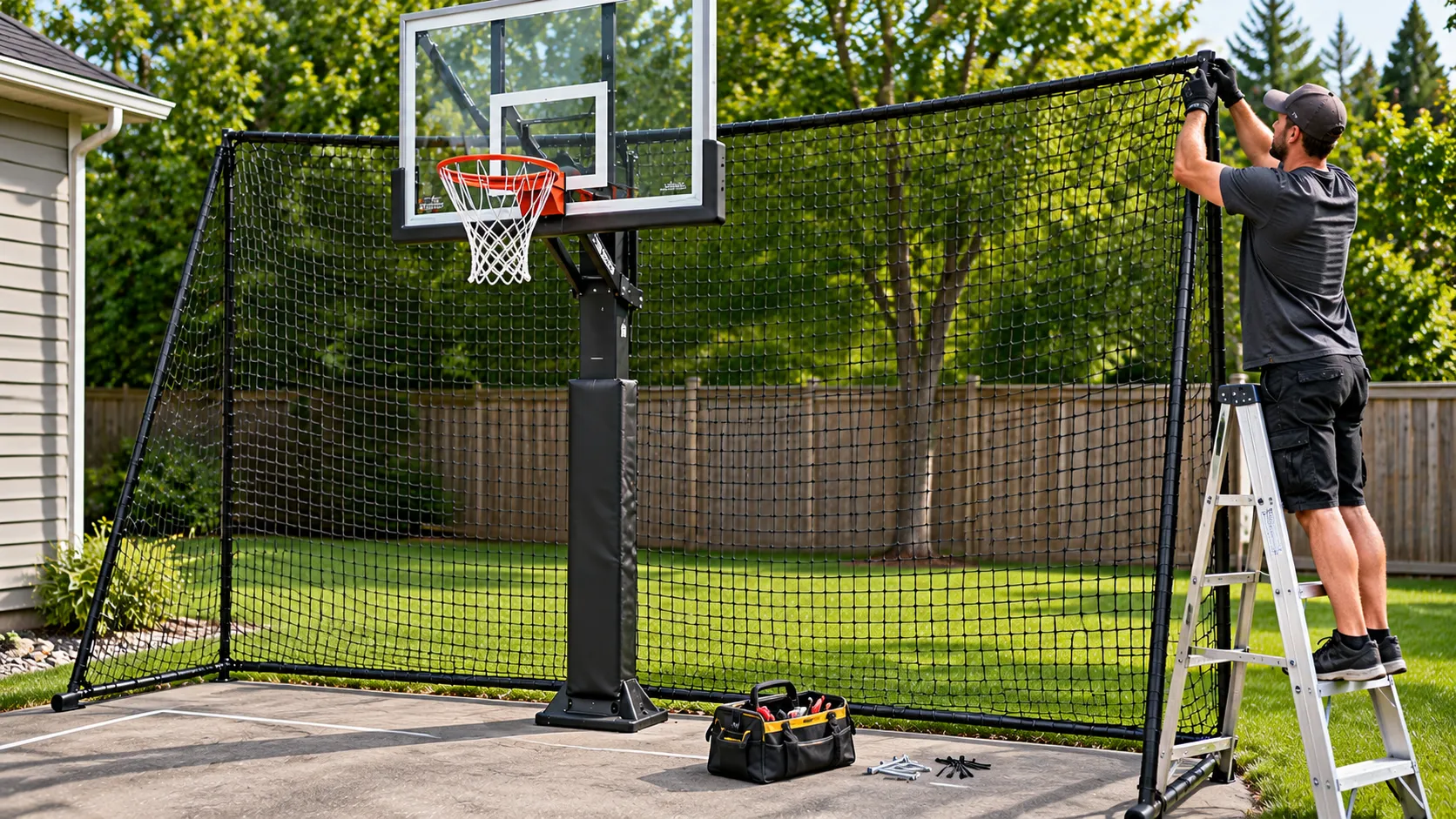
A basketball backstop net catches many missed shots before they roll into the street, neighboring yards, or landscaping. It sits behind or around your basketball hoop and helps you spend less time chasing balls.
Backstop nets come in several designs, including portable barriers, hoop-mounted attachments, and permanent netting systems. The best choice depends on your available space, basketball system, and where missed shots usually go.
This guide explains the different types, recommended sizes, materials, costs, and installation options for a backyard or driveway basketball court.
What Is a Basketball Backstop Net?
A basketball backstop net is a large mesh barrier designed to stop basketballs from traveling beyond a playing area.
Unlike the small net attached to a basketball rim, a backstop net usually stands behind the hoop. When a missed shot hits the barrier, the net absorbs some of the impact and prevents the ball from traveling farther.
Some basketball backstop nets also redirect balls toward the court. However, they are primarily designed for ball containment, not controlled passing or shooting practice.
A backstop can be useful when your basketball hoop is near:
A street or driveway entrance.
A neighbor’s property.
Windows, vehicles, or landscaping.
A fence that missed shots frequently clear.
Backstop nets reduce the need to retrieve basketballs, but they cannot guarantee that every missed shot stays within your yard.
Types of Basketball Backstop Nets
There are four main types of basketball backstop systems. Each offers different benefits depending on your basketball hoop and available space.
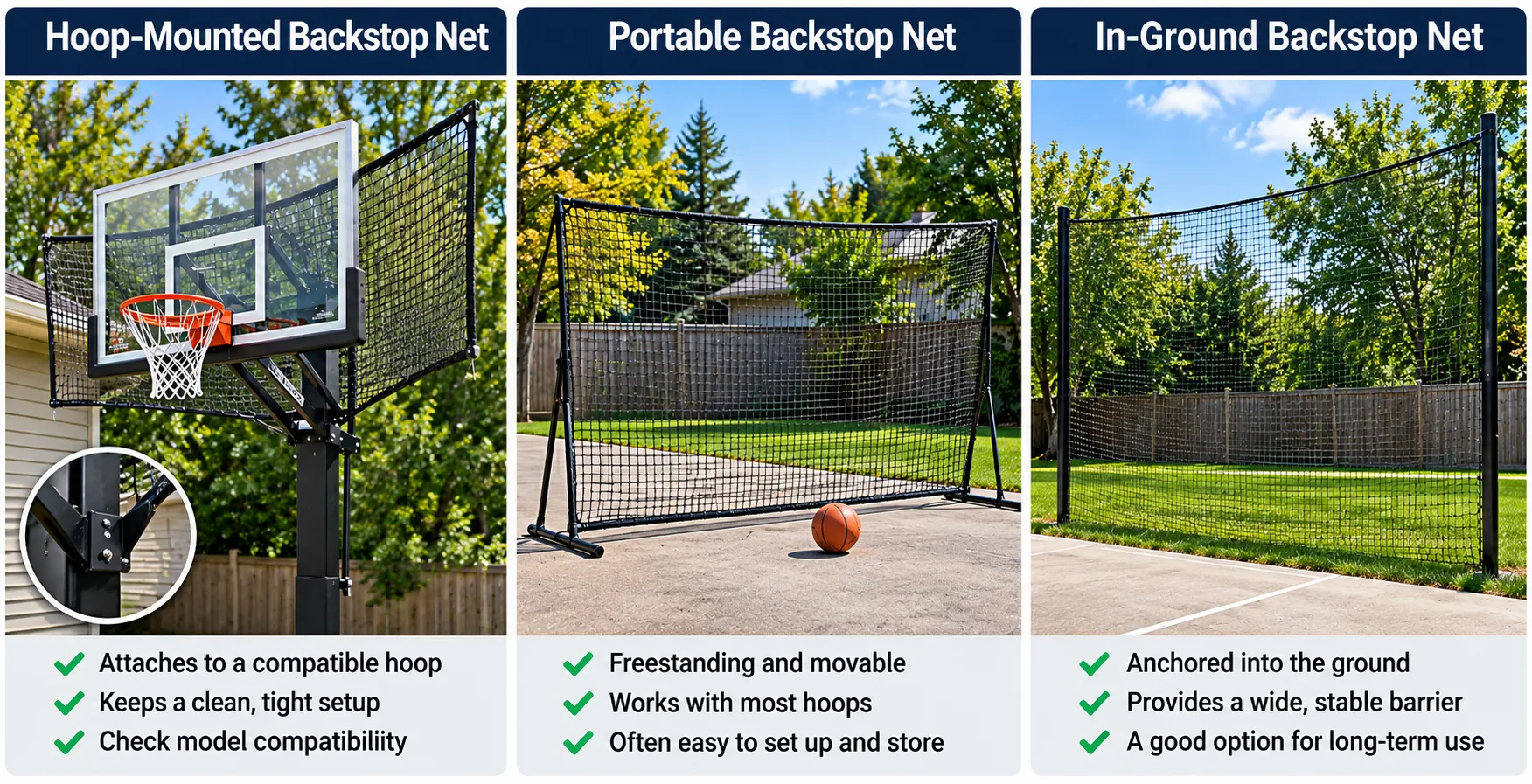
Three types of basketball backstop nets.
1. Hoop-Mounted Basketball Backstop Nets
Hoop-mounted backstop nets attach directly to compatible basketball systems.
They usually use brackets, support rods, and a mesh barrier positioned behind the backboard.
For example, the Goalrilla Yard Guard attaches to selected Goalrilla basketball systems. Its installed width is approximately 12 feet 9 inches, with a height ranging from 7 to 9 feet.
These systems are convenient because they work alongside an existing basketball hoop.
However, compatibility is essential. Some attachments only fit specific pole dimensions or basketball hoop models.
Before ordering, check your hoop’s manufacturer, model, and pole dimensions.
2. Portable Basketball Backstop Nets
Portable backstop nets use freestanding frames that can be positioned behind a basketball hoop.
They are useful for driveways, backyard basketball courts, and temporary practice areas.
These systems are particularly useful when you have grass or another suitable natural-ground installation area.
However, they require appropriate ground conditions and installation according to the manufacturer’s instructions.
Check underground utilities before installing ground anchors.
4. Custom and Permanent Basketball Backstop Nets
Custom basketball backstop nets are designed for specific court layouts.
They may use independent posts, cables, walls, or other engineered support systems.
Suppliers such as West Coast Netting provide basketball netting for residential and commercial applications.
Custom systems may be appropriate when a standard net cannot provide enough coverage.
Larger permanent installations should be assessed by a qualified specialist, particularly where wind exposure, structural attachments, or nearby hazards are involved.
Basketball Backstop Net Comparison
Type
Best for
Main consideration
Hoop-mounted
Compatible driveway hoops
Model compatibility
Portable
Temporary backyard use
Anchoring and storage
In-ground
Natural-ground installations
Soil and ground anchors
Custom/permanent
Larger or unusual courts
Professional design and installation
What Size Basketball Backstop Net Do You Need?
The correct basketball backstop net size depends on your hoop’s position, the available space, and where missed basketballs travel.
There is no universal required height or width for residential basketball backstop nets.
Basketball Backstop Net Height
Consumer backstop nets commonly include products with heights between approximately 7 and 10 feet.
For example:
Pro Dunk: 7-foot-high attachment.
Silverback Yard Guard: Approximately 8 feet high.
Goalrilla Yard Guard: 7–9 feet high, depending on the section.
QUICKPLAY: 10-foot-high barrier configurations.
These are product specifications, not official basketball backstop height standards.
West Coast Netting recommends approximately 10 feet of height as a residential starting point.
A taller net may intercept more high misses, but its support structure must also be suitable for the installation.
Basketball Backstop Net Width
The net should cover the area where basketballs usually escape.
West Coast Netting suggests a residential starting width of approximately 12–15 feet.
However, a narrow driveway may need different coverage from a large backyard basketball court.
Measure the available space and consider shots that travel diagonally past the backboard.
Do not assume that a net’s advertised maximum height applies across its entire width.
Where Should You Position the Net?
Position the backstop where it can intercept missed basketballs without creating an obstacle for players.
Consider:
The basketball hoop’s location.
The court boundaries and player movement.
The net’s width and height.
Support posts, anchors, and frame feet.
Space behind the net for movement when struck.
Avoid placing hard supports where players may run or land.
Follow the manufacturer’s instructions for connecting the frame, brackets, rods, or posts.
Some systems require two adults and a stable ladder.
Do not modify your basketball hoop or improvise structural attachments.
Step 5: Attach and Position the Net
Secure the mesh using the supplied attachment components.
Check that the net is properly positioned and that its supports do not obstruct players.
Follow the manufacturer’s tensioning instructions.
Step 6: Inspect Before Playing
Check the assembled system for loose connections, instability, and damaged mesh.
Make sure the basketball hoop still operates correctly.
Do not use the backstop if any part appears unsafe.
Basketball Backstop Net Safety and Maintenance
A basketball backstop net should reduce ball escapes without introducing unnecessary hazards.
Inspect the net and its supporting components regularly.
Look for:
Torn or fraying mesh.
Loose brackets and connections.
Rust or damaged supports.
Moving or unstable anchors.
Gaps that allow basketballs to escape.
Follow the manufacturer’s cleaning and storage instructions.
For example, Goalrilla’s Yard Guard manual requires storage when the product is not being used, during storms, and during aggressive play.
Do not assume that a net marketed for outdoor use can remain installed in every weather condition.
A basketball backstop is also not designed to catch falling players. Keep hard components outside the playing area.
Basketball Backstop Nets vs. Basketball Court Fencing
Basketball backstop nets and court fencing can both help contain missed basketballs, but they serve different purposes.
A backstop net usually covers a specific area behind or around a basketball hoop.
Court fencing typically forms a more permanent boundary around part or all of a basketball court.
A backstop net may be easier to remove or reposition, while fencing can provide a longer-lasting perimeter solution.
However, neither automatically guarantees complete ball containment.
If you need a larger court boundary, read our basketball court fencing guide for fence types, heights, costs, and installation.
Common Basketball Backstop Net Mistakes
Avoid these mistakes when choosing and installing a basketball backstop net.
Buying an incompatible attachment: Check the basketball system’s exact model before purchasing.
Choosing a net that is too narrow: Measure where missed shots actually travel rather than relying on the backboard’s width.
Ignoring the installation surface: Ground stakes and hard-surface ballast are not interchangeable.
Overlooking weather instructions: Outdoor-compatible materials do not guarantee that a portable system can remain outside permanently.
Installing supports too close to players: Keep frames, posts, and anchors outside the playing area.
Confusing a backstop with a rebounder: Some backstop nets redirect balls, but they are not necessarily designed to deliver controlled practice passes.
Frequently Asked Questions
Where Can I Find Backstop Nets for My Basketball Hoop?
You can find basketball backstop nets through basketball hoop manufacturers, sports-equipment retailers, and specialist netting suppliers.
Goalrilla, Silverback, and Pro Dunk sell attachments for compatible basketball systems. GoSports and QUICKPLAY offer separate barrier systems.
Check the product’s dimensions and compatibility before ordering.
Are Basketball Rebounders Worth It?
A basketball backstop with a ball-return function may be worthwhile if you regularly chase missed shots.
However, a backstop is different from a dedicated basketball rebound training system.
Choose based on whether you need ball containment, controlled passing practice, or both.
What Is the Best Basketball Net for a Driveway?
For a driveway with a compatible in-ground hoop, a manufacturer-approved hoop-mounted backstop can be convenient.
For other setups, a freestanding portable barrier designed for hard-surface use may be more suitable.
The best option depends on your hoop, driveway space, and anchoring requirements.
What Is a Backstop in Basketball?
A basketball backstop is a barrier that intercepts missed shots before they travel beyond the playing area.
It commonly consists of mesh netting supported by a frame, posts, or a compatible basketball hoop.
Can You Use a Backstop Net With a Portable Basketball Hoop?
Yes, a separately supported portable barrier can be positioned behind a portable basketball hoop.
However, do not assume that hoop-mounted attachments designed for in-ground basketball systems will fit a portable hoop.
Can a Basketball Backstop Net Stay Outdoors All Year?
That depends on the manufacturer’s instructions.
Some products use UV-treated materials, but portable systems may still require storage during storms or when not in use.
Check the exact product’s weather limitations and warranty.
Final Thoughts
A basketball backstop net can make backyard and driveway basketball more convenient by reducing the number of missed shots that leave the playing area.
For many homeowners, a compatible hoop-mounted attachment or portable barrier is a practical starting point. Larger courts may benefit from custom netting.
Before buying, focus on coverage, compatibility, anchoring, and player safety rather than choosing the largest net available.
The right backstop should suit your basketball court, stop balls where they usually escape, and remain safe throughout its intended use.
Basketball court fencing helps keep stray balls inside the playing area, control access, and reduce the chance of balls reaching roads or neighboring properties. It is used around backyard courts, schools, parks, and commercial sports facilities.
Chain-link fencing is a practical starting point for many outdoor basketball courts. Available options range from low 4-foot barriers to 10-foot or taller systems, depending on the court and its surroundings. There is no single regulation fence height for every basketball court.
This guide explains fencing types, heights, installation costs, safety considerations, and how to choose a suitable fence for your court.
What Is Basketball Court Fencing?
Basketball court fencing is a barrier installed around all or part of a basketball court. Its main purpose is usually to contain stray balls, although some systems also help control access to the facility.
A court fence can serve several purposes:
Ball containment: Reduces the number of balls leaving the playing area.
Access control: Helps manage entry to schools, parks, and private facilities.
Court separation: Creates boundaries between nearby sports facilities.
Not every basketball court needs a complete enclosure. A backyard hoop may only need netting behind the basket, while a public sports facility may benefit from a full perimeter fence with gates.
The right design depends on the court’s location, available space, and intended use.
Does a Basketball Court Need a Fence?
Not every basketball court requires fencing. Whether a fence is necessary depends on local regulations, the surrounding environment, and the risks associated with stray balls. ASTM F3729-25 provides guidance for assessing fencing around outdoor sport and recreation areas, but it does not impose one national basketball fencing rule.
A fence is particularly useful when a court is close to:
Roads or parking areas.
Neighboring properties.
Buildings and windows.
Other sports courts.
Areas where spectators gather.
For a backyard basketball court, partial fencing behind the hoop may provide useful ball containment for casual play. Schools and public sports facilities may prefer full-perimeter fencing to manage access and reduce interruptions from stray balls.
However, an ordinary court fence is not a certified vehicle-impact barrier or a guarantee that every ball will remain inside.
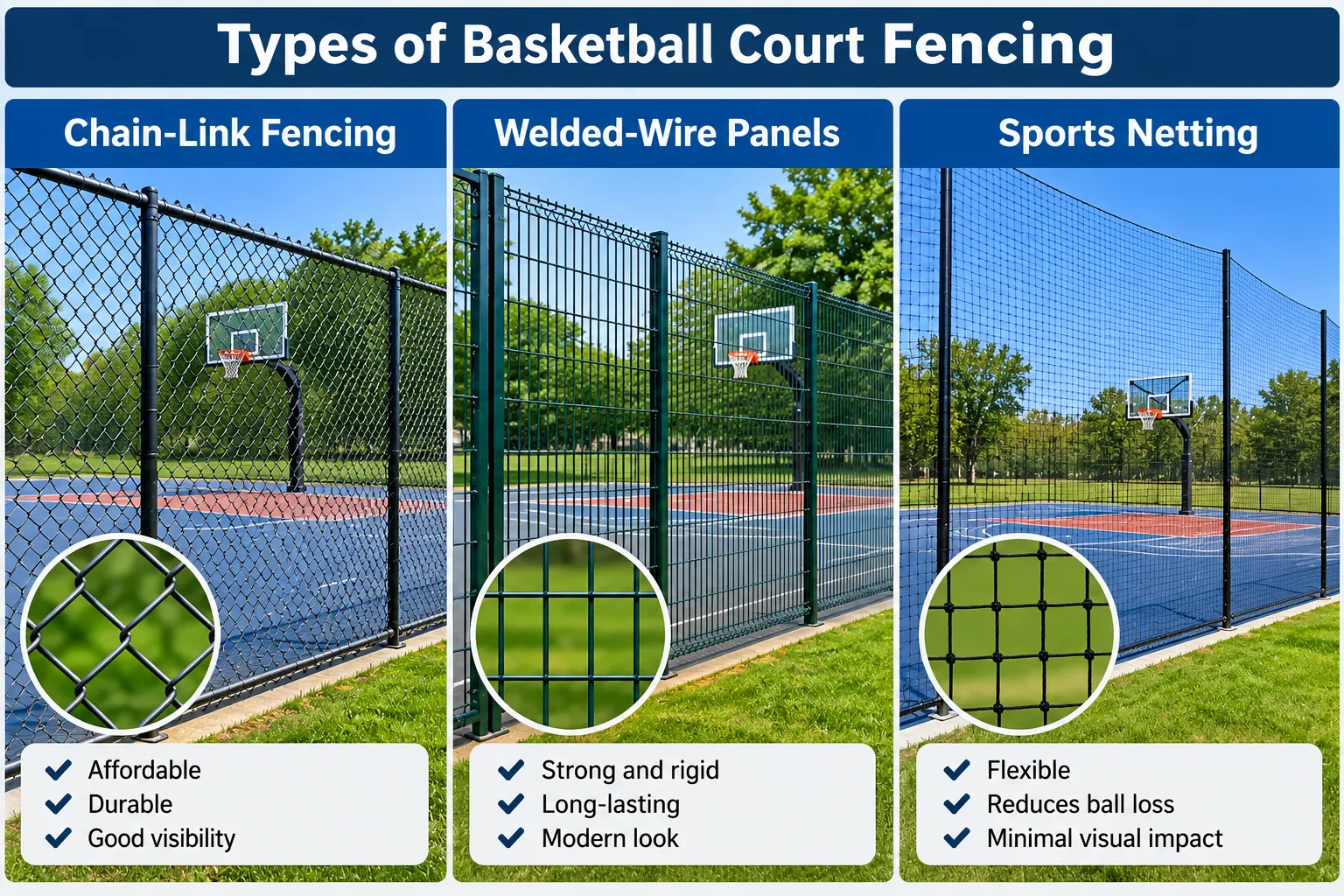
Several fencing materials are available. Each has different benefits, costs, and maintenance requirements.
Chain-Link Fencing
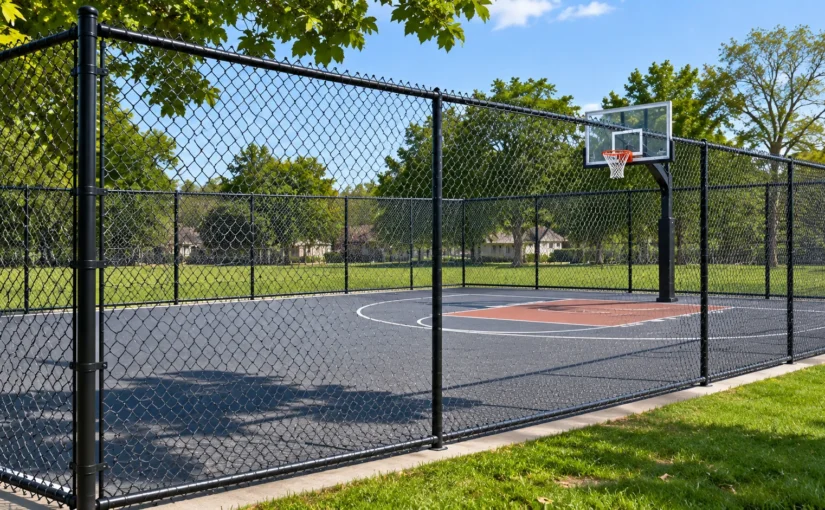
Chain-link fencing is a common choice for outdoor sports courts because it provides a durable barrier while allowing visibility through the mesh.
Two common finishes are available:
Galvanized chain-link: Steel wire protected by a zinc coating to resist corrosion.
Vinyl-coated chain-link: Steel wire with an additional polymer coating, commonly available in black or green.
Chain-link fencing can be used around residential courts, schools, parks, and commercial facilities.
When comparing products, check the wire gauge, mesh opening, coating, posts, and wire-end finish. The Chain Link Fence Manufacturers Institute’s product manual recommends knuckled wire ends for additional safety in playfields and parks.
Welded-Wire Sports Fencing
Welded-wire fencing uses rigid steel panels with wires joined at their intersections. Unlike flexible chain-link mesh, welded panels maintain a fixed shape.
Purpose-designed sports panels may suit courts where a rigid barrier and a particular appearance are preferred. However, ordinary garden fencing should not automatically be considered suitable for repeated ball impacts.
Ask the supplier about impact suitability, panel connections, exposed edges, and replacement parts.
Basketball Court Netting
Basketball netting provides a flexible barrier designed primarily to stop or slow stray balls. It can be installed behind a hoop, along one court boundary, or around a larger playing area. For smaller backyard setups, a basketball backstop net can help contain missed shots without requiring a full court enclosure.
Netting is useful when a full chain-link enclosure is unnecessary. Suppliers offer different mesh openings, heights, and materials. Outdoor netting should be suitable for sunlight and weather exposure.
Important: Ball-containment netting is not automatically suitable for security, child containment, or vehicle protection.
Other Fencing Options
Other possibilities include ornamental metal fencing, wood screening, and solid barriers. These options may suit certain properties, but their appearance alone does not establish their suitability for basketball.
Consider visibility, collision hazards, ball containment, and structural requirements. Indoor basketball facilities may instead use divider nets or retractable curtains to separate courts.
Basketball Court Fencing Comparison
Fence type
Main advantage
Main limitation
Galvanized chain-link
Durable, visible barrier
Can corrode if its protection is damaged
Vinyl-coated chain-link
Coating and color options
Coating can wear or become damaged
Welded-wire sports panels
Rigid construction
Requires a suitable sports-fencing design
Sports netting
Flexible ball containment
Usually not a security barrier
Wood or solid screening
Privacy and visual screening
Visibility, impact, and wind-load concerns
For many outdoor courts, chain-link offers a practical balance of durability, visibility, and ball containment.
How High Should Basketball Court Fencing Be?
Basketball court fencing comes in several heights, but there is no universal regulation height that applies to every basketball court in the United States.
The appropriate height depends on how much ball containment is needed and what lies beyond the fence.
Fence height
Possible application
4–6 feet
Lower residential boundaries where some ball escape is acceptable
8 feet
Taller ball-containment options for residential courts
10 feet
Residential or commercial sites needing greater containment
11 feet or more
Project-specific public or commercial installations
These are planning examples, not mandatory minimum heights. A 6-foot fence may stop some stray balls but cannot guarantee full containment. An 8- or 10-foot barrier may catch more shots, particularly behind baskets.
For example, a 2025 court project in Beacon, New York, specified 11-foot vinyl-coated chain-link fencing. That does not make 11 feet a national requirement.
If a court is near a busy road or another serious hazard, height alone may not be enough. A designer may recommend additional containment or a different layout.
How Far Should a Fence Be From a Basketball Court?
Basketball fencing should be positioned beyond the playing boundaries so players have room to move without immediately encountering a hard obstruction. This surrounding space is often called the run-off area.
For reference:
NCAA men’s basketball rules: At least 3 feet of unobstructed space outside the sidelines, preferably 10 feet.
FIBA basketball rules: At least 2 meters (approximately 6 feet 7 inches) of unobstructed space surrounding the court.
These figures apply within their respective playing-rule contexts. They are not universal backyard-fencing laws or interchangeable construction standards. See the NCAA men’s rules and FIBA Official Basketball Rules 2026 for their exact requirements.
When planning a fence, account for posts, gate hardware, braces, and other protruding components. Do not assume protective padding makes inadequate clearance acceptable.
These figures are not directly interchangeable. The Austin allowances do not specify fence height or all installation inclusions. None of the figures is a guaranteed local quotation.
Example Basketball Court Fencing Cost
Suppose a hypothetical rectangular enclosure measures 40 × 60 feet. Its perimeter is 200 linear feet.
Using the published $38–$60 installed rate for one specified 10-foot commercial chain-link configuration:
Lower estimate: 200 × $38 = $7,600.
Higher estimate: 200 × $60 = $12,000.
The illustrative fencing subtotal is $7,600–$12,000, before any work excluded from the base pricing. Gate openings and gate charges may be measured separately.
This is an arithmetic example, not a regulation basketball court layout or contractor quote.
What Affects Basketball Court Fencing Costs?
Several factors can increase the final price:
Taller or heavier fencing materials.
Difficult excavation or rocky ground.
Larger foundations.
Pedestrian and maintenance gates.
Removing existing fencing.
Engineering and permits.
Surface repairs and drainage work.
Windscreens or other accessories.
Request an itemized quotation identifying the fence specifications, labor, gates, foundations, and any exclusions. If you are building the playing surface too, our basketball court installation guide explains the wider construction process.
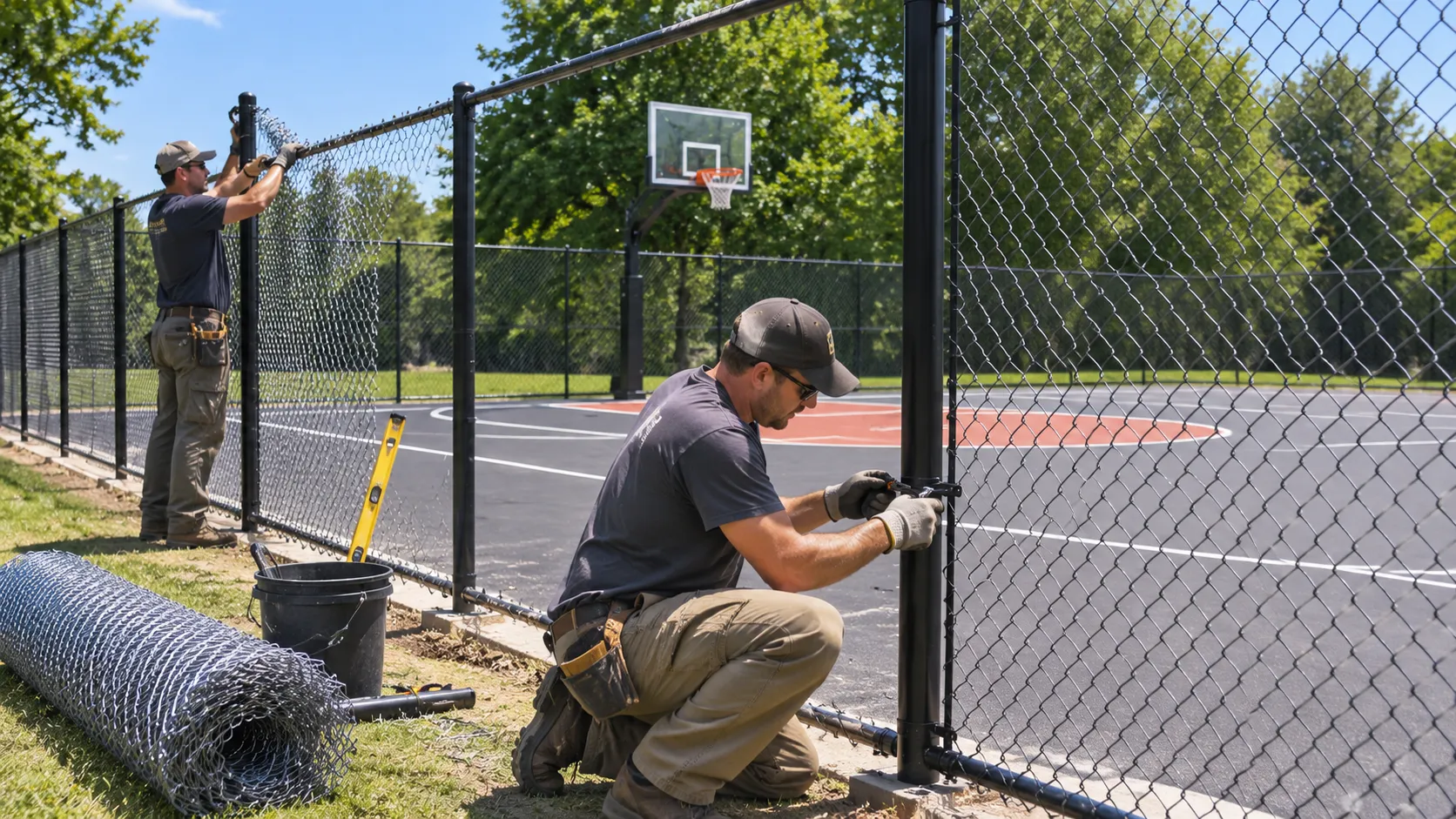
How to Install Basketball Court Fencing
Installing basketball court fencing involves more than attaching mesh to posts. The layout, foundations, drainage, and structural requirements must be considered before construction begins.
Step 1: Plan the Layout and Check Local Rules
Measure the proposed fence perimeter and identify the playing boundaries. Allow appropriate player clearance and decide where gates will be installed.
Check local requirements covering fence height, setbacks, permits, and property boundaries.
Step 2: Locate Underground Utilities
Before digging, arrange for underground utilities to be located. In the United States, contact the relevant 811 service and follow your state’s notification requirements.
Do not assume the same notice period applies everywhere.
Step 3: Prepare the Ground and Drainage
Clear the installation area and confirm the finished ground level. Identify existing drainage routes.
Fence foundations, bottom rails, and gate thresholds should not block water from leaving the court.
Step 4: Install Posts and Foundations
Install the specified posts and foundations according to the approved design. Concrete-set posts are common, although other systems may be available.
Post spacing and foundation depth depend on fence height, soil, wind exposure, and structural loads. There is no single foundation depth suitable for every basketball court fence.
Step 5: Fit the Fencing and Gates
Attach the selected chain-link fabric, rigid panels, or netting system. Install the specified rails, tension components, fasteners, and gates.
Check that wire ends, connections, and gate hardware do not create unnecessary contact hazards.
Step 6: Inspect the Completed Fence
Before allowing play, check that:
Posts and connections are secure.
Gates open and latch correctly.
Mesh or panels have no dangerous exposed edges.
Planned player clearance remains unobstructed.
Drainage paths are clear.
Tall fences, challenging ground conditions, and public facilities are good reasons to use qualified professional installers.
Basketball Court Fence Gates and Access
A basketball court enclosure needs suitable access for players and, where necessary, maintenance equipment.
A pedestrian gate may be sufficient for a small private court. Larger facilities may also need wider service gates for resurfacing equipment and other maintenance work.
Gate placement should avoid interfering with the playing area or player run-off space. Public facilities may also need to meet accessibility requirements.
For covered facilities, the ADA accessibility standards generally require at least a 32-inch clear opening at an accessible gate; openings more than 24 inches deep require 36 inches. Route width, hardware, and maneuvering space have separate requirements.
Local authorities should confirm applicable emergency access and exit requirements.
Basketball Court Fencing Safety and Maintenance
Even durable sports fencing needs regular inspection. Look for:
Rust or damaged protective coatings.
Loose bolts, ties, and fasteners.
Broken wires or sharp edges.
Leaning or unstable posts.
Damaged gates and hinges.
Sagging or torn netting.
Clean chain-link fencing when needed using manufacturer-recommended methods. Repair damaged components before they become a hazard.
Can You Add a Windscreen?
Windscreens can provide privacy and reduce visibility through a fence. However, they also increase the area exposed to wind.
A fence designed for open chain-link mesh may not be suitable for an added privacy screen. Have the structure and attachments assessed before installing windscreens, privacy slats, or large banners. The CLFMI wind-load guide explains why fence height, exposure, and configuration matter.
Common Basketball Court Fencing Mistakes
Choosing a fence based only on height. Consider ball escape routes, surrounding hazards, and local rules.
Installing fencing too close to the playing area. Allow appropriate unobstructed space for players.
Comparing incomplete prices. A materials-only kit is not equivalent to a fully installed fence.
Ignoring wind loads. Tall fences and attached screens can require additional structural design.
Using unsuitable fencing materials. Choose systems appropriate for sports facilities rather than assuming any residential fence will work.
Forgetting gates and maintenance access. Plan entrances before foundations and posts are installed.
Frequently Asked Questions
What Is the Recommended Fence Height for a Basketball Court?
There is no single recommended height for every basketball court. Lower 4–6-foot fences may suit some residential situations, while 8–10-foot systems offer taller ball-containment options. Public facilities may use taller fencing depending on the project.
Choose the height based on ball containment needs, nearby hazards, and local requirements.
What Is the Best Fencing for an Outdoor Basketball Court?
Chain-link fencing is a practical starting point because it offers visibility, durable construction, and different height and coating options. However, flexible netting or purpose-designed welded-wire panels may be better for particular sites.
Can You Install Fencing Around an Existing Basketball Court?
Yes, fencing can be added to an existing court if the available space, ground conditions, and foundations allow it. An installer should assess the proposed mounting method and whether player clearance and drainage will be affected.
Can Basketball Netting Replace Chain-Link Fencing?
Netting can replace chain-link for some ball-containment purposes. However, it should not automatically replace fencing needed for security, access control, or other specific safety requirements.
Do You Need a Permit for Basketball Court Fencing?
Possibly. Permit requirements depend on location, fence height, property classification, and local regulations. Contact your local planning or building department before construction.
Can You Install Basketball Court Fencing Yourself?
Some smaller fencing projects may suit experienced DIY installers. However, tall sports fencing requires careful consideration of foundations, wind loads, and player safety. Professional installation is advisable when structural requirements are complex.
Final Thoughts
Basketball court fencing helps contain stray balls, manage access, and separate the playing area from nearby hazards.
Chain-link fencing is a practical starting point for many outdoor courts, while sports netting and welded-wire panels provide alternatives.
Before choosing a system, confirm the fence height, available player clearance, local requirements, and complete installation costs. The right fence fits the site, provides the required containment, and allows players to use the court safely.
Basketball pole pads are cushioned covers that fit around basketball hoop support poles. They help soften accidental contact when players run or fall into the pole.
Basketball pole pads come in different shapes, sizes, materials, and thicknesses. Some cover only the upright pole, while others extend over the baseplate or mounting hardware.
The most important thing is choosing a pad that fits your hoop and covers the areas players might contact. A thicker or more expensive pad is not automatically safer.
This guide explains the different types of basketball pole padding, how to measure your pole, what pads cost, and how to install and maintain them.
What Is a Basketball Pole Pad?
A basketball pole pad is protective cushioning attached to the vertical support post of a basketball hoop.
Most designs contain foam padding covered by vinyl or another protective material. Straps, hook-and-loop fasteners, zippers, or laces hold the padding in place.
Pole padding is commonly used on:
In-ground basketball hoops
Compatible portable basketball hoops
School and recreational basketball equipment
Indoor and outdoor basketball courts
The purpose is to cushion accidental contact with the support structure.
However, pole padding cannot eliminate the risk of injury. It does not replace proper hoop placement, secure installation, or sufficient space around the court.
Basketball Pole Padding vs. Other Hoop Padding
Different parts of a basketball system may need different protective products.
Padding type
What it covers
Pole padding
The vertical support pole
Base padding
Baseplates, anchor bolts, or other lower mounting components
Backboard padding
Exposed edges of the basketball backboard
Boom padding
Parts of the support structure extending toward the backboard
Portable backstop padding
Designated areas of a larger portable basketball support system
A standard pole wrap does not necessarily protect exposed anchor bolts or the base of a portable hoop.
Basketball pole pads differ mainly in their shape, attachment method, and coverage.
Some are designed for particular hoop models. Others accommodate several pole sizes.
Wrap-Around Basketball Pole Pads
Wrap-around pads fit around the lower section of a basketball pole and are secured using straps or hook-and-loop fasteners.
They are common accessories for residential basketball hoops.
For example, the Silverback Basketball Pole Pad has:
A height of 49 inches
1.5 inches of cushioning
Hook-and-loop attachment straps
Compatibility with specified 4 × 4-inch square and 3.5-inch round poles
Wrap-around designs can be convenient because they usually do not require permanent changes to the basketball hoop.
However, the manufacturer’s compatibility instructions still matter. A pad that wraps around one pole may not fit another pole with a different shape or circumference.
Fitted Square Pole Pads
Fitted pads are designed for square support poles.
They may have shaped sections that sit against the front and sides of the upright.
For example, Douglas offers fitted pole padding for specified 4-inch and 6-inch square poles. Its published design includes:
72-inch pad height
2-inch foam padding
Vinyl covering
Model-specific sizing
Some fitted pads protect three sides rather than surrounding the entire pole.
Before buying, check whether players can reach any uncovered side.
Round and Cylindrical Pole Pads
Round pole pads are designed for cylindrical support posts.
Some wrap around the pole, while others use a thicker cylindrical design.
The Jaypro PPP-5HP Protector Pad, for example, is designed for a 4.5-inch-diameter pole.
Its published specifications include:
72-inch height
4-inch-thick polyurethane foam
Vinyl enclosure
Laced attachment
Larger cylindrical pads may be useful in facilities where players can approach a support post from multiple directions.
However, the additional thickness increases the finished outside dimensions. Check that the installed pad will not interfere with nearby equipment or required clearances.
Basketball Pole Pads With Base Protection
Some basketball systems have exposed baseplates, anchor bolts, or support brackets near the bottom of the pole.
A standard upright pad may leave these areas uncovered.
Certain products address this by extending over the lower mounting assembly.
For example, the Goalrilla Universal Basketball Pole Pad is 62 inches tall and includes baseplate coverage.
Other manufacturers, including Douglas, offer separate padding for anchor bolts and lower mounting components.
Check the entire support structure before purchasing. A pad that protects the upright may still leave hard surfaces exposed near the ground.
Basketball Pole Pad Types Compared
Type
Main advantage
Important limitation
Wrap-around
Convenient attachment on compatible poles
May not cover the base
Fitted square
Designed around specific square-pole dimensions
May leave one side exposed
Cylindrical
Can provide substantial surrounding coverage
Must match pole diameter
Pole and baseplate
Covers additional lower hardware
Often model-specific
Separate base pad
Protects designated anchor or mounting areas
May require a matching upright pad
The best type depends on your basketball hoop, its surroundings, and the surfaces that need protection.
How to Choose the Right Basketball Pole Pad
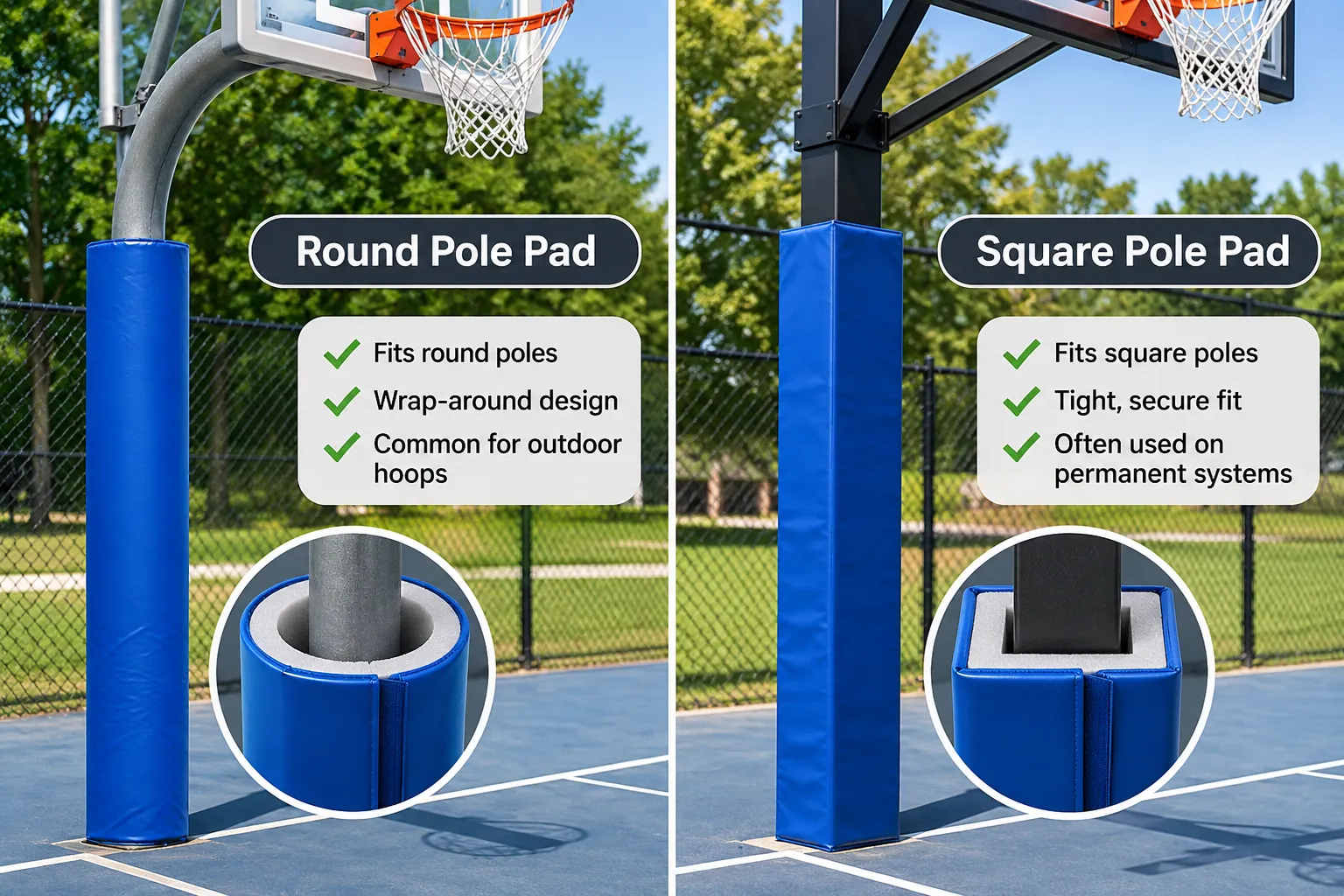
Round and square basketball pole pads have different shapes and fitting requirements.
Before comparing prices or materials, identify your basketball hoop’s exact support-pole dimensions.
This is particularly important because manufacturers use different compatibility measurements.
1. Measure Your Basketball Pole
Start by identifying whether the pole is round, square, or rectangular.
For a round pole, measure straight across its outside diameter.
For a square pole, measure the width of one outside face. Do not measure diagonally between the corners.
For a rectangular pole, measure both outside dimensions.
Common published compatibility sizes include:
3.5-inch round poles
4 × 4-inch square poles
5 × 5-inch square poles
6-inch square poles
These are examples of manufacturer-listed sizes, not a complete list of basketball pole dimensions.
If your hoop has multiple pole sections, measure the section where the padding will sit.
2. Check Round vs. Square Compatibility
A pad advertised for a 4-inch round pole does not automatically fit a 4-inch square pole.
Although both measurements include the number four, the shapes have different outside perimeters.
Some manufacturers offer products compatible with both shapes.
For example, Silverback specifies certain round and square pole sizes for its B5451W pad.
Other products are designed for one particular shape.
Always check the exact product’s compatibility information rather than assuming that matching measurements guarantee a proper fit.
3. Choose the Right Padding Height
Basketball pole pads are available in different heights.
Examples from manufacturer specifications include:
Product
Published height
Silverback Pole Pad
49 inches
Goalsetter Pole Pad
60 inches
Goalrilla Universal Pole Pad
62 inches
First Team FT75
66 inches
Douglas Fitted Pole Padding
72 inches
These measurements describe how tall the pads are, not how thick their foam is.
A taller pad covers more of the upright, but coverage still depends on how the product fits and where it is positioned.
Consider the areas players could realistically contact.
Also check whether the pad covers exposed lower hardware or requires separate base protection.
There is no single verified residential pole-pad height requirement that applies to every basketball hoop.
4. Check Your Basketball Hoop Model
Your hoop’s manufacturer and model number can help identify compatible accessories.
Look for the model information in the owner’s manual, product documentation, or on the equipment itself.
Check whether the pad interferes with:
Height-adjustment handles
Cranks or adjustment mechanisms
Support braces
Transport wheels
Baseplates and mounting hardware
Important operating instructions or warning labels
Some basketball pole pads have cutouts or notches to accommodate specific equipment features.
If compatibility is unclear, contact the manufacturer before purchasing.
Basketball Pole Pad Materials and Thickness
Basketball pole padding commonly combines a cushioning material with a protective outer cover.
However, manufacturers do not always disclose the same level of detail about their products.
Foam Padding
Foam absorbs and spreads some of the force generated during contact.
Manufacturers use different foam constructions.
Examples include:
Closed-cell foam: Goalsetter specifies closed-cell foam in certain fitted basketball pole pads.
Polyurethane foam: Jaypro lists high-density polyurethane foam in its cylindrical PPP-5HP pad.
High-density foam: Goalrilla describes high-density foam in its square-pole padding, although the published description does not establish its exact chemical composition.
Foam density, thickness, construction, and response to impact can all affect performance.
The term high-density alone does not prove that one product offers better protection than another.
Vinyl Covers and Weather Resistance
Many basketball pole pads use vinyl covers.
These covers help protect the cushioning material from ordinary wear and environmental exposure.
Depending on the product, manufacturers may advertise:
All-weather vinyl
Weather-resistant construction
UV-resistant materials
Reinforced seams
Custom colors or graphics
Outdoor suitability should be checked for the exact product.
A weather-resistant label does not guarantee that water cannot enter through seams, fasteners, or damaged areas.
For an outdoor driveway hoop, choose padding specifically intended for outdoor use.
What Thickness Should a Basketball Pole Pad Be?
There is no verified universal best foam thickness for every basketball pole.
Published examples include:
Product
Published foam thickness
Silverback Pole Pad
1.5 inches
Douglas Fitted Pole Padding
2 inches
Jaypro PPP-5HP
4 inches
Bison Post Padding sold by Gopher
5 inches
These products differ in size, construction, intended use, and coverage.
A thicker pad is not automatically safer.
Meaningful comparisons require suitable impact-testing evidence under comparable conditions.
Also, avoid confusing foam thickness with the overall dimensions of the finished pad.
For example, a product might have 1.5 inches of foam but list an overall depth of 2 inches.
When choosing padding, consider fit, coverage, construction, and the intended playing environment together.
How Much Does a Basketball Pole Pad Cost?
Basketball pole pad prices vary considerably.
Smaller residential accessories generally cost less than larger fitted or institutional padding systems.
The following prices were listed on US manufacturer or retailer websites during research on November 12, 2026.
They are examples rather than a market-wide average.
Prices may change, and availability was not confirmed for every product.
Shipping, taxes, customization, and additional base protection may increase the total cost.
How Much Do Larger Pole Pads Cost?
Larger or specialized products can cost considerably more.
Research examples include:
Jaypro PPP-5HP: $408 manufacturer-listed MSRP
Flooring Inc Premium 6-Foot Pole Padding: $445.99 for the researched option
Greatmats Safety Pole Pad: $489.31 for the researched option
Bison Post Pads from Gopher: $829
These products are not directly interchangeable.
They have different dimensions, materials, intended applications, and coverage.
Some are made to order or have special delivery conditions.
Before purchasing a custom pad, confirm the final price, shipping costs, lead time, and return policy.
What Affects Basketball Pole Pad Prices?
Several factors can influence the price:
Size: Taller and larger pads require different amounts of material.
Foam construction: Different foam types, thicknesses, and manufacturing methods affect the finished product.
Coverage: Products that include baseplate or anchor protection may cost more than basic upright wraps.
Attachment system: Straps, fitted enclosures, zippers, laces, and specialized hardware vary by design.
Customization: Team colors, logos, and custom dimensions may increase costs.
Price alone does not establish how well a pad performs during an impact.
How to Install a Basketball Pole Pad
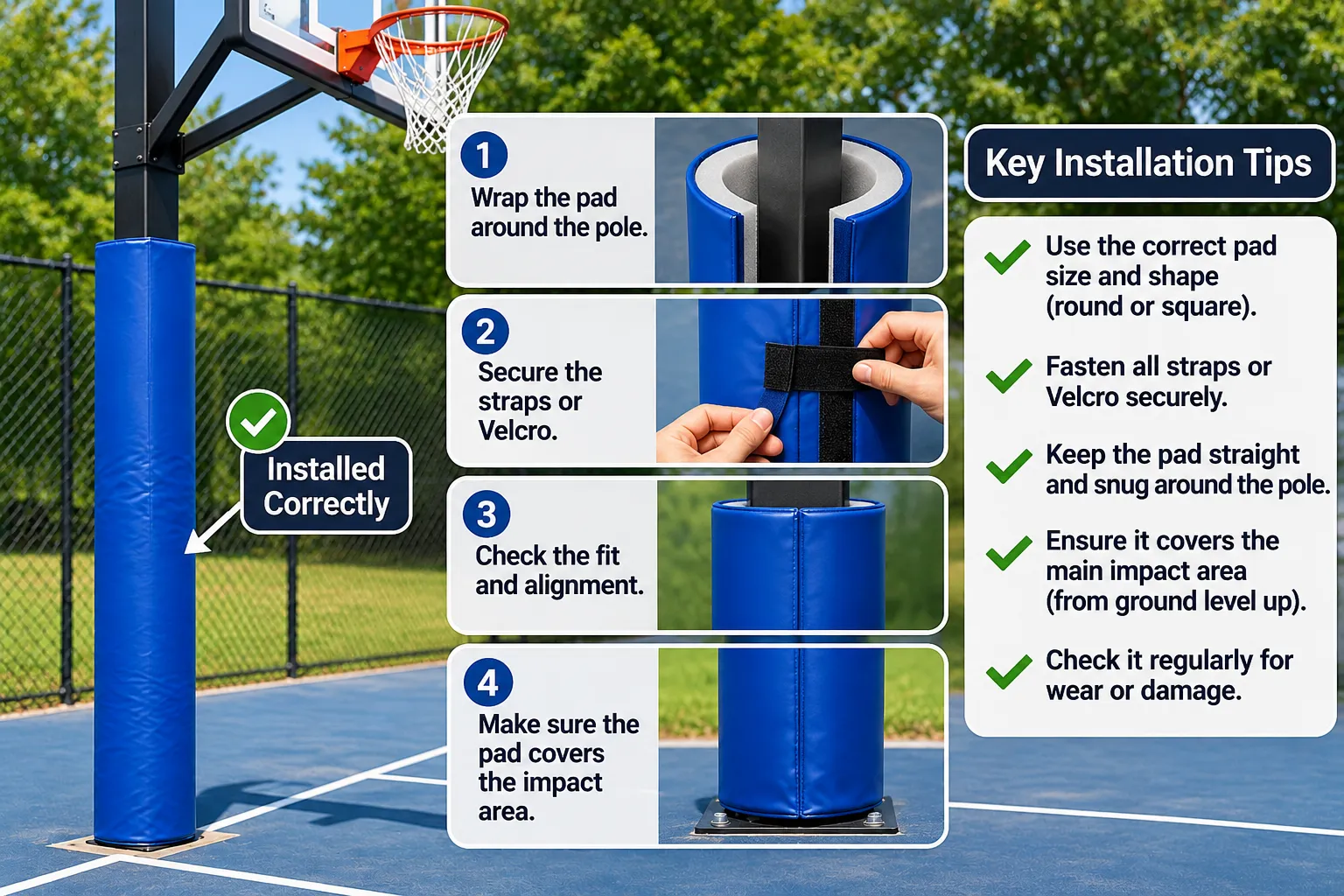
Illustration of basketball pole pad installation. Always follow the manufacturer’s instructions.
Many residential basketball pole pads use a wrap-around design.
However, installation varies by product.
Always follow the instructions supplied with your exact pad and basketball system.
The following steps describe a general installation process for compatible removable padding.
Step 1: Inspect the Basketball Hoop
Stop play before installing the pad.
Check the support pole for visible damage, loose components, corrosion, or instability.
Do not use padding to hide damaged equipment.
If the basketball hoop is structurally unsafe, address that problem before returning it to use.
Step 2: Confirm the Pad Fits
Check the pad’s model number and compatibility specifications.
Compare them with your pole’s dimensions and shape.
Make sure you have the required straps, fasteners, or other installation components.
Do not force an incompatible pad around the support pole.
Step 3: Position the Padding
Place the pad around the intended section of the basketball pole.
Align its protective surfaces with the areas specified by the manufacturer.
If the product includes a baseplate extension, position that section according to its instructions.
Check that the padding does not cover moving mechanisms or interfere with the hoop’s normal operation.
Step 4: Secure the Fasteners
Close the supplied straps, hook-and-loop sections, laces, or zippers.
Follow the manufacturer’s required attachment method.
For example, a Spalding portable basketball system manual describes wrapping the pole pad around the lower pole and securing it with hook-and-loop straps.
This is an example of one system’s installation method, not a universal procedure.
Some institutional padding assemblies use bolts and other specialized hardware.
Do not drill into a basketball pole or modify its mounting system unless the manufacturer specifically authorizes it.
Step 5: Check the Coverage
Inspect the installed padding from different directions.
Look for:
Exposed hard corners
Uncovered anchor bolts
Open seams
Gaps between pole and base padding
Loose or incorrectly positioned fasteners
Check that the pad remains in position during a gentle hand inspection.
Do not deliberately collide with the pole to test the padding.
Step 6: Check the Hoop Before Playing
Make sure the padding does not interfere with height adjustment, transport, or other intended functions.
Check the basketball system itself for stability and proper assembly.
For portable hoops, verify the required ballast according to the owner’s manual.
Padding cannot compensate for an unstable basketball hoop.
Requirements depend on the type of basketball facility, the equipment, and the rules that apply.
A residential driveway hoop is not necessarily subject to the same requirements as a college basketball facility.
Residential Basketball Hoops
The research did not establish a universal US legal requirement for every residential basketball hoop to have a separately purchased pole pad.
It also did not establish a universal residential foam-thickness minimum.
However, this does not mean that every unpadded hoop is safe.
Homeowners should consider the position of the support pole, available playing space, exposed mounting hardware, and the manufacturer’s safety instructions.
A properly fitted pad can be a useful additional precaution where accidental contact is possible.
Schools and Competition Facilities
Organized basketball facilities may have specific equipment and padding requirements.
For example, the 2026–27 NCAA Men’s Basketball Rules include requirements for certain backboard support structures and portable backstop bases.
These requirements concern particular equipment configurations.
They should not be interpreted as a universal rule requiring the same padding on every residential basketball pole.
Facility managers should confirm the rules adopted by their competition organization and any applicable building or safety requirements.
What About ASTM Standards?
Several ASTM documents are relevant to sports padding and basketball equipment.
ASTM F2440-24 addresses impact attenuation for wall padding and other indoor structures used in sports facilities.
ASTM F355-26 describes methods for measuring impact attenuation under specified testing conditions.
ASTM F3740-26 provides guidance about padding around playing areas and fixed objects. Its scope has exclusions, so it should not be treated as a universal certification for basketball pole accessories.
ASTM F1882-26 concerns complete residential basketball systems. Its scope excludes separately sold accessories and add-ons.
These documents do not establish that every basketball pole pad meets a particular impact-performance requirement.
A manufacturer should provide suitable product-specific documentation when compliance matters.
For school or recreational facility projects, consult the responsible facility designer or equipment supplier.
How to Clean and Maintain Basketball Pole Padding
Regular inspection helps identify damage that could affect a pad’s fit or coverage.
Maintenance requirements depend on the product and its materials.
Cleaning Basketball Pole Pads
Check the manufacturer’s cleaning instructions before using any product.
For suitable vinyl-covered padding, gentle cleaning may involve:
Removing loose dirt.
Wiping the cover with water and a mild detergent.
Using a soft sponge or cloth.
Removing cleaning residue.
Allowing the padding to dry as directed.
Sportsfield recommends similar methods for its outdoor wall padding, although those instructions should not automatically be applied to every basketball pole pad.
Avoid harsh chemicals, pressure washing, or soaking unless the pad manufacturer permits them.
Maintaining Outdoor Pole Padding
Outdoor basketball pole pads may experience sun exposure, rain, temperature changes, and general wear.
Check for:
Cracked or torn vinyl
Loose seams
Damaged straps
Exposed foam
Moisture trapped inside the covering
Padding that has moved out of position
Some manufacturers recommend removing and storing particular products indoors between uses.
For example, Gopher recommends indoor storage between uses for its Bison post padding to help extend its life.
Follow the instructions for your specific model.
When Should You Replace a Basketball Pole Pad?
There is no verified universal replacement interval for basketball pole padding.
Instead, inspect the product’s condition.
Replacement or manufacturer assessment may be necessary when:
Foam becomes exposed or deteriorates.
Straps or closures no longer hold securely.
The cover has significant tears or open seams.
Padding no longer provides its intended coverage.
Moisture or mold problems cannot be resolved.
The pad no longer fits after equipment changes.
If the underlying basketball pole is damaged, replacing the padding alone will not solve the problem.
Common Basketball Pole Pad Mistakes
Choosing and installing basketball pole padding involves more than matching a product’s color to your hoop.
Here are several mistakes worth avoiding.
Buying the Wrong Pole Size
A pad designed for a round pole may not fit a square pole with the same nominal measurement.
Measure the pole and verify the manufacturer’s compatibility specifications.
Ignoring the Baseplate
Some upright pads leave anchor bolts or mounting brackets exposed.
Inspect the lower support structure and consider compatible base protection where appropriate.
Choosing Based Only on Thickness
More foam does not automatically mean better protection.
The foam material, construction, attachment, coverage, and tested performance all matter.
Blocking Adjustment Mechanisms
An incorrectly fitted pad can interfere with handles, cranks, braces, or transport components.
Check that the basketball hoop operates as intended after installation.
Using Improvised Household Padding
Pool noodles, towels, carpet scraps, and pipe insulation are not established substitutes for purpose-made basketball pole padding.
Their impact performance and attachment security have not been shown to match suitable manufactured products.
Assuming Padding Makes a Hoop Safe
A pole pad cannot fix loose anchors, missing ballast, damaged steel, or unsafe equipment placement.
Treat padding as one part of a broader approach to basketball equipment safety.
Frequently Asked Questions
What Is the Basketball Pole Called?
The upright structure supporting a basketball hoop is commonly called the support pole or support post.
Depending on the equipment, manufacturers may also use terms such as upright or support structure.
The complete basketball system includes other components, such as the backboard, rim, mounting hardware, and base or foundation.
Where Can I Find a Custom Basketball Pole Pad?
Manufacturers and sports-equipment suppliers such as First Team, Douglas, and Goalsetter offer pole-padding options with different sizes, colors, or customization features.
Some products support custom graphics or team branding.
Before ordering, confirm the required dimensions, compatible attachment method, price, production time, and return conditions.
Do Basketball Pole Pads Prevent Injuries?
Basketball pole pads are designed to cushion contact with hard support structures.
However, they cannot guarantee that a collision will not cause injury.
Correct hoop placement, adequate clearance, equipment maintenance, and safe play remain important.
Can You Put a Round Pole Pad on a Square Pole?
Only if the manufacturer explicitly lists compatibility with that square-pole size.
Round and square poles have different shapes and perimeters.
Do not assume a pad will fit simply because the advertised measurements look similar.
Can Basketball Pole Padding Stay Outside All Year?
Some basketball pole pads are designed for outdoor use.
However, weather resistance varies by product.
Inspect the padding regularly and follow the manufacturer’s cleaning and storage instructions.
Outdoor suitability does not mean the pad will last indefinitely without maintenance.
Can You Put Padding on a Portable Basketball Hoop?
Yes, if the padding is compatible with the specific portable basketball system.
Check that it does not interfere with the base, wheels, height adjustment, or transport mechanisms.
Pole padding does not replace the ballast required to stabilize a portable hoop.
How Tall Should a Basketball Pole Pad Be?
Published examples include pads approximately 49 to 72 inches tall.
The appropriate height depends on the support structure, exposed contact areas, and manufacturer guidance.
There is no verified single residential height requirement for every basketball pole.
Can You Make Your Own Basketball Pole Pad?
It is possible to wrap cushioning material around a pole, but that does not establish its protective performance.
Household materials may lack suitable impact testing, weather resistance, or secure attachment.
A purpose-made pad that fits the basketball system is the more reliable starting point.
For public facilities, obtain suitable product documentation and confirm applicable requirements.
Final Thoughts
A basketball pole pad is a useful accessory for protecting the exposed support structure of a basketball hoop.
The right choice depends on your pole’s shape and dimensions, the coverage needed, the pad’s construction, and its compatibility with your equipment.
Before buying, measure your pole, check the manufacturer’s specifications, and inspect the base for exposed hardware.
Most importantly, remember that padding supplements safe basketball equipment installation and maintenance. It does not replace them.
Featured image: Photo by Ildar Sagdejev (Specious), via Wikimedia Commons. Licensed under CC BY-SA 4.0. Resized and converted to WebP.
Basketball court wall padding helps reduce the force of collisions between players and hard surfaces. It is commonly installed behind basketball hoops, along gym walls, and around columns, corners, and other fixed obstacles.
Most gym wall pads contain impact-absorbing foam, a protective vinyl cover, and a backing or attachment system. However, not all padding provides the same protection.
The right choice depends on the court layout, the padding’s tested performance, local building requirements, and installation conditions.
What Is Basketball Court Wall Padding?
Basketball court wall padding is protective equipment installed on walls and fixed structures that players might collide with during basketball activities.
Players can travel beyond the court boundary while chasing loose balls, defending opponents, or attempting layups. Hard walls, columns, and stage edges create potential impact hazards in these situations.
Gym wall pads use cushioning materials to absorb some of the energy from collisions.
They are commonly used in:
School gymnasiums.
College athletic facilities.
Recreation centers.
Indoor basketball training facilities.
Multipurpose sports gyms.
Private and home basketball courts.
Wall padding can also help protect the building’s walls from repeated contact.
However, wall padding does not eliminate the risk of injury or replace adequate space around the playing court.
A basketball court needs suitable clearance even when nearby surfaces are padded. Our ceiling height for basketball court guide covers another important indoor planning consideration.
Illustration showing the main layers of basketball court wall padding.
Types of Basketball Court Wall Padding
Basketball wall pads come in several designs. Each serves a different purpose depending on the building and surrounding obstacles.
Padding Type
Common Features
Typical Applications
Standard foam wall panels
Foam, vinyl cover, rigid backing
Indoor gymnasium walls
Fire-rated wall padding
Fire-tested components or assemblies
Facilities with specific fire-code requirements
Removable wall pads
Detachable mounting systems
Multipurpose gyms
Column and corner pads
Custom shapes or wrapped padding
Columns, poles, I-beams, and corners
Stage padding
Panels designed for stage faces and edges
School gyms and auditoriums
Outdoor wall padding
Weather-resistant construction
Outdoor basketball courts
Standard Foam Wall Panels
Standard gym wall pads usually contain a foam layer covered with durable vinyl.
Many products also include a rigid wood backing that helps support the panel and provides a mounting surface.
A common construction uses approximately 2 inches of foam attached to an oriented strand board (OSB) backing.
OSB is an engineered wood panel made from compressed wood strands. It provides structural support for the padding and its mounting hardware.
Manufacturers offer different foam formulations, backing materials, covers, and installation styles.
Standard wall panels are commonly used behind baskets and along high-contact gym walls.
Fire-Rated Wall Padding
Some athletic facilities need wall padding with specific fire-performance documentation.
These systems may use fire-retardant foam, specialized vinyl covers, or complete assemblies tested under applicable fire standards.
For example, manufacturers offer neoprene-based padding systems intended for facilities with additional fire-safety requirements.
However, a product advertised as having Class A vinyl does not automatically mean the complete wall pad meets the building’s fire requirements.
Foam, backing, adhesives, covering, and installation can all affect fire performance.
Schools and public facilities should confirm the required documentation with their architect or local fire authority before purchasing.
Removable Basketball Wall Padding
Removable gym wall mats allow a facility to take down individual panels when needed.
They can be useful in multipurpose spaces where the wall arrangement or activities change.
Multipurpose gyms may also need basketball gym floor coverings to protect the playing surface during graduations, concerts, and other non-sporting events.
Common mounting options include Z-clips and channel systems.
A Z-clip system uses interlocking mounting pieces attached to the wall and panel backing. The panel can be lifted into place and removed according to the manufacturer’s instructions.
Removable does not mean freestanding.
The wall-side hardware must remain properly anchored, and panels must be secured against unintended movement during use.
Column, Corner, and Stage Padding
Flat wall panels do not protect every obstacle in a gymnasium.
Manufacturers also supply custom padding for:
Square and round columns.
Exposed wall corners.
Steel poles and I-beams.
Structural pilasters.
Stage fronts and edges.
Door frames and other fixed structures.
Column pads may wrap around the structure, while stage padding can cover both the front surface and exposed edges.
The padding needs to fit the obstacle’s actual dimensions.
An incorrectly fitted panel may leave a hard edge exposed or create a gap where the padding can shift.
Outdoor Basketball Wall Padding
Outdoor basketball court wall padding must withstand conditions that indoor products may not be designed for.
Rain, sunlight, moisture, and temperature changes can affect foam, backing, covers, and mounting hardware.
Some outdoor systems use water-resistant PVC backing and UV-treated vinyl instead of conventional indoor wood-backed construction.
A vinyl cover described as weather-resistant does not necessarily make the complete pad suitable for outdoor use.
Check that the entire product, including its backing and attachment system, is approved for the intended exposure.
For outdoor courts, fencing can also help contain stray basketballs. Our basketball court fencing guide explains fence types, heights, costs, and installation.
What Materials Are Basketball Wall Pads Made Of?
The materials inside basketball court wall padding affect its construction, durability, and performance.
Common components include polyurethane foam, polyethylene foam, neoprene foam, vinyl covers, and rigid backing boards.
Polyurethane Foam
Polyurethane foam is used in many indoor athletic wall padding systems.
Manufacturers can produce it in different densities and firmness levels.
A thicker or firmer polyurethane pad is not automatically safer than another product.
Its impact performance depends on the foam formulation and complete padding construction.
For example, Porter Athletic uses polyurethane foam in its DuraSafe wall pads.
When comparing products, review the actual impact-test documentation rather than relying only on the material name.
Polyethylene Foam
Polyethylene foam is another material used in gym wall mats.
Some products use closed-cell polyethylene, while others combine polyethylene with additional foam layers.
Closed-cell foam has a different internal structure from open-cell foam, which can affect properties such as moisture absorption.
However, the label closed-cell does not establish how well a basketball wall pad absorbs impacts.
The complete panel still needs appropriate performance evidence.
Neoprene Foam
Neoprene, also called polychloroprene, appears in some specialized wall padding products.
Manufacturers use it in systems marketed for particular fire-performance requirements.
For example, Porter SuperSafe and Draper EcoVision fire-retardant systems specify neoprene foam.
Fire performance and impact protection are separate considerations.
A neoprene pad should not be assumed to satisfy both requirements without suitable documentation.
Vinyl Covers and Rigid Backing
Vinyl is a common covering material for basketball wall pads.
It provides a cleanable surface and can be manufactured in different colors, textures, and weights.
Commercial products may offer 14-ounce, 18-ounce, or 19-ounce vinyl coverings.
However, vinyl weight alone does not establish durability or impact protection.
Buyers should also consider seams, tear resistance, edge construction, and cleaning requirements.
Rigid backing, such as OSB or other wood board, supports the padding and helps connect it to the wall.
Some systems instead use softer backing or continuous padding materials.
The important point is to evaluate the complete padding system, not just its foam or vinyl cover.
How Thick Should Basketball Court Wall Padding Be?
Two-inch foam is a common thickness for basketball court wall padding, but it is not a universal requirement for every gym in the United States.
Many standard commercial panels use a 2-inch foam core. Other products use thinner, thicker, or layered materials.
The appropriate thickness depends on the padding’s tested impact performance, construction, and intended use.
Standard Basketball Wall Padding Dimensions
A common panel measures:
Width: 2 feet.
Height: 6 feet.
Foam thickness: 2 inches.
Nominal panel area: 12 square feet.
Manufacturers also offer other heights, widths, and custom sizes.
Some panels measure 4 to 8 feet tall.
These dimensions are common commercial options, not universal basketball regulations.
Foam Thickness vs. Total Panel Thickness
A pad with 2-inch foam may project more than 2 inches from the wall.
For example, Flooring Inc. lists a wall panel with 2-inch foam and approximately 2½ inches of total thickness.
The total measurement includes other construction components.
Mounting tracks, clips, or wall preparation can increase the installed projection further.
This matters near narrow passageways, doors, and other areas where equipment may reduce available space.
How High Should Basketball Wall Padding Extend?
The NCAA’s basketball rules recommend padding on walls and other facility features that players might contact.
The recommendation describes padding positioned no more than 4 inches above the floor and extending up to 6 feet.
This is guidance, not a blanket legal requirement for every basketball facility.
The difference between the panel’s overall height and its installed protective area also matters.
For example, a 6-foot panel installed several inches above the floor may finish higher than 6 feet.
Manufacturers may also include unpadded attachment margins.
Before ordering, confirm the distance from the finished playing surface to the bottom of the protective foam and the height reached by the padding.
Where Should Basketball Court Wall Padding Be Installed?
Basketball court wall padding should be placed where players could reasonably make contact with walls or fixed obstacles.
The required coverage depends on court dimensions, available clearance, player movement, and the building layout.
Behind Basketball Hoops
End walls behind basketball hoops are common locations for protective wall padding.
Players can move toward these areas when driving to the basket, following rebounds, or chasing loose balls.
Some suppliers suggest using eight to ten panels, each 2 feet wide, behind a basket.
That provides approximately 16–20 feet of nominal wall coverage.
However, this is a commercial planning guideline, not an established nationwide minimum.
A wider or differently shaped court may require additional protection.
Assess the area around the basket, the available runoff space, and any nearby hard surfaces before selecting coverage.
Along Basketball Court Sidelines
Side walls may also need gym padding, particularly where a playing court sits close to the building’s perimeter.
Players can travel beyond the sidelines when defending or attempting to save possession.
The NCAA requires at least 3 feet of unobstructed space outside the sidelines and identifies 10 feet as preferable.
Wall padding must not be treated as permission to eliminate required clear space.
Columns and structural supports may create hazards where they are close to basketball activities.
These structures can require custom shapes rather than ordinary flat panels.
Measure the complete obstacle, including exposed corners, flanges, brackets, and nearby surfaces.
A square column may require padding on multiple faces.
A round column may need a fitted wrap with an approved closure system.
Basketball hoop support poles may also need protection. See our basketball pole pads guide for types, sizes, costs, and installation advice.
Also inspect the ends of wall padding runs. A protruding or exposed corner can remain hazardous even when the surrounding wall has protective panels.
Near Doors, Stages, and Other Obstacles
School gymnasiums often contain features beyond basketball equipment.
Examples include stage fronts, door frames, light switches, electrical outlets, and wall-mounted fixtures.
These areas can require special padding arrangements or custom cutouts.
However, padding must not block emergency exits, accessible routes, door hardware, fire equipment, or required controls.
Have the layout checked before installing panels around these features.
How Much Wall Padding Do You Need?
For a straight, uninterrupted wall, divide its length by the panel width.
For example, using 2-foot-wide panels:
Wall Length
Number of Panels
Nominal Area With 6-Foot Panels
12 feet
6
72 sq ft
16 feet
8
96 sq ft
20 feet
10
120 sq ft
24 feet
12
144 sq ft
These calculations estimate panel quantities only.
They do not establish safe coverage limits.
Corners, doors, custom dimensions, and actual player-contact areas may change the final order.
Basketball Court Wall Padding Safety Standards
Basketball wall padding involves several kinds of guidance, including sports rules, impact-testing standards, manufacturer instructions, and building codes.
These sources do not serve the same purpose.
NCAA Basketball Wall Padding Recommendations
The NCAA recommends protective padding that meets current ASTM standards on facility features an athlete may contact.
Its placement guidance refers to padding from no more than 4 inches above the floor to a height of 6 feet.
The wording is a recommendation rather than a universal mandate for every basketball facility.
Individual schools, athletic associations, and facility owners may also establish additional requirements.
The NCAA separately addresses basketball court clearance and other equipment protection.
Wall padding, backboard padding, and portable backstop protection should not be confused with one another.
Prices reflect selected online listings checked November 11, 2026. They exclude taxes, delivery, and installation. Products have different specifications and should not be treated as equivalent solely because they share dimensions.
Suppose a facility needs ten 2-foot-wide panels for an uninterrupted 20-foot wall section.
Using the selected Greatmats prices:
Panel Configuration
10-Panel Material Cost
Conventional Lip TB
$1,490.90
Conventional Z-Clip
$1,759.70
Fire-Rated Lip TB
$2,843.20
Fire-Rated Z-Clip
$3,112.00
These are materials-only calculations.
They do not include shipping, wall-side hardware, installation labor, taxes, or custom work.
They also do not establish that 20 feet is enough padding for a particular basketball court.
What Affects the Total Installation Cost?
The final price depends on more than the number of panels.
Important cost factors include:
Panel size: Larger and custom-sized wall mats can cost more.
Foam and backing: Different constructions have different prices.
Fire requirements: Specialized systems may cost more than conventional padding.
Mounting hardware: Tracks, clips, anchors, and fasteners may be sold separately.
Custom cutouts: Obstacles and irregular wall shapes require additional work.
Graphics: Printed team logos or custom artwork may add costs.
Shipping: Large wall pads often require freight delivery.
Labor: Installation costs depend on the wall, project size, and site conditions.
Some sellers exclude wall-side clips or screws from the advertised price.
Before purchasing, request an itemized quotation covering the complete delivered and installed system.
Is Custom Basketball Wall Padding More Expensive?
Custom gym wall padding can cost more because it requires additional manufacturing or design work.
For example, a school might order panels with its team logo, mascot, or specific color arrangement.
Other facilities may need custom sizes around columns, doors, outlets, or light switches.
The additional cost depends on the manufacturer’s pricing, the artwork, panel quantity, and production requirements.
Ask the supplier to confirm the price of each customization before approving the order.
Illustration of a Z-clip mounting system used to secure basketball court wall padding.
How to Install Basketball Court Wall Padding
Basketball wall padding installation depends on the panel construction, mounting system, and wall material.
Some products use attachment lips and screws. Others use Z-clips, channels, or manufacturer-specific fasteners.
Follow the selected manufacturer’s installation instructions rather than assuming every gym wall pad attaches the same way.
Step 1: Measure the Walls and Plan Coverage
Measure the length and height of the areas requiring protection.
Identify potential contact hazards around the playing court, including end walls, sidelines, columns, stage edges, and corners.
Also record:
Door locations.
Electrical outlets.
Light switches.
Baseboards.
Wall projections.
Floor height changes.
Existing sports equipment.
Determine where the protective foam needs to begin and end.
Order custom panels or approved cutouts where necessary.
Step 2: Choose the Mounting System
Common installation styles include attachment lips, Z-clips, and channel systems.
Attachment lips: Some panels have unpadded margins at the top and bottom. Installers secure these margins using approved fasteners.
Z-clips: Interlocking clips secure the panel to the wall while allowing removal when the system is designed for it.
Channels: Panels fit into mounting tracks or channels anchored to the wall.
Each method requires suitable wall preparation and hardware.
A removable mounting system can be useful for multipurpose athletic facilities, while permanent panels are common in dedicated basketball gyms.
Neither method is automatically safer without considering the complete design.
Step 3: Check the Wall and Anchoring Requirements
Examine the wall before installing anything.
Common substrates include:
Concrete.
Concrete masonry units.
Wood framing.
Drywall over structural framing.
Other manufactured wall systems.
Different surfaces require different anchoring methods.
For example, a masonry anchor may not be suitable for a drywall installation.
Confirm that the wall can support the selected padding and its mounting system.
Check for concealed electrical wiring, plumbing, and other building services before drilling.
Do not assume that ordinary screws or adhesive tape provide acceptable attachment.
Step 4: Install and Secure the Panels
Follow the manufacturer’s mounting measurements and installation sequence.
Depending on the product, this may involve positioning tracks, attaching clips, or securing the panel through its mounting margins.
Keep the panels aligned and follow the specified joint spacing.
Pay particular attention to:
Bottom-of-foam clearance.
Proper clip engagement.
Exposed fasteners.
Panel movement.
Outside corners.
Openings and cutouts.
Transitions between panels.
Some products require different mounting arrangements on uneven walls.
Do not substitute longer screws or change the backing construction without approval.
For schools, public gyms, uncertain wall structures, or complex custom installations, professional installation is generally the more appropriate approach.
Step 5: Inspect the Finished Installation
After installation, inspect every panel.
Check that the padding is secure and the protective area matches the approved layout.
Verify that:
Panels do not move unexpectedly.
No dangerous hard edges remain exposed.
Fasteners and tracks are properly secured.
Doors and emergency equipment remain accessible.
Required routes and clearances are maintained.
Custom corners and cutouts fit correctly.
Keep the manufacturer’s instructions, test documentation, and maintenance guidance with the facility records.
Custom Basketball Wall Padding: Colors, Logos, and Graphics
Basketball wall pads can also form part of a gymnasium’s appearance.
Manufacturers offer solid colors, printed graphics, team logos, school mascots, and other custom designs.
A school might select royal blue wall padding to match its team colors or use printed panels to display its school spirit.
Custom graphics can also include sponsor branding or facility artwork.
However, appearance should come after performance and installation requirements.
A visually attractive pad still needs suitable impact protection, secure mounting, and the required fire-performance documentation.
Printed artwork, custom seams, or alterations must not compromise the approved construction.
Check whether the manufacturer can produce the design without changing the tested padding assembly.
How to Clean and Maintain Basketball Wall Padding
Regular maintenance helps identify damage and keeps gym wall pads in suitable condition.
Cleaning requirements vary by product.
Many vinyl-covered wall pads can be cleaned with mild detergent and water or a compatible vinyl cleaner.
Always follow the manufacturer’s instructions and test unfamiliar cleaning products on a small area first.
Avoid harsh solvents unless the manufacturer specifically approves them.
Inspect Wall Padding for Damage
Look for:
Torn or punctured vinyl.
Loose mounting clips.
Damaged or missing fasteners.
Panels pulling away from the wall.
Exposed backing or hard edges.
Permanently compressed foam.
Moisture damage or swelling.
Deteriorated corners and seams.
Facility staff should also check padding after significant collisions or nearby construction work.
Draper’s maintenance guidance calls for specified maintenance procedures at least annually, but busy facilities may need more frequent checks.
Can Torn Wall Padding Be Repaired?
Some manufacturers permit small vinyl tears to be repaired with suitable patches and adhesives.
However, a damaged cover is different from damaged internal foam.
Repairing the vinyl does not prove that the foam or backing still performs correctly.
Badly torn padding, deteriorated foam, or damaged structural backing may require replacement.
Follow the manufacturer’s instructions and obtain professional advice when the condition is uncertain.
How Long Does Basketball Wall Padding Last?
There is no verified universal replacement age for basketball wall pads.
Service life depends on usage, environmental exposure, construction, installation, and maintenance.
Some products have one-year limited warranties, while others offer longer coverage.
A warranty period is not the same as the expected lifespan.
Inspect the padding and replace or repair it when its condition or attachment no longer meets the applicable requirements.
Common Basketball Court Wall Padding Mistakes
Several mistakes can reduce the usefulness of an otherwise suitable padding system.
Buying based only on thickness. A 2-inch foam label does not establish the impact performance of the complete panel.
Leaving exposed corners. A flat wall may be padded while nearby columns, stage edges, or corners remain unprotected.
Confusing fire ratings. Fire-rated vinyl does not automatically establish the fire classification of the complete assembly.
Using outdated test results. Older reports may not represent current materials or manufacturing methods.
Ignoring court clearance. Padding does not replace adequate space outside the playing boundaries.
Using indoor pads outdoors. Moisture and sunlight can damage materials not intended for outdoor exposure.
Overlooking installation costs. Clips, fasteners, freight, custom cutouts, and labor can substantially increase the final budget.
Neglecting inspections. Loose panels and damaged foam may not provide the intended protection.
Basketball Court Wall Padding FAQs
Is Wall Padding Required in Basketball Gyms?
There is no single nationwide requirement established by the reviewed sources that makes wall padding mandatory on every basketball court.
The NCAA recommends padding on walls and facility features that athletes may contact.
However, a school, competition organizer, building authority, insurer, or facility owner may have additional requirements.
Check the rules and codes that apply to the specific building.
How Thick Is Gym Wall Padding?
Many gym wall pads use approximately 2 inches of foam.
However, manufacturers offer other thicknesses and constructions.
The correct thickness should be selected using relevant impact-performance documentation and facility requirements.
Foam thickness should also be distinguished from the total installed panel thickness.
How High Should Basketball Wall Padding Be?
The NCAA recommends wall padding positioned no more than 4 inches above the floor and extending up to 6 feet.
This is a recommendation rather than a universal legal requirement.
Facilities may require different coverage based on their design and applicable standards.
How Much Wall Padding Do You Need Behind a Basketball Hoop?
Some suppliers suggest approximately 16–20 feet of nominal padding width behind a basket, often using eight to ten 2-foot-wide panels.
However, this is not a universal safety rule.
The appropriate coverage depends on the court layout, available space, and nearby hazards.
How Do You Put Padding on a Wall?
Gym wall padding is generally installed using manufacturer-approved attachment lips, screws, Z-clips, or channel systems.
First, measure the wall and determine the required panel placement.
Then select mounting hardware suitable for the wall material and install the padding according to the manufacturer’s instructions.
Finally, check that the panels are secure and no dangerous edges or obstacles remain exposed.
Can Basketball Wall Padding Be Installed on Concrete?
Yes. Manufacturers offer mounting systems for concrete and concrete block walls.
However, the anchors must suit the actual wall material and condition.
Follow the selected manufacturer’s installation details.
Can Gym Wall Pads Be Installed on Drywall?
Some wall padding systems can be installed on suitable drywall assemblies using approved mounting methods.
However, drywall alone should not be assumed to provide adequate anchoring.
The manufacturer or installer must confirm the structural support and attachment requirements.
Does Basketball Wall Padding Prevent Injuries?
Wall padding is intended to reduce impact forces when athletes collide with walls or fixed structures.
However, it cannot eliminate every injury risk.
The effectiveness of the protection depends on the tested padding assembly, installation, coverage, condition, and circumstances of the collision.
Can Basketball Wall Padding Reduce Noise?
Some specialized wall padding systems also provide sound absorption.
For example, acoustic/impact padding may help reduce reflected sound inside a gymnasium.
However, sound absorption is not the same as soundproofing.
A wall pad that reduces echoes will not necessarily prevent sound from passing through the building’s walls.
Can You Install Basketball Wall Padding Yourself?
Some manufacturers provide instructions for straightforward installations.
However, successful installation depends on the wall material, approved fasteners, and proper panel placement.
Schools, public facilities, and complicated installations should use qualified installers and appropriate design review.
These features can help padding fit around doors, columns, light switches, and other structures.
Confirm that customization does not invalidate the required impact or fire-performance documentation.
How Often Should Basketball Wall Padding Be Replaced?
There is no universal replacement schedule established by the reviewed research.
Inspect wall padding regularly and follow the manufacturer’s maintenance guidance.
Replace or repair damaged panels when their protective performance or mounting condition is uncertain.
Final Recommendations
Basketball court wall padding is an important part of planning protection around indoor basketball facilities.
Standard panels commonly use 2-inch foam and vinyl-covered backing, but thickness alone does not determine the best product.
Before purchasing, assess the wall locations, obstacles, and available court clearance. For larger indoor construction projects, see our basketball court installation guide.
Choose a padding system with suitable impact-test documentation, confirm any fire requirements, and plan the correct mounting method.
Compare the total delivered and installed cost rather than looking only at the advertised panel price.
The goal is to provide suitable protection for the facility’s actual basketball activities while preserving required clearances and meeting applicable requirements.
Featured image: Photo by Incipient09, via Wikimedia Commons. Licensed under CC BY-SA 3.0. Resized and converted to WebP.
A pole barn basketball court can give you a covered place to shoot, train, and play throughout the year. You can design a new post-frame building around a court or convert an existing barn if its structure and usable space are suitable.
The key is to plan around the clear interior playing area, not just the dimensions on a building-kit listing. A 30×40-foot barn may work for shooting drills, while a regulation-sized half court or full court needs substantially more room. Ceiling clearance, structural columns, flooring, hoop support, and the full construction budget also matter.
This guide explains practical building sizes, ceiling heights, construction costs, flooring options, and the checks to make before you order a kit or start a conversion.
Can You Put a Basketball Court in a Pole Barn?
Yes. A properly planned pole barn can contain an indoor basketball court. The important question is what kind of basketball you want to play. A shooting station is different from a recreational one-basket court, and both are different from a regulation-sized half court.
Post-frame construction uses a system of structural posts, beams, and roof framing. Some designs can provide a large, column-free interior. That does not mean every pole barn automatically has the clear span, roof height, or equipment support needed for basketball.
Building New vs. Converting an Existing Barn
A new building lets you choose the court layout before the structural posts, roof framing, doors, and utilities are designed. You can also coordinate the concrete slab with the sports floor and hoop foundations.
Converting an existing pole barn may avoid buying a new building shell. But you must work with the space and structure already there. Repairs, structural changes, slab problems, and moisture protection can make conversion expensive. Do not assume conversion is always cheaper.
Pole Barn vs. Steel Building
A pole barn usually refers to post-frame construction, often using wood structural posts. A pre-engineered metal building may use steel frames instead. Metal siding does not necessarily mean a barn is steel-framed.
Both construction types can house basketball courts, but their structural layouts and costs differ. Our metal building basketball court guide covers the steel-building option in more detail.
What Size Pole Barn Do You Need for a Basketball Court?
Start with the court format. An NCAA or NBA playing court measures 94×50 feet. A common US high-school playing court measures 84×50 feet. Half of an NCAA playing court is 47×50 feet; half of the common high-school layout is 42×50 feet.
Those are playing dimensions, not finished room dimensions. You need additional space around the lines, and the hoop’s support and projection must fit the plan. The NCAA specifies at least 3 feet of unobstructed space outside the sidelines, with 10 feet preferred. Its provisions for end areas and equipment must be considered separately. A private recreational barn is not automatically governed by every NCAA facility provision.
Only 8 ft at each end and 5 ft at each side if centered
60×104 ft
94×50-ft playing court plus illustrative 5-ft boundary allowances
Not an automatically approved competition gym
70×114 ft
94×50-ft court plus illustrative 10-ft allowances on every side
Still excludes some support rooms and facility requirements
These are geometric examples, not approved designs or universal safety clearances. Actual building footprints may be exterior measurements. Ask for the finished, unobstructed inside dimensions before choosing a size.
Is a 30×40 Pole Barn Big Enough?
A 30×40-foot clear room can work for a compact shooting station, stationary drills, and some movement around one basket. It cannot fit a regulation-sized half court. It is most suitable if your priority is convenient practice rather than normal half-court games.
Is a 40×60 Pole Barn Big Enough?
A 40×60-foot barn offers useful space for a recreational one-basket layout. However, a common high-school half-court playing rectangle is 42×50 feet. It will not fit inside a 40-foot-wide clear room, even before you allow space beyond the lines.
You can still build a smaller, nonregulation playing area. Be clear about what the reduced width and depth mean for driving, passing, court markings, and pickup games.
How Big Should a Half-Court Barn Be?
An NCAA-sized half-court playing rectangle is 47×50 feet. If you illustratively allow 5 feet beyond every boundary, the clear rectangle becomes 57×60 feet. That is arithmetic, not a universal clearance rule. A 60×60-foot clear room may fit the geometry but leave little room for storage, seating, or equipment that projects into the space.
How Big Should a Full-Court Barn Be?
For a 94×50-foot playing court, adding an illustrative 5 feet beyond every boundary gives 104×60 feet. Adding 10 feet beyond every boundary gives 114×70 feet. Neither calculation establishes that the building satisfies all competition, accessibility, equipment, or local code requirements.
Choose the court and clearance layout first. Then have the builder specify the shell dimensions needed to deliver that clear finished interior.
How Tall Should a Pole Barn Basketball Court Be?
The useful number is the distance from the finished playing surface to the lowest overhead obstruction across the court. It is not necessarily the building’s eave height or roof peak.
Recreational Basketball Ceiling Height
Some real recreational basketball barns use relatively low ceilings. Hansen Pole Buildings describes a home half-court space with a 16-foot ceiling, but the author later said a 20-foot ceiling would have been preferable. That is one owner’s experience, not an official minimum.
A low ceiling can interfere with higher shots, passes, and drills. When building from scratch, consider whether the savings from a shorter structure are worth those restrictions.
Competitive Basketball Ceiling Height
The NCAA’s 2026–27 men’s basketball facility guidance recommends at least 25 feet above the playing court to the ceiling and hanging obstructions, apart from the basket, with greater height preferred. FIBA’s 2026 basketball equipment specifications require at least 7 meters (about 23 feet) within their competition framework.
These are different governing-body provisions. Neither means every private backyard basketball barn must legally have a 25-foot ceiling. Our ceiling height for basketball court guide explains the distinctions.
Eave Height, Roof Peak, and Finished Clearance
Roof peak and eave height are different from the usable ceiling clearance needed for basketball.
The eave height is a building measurement defined by the supplier. The roof peak is the high point at the ridge. Finished clear height is the distance from the sports floor to the lowest relevant obstacle. These can be three very different numbers.
Ask for a cross-section showing truss chords, bracing, lights, fans, ducts, garage-door tracks, and any retractable basketball equipment. The clearance must work at the basket locations and across the intended playing area, not only at the center of the roof.
Clear Span Framing, Columns, and Trusses
A column-free playing area is one of the most important design goals for a basketball barn. A post in the middle of the court can interrupt play and create a collision hazard. Padding does not turn a badly positioned column into an unobstructed playing area.
Specify the Clear Interior Width
Ask the builder to show the clear width after structural posts, wall liners, insulation, padding, and other finishes. A nominal 60-foot-wide building does not necessarily provide 60 feet of finished usable court width.
Post-frame builders can design substantial clear spans, but available framing arrangements and costs depend on the site, loads, and supplier. Do not treat one manufacturer’s span or pricing threshold as a universal engineering limit.
Do Not Alter Roof Trusses Without Engineering Review
Scissor trusses and other roof geometries may create more height near the middle, but they do not guarantee adequate clearance everywhere. Cutting trusses, removing columns, or modifying bracing to fit a court can compromise the structure. Have an appropriate structural professional evaluate proposed changes before any work begins.
How Much Does a Pole Barn Basketball Court Cost?
There is no reliable single nationwide price for a finished, climate-controlled pole barn basketball court. The project could involve a bare kit, an erected shell, a court installed inside an existing barn, or a fully finished facility. Those are different scopes.
Published Pole Barn Kit Prices
The following are advertised base-kit examples, not installed basketball-building prices. They were checked against Hansen Pole Buildings’ pricing page on November 11, 2026.
Advertised kit dimensions
Listed starting price
40×40×12 ft
$16,600
40×60×12 ft
$21,100
40×60×14 ft
$22,600
40×60×16 ft
$23,900
40×72×16 ft
$27,500
60×96×16 ft
$47,800
60×120×16 ft
$59,600
These prices vary by location and design requirements, and optional items are excluded. A 16-foot listed building height does not mean 16 feet of finished clear basketball space. Prices can change; request a current, location-specific quote.
Storage, seating, circulation, bathrooms where needed
Get written bids that identify inclusions, exclusions, allowances, and assumptions. Do not compare a kit price with a turnkey quote or add unrelated published estimates into a supposed national average.
Choosing Basketball Flooring for a Pole Barn
The best playing surface depends on the activities, available budget, building climate, and maintenance you can support. Compare complete flooring systems rather than their appearance alone.
Finished Concrete
Finished concrete can provide a basic shooting surface, but an ordinary coating is not automatically equivalent to a tested indoor sports floor. Ask about traction, moisture compatibility, maintenance, and suitability for basketball before selecting a finish.
Modular Basketball Tiles
Modular tiles may be installed over an appropriate solid, smooth, level substrate. Product requirements differ. Confirm indoor suitability, expansion allowances, edge transitions, anchoring or restraint, and any restrictions on rolling loads or shared workshop use. Follow the exact product’s installation instructions.
Synthetic Sports Flooring
Synthetic systems are available for basketball, but they have product-specific slab, adhesive, moisture, and temperature requirements. Do not assume that all synthetic floors tolerate a damp barn or use the same installation method.
Maple Hardwood
Maple is a traditional gym floor, but it needs environmental control. The Maple Flooring Manufacturers Association’s 2026 guidance recommends a location-appropriate 15-percentage-point indoor humidity range at 55–75°F. That range must be maintained before, during, and after installation as applicable. It is not a universal instruction to use the same humidity target in every US climate.
If you cannot control the building’s conditions year-round, discuss alternatives with the flooring supplier before choosing maple.
Concrete Slab, Moisture Protection, and Drainage
Choose the flooring type before finalizing the slab design. Sports-floor systems can have different requirements for flatness, moisture, pH, surface preparation, and finished elevation. There is no supported universal concrete thickness or reinforcement recipe for every basketball barn.
Test the Slab Before Installing Flooring
A slab can look dry and still fail a floor manufacturer’s moisture limits. Follow the current system specification and required test method. Some published sports-floor systems use different in-slab relative-humidity limits; do not substitute room humidity for slab measurements.
If converting an existing barn, investigate the slab’s condition, known construction details, cracks, movement, and moisture protection. An old slab is not automatically suitable just because it has been in place for years.
Keep Water Out of the Building
Ground moisture, roof leaks, surface runoff, and condensation require different solutions. A below-slab vapor retarder is not a substitute for proper grading, roof-water disposal, and building-envelope design. Nor do perforated tiles automatically solve an indoor drainage problem.
Do not slope the basketball playing surface toward a workshop drain without checking the selected sports-floor requirements. Coordinate any vehicle-storage or wash areas separately from the court.
Installing Basketball Hoops in a Pole Barn
Choose the hoop system before finalizing wall locations, court markings, and structural details. The backboard projection and support arrangement can change the usable court depth.
Wall-Mounted Hoops
Wall-mounted systems can save floor space, but the wall must be designed for the equipment and stresses from use. Visible plywood, OSB, or metal liner panels are not proof of adequate support. Check the equipment manufacturer’s mounting requirements and have the structural load path verified.
Ceiling-Suspended Hoops
A suspended backstop needs a suitable engineered support arrangement, not just a convenient roof member. Coordinate framing, bracing, lights, fans, ducts, operating clearance, and any retractable mechanism. Follow the manufacturer’s safety and inspection instructions.
Floor-Anchored and Portable Hoops
Floor-anchored equipment may need a separate footing or engineered anchor arrangement. Portable hoops occupy space and must be ballasted or secured according to their instructions. In all cases, review wall, post, base, and backboard padding and likely player contact points. Our basketball court wall padding guide explains padding types, thickness, costs, and installation.
For standard NCAA play, the top of the rim is 10 feet above the finished playing floor. Do not measure it from the bare concrete before the sports floor is installed.
Lighting, Insulation, Heating, and Ventilation
Plan Lighting for Basketball
Court lighting should provide useful visibility and limit glare when players look up to shoot or rebound. Fixture output alone does not tell you how evenly the court will be lit. Ask a lighting professional about illumination, uniformity, fixture placement, and clearance below lights.
Control Temperature and Humidity
Insulation, heating, cooling, and ventilation need to work together. The required conditions depend partly on the selected flooring. A maple court may require year-round humidity control even when the barn is unused.
Consider Noise and Other Uses
Large rooms with hard surfaces can echo. Acoustic treatments may help, but they also take up space and may affect overhead clearance. If the barn doubles as a workshop or storage area, keep vehicles, tools, and equipment outside the playing area and its intended clearance during play.
If the barn also hosts events or gatherings, consider using basketball gym floor coverings to protect a compatible indoor sports floor from foot traffic and furniture.
How to Convert an Existing Pole Barn Into a Basketball Court
1. Measure the finished clear space. Record length, width, lowest overhead obstructions, and post locations. Decide which activities fit without pretending a small court is regulation-sized.
2. Assess the structure. Review available drawings, building condition, roof framing, and proposed hoop attachments. Do not remove posts or alter trusses without an appropriate structural design.
3. Investigate the slab and water conditions. Check damage, flatness, drainage, moisture, and the requirements of the proposed sports floor.
4. Plan equipment and services. Locate hoops, lighting, doors, ventilation, storage, and any heating or cooling outside the intended playing envelope where possible.
5. Confirm permits and obtain a full quote. Ask the local authority about the intended use and required approvals. Obtain itemized estimates for repairs, flooring, equipment, and utilities.
Do You Need a Permit for a Pole Barn Basketball Court?
You may need zoning approval, building permits, engineering documentation, or inspections. Requirements depend on your jurisdiction, the proposed structure, and how it will be used.
A private family recreation barn may be reviewed differently from a facility offering lessons, rentals, league play, or public access. Wind and snow loads can also affect structural design. Do not assume that calling the building a “barn” creates a permit exemption. Check with the local building and zoning authorities before construction or conversion.
Common Pole Barn Basketball Court Mistakes
Ordering the building before drawing the court. The nominal footprint may not provide the clear playing space you need.
Using roof-peak height as ceiling clearance. Trusses, fans, lights, and doors may hang lower.
Ignoring structural posts. Padding is not a substitute for an unobstructed court layout.
Choosing flooring before checking the slab. Moisture and flatness problems can delay installation.
Mounting a hoop to wall finishes. Equipment needs verified structural support.
Treating kit prices as finished project prices. Site work, slab, labor, flooring, and services can be substantial.
Forgetting shared uses. Storage, workshop equipment, and vehicles can occupy space needed for safe play.
Frequently Asked Questions
Can You Put a Basketball Court in a Pole Barn?
Yes, if the barn provides suitable clear floor space, overhead clearance, structural support, and playing conditions. A compact shooting area needs much less space than a full court.
What Is the Cheapest Way to Build a Basketball Court?
A smaller recreational court or a conversion of a genuinely suitable existing building may avoid some costs. Neither option is always cheapest once repairs, flooring, equipment, and utilities are included. Compare complete written quotes.
Do I Need a Permit to Build a Basketball Court in My Backyard?
Possibly. A new enclosed pole barn can trigger zoning and building requirements even when used privately. Ask your local authority before beginning work.
How Expensive Is It to Build a Basketball Court?
There is no reliable single price for a completed basketball barn. Base kits, erected shells, and finished courts have different costs. Get a project-specific quote covering all major work.
Can You Mount a Basketball Hoop on a Pole Barn Wall?
Yes, if the chosen wall and support system are verified as suitable for the equipment and its use. Do not rely on a liner panel or unidentified framing member alone.
Can You Play Basketball Year-Round in a Pole Barn?
Yes, if the building is designed and operated for the intended conditions. Weather protection alone does not guarantee comfortable temperatures or a suitable environment for every sports floor.
Does a Basketball Barn Increase Property Value?
It may appeal to some buyers, but there is no reliable evidence here for a predictable resale-value increase. Build it primarily for the use you expect to get from it.
Final Thoughts
A pole barn basketball court can be a useful home training space, but the court layout must come before the building order. Decide whether you need a shooting area, recreational half court, or regulation-sized court. Then verify clear interior dimensions, finished overhead clearance, structure, flooring, and the full project budget.
A well-planned smaller barn can be more useful than a larger one with poorly placed posts, insufficient height, or an unsuitable floor.
A metal building basketball court can give you a covered space to shoot, practice, and play throughout the year. With the right design, a steel building can accommodate anything from a small home practice area to a full-size indoor basketball court.
The most important decisions are the building’s usable floor space, clear ceiling height, construction costs, and basketball flooring.
A 40×60-foot metal building might work for a home practice court. A 60×100-foot building could accommodate a high school-size playing area, depending on its actual interior dimensions and equipment layout.
However, a metal building kit is not the same as a finished basketball facility. You also need to account for foundations, flooring, hoops, lighting, insulation, ventilation, and local building requirements.
This guide explains how to plan a metal basketball court building, compare building sizes, understand costs, and avoid expensive construction mistakes.
Can You Build a Basketball Court in a Metal Building?
Yes. A properly designed metal building can accommodate an indoor basketball court.
Pre-engineered steel buildings are one option because they can provide large open interiors without columns interrupting the playing area.
Manufacturers such as Butler Manufacturing offer clear-span framing systems that can accommodate wide recreational spaces.
However, not every metal building is suitable for basketball.
A building designed for storing vehicles or agricultural equipment may lack the ceiling height, floor quality, or structural support needed for a basketball court.
Before buying a building, you need to decide how you intend to use the court.
For example:
Home practice: Shooting, ball-handling, and casual games.
Half court: Shooting drills, one-on-one, and smaller games.
Full court: Five-on-five basketball and organized training.
Commercial facility: Basketball training, team practices, and potentially public access.
Each use requires a different amount of space, equipment, and construction work.
Example metal building sizes for basketball courts. Actual usable space depends on the building design.
What Size Metal Building Do You Need for a Basketball Court?
The right metal building size depends on the basketball court dimensions, the amount of space around the playing area, and the building’s interior structure.
A basketball court needs more space than its painted boundary lines.
You must also consider walls, structural columns, hoop supports, doors, and safe movement around the playing area.
Metal Building Basketball Court Size Comparison
Building size
Potential basketball use
Main limitation
30×40 ft
Small home shooting and practice area
Limited playing space
40×60 ft
Recreational practice court
Too narrow for a full-width regulation court
60×60 ft
Potential full-width half-court layout
Actual clear dimensions and hoop placement matter
60×100 ft
Potential high school-size full court
Limited room for additional facilities
60×110 ft
Potential NBA/NCAA-size full court
Interior clearance and equipment still need checking
70×120 ft
Larger full-court facility
More construction and operating costs
These are preliminary planning examples, not guaranteed building specifications.
The dimensions advertised by a manufacturer may describe the exterior building footprint rather than the finished usable interior.
Small Home Basketball Courts
A 30×40-foot or 40×60-foot metal building can be a starting point for a home practice facility.
You may have enough space for a basketball hoop, shooting drills, ball-handling, and recreational games.
However, the available court dimensions will be smaller than those of a regulation basketball court.
A 40-foot-wide building cannot accommodate a 50-foot-wide regulation playing area across that width.
For a home setup, you can choose a smaller court layout rather than attempting to reproduce official dimensions.
The important thing is to design the playing area around the activities you actually want to do.
Half-Court Metal Buildings
A 60×60-foot metal building may be suitable for a full-width half-court layout.
For comparison, half of an 84×50-foot high school playing rectangle measures 42×50 feet.
However, this is a geometric example, not a universal half-court specification.
You still need room for the basket, wall clearance, structural elements, and safe movement.
If you want a smaller recreational half court, you may be able to use a narrower building.
Full-Court Metal Buildings
A typical US high school basketball court measures 84×50 feet.
NBA and NCAA courts measure 94×50 feet.
These are the playing dimensions, not complete building dimensions.
For example, a building with a genuinely clear 60×100-foot interior could theoretically fit an 84×50-foot playing rectangle.
That would leave:
8 feet beyond each end line.
5 feet beyond each sideline.
This is only a space calculation. It does not establish compliance with competition rules or account for structural intrusions, equipment, seating, or support rooms.
A 94×50-foot court inside the same space would leave only 3 feet at each end.
That makes a 60×100-foot building a less practical starting point for an NBA/NCAA-size court.
If you’re planning a school, church, or commercial basketball facility, the court itself may only be part of the building.
You may also need:
Equipment storage
Locker rooms and restrooms
Seating areas
Entrances and circulation space
Mechanical and electrical rooms
These features can significantly increase the required building footprint.
Design the entire facility before choosing the metal building dimensions.
Ceiling-height measurements in a metal basketball building. Actual clearance depends on the structure and overhead equipment.
How Tall Should a Metal Basketball Court Building Be?
Ceiling height is one of the most important requirements for an indoor basketball court.
A regulation basketball rim is 10 feet above the playing surface, but the ball needs considerably more space above the rim during shooting.
A building that accommodates the hoop may still be too low for normal basketball.
Recommended Basketball Court Ceiling Height
For a competition-oriented facility, 25 feet of unobstructed clearance is a useful planning target, consistent with NCAA and commonly cited US high school gym guidance.
FIBA’s venue guide specifies at least 7 meters (approximately 23 feet) of unobstructed space above the playing area. FIBA’s 2026 rules took effect on October 1, 2026.
These standards and recommendations apply to their respective basketball contexts. They are not universal legal requirements for every private home court.
A recreational basketball building may operate with less clearance, but lower ceilings can restrict shooting arcs and some types of play.
When comparing metal buildings, pay attention to three different measurements.
Eave height describes a building measurement near the roof and wall connection.
Ridge height describes the highest point of the roof.
Clear ceiling height is the unobstructed distance between the finished playing surface and the lowest overhead structure or equipment.
For basketball, clear ceiling height matters most.
A metal building advertised with a 20-foot eave height does not automatically provide 20 feet of unobstructed space everywhere.
Structural framing, lights, heating equipment, and other installations may reduce the available clearance.
Ask the manufacturer for drawings showing the actual interior height throughout the playing area.
Why Clear-Span Construction Matters
A clear-span metal building provides open space without interior support columns.
This is particularly useful for basketball because columns can interfere with the court layout and create hazards.
However, clear-span does not mean that every part of the interior is completely unobstructed.
Steel framing can still project into the space near the roof and walls.
Review the proposed structural drawings before ordering the building.
How Much Does a Metal Building Basketball Court Cost?
The cost of a metal building basketball court depends on its size, height, location, construction method, and interior features.
The biggest mistake is comparing the advertised price of a steel building kit with the cost of a completed indoor basketball facility.
A kit may provide the structural frame, roofing, and wall panels, but it does not necessarily include the concrete, labor, sports flooring, hoops, lighting, or heating and cooling systems.
Example: 40×60 Metal Building Costs
Worldwide Steel Buildings publishes the following planning example for a general 40×60-foot farm or commercial storage building in the Kansas City market.
Supplier pricing observed November 9, 2026. These are not basketball-specific quotations.
Cost category
Example price
Metal building kit
$45,000–$60,000
Concrete foundation
$16,000–$28,000
Labor and installation
$20,000–$36,000
Site preparation and permits
$5,000–$12,000
Optional upgrades
$10,000–$40,000+
Total example project
$96,000–$176,000+
The supplier describes these figures as general planning estimates, not fixed prices.
Important: This example is not the price of a finished indoor basketball court.
It does not establish the cost of a tall, fully insulated basketball facility with a suitable sports floor and installed equipment.
A basketball-focused building may require a different structure, additional height, more demanding slab preparation, and a substantially larger interior budget.
Basketball-Specific Construction Costs
Beyond the basic building, you need to budget for several additional components.
Component
What affects the price
Sports flooring
Material, subfloor, installation, markings
Basketball hoops
Wall-mounted, ceiling-mounted, or freestanding
Lighting
Court size, fixture placement, glare control
Insulation
Roof and wall construction, local climate
Heating and cooling
Building volume, occupancy, operating schedule
Ventilation
Airflow, humidity control, intended use
Electrical work
Service capacity, lighting, equipment
Acoustics
Sound-absorbing materials and installation
Restrooms and storage
Plumbing, partitions, finishes
Permits and engineering
Local requirements and project complexity
Reliable nationwide prices for complete basketball facilities were not established by the research.
For that reason, it would be misleading to promise that every half-court or full-court metal building falls within one particular price range.
Are Metal Building Kits Cheaper?
A metal building kit can reduce some purchasing and construction complexity, but it is not automatically the cheapest way to create a finished basketball facility.
A kit may still require separate contractors for:
Site preparation and foundations
Structural erection
Electrical installation
Insulation and HVAC
Basketball flooring
Hoop installation
Some suppliers offer construction services, while others primarily provide building materials.
Before comparing prices, ask each manufacturer or contractor for a written list of everything included and excluded.
Compare the same finished facility, not just the steel package.
Which Type of Metal Building Works Best?
Several building systems can accommodate basketball.
The best choice depends on your intended court size, structural requirements, site, and budget.
Pre-Engineered Steel Buildings
Pre-engineered metal buildings, often called PEMBs, use an engineered structural system designed around the project’s dimensions and loading requirements.
They can provide large open interiors and flexible layouts.
For basketball, their main advantage is the possibility of a clear-span playing area.
However, the actual design still needs to account for roof framing, wall columns, equipment attachments, and overhead clearance.
Other Steel-Frame Buildings
Steel-frame construction can also be designed specifically for recreational buildings.
Depending on the system, it may allow different roof shapes, column layouts, and interior arrangements.
The important consideration is not simply whether the building uses steel.
It is whether the completed design provides enough usable space for basketball.
Metal Buildings vs. Pole Barns
Pole barns, also called post-frame buildings, are another option for indoor basketball. They use a different structural system from rigid-frame steel buildings. Both can provide open playing space when properly designed.
They generally use a different structural system from rigid-frame steel buildings.
Both construction methods can accommodate recreational spaces.
Feature
Steel building
Pole barn
Open playing space
Possible with clear-span framing
Possible with suitable trusses
Structural design
Engineered steel system
Engineered post-frame system
Basketball flooring
Separate sports-floor design
Separate sports-floor design
Insulation and HVAC
Project-specific
Project-specific
Hoop supports
Must be engineered
Must be engineered
Overall cost
Depends on complete project
Depends on complete project
Neither system is automatically cheaper or better for every basketball facility.
A fair comparison requires matching the court size, clear height, insulation, flooring, and other finished features.
How to Build a Basketball Court in a Metal Building
Building an indoor basketball court requires planning beyond choosing a building kit.
The following steps provide an overview of the construction process.
1. Decide How You’ll Use the Court
Start by identifying the intended activities.
Will the building be used for casual shooting, family games, team practices, or organized competitions?
This decision affects the court dimensions, ceiling height, flooring, equipment, and budget.
A private practice space has different requirements from a public gym.
2. Design the Court Layout
Determine the actual playing area and the additional space needed around it.
Include the basketball hoop supports, doors, storage, and any seating or other facilities.
For a full-size court, confirm the appropriate governing-body dimensions and clearance requirements.
Do not assume the building’s advertised exterior dimensions equal its usable interior space.
3. Check Local Building Requirements
Before ordering materials, contact your local planning or building department.
Ask about the proposed building’s permitted use, height, setbacks, structural requirements, and necessary approvals.
Requirements can differ depending on whether the facility is private, commercial, educational, or open to the public.
4. Arrange Structural Design and Foundations
The building needs foundations designed for its structure and site conditions.
The concrete slab must also be compatible with the selected basketball flooring.
These are related but separate requirements.
Do not assume a generic garage slab will automatically meet sports-floor installation standards.
5. Construct the Building
Once the necessary designs and approvals are in place, qualified contractors can prepare the site and erect the structure.
Construction includes the foundations, framing, roofing, wall panels, and openings.
The building’s insulation, moisture-control details, and services must be coordinated with the construction plan.
6. Install the Basketball Flooring
The concrete must meet the flooring manufacturer’s flatness, moisture, and installation requirements.
Different floor systems have different specifications.
A slab that looks smooth may still require correction before a basketball floor can be installed.
7. Install Hoops, Lighting, and Other Equipment
Basketball hoops need suitable structural support.
Wall-mounted and ceiling-suspended systems must be coordinated with the building’s structural design.
Lighting should provide suitable visibility without excessive glare or interference with shooting.
8. Complete Inspections and Final Checks
Before using the facility, complete any required inspections and verify that the basketball equipment and flooring have been installed according to their specifications.
For public or commercial facilities, additional safety and operational requirements may apply.
Choosing Basketball Court Flooring for a Metal Building
Flooring is one of the most important decisions because it affects how the court plays, feels, and performs over time.
A metal building does not automatically need one particular type of basketball flooring.
The right choice depends on your budget, intended use, and indoor conditions.
Hardwood Basketball Flooring
Hardwood sports floors are commonly associated with professional and organized indoor basketball.
A properly designed maple sports-floor system can provide a suitable playing surface for competitive use.
However, hardwood flooring requires careful installation and environmental control.
Moisture protection, temperature, and humidity must be considered before installation.
Hardwood is not simply a layer of wood placed over any concrete slab.
Synthetic Basketball Flooring
Synthetic sports floors provide another option.
Depending on the product, they may use resilient materials designed for indoor athletic use.
Their performance, maintenance requirements, and installation methods vary.
Choose a system specifically suitable for basketball rather than assuming any general-purpose gym flooring will work.
Indoor Modular Court Tiles
Modular tiles are another possible flooring option.
For example, VersaCourt offers products intended for indoor basketball applications.
These systems may appeal to homeowners who want a different installation approach from traditional hardwood.
However, indoor modular products are not all identical.
Check their ball-response characteristics, surface requirements, and manufacturer guidance.
Can You Play Basketball on Concrete?
You can use a concrete surface for basic recreational basketball, but bare or sealed concrete should not be assumed to provide the same performance as a purpose-designed sports floor.
A harder surface may be less forgiving during repeated running and jumping.
If the building will be used for frequent practices or organized games, compare suitable basketball flooring systems before making your decision.
Moisture Protection Matters
Concrete moisture is particularly important when installing wood or bonded synthetic flooring.
The slab may need moisture testing, vapor protection, and additional preparation.
Do not install sports flooring simply because the concrete has reached a certain age.
Follow the current specifications for the exact flooring product and installation system.
Installing Basketball Hoops in a Metal Building
A metal building can accommodate different basketball hoop systems, but the supporting structure must be designed for the selected equipment.
Wall-Mounted Basketball Hoops
Wall-mounted basketball hoops can save floor space.
They are particularly useful when you want a permanent basket without a portable base.
However, a full-size hoop should not be attached directly to thin metal wall panels.
The mounting system needs suitable structural support behind the finished wall.
Choose the hoop early enough for the building designer to account for its loads and connections.
Wall padding can also help protect players near the court boundaries. Our basketball court wall padding guide explains the different types, thicknesses, installation methods, and costs.
Ceiling-Mounted Basketball Hoops
Ceiling-mounted systems are common in larger indoor facilities.
They may allow baskets to be raised or folded when the space is used for other activities.
However, suspended hoops place loads on the building structure and require appropriate attachments.
Manufacturers such as Draper provide purpose-designed basketball backstop systems.
The building engineer and equipment supplier should coordinate the installation before the steel structure is finalized.
Freestanding Basketball Hoops
Freestanding hoops avoid the need to suspend a basket from the roof or mount it to a wall.
However, they require enough space for their bases and supports.
Their stability, floor compatibility, and safe operating area still need checking.
For a smaller home practice setup, a suitable portable hoop may be simpler than installing a permanent structural system.
Lighting, Insulation, Heating, and Ventilation
A usable basketball facility needs more than walls and a roof.
Indoor comfort, visibility, and moisture control affect the playing experience and long-term performance of the building.
Basketball Court Lighting
Lighting should illuminate the playing area without creating excessive glare.
Consider fixture placement, brightness, uniformity, and protection from ball impacts.
Lights also need to fit within the available overhead space.
For a dedicated court, ask a lighting designer or supplier for a layout based on the actual building dimensions and intended use.
Insulation and Condensation Control
Metal buildings need appropriate insulation and moisture-control details to maintain comfortable indoor conditions.
However, insulation alone does not guarantee that condensation will be prevented.
Air leakage, vapor movement, climate, and ventilation all affect moisture conditions.
The roof and wall assemblies should be designed for the building’s location and operating conditions.
Heating and Cooling
Heating and cooling requirements depend on the building size, climate, insulation, occupancy, and usage schedule.
A large basketball building can have a substantial amount of interior air to condition.
Some recreational buildings use radiant-floor heating, while others use different mechanical systems.
The best approach should be determined through a project-specific mechanical design.
Ventilation and Humidity
Ventilation helps manage indoor air quality, but it is not always sufficient to control humidity.
This matters particularly when installing moisture-sensitive sports flooring.
Coordinate the heating, cooling, ventilation, and humidity-control systems with the flooring manufacturer’s requirements.
Acoustics and Noise
Basketballs bouncing on hard surfaces can create considerable noise inside a large building.
Hard walls and roofs may also contribute to sound reflections.
Acoustic treatment can help make the facility more comfortable.
However, sound absorption inside the building is different from preventing noise from reaching neighboring properties.
Consider both issues if the facility will be used frequently or for organized games.
Permits, Building Codes, and Structural Safety
Building a metal basketball court requires checking the rules that apply to the property and intended use.
There is no single nationwide permit checklist that covers every US project.
Local requirements may address:
Zoning and permitted land use
Building height and setbacks
Structural design and foundations
Wind and snow loads
Electrical and mechanical work
Fire safety and exits
Accessibility
Parking and restrooms
A private family basketball building may face different requirements from a commercial training facility or school gymnasium.
An existing barn or warehouse conversion may also require approval for a change of use.
Contact the relevant local authority before purchasing the building.
For structural work, use qualified professionals who can verify the design for the actual site.
Common Metal Building Basketball Court Mistakes
Buying the Building Before Planning the Court
A cheap building kit is not a good deal if the finished interior cannot accommodate the court you want.
Design the playing space first.
Confusing Building Height With Clear Height
A high roof peak does not guarantee enough space for basketball.
Check the lowest obstruction above the playing area.
Forgetting the Full Construction Budget
The steel structure is only one part of the project.
Include foundations, flooring, equipment, insulation, electrical work, and mechanical systems.
Choosing the Wrong Flooring
Not every garage or warehouse floor is suitable for basketball.
Select the sports-floor system before finalizing the concrete slab specifications.
Mounting Hoops Without Structural Planning
A wall-mounted or suspended hoop needs appropriate structural support.
Do not assume metal cladding or ordinary roof framing can carry the equipment without an approved design.
Ignoring Condensation and Humidity
Poor moisture control can create problems for the building and its interior finishes.
Plan the roof, walls, slab, and mechanical systems together.
Forgetting Future Uses
If you may eventually add spectator seating, divider curtains, more hoops, or other sports equipment, discuss those possibilities during the initial design.
Retrofitting the building later can be more complicated.
Frequently Asked Questions
What Is the Cheapest Way to Build a Basketball Court?
For basic basketball practice, using an existing suitable space may be cheaper than constructing a new building.
If you need a new indoor facility, a smaller practice court may reduce the required building footprint and construction scope.
However, the cheapest building kit is not necessarily the cheapest completed basketball facility.
Compare the full cost of the structure, foundations, flooring, equipment, and utilities.
How Much Does It Cost to Build a Basketball Court Building?
Costs vary substantially by building size, height, location, and finish level. Some buyers compare quotes on a square foot basis, but that figure still changes with height, local codes, finishes, and court use.
As one example, Worldwide Steel Buildings publishes a $96,000–$176,000+ planning range for a general 40×60-foot building in the Kansas City market.
That is not a finished basketball gym estimate.
A basketball-specific quote must account for the necessary ceiling height, court flooring, hoops, lighting, and environmental systems.
Do I Need a Permit to Put a Basketball Court in My Backyard?
You may need permits or other approvals, especially if you are constructing an enclosed metal building.
Requirements depend on your local jurisdiction, property zoning, building dimensions, and intended use.
Check with your local building department before starting construction.
How Much Does It Cost to Build a Basketball Court?
An outdoor basketball court and an enclosed indoor basketball facility have very different cost structures.
An indoor project requires a building, foundations, and additional systems that an uncovered court may not need.
The research did not establish a reliable nationwide price for a completed indoor metal-building basketball court.
Obtain a quote based on your actual court dimensions and intended specifications.
Can a 40×60 Metal Building Fit a Basketball Court?
Yes, a 40×60-foot metal building may accommodate a reduced-size recreational basketball court or practice area.
However, it cannot fit a 50-foot-wide regulation playing rectangle across a truly 40-foot-wide interior.
If you want a full-width court, consider a wider building.
Is a 60×100 Metal Building Big Enough for a Full Basketball Court?
A genuinely clear 60×100-foot interior can geometrically accommodate an 84×50-foot high school playing rectangle.
However, the available clearance, structural elements, hoop supports, and other requirements must be checked.
It is not automatically suitable for every regulation competition.
Can You Convert an Existing Metal Building Into a Basketball Court?
Possibly.
Converting an existing metal building is sometimes practical for homeowners or businesses if the structure, approved use, and interior conditions are suitable for basketball.
You also need to check the building’s approved use and any necessary upgrades.
A professional feasibility assessment is advisable before spending money on equipment or flooring.
The building must be able to house the court layout, overhead clearance, and any support spaces you need.
Are Metal Basketball Court Buildings Low Maintenance?
A metal building may have durable structural and exterior components, but the complete basketball facility still requires maintenance.
Roofing, seals, drainage, HVAC equipment, sports flooring, and basketball hoops all need appropriate inspection and care.
No building should be treated as maintenance-free.
Final Answer
A metal building basketball court can be an effective way to create a dedicated indoor basketball space.
For a small home practice court, a 30×40-foot or 40×60-foot building may be worth considering.
For a full-width half court, a 60×60-foot building may be a starting point. A full court generally requires a considerably larger structure.
The building must also provide enough unobstructed ceiling height, suitable flooring, safe hoop installation, and appropriate indoor conditions.
Before purchasing a kit, plan the court layout, confirm the usable interior dimensions, and obtain a complete construction quote.
That will give you a much clearer picture of whether the building suits your basketball needs and budget.
The right ceiling height for a basketball court depends on the level of play, the type of building, and the available overhead clearance. The NCAA recommends at least 25 feet above the playing court, and NFHS-related high school guidance recommends the same clearance, which is why that number is a practical benchmark for school, college, and many serious training gyms.
However, 25 feet is not a universal minimum for every basketball court, and the right ceiling height depends on whether you are planning a competition facility, a school gym, a recreational space, or a home court.
FIBA requires at least 7 metres (approximately 23 feet) of overhead clearance under its basketball equipment specifications. The NBA’s publicly available court and equipment rule does not identify a numeric minimum ceiling height.
The most important measurement is the distance from the finished playing surface to the lowest overhead obstruction—not simply the height of the building’s roof. From there, the details that matter are the minimum and recommended heights used by different governing bodies, how lower ceilings affect play, where home and recreational courts can differ from competitive gyms, how to measure true clearance, and what those choices mean for gym design and construction cost.
What Is the Minimum Ceiling Height for a Basketball Court?
The minimum ceiling height for a basketball court depends on the governing body, intended use, and facility requirements.
Here is how the main basketball organizations compare.
Organization
Ceiling Height
Status
NBA
No numeric minimum identified in public Rule 1
Separate arena requirements may apply
NCAA
25 feet (7.62 m) or higher
Recommendation
NFHS (High School)
25 feet (7.62 m) or higher
Recommendation
FIBA
7 metres (approximately 23 feet)
Mandatory equipment specification
These measurements refer to overhead clearance above the playing court. They should not be confused with the height of the basketball rim.
NCAA Basketball Court Ceiling Height
The National Collegiate Athletic Association (NCAA) recommends that the ceiling and anything hanging from it, other than the basket, should be at least 25 feet above the playing court.
The NCAA also recommends greater height where possible.
This guidance appears in the 2026–27 men’s basketball rules book under Court and Equipment.
The wording matters. The NCAA uses “should,” meaning the 25-foot figure is a recommendation rather than a mandatory minimum stated in that passage.
The International Basketball Federation (FIBA) requires a minimum ceiling height of 7 metres above the court.
That equals approximately 22 feet 11.6 inches, usually rounded to 23 feet for general explanation.
Section 11.4 of the 2026 FIBA Basketball Equipment specifications measures the height to the ceiling or lowest overhead obstruction.
Unlike the NCAA recommendation, this provision uses mandatory wording.
The requirement applies within the relevant FIBA competition specifications. It does not automatically establish the minimum height for every American school, recreational facility, or private basketball court.
Recommended Ceiling Heights by Basketball Court Type
Different indoor basketball courts serve different purposes.
A family shooting area does not necessarily need the same ceiling height as a college competition gym. However, a lower ceiling may limit the activities that players can perform.
Basketball Court Type
Planning Guidance
Home recreational court
Some builders suggest 16–22 feet, depending on intended use
Indoor half-court
Depends on shooting range and intended activities
Middle school gym
Confirm school district and program requirements
High school gym
25 feet recommended; some districts require more
College gym
NCAA recommends 25 feet or higher
FIBA competition court
Minimum 7 metres
NBA or professional arena
Confirm applicable league and venue specifications
Multipurpose sports gym
Check the requirements of every intended sport
These figures are not interchangeable legal requirements.
Recreational Basketball Courts
A recreational basketball court can sometimes operate with less overhead clearance than a competition facility.
For example, a home basketball gym used for close-range shooting and basic drills may not need the same space as a full court used for competitive games.
However, the ceiling still needs to accommodate the intended shots and movements.
A lower ceiling can restrict:
Long-range shooting.
High-arcing shots.
Floaters and lobs.
Rebounding and tipped balls.
Certain training drills.
A recreational court should be planned around the activities players actually intend to perform.
School and College Basketball Gyms
For a new high school or college basketball gym, 25 feet of clear overhead space is a reasonable planning baseline.
That figure reflects NCAA and NFHS-related recommendations.
However, the final design should also account for lighting, ventilation, suspended basketball equipment, and any school or tournament requirements.
Some facilities require greater clearance.
For example, Albuquerque Public Schools specifies 30 feet for its high school main and auxiliary gymnasiums, with lighting and ductwork kept above the specified clearance.
Multipurpose Sports Facilities
Basketball is not always the only activity in a school gym.
Facilities may also accommodate volleyball, badminton, physical education, or other events.
Each activity can have different overhead space requirements.
A ceiling height suitable for basketball does not automatically make the building suitable for every other sport.
The designer should check the most demanding intended use before finalizing the building height.
How Ceiling Height Affects Basketball Shooting
Higher basketball shot arcs need more overhead clearance.
Basketball shots travel along an arc.
The ball normally rises above the rim before descending toward the basket.
This means a ceiling that clears the basketball hoop may still interfere with shooting.
Basketball Rim Height vs. Ceiling Height
The standard basketball rim height is 10 feet (3.05 m) above the playing surface.
However, ceiling height is measured from the floor, not from the rim.
For example:
Ceiling Height
Vertical Distance Above a 10-Foot Rim
12 feet
2 feet
16 feet
6 feet
18 feet
8 feet
20 feet
10 feet
25 feet
15 feet
These measurements show the difference between rim height and overhead space.
They do not guarantee that a particular shot will clear the ceiling.
Why High-Arcing Shots Need More Space
A basketball’s highest point depends on several factors, including:
Release height.
Shooting distance.
Launch angle.
Ball speed.
The intended target.
A high-arcing shot may rise much farther above the rim than a flatter shot.
Long-range shots can therefore create clearance problems in low-ceiling gyms.
For illustration, our illustrative calculations show several idealized basketball trajectories using a 7-foot release height and a 10-foot target.
At a horizontal shooting distance of 23 feet 9 inches:
Example Launch Angle
Calculated Ball-Center Peak
50°
14.91 feet
60°
18.09 feet
65°
20.53 feet
These are mathematical examples, not measurements of actual players.
They exclude air resistance and require additional clearance for the basketball’s radius.
The examples show why one ceiling height cannot guarantee enough space for every shot.
Can a Low Ceiling Affect Shooting Technique?
A low ceiling can interfere with normal basketball shooting.
Players may find that certain shots strike overhead structures or cannot be practiced without changing their trajectory.
Forcing a flatter shot to avoid the ceiling may make practice conditions different from those on an unrestricted court.
However, there is no verified universal percentage improvement in shooting accuracy from increasing ceiling height.
The practical goal is to provide enough overhead space for the intended basketball activities without forcing players to avoid the ceiling.
Ceiling Height for a Home Basketball Court
Home basketball gyms often have less space than school or college facilities.
The best ceiling height depends on the room, players, and intended use.
Some residential basketball court builders recommend 16–18 feet for recreational shooting areas and 20–22 feet for broader shooting activities.
These are commercial planning suggestions, not official competition minimums.
Increasing the height after construction can be expensive or impractical.
Roof Height Is Not the Same as Clear Height
A building’s advertised height may refer to its roof ridge, eaves, or another structural measurement.
However, basketball requires usable space beneath the roof structure and equipment.
For example, a metal building with a nominal 25-foot height does not necessarily provide 25 feet of clear basketball space.
Structural framing, lighting, ventilation, and the finished floor all affect the final measurement.
Ask the supplier or designer for drawings showing the actual clear height across the playing area.
Scissor Trusses and Sloped Roofs
Scissor trusses can create a sloped interior ceiling that provides additional height toward the center of a building.
However, the ceiling may be considerably lower near the walls, making those side areas too low for tall shot arcs.
This can create problems when shots originate from the corners or other areas beneath the lower roof sections.
Players can still encounter clearance issues even when the center of the gym seems high enough.
The entire intended shooting area should be checked, not just the highest point.
Any structural design or modification must be reviewed by qualified professionals.
Basketball Gym Ceiling Height and Construction Costs
A taller gym can require changes to the building structure and associated systems.
Potential cost factors include:
Structural framing.
Wall materials and insulation.
Heating and ventilation.
Lighting and electrical systems.
Foundations and site conditions.
Construction labor.
Permits and professional design fees.
There is no reliable universal price for adding another foot of ceiling height to a basketball gym.
Costs depend on the building’s location, size, structure, and intended use.
Obtain comparable local quotes using the same finished clear-height specification.
Do not confuse the price of a basketball court floor with the total cost of constructing an indoor sports building.
Basketball Court Ceiling Height FAQs
What Is the Standard Ceiling Height for a Basketball Court?
For US school and college basketball gym planning, 25 feet of clear overhead space is a commonly supported recommendation.
The NCAA and NFHS-related guidance recommend that height or higher.
FIBA requires at least 7 metres under its basketball equipment specifications.
There is no single universal ceiling height for every basketball court.
Is the NBA Rim 12 Feet High?
No. The standard NBA basketball rim is 10 feet above the playing surface.
The 12-foot figure is not the regulation NBA rim height.
Ceiling height is a separate measurement.
How Much Ceiling Height Do You Need to Shoot a Basketball?
The required clearance depends on the player’s release height, shooting distance, and shot trajectory.
Some recreational shots may fit beneath ceilings of 16–20 feet, while others can rise higher.
For a purpose-built basketball gym intended for broad use, 25 feet of clear overhead space is a reasonable starting point based on NCAA and NFHS-related recommendations.
What Is the Minimum Height Required for a Basketball Court?
There is no single minimum that applies to every basketball court.
FIBA specifies a minimum of 7 metres, while NCAA and NFHS-related guidance recommend 25 feet.
Private recreational spaces may use lower ceilings with restrictions on the activities they can accommodate.
Is 20 Feet Enough for an Indoor Basketball Court?
A 20-foot ceiling may be enough for certain recreational activities.
However, it is below the 25-foot NCAA and NFHS-related recommendations.
High-arcing shots may also exceed 20 feet.
Can You Play Basketball With an 8-Foot Ceiling?
An 8-foot ceiling is too low for a regulation 10-foot basketball rim.
The room may accommodate selected dribbling exercises or activities using suitably designed lower equipment.
It is not suitable for normal regulation-height basketball shooting.
Does a Half-Court Need a Lower Ceiling?
No. A half-court is shorter than a full court, but basketball shooting trajectories do not shrink in the same proportion.
The necessary ceiling height still depends on the intended activities and governing requirements.
Do Ceiling Lights Count as Overhead Obstructions?
Yes.
Lighting, ventilation, beams, and other hanging equipment can reduce the available clear height.
The relevant measurement is the usable clearance beneath the lowest applicable obstruction, not the highest point of the roof.
Final Recommendations
For a new indoor basketball gym in the United States, 25 feet of unobstructed overhead clearance is a sensible planning baseline based on NCAA and NFHS-related recommendations.
For FIBA competition, the applicable equipment specification requires at least 7 metres.
Home basketball courts may use lower ceilings, but players should expect limitations depending on their shooting range and shot trajectory.
Before building or converting a space, measure from the finished playing surface to the lowest overhead obstruction.
Then confirm the requirements for the intended level of basketball and any other activities planned for the facility.
The right ceiling height is the one that provides suitable clearance for the intended use while meeting the applicable facility and competition requirements.
Choosing between an in-ground vs portable basketball hoop comes down to your budget, available space, and how you plan to use it.
An in-ground basketball hoop is generally the better choice for a permanent home setup because its concrete foundation can provide stronger support. A portable basketball hoop is usually more practical for families who want a lower starting cost, easier setup, or the ability to move their hoop.
Neither option is automatically better for every player. Here’s how they compare.
In-Ground vs Portable Basketball Hoops at a Glance
Both types are available with adjustable rims, different backboard materials, and equipment designed for recreational basketball. Their main differences involve how they’re supported and installed.
Feature
In-Ground Hoop
Portable Hoop
Support
Concrete foundation
Weighted base
Stability
Generally stronger foundation when properly installed
Depends on ballast and construction
Installation
Excavation, concrete, and assembly
Assembly and base filling
Starting cost
Equipment plus installation expenses
Budget-friendly options available
Portability
Permanent or difficult to relocate
Can be repositioned
Playing space
No large weighted base
Base occupies ground space
Maintenance
Hardware, corrosion, and structural inspections
Similar inspections plus ballast care
Best suited for
Long-term home installations
Families, renters, and flexible setups
The right choice depends on the complete basketball hoop system, not just whether its pole sits in concrete or a portable base.
Key differences between in-ground and portable basketball hoops.
What’s the Difference Between In-Ground and Portable Basketball Hoops?
How In-Ground Basketball Hoops Work
An in-ground basketball hoop uses a concrete foundation to support its pole. Some models have poles embedded directly in concrete, while others attach to anchor systems installed in the ground.
This creates a fixed basketball setup without a large portable base occupying part of the playing surface.
However, installation requires careful positioning, excavation, and concrete curing. Some bolt-down models can eventually be relocated, but they aren’t designed for regular movement.
A properly installed in-ground hoop generally provides a stronger foundation than a portable system that relies on a weighted base.
However, stability involves two different things: resisting tipping and reducing movement when the basketball hits the rim or backboard.
An in-ground hoop can still shake if its foundation or support structure is inadequate. Likewise, a well-built portable hoop can provide a substantial playing experience when correctly assembled and weighted.
Backboard construction also affects performance. Tempered glass is commonly associated with an indoor-style rebound, while acrylic and polycarbonate offer different combinations of durability, weight, and playing response.
Neither mounting type guarantees a particular backboard material. Some in-ground hoops use polycarbonate, while premium portable systems can use tempered glass.
These were observed prices, not guaranteed checkout prices. They may change and exclude applicable taxes, delivery, installation, and other expenses.
In-ground hoops also require foundation work. Goalrilla’s installation guidance suggests budgeting $400–$600 for professional installation. This is manufacturer guidance, not a guaranteed US-wide price. Actual quotes depend on the site and whether concrete, materials, and final assembly are included.
Portable systems avoid most foundation expenses but may still require purchased ballast or professional assembly.
Compare the total installed cost rather than the equipment price alone.
Installation and Assembly Differences
Portable hoops are usually quicker to set up because they don’t require a concrete foundation.
According to Lifetime’s assembly guidance, its portable basketball systems generally take one to four hours to assemble. Actual assembly time depends on the model and available help.
Checking underground utilities and local requirements.
Excavating the specified foundation hole.
Installing the pole or anchor assembly in concrete.
Allowing the concrete to cure.
Completing assembly and checking alignment.
Concrete curing can extend the project over several days. The required foundation dimensions, curing period, and number of helpers vary between products.
Before digging in the US, contact 811 or your state 811 center to arrange underground utility marking. Private underground lines may need separate identification.
Never substitute another manufacturer’s foundation measurements for the instructions supplied with your hoop.
Which Basketball Hoop Is Better for a Driveway?
Both hoop types can work well on a driveway, but they use the available space differently.
The in-ground vs portable basketball hoop choice often depends on whether you need to clear space for parking.
An in-ground hoop can keep a large weighted base out of the playing area. However, its permanent position must allow enough clearance for vehicles, players, and nearby obstacles.
A portable hoop can be repositioned when necessary, but its base takes up space and moving it may require adult assistance.
Measure the complete system, including the backboard, pole, base, and overhang. Don’t assume that a portable hoop will fit inside a garage simply because its rim height can be lowered.
Both in-ground and portable basketball hoops need regular inspection and maintenance.
Check for loose hardware, corrosion, damaged components, and unusual movement. A powder-coated steel pole can resist corrosion, but it isn’t maintenance-free.
You can also consider basketball pole pads to help cushion accidental contact with the support pole. Choose padding compatible with your hoop’s pole size and adjustment mechanism.
Wind and Tipping Risks
Portable basketball hoops depend on their weighted bases for support. A leaking base or incorrect ballast can create a tipping hazard.
Manufacturers also recommend precautions during severe weather, including moving compatible portable systems into an approved storage position or sheltered location.
Don’t assume that adding extra weight makes a portable hoop windproof. Follow the exact model’s instructions.
Water vs Sand for Portable Basketball Hoops
Some portable basketball hoops allow either water or sand inside the base.
Water can be easier to fill and drain, but leaks and freezing temperatures require attention. Sand avoids liquid leakage, although it can make emptying and repositioning the system less convenient.
The correct quantity depends on the specific product. Never estimate the required sand weight from the base’s advertised water capacity.
Winter Storage and Maintenance
Freezing temperatures can damage water-filled bases if the manufacturer’s winterization instructions aren’t followed.
Different manufacturers recommend different procedures. Follow your specific model’s instructions rather than using a generic antifreeze mixture or draining method. Spalding’s product FAQ illustrates why instructions must be checked by manufacturer.
In-ground hoops also require maintenance, including checking their hardware, pole, rim, and adjustment mechanism.
In-Ground vs Portable Basketball Hoops: Pros and Cons
In-Ground Basketball Hoop Pros and Cons
Advantages:
Strong permanent foundation when installed correctly.
No large portable base occupying the driveway.
Suitable for long-term residential setups.
Available with substantial poles and glass backboards.
Disadvantages:
Requires excavation and concrete work.
Higher potential installation expenses.
Installation can take several days.
Difficult to reposition or remove.
Portable Basketball Hoop Pros and Cons
Advantages:
Lower-cost entry options.
No ordinary concrete foundation required.
Can be moved when necessary.
Suitable for households that need flexibility.
Disadvantages:
Weighted base occupies ground space.
Ballast requires regular attention.
Wind and freezing conditions need planning.
Some models require two adults to move.
Which Type of Basketball Hoop Should You Choose?
When making an in-ground vs portable basketball hoop decision, consider your long-term plans as well as the upfront cost.
The best basketball hoop depends on your priorities.
Your Situation
Recommended Starting Point
Beginner or family on a limited budget
Portable hoop
Renter or planning to move
Portable hoop, subject to property rules
Long-term homeowner wanting a fixed setup
In-ground hoop
Serious player prioritizing rebound performance
Compare backboard and support construction across both types
Driveway that must regularly be cleared
Portable hoop, if movement is practical
Permanent playing area with suitable installation space
In-ground hoop
If you’re still deciding between specific systems, compare our best in-ground basketball hoops with our portable recommendations.
Frequently Asked Questions
Are In-Ground Basketball Hoops Worth It?
They can be worth the additional installation expense for homeowners who want a permanent basketball setup. However, the equipment, installation quality, and available playing space all affect the final result.
Can You Dunk on a Portable Basketball Hoop?
Only if the manufacturer explicitly permits the intended use. Some residential hoops prohibit dunking or hanging, including certain in-ground models with breakaway rims. Always check the exact product manual.
Can You Move an In-Ground Basketball Hoop?
Some bolt-down systems can be removed from their anchors and relocated to another suitable foundation. Direct-burial systems are generally more difficult to move.
How Long Does Basketball Hoop Installation Take?
Portable assembly can often be completed in one day. In-ground installation usually takes longer because excavation, concrete work, and curing must be completed before the hoop is ready for use.
Can You Install an In-Ground Hoop on an Existing Driveway?
Possibly, but an ordinary driveway slab shouldn’t automatically be considered a suitable foundation. The installation must meet the hoop manufacturer’s requirements and any applicable local conditions.
Final Verdict: In-Ground or Portable Basketball Hoop?
Choose an in-ground basketball hoop if you want a permanent setup, have suitable installation space, and can afford the additional foundation work.
Choose a portable basketball hoop if you want a more flexible option, prefer to avoid permanent construction, or need a lower starting price.
Whichever type you choose, pay attention to the backboard, pole construction, stability, and installation requirements. A well-matched basketball hoop is more useful than simply choosing the biggest or most expensive model.