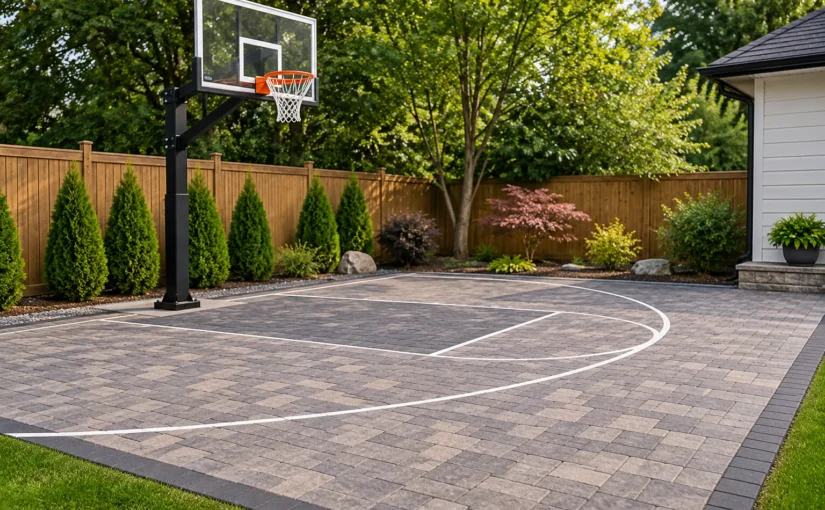
A paver basketball court can turn part of a backyard or driveway into a place for shooting hoops. However, traditional paving stones are not always the best surface for basketball.
Concrete pavers, brick pavers, and natural stone have joints that can affect ball bounce. Uneven pavers can also create trip hazards.
For regular basketball practice, a smooth asphalt or concrete court is generally a better starting point. Modular sports tiles designed for basketball are another option.
This guide explains paver types, US installation costs, advantages, disadvantages, and how to build a backyard paver basketball court.
Can You Build a Basketball Court With Pavers?
Yes. You can build a basketball court using traditional paving stones, provided the surface is carefully installed and maintained.
However, being suitable for paving does not automatically make a material suitable for basketball.
A basketball court needs a stable, consistent playing surface. Players must be able to dribble, run, stop, and change direction without unexpected changes in traction or footing.
Traditional pavers introduce several potential problems:
- Joints can interrupt basketball bounce.
- Individual pavers can shift or settle.
- Raised edges can create trip hazards.
- Rough textures can increase wear on basketballs.
- Hard paving stones provide little cushioning.
These issues matter more during competitive games and frequent training than occasional backyard shooting.
When Does a Paver Basketball Court Make Sense?
Pavers may be practical when an existing paved driveway or patio doubles as a casual basketball area.
They can also work for small shooting areas where appearance and easy replacement of individual paving stones are important.
For a dedicated basketball court, consider whether a continuous playing surface would provide more consistent performance and better value.
Types of Pavers for Basketball Courts
The term paver basketball court can describe several different materials. They should not be treated as interchangeable.
Concrete Pavers
Concrete pavers are manufactured paving blocks commonly used for driveways, patios, and walkways.
They are durable and available in different colors, sizes, and finishes. Their main disadvantage for basketball is the number of joints between individual blocks.
Even carefully installed concrete pavers may provide a less consistent bounce than a smooth concrete slab.
If you choose concrete pavers, prioritize uniform dimensions, narrow joints, and a stable foundation.
Brick and Natural Stone Pavers
Clay brick pavers offer a traditional appearance and can withstand outdoor exposure when properly specified.
However, their joints and surface texture can interfere with basketball dribbling.
Natural stone pavers, including granite and other paving stones, present similar concerns. Some stone finishes are too rough, uneven, or slippery for reliable basketball play.
These materials are generally better suited to decorative landscaping than dedicated sports courts.
Permeable Pavers
Permeable paving systems allow water to pass through joints, openings, or specially designed materials.
They can help manage stormwater when installed over a suitable drainage foundation. However, permeable does not mean maintenance-free or automatically safe for basketball.
Large openings, uneven joints, and loose infill can affect ball bounce and footing.
Some plastic permeable grids are designed to stabilize gravel rather than provide a finished basketball surface. The Concrete Masonry & Hardscapes Association (CMHA) publishes separate construction guidance for permeable interlocking concrete pavement systems.
Always check the manufacturer’s intended use before selecting a permeable system.
Interlocking Modular Sports Tiles
Modular sports tiles are different from traditional concrete or brick pavers.
They are manufactured panels designed for sports surfaces, commonly made from polypropylene or similar materials.
Depending on the product, they may offer:
- Playing texture designed for athletic use.
- Drainage openings.
- Consistent panel connections.
- Court colors and markings.
- Replaceable individual panels.
Many modular sports tiles require a suitable concrete or asphalt foundation. However, some systems can also use a manufacturer-approved engineered alternative, such as foundation panels or a specified crushed-stone system. See VersaCourt’s court base options for examples.
Do not assume sports tiles can be installed directly over ordinary paving stones. Check the exact product’s installation requirements.
How Much Does a Paver Basketball Court Cost?
General US paving cost guides put installed pavers at approximately $10–$30 per square foot, depending on material, design, and site requirements. This range comes from HomeGuide’s paver cost guide and covers general paving projects such as patios and driveways.
It is not a national average for basketball courts. A sports-ready surface may need more exacting groundwork, grading, or other work than an ordinary patio.
For comparison, HomeGuide’s standard paver patio guide quotes about $10–$17 per square foot installed. More complex, premium, or driveway-type installations can fall outside that narrower range.
Paver Basketball Court Cost by Size
The following table applies the broad $10–$30-per-square-foot installed paving range to different recreational court sizes.
| Example court size | Area | Illustrative paving cost |
|---|---|---|
| Small shooting area, 20 × 20 ft | 400 sq ft | $4,000–$12,000 |
| Backyard shooting area, 20 × 30 ft | 600 sq ft | $6,000–$18,000 |
| Compact backyard court, 30 × 30 ft | 900 sq ft | $9,000–$27,000 |
| Larger recreational half court, 40 × 50 ft | 2,000 sq ft | $20,000–$60,000 |
| Full-size playing area, 94 × 50 ft | 4,700 sq ft | $47,000–$141,000 |
These figures are mathematical examples based on general paving rates—not basketball court contractor quotes or complete project budgets. The first four dimensions are recreational planning examples, not universal regulation sizes. Larger projects may not scale at a fixed price per square foot.
The final budget can change substantially with site preparation, structural base work, drainage, basketball equipment, and optional features. A full-size playing area also needs appropriate clearance around the marked boundaries.
What Affects Paver Basketball Court Costs?
Several factors can change the price:
- Paver materials: Standard concrete pavers may cost less than premium natural stone or complex decorative designs.
- Ground preparation: Excavation, soil replacement, and grading increase costs, particularly on sloped sites.
- Aggregate foundation: A suitable compacted base is needed to support the paving and limit settlement.
- Drainage: Poorly draining sites may require additional aggregate, drainage pipes, or other improvements.
- Labor: Installing many individual paving stones requires careful preparation and placement.
- Basketball equipment: Permanent hoops need their own suitable foundations and installation.
- Optional features: Fencing, lighting, landscaping, and court markings can increase the total budget.
Ask contractors for itemized quotes that separate paving work from basketball-specific equipment and finishing.
Pros and Cons of Paver Basketball Courts
Pavers have useful properties, but they also introduce challenges that do not exist on continuous basketball surfaces.
Advantages
1. Individual pavers can be replaced. Damaged or settled paving stones can sometimes be lifted, repaired, and reinstalled without replacing the entire surface.
2. Multiple design options. Concrete and brick pavers come in different colors, patterns, and finishes. This can help a basketball area blend into a landscaped backyard.
3. Durable hardscape materials. Suitable outdoor pavers can withstand regular foot traffic and weather exposure when properly installed.
4. Drainage options. Purpose-designed permeable paving systems can help manage stormwater. Effective drainage depends on the complete construction system, not just the surface material.
5. Multi-use spaces. A paved driveway or patio can serve several purposes, including occasional basketball.
Disadvantages
1. Inconsistent ball bounce. Joints, texture, and small height differences can change how a basketball rebounds.
2. Potential trip hazards. Individual pavers can shift or settle over time, creating raised edges.
3. Hard playing surface. Traditional concrete, brick, and stone pavers offer little impact cushioning.
4. Joint maintenance. Joint sand may need replenishing. Weeds and debris can collect between paving stones.
5. Installation costs. Large paved areas can require substantial labor, making them costly compared with some continuous paving systems.
Are Pavers Safe for Basketball?

Safety depends on the material, installation quality, maintenance, and type of play.
A properly installed paved surface can support casual basketball. However, traditional paving stones have more joints than a continuous concrete or asphalt court.
These joints become a concern if pavers settle, edges rise, or the surface loses traction. For frequent running, cutting, and competitive basketball, a purpose-built sports surface is generally preferable.
Inspect any existing paved area for uneven or loose stones before playing.
How to Build a Paver Basketball Court
Building a traditional paver basketball court requires careful groundwork. The following steps describe a general sand-set concrete paver installation, not universal specifications for every paver product or soil condition.
The CMHA guide to constructing interlocking concrete pavement covers subgrade preparation, compacted aggregate, bedding sand, edge restraints, and paver placement.
1. Plan the Court Layout and Check Local Requirements
Measure the available area and decide how the court will be used.
A small shooting area requires less space than a half court intended for running and dribbling. Consider the hoop location, nearby buildings, fences, drainage, and player clearances.
Check local zoning, permits, property boundaries, and stormwater requirements before construction.
In the US, contact 811 before digging so buried utilities can be identified through the relevant state process. Allow the required notice period and confirm utilities have responded before excavation.
2. Excavate and Prepare the Ground
Remove vegetation, topsoil, roots, and unsuitable material.
Excavation depth depends on paver thickness, bedding material, aggregate foundation, and soil conditions.
The prepared ground must provide stable support. Soft or unsuitable soils may require additional treatment or a different base design.
3. Install the Compacted Aggregate Base
Place suitable crushed aggregate over the prepared subgrade. Compact the aggregate in layers to create a stable foundation.
Required base depth depends on soil, drainage, climate, and expected loads. Poor compaction can allow individual pavers to settle, creating uneven playing areas.
A strong foundation is especially important where players need predictable ball bounce and footing.
4. Add Bedding Sand and Edge Restraints
Traditional sand-set concrete pavers commonly use a carefully prepared bedding layer. Select the material and thickness specified for the paving system.
Bedding sand helps position the pavers. It cannot replace a compacted structural base.
Install approved edge restraints to help prevent the pavers from spreading or moving. CMHA explains their role in its edge restraint guidance.
5. Lay and Secure the Pavers
Install uniform pavers in the specified pattern, maintaining consistent joints and carefully controlled surface elevations.
Fill the joints with the material recommended for the paving system, then complete the required compaction and finishing steps.
Before using the area for basketball, inspect for raised edges, loose units, large gaps, and uneven sections.
A smooth-looking patio is not necessarily suitable for sports use.
6. Install the Basketball Hoop and Court Markings
A permanent in-ground basketball hoop generally needs a separate manufacturer-specified foundation.
Plan its position and footing before completing the paving. Follow the hoop manufacturer’s installation and curing instructions.
Court markings should match the intended layout. Check that any paint or marking product is compatible with the paving material and intended outdoor use.
Some marking systems may wear unevenly across paver joints.
Paver Basketball Court Drainage and Maintenance
Proper drainage and inspection help keep a paved basketball area usable.
Drainage and Freeze-Thaw Conditions
A paver basketball court needs a drainage plan suited to local soil and weather.
Conventional paving systems often use a controlled surface slope to direct water away. Permeable systems instead rely partly on water moving through the paving and supporting layers.
Neither approach works properly without suitable drainage. In colder regions, trapped water and freezing temperatures can contribute to movement or damage if the system is poorly designed.
Follow local engineering guidance rather than assuming one slope or foundation depth works everywhere.
Cleaning and Joint Maintenance
Remove leaves, dirt, loose stones, and other debris.
Inspect the joints and replenish joint material when required. Check for weed growth and displaced paving stones.
Avoid cleaning methods that damage the paver surface or wash out excessive joint material.
Repairing Uneven Pavers
Raised or sunken pavers should be repaired before basketball play continues.
The repair may involve lifting the affected units, correcting bedding or foundation problems, and reinstalling the pavers.
Repeated settlement may indicate deeper drainage or base defects. Simply replacing a stone will not fix an unstable foundation.
Do Pavers Need Sealing?
Not every paver installation requires sealing. Some manufacturers recommend optional sealers to reduce staining or maintain appearance.
However, sealers can change surface texture or slip resistance. For basketball areas, confirm that any product is suitable for athletic foot traffic before applying it.
Pavers vs Concrete vs Asphalt vs Sports Tiles
Traditional pavers are only one option for outdoor basketball.
| Surface | Main advantage | Main disadvantage |
|---|---|---|
| Concrete pavers | Individual units can be repaired | Joints can affect bounce and footing |
| Brick or stone pavers | Decorative appearance | Texture and joints may reduce playability |
| Asphalt | Continuous playing surface | Can crack and deteriorate |
| Concrete slab | Firm, consistent foundation | Can crack and needs suitable construction |
| Modular sports tiles | Designed for sports use | Needs an approved supporting base |
Which Surface Provides the Best Basketball Bounce?
A smooth, stable concrete or asphalt court generally provides more predictable ball bounce than traditional paving stones.
Modular sports tiles can also provide suitable rebound when designed and installed for basketball. Actual performance depends on the product and base.
Traditional pavers have joints that may interrupt dribbling, particularly when individual units become uneven.
Which Surface Is Best for a Backyard Basketball Court?
For a dedicated backyard basketball court, a suitable concrete or asphalt foundation with an appropriate sports finish is usually the more practical starting point.
Modular sports tiles are another option over a manufacturer-approved base.
Traditional pavers make more sense if the area is primarily a driveway, patio, or landscaped space used occasionally for basketball.
Our asphalt basketball court guide explains asphalt installation, costs, and maintenance.
Read our basketball court materials guide for a broader comparison of playing surfaces.
DIY vs Professional Paver Basketball Court Installation
Some experienced homeowners can install small paved areas themselves. However, a basketball court requires more consistent surface conditions than an ordinary patio.
DIY work needs suitable excavation tools, compaction equipment, accurate grading, and careful paver placement.
Mistakes can create drainage problems, settlement, uneven joints, and unsafe playing conditions.
Professional installation is generally preferable for larger courts, sloped properties, difficult soil, or projects needing extensive drainage.
Before hiring a contractor, ask whether they have built paved areas intended for basketball, not only decorative patios.
Our basketball court installation guide explains the wider construction process and what to ask an installer.
Frequently Asked Questions
Can You Dribble a Basketball on Pavers?
Yes, but ball bounce may be less consistent than on smooth asphalt or concrete. Joints, rough textures, and uneven paving stones can change how the ball rebounds.
For regular dribbling practice, a continuous playing surface is generally preferable.
How Much Does a Paver Half Court Cost?
Using the broad general paving range of $10–$30 per square foot, a 2,000-square-foot recreational half court gives an illustrative paving calculation of $20,000–$60,000.
This is not a basketball court quote. Basketball equipment, drainage, access, and sport-specific work may alter the final project total. Ask local contractors for detailed estimates.
What Base Do You Need Under Pavers?
Traditional sand-set concrete pavers generally need a prepared subgrade, compacted aggregate foundation, appropriate bedding material, and edge restraints.
The exact design depends on soil, climate, drainage, and the selected paving system.
Can You Install Basketball Court Tiles Over Pavers?
Do not assume that modular basketball tiles can be installed directly over ordinary paving stones.
Many systems use concrete or asphalt. Some have alternative approved foundations, but the base must meet the manufacturer’s specifications.
Are Pavers Better Than Concrete for Basketball?
Traditional pavers offer decorative flexibility and the ability to replace individual units.
However, a properly constructed concrete slab generally offers a more continuous surface for ball bounce and movement. For a dedicated court, concrete is often a better starting point.
How Long Does a Paver Basketball Court Last?
There is no reliable universal lifespan for a paver basketball court.
Durability depends on material, foundation, climate, drainage, use, and maintenance. Even durable pavers may need resetting or repairs if the supporting ground moves.
Final Thoughts
A paver basketball court can work for occasional backyard shooting, particularly when the space also serves as a driveway or patio.
However, traditional concrete, brick, and stone pavers are not ideal for every basketball activity. Their joints can affect ball bounce, while uneven units can create trip hazards.
For a dedicated basketball court, compare the complete costs and performance of asphalt, concrete, and modular sports tiles before choosing traditional pavers.
The most important consideration is whether the surface provides a stable, consistent, and safe area for basketball—not simply how it looks.
One thought on “Paver Basketball Court | Costs, Pros & Installation”
Comments are closed.