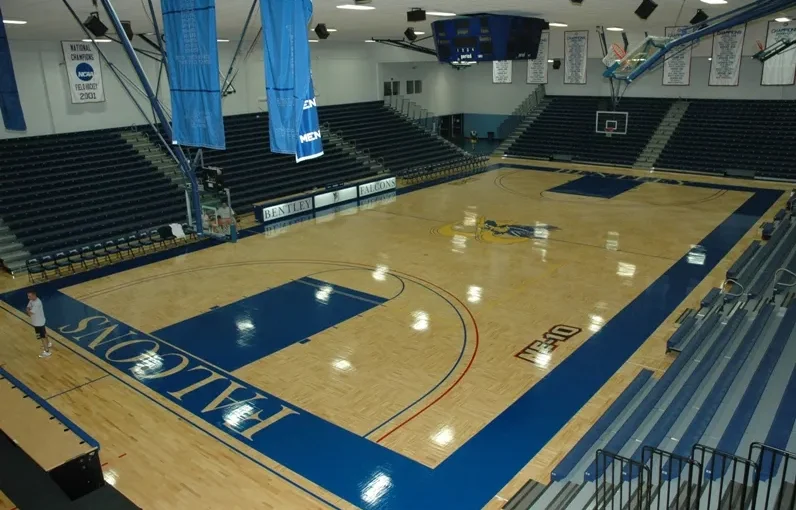
A professionally installed basketball gym floor often costs approximately $10–$26 per square foot for a sports-rated synthetic or hardwood system, based on published estimates from sports flooring manufacturer Robbins Sports Surfaces. More expensive systems and difficult projects can exceed that range.
For a 4,200-square-foot high school basketball playing area, that works out to about $42,000–$109,200 for flooring installation using the low end of the synthetic estimate and the high end of the hardwood estimate. A full gymnasium usually has more floor area than the marked basketball court.
Restoring an existing hardwood floor is usually cheaper. Screening and recoating may cost about $0.50–$2.50 per square foot, while full sanding and refinishing may cost around $3–$8 per square foot.
These are US planning estimates, not fixed prices or contractor quotes. They do not automatically include removing an old floor, correcting moisture problems, major concrete repairs, or custom graphics.
This guide explains basketball gym floor installation, replacement, and refinishing costs, plus the differences between maple hardwood and synthetic sports flooring.
How Much Does a Basketball Gym Floor Cost?
The biggest pricing difference is whether you are installing an entirely new sports floor or restoring the finish on an existing hardwood court.
| Project | Estimated cost per sq ft | What the estimate describes |
|---|---|---|
| New hardwood sports floor | $12–$26 | Installed hardwood gym flooring system |
| New synthetic sports floor | $10–$22 | Installed synthetic gym flooring system |
| Hardwood screening and recoating | $0.50–$2.50 | Light abrasion and compatible new finish |
| Hardwood sanding and refinishing | $3–$8 | More extensive finish removal and renewal |
Sources: Robbins Sports Surfaces for general installed flooring estimates; Kimminau Floors and The Final Floor for the broad recoating range; and Sports Venue Calculator for full hardwood refinishing. Published estimates vary in date, scope, and contractor assumptions.
Hardwood systems can be more expensive than synthetic flooring, although the price ranges overlap. A premium synthetic sports floor may cost more than a basic hardwood system.
Before comparing quotes: check the full floor area, subfloor components, labor, surface preparation, finishes, court markings, and disposal costs. Do not assume every quoted price includes the same work.
Basketball Gym Flooring Costs by Material
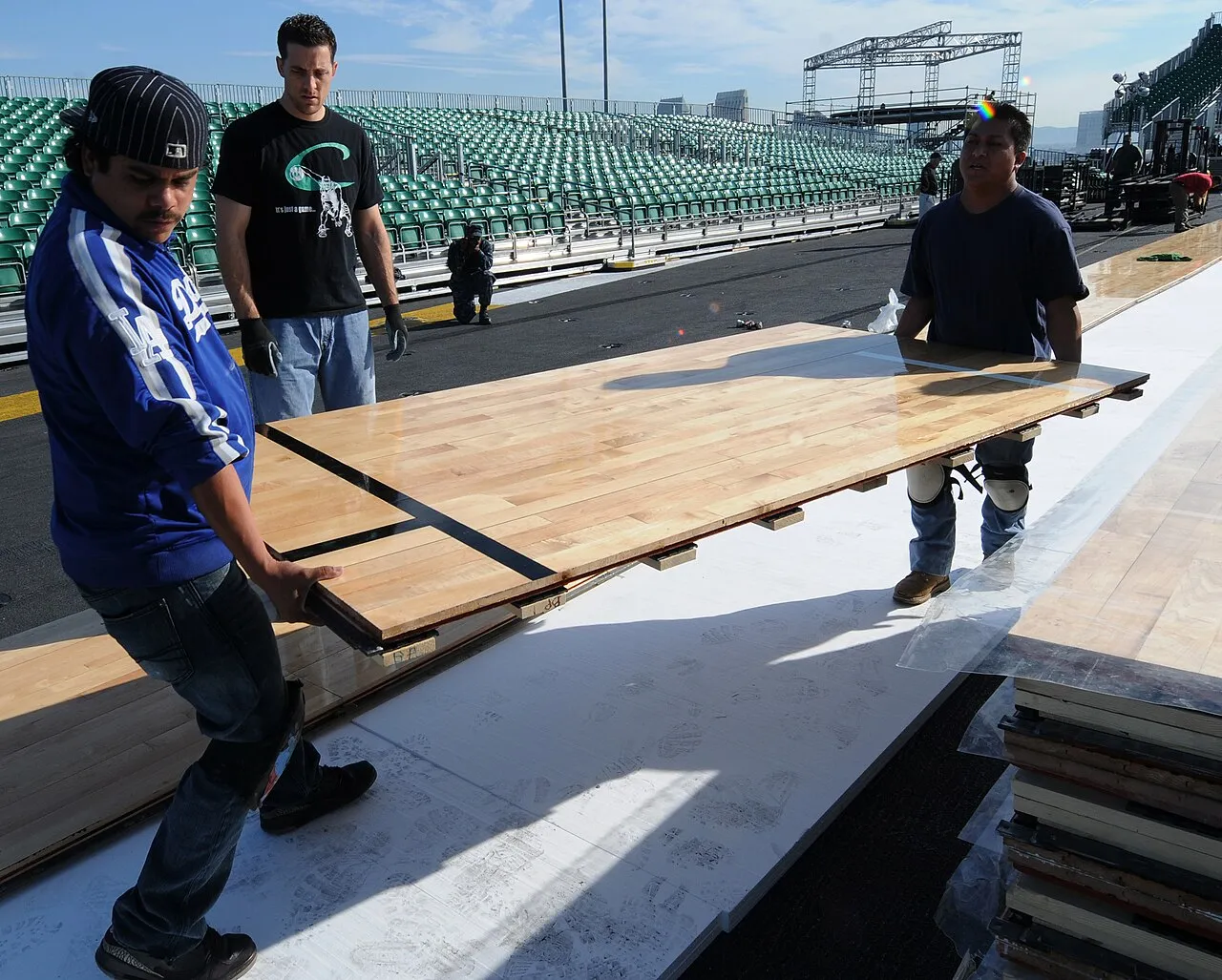
The playing surface affects cost, ball bounce, traction, durability, and maintenance. For an indoor basketball gym, choose a complete sports-rated flooring system, not just an inexpensive surface material.
Maple Hardwood Basketball Flooring
Maple hardwood is a traditional choice for indoor basketball courts in US schools, colleges, and professional facilities.
Robbins estimates approximately $12–$26 per square foot for an installed hardwood gym floor system. The actual price depends on floor design, location, and preparation. Premium systems or special site conditions can exceed that estimate.
A complete maple sports floor may contain northern hard maple boards, engineered wood subfloor components, resilient pads, a vapor retarder, game lines, and protective finishes. The exact construction varies by system.
The Maple Flooring Manufacturers Association (MFMA) performance-based floor specification shows how these layers can work together. Hardwood is valued for its established basketball performance and its ability to be sanded and refinished when the boards have enough usable thickness.
However, maple needs careful environmental control and ongoing maintenance.
Engineered Wood Sports Flooring
Engineered wood sports floors use manufactured wood components, often with a hardwood playing surface and additional structural or resilient layers.
Some systems use engineered panels rather than conventional solid maple strip flooring. Product designs and installation requirements vary, so there is no dependable single price range for this entire category.
Ask the manufacturer whether the floor can be sanded and refinished, how thick its wear layer is, and which sports performance tests it meets. Engineered wood is not automatically cheaper than solid maple.
Vinyl Sports Flooring
Sports vinyl is often considered for multipurpose school gyms and recreation centers. Dedicated indoor sports vinyl systems may have resilient backing or other layers designed to provide suitable sports performance.
Vinyl can be easier to clean than hardwood and does not require traditional wood sanding. However, an ordinary commercial vinyl sheet is not necessarily suitable for basketball.
For budgeting, use the broader $10–$22 per square foot installed synthetic sports-floor estimate as a starting point, rather than assuming a cheap material-only vinyl price includes the complete system. Obtain a product-specific quote for your chosen vinyl floor.
Rubber Sports Flooring
Rubber flooring is widely used in fitness spaces and some multipurpose athletic facilities. It can provide resilience and withstand certain types of equipment use.
However, general-purpose rubber gym tiles are not the same as basketball sports flooring. Ball rebound, friction, and other performance characteristics vary by product.
Only consider rubber-based flooring for basketball when the manufacturer confirms its suitability for court sports. The installed cost depends on the approved system, subfloor, and site conditions.
Poured Polyurethane Sports Flooring
Poured polyurethane systems form a continuous synthetic playing surface. Some use resilient layers beneath the top coating and are intended for multipurpose indoor sports.
They may be attractive for facilities that need one floor for basketball and other activities. Installation depends heavily on the condition of the substrate and the selected sports performance specification.
A poured polyurethane system should be priced by a specialist contractor. Do not compare a thin coating price with the price of a complete resilient sports floor.
What Is Included in Basketball Gym Floor Installation?
A flooring proposal should explain what the contractor will supply and install. The visible surface is only one part of the project.
Materials and Labor
The quoted price may cover flooring materials, delivery, installation, and work needed to complete the selected floor system. Specialist hardwood installations can also require sanding, sealing, and finishing.
Costs change with local labor rates, building access, installation timing, and product availability.
Subfloor and Shock Absorption
Many hardwood sports floors use a resilient subfloor to support player movement and manage impact. Different systems use different combinations of plywood, sleepers, pads, and other components.
Some synthetic systems also require resilient underlayers. Confirm which layers are included in the proposed system.
Avoid double-counting: if a contractor quotes a complete installed sports floor, its supporting layers may already be included. Do not add another allowance for those same components without checking the scope.
Concrete Preparation and Moisture Control
The slab beneath the floor must meet the selected manufacturer’s requirements. Uneven concrete, moisture issues, damaged materials, or old adhesive may require additional work.
Hardwood flooring is especially sensitive to moisture. MFMA recommends stable building conditions and appropriate humidity management for maple sports floors.
Major slab preparation, demolition, and moisture mitigation may be extra costs on top of a published installed-floor estimate.
Court Lines, Finishes, and Logos
A basketball floor needs the appropriate playing lines for its intended use. Schools may also want volleyball markings, center-court logos, colored keys, or school branding.
Basic markings may be included in some quotes. Custom artwork, multiple court layouts, and special finishes can be priced separately.
Ask contractors to identify these items in writing.
Basketball Gym Floor Costs by Size
Official basketball court dimensions help estimate the playing area, but the actual gym floor is usually larger. Space beyond the sidelines and baselines also needs flooring.
Here are example budgets using the published installed-floor estimates above:
| Example floor area | Area | Hardwood at $12–$26/sq ft | Synthetic at $10–$22/sq ft |
|---|---|---|---|
| Small practice area | 1,500 sq ft | $18,000–$39,000 | $15,000–$33,000 |
| High school playing court | 4,200 sq ft | $50,400–$109,200 | $42,000–$92,400 |
| College playing court | 4,700 sq ft | $56,400–$122,200 | $47,000–$103,400 |
| Larger gym floor example | 8,000 sq ft | $96,000–$208,000 | $80,000–$176,000 |
These are arithmetic examples based on quoted price bands, not actual bids. They exclude work outside the flooring quote, such as major concrete repairs or removal of an existing floor. The 1,500- and 8,000-square-foot examples are illustrative areas, not regulation court sizes.
High School Basketball Gym
The ideal US high school basketball playing court measures 84 × 50 feet, or 4,200 square feet. At the example rates above, the marked playing area alone would cost approximately $50,400–$109,200 for hardwood or $42,000–$92,400 for synthetic flooring.
The entire gym floor may be substantially larger. Measure the full installation area before budgeting.
College Basketball Court
A standard NCAA basketball playing court measures 94 × 50 feet, or 4,700 square feet. That produces a flooring-only planning range of $56,400–$122,200 for hardwood or $47,000–$103,400 for synthetic systems.
College facilities may also specify premium performance systems, custom graphics, or larger surrounding floor areas.
Full Gymnasium
A gymnasium can include much more floor space than the marked basketball court. For example, an 8,000-square-foot floor could cost approximately $96,000–$208,000 for hardwood at the stated rates.
This 8,000-square-foot example is not a universal standard gym size. Actual dimensions depend on the building and how it is used.
Small Indoor Basketball Court
A smaller private or practice area might cover 1,500 square feet. At the example rates, hardwood could cost about $18,000–$39,000 and a synthetic system about $15,000–$33,000.
Small projects may have higher per-square-foot prices because delivery and contractor setup costs are spread over fewer square feet.
For official playing measurements, see our basketball court dimensions guide.
How Much Does It Cost to Refinish a Basketball Gym Floor?
Restoring an existing maple hardwood floor can cost far less than replacing the entire system. The two main services are screening and recoating, and full sanding and refinishing.
Screening and Recoating
Screening lightly abrades the existing finish before a compatible new coat is applied. It can refresh the floor’s protective finish and friction characteristics without sanding down to bare wood.
A broad contractor-published planning range is approximately $0.50–$2.50 per square foot. For a 4,200-square-foot playing area, that equals about $2,100–$10,500.
Actual pricing can be lower or higher depending on region, finish, floor size, and whether markings need touching up. For example, Robbins has published a lower recoat range, while other contractors quote higher rates.
MFMA states that most maple gymnasium floors should be recoated annually, although use and condition affect the schedule. Recoating cannot repair serious structural problems or deep damage in the wood.
Sanding and Refinishing
Full sanding removes the existing finish and a thin layer of wood before the floor is resealed, finished, and marked as required.
Sports Venue Calculator estimates roughly $3–$8 per square foot for maple court refinishing. For a 4,200-square-foot area, that’s approximately $12,600–$33,600.
The final cost depends on the floor’s condition, sanding requirements, finishing products, and the amount of line painting or artwork.
Full sanding is only suitable when the wood has sufficient usable thickness remaining. An experienced sports flooring contractor should assess that before work starts.
Gym Floor Resurfacing
The word resurfacing is used for different jobs. On hardwood, it may mean recoating or sanding and refinishing. On synthetic flooring, it may refer to repairing or renewing a compatible coating or surface.
These services are not interchangeable. Ask exactly what a contractor means by resurfacing and what materials or work will be included.
When Should You Refinish Instead of Replace?
Refinishing is generally worth investigating when the flooring structure is sound and most damage is limited to the surface finish.
Replacement may be necessary when moisture damage, failing subfloor components, severe deterioration, or insufficient remaining wood thickness makes restoration impractical.
Have the floor inspected before choosing the more expensive option.
How Much Does It Cost to Replace a Gym Floor?
Replacing a gym floor involves more than installing a new surface. The project may include demolition, disposal, inspection of the concrete slab, repairs, and fitting a complete new sports flooring system.
For example, installing a new hardwood system over 4,200 square feet at $12–$26 per square foot gives a new-floor installation allowance of $50,400–$109,200. That is not a complete replacement quote if removal, disposal, or repair work is excluded.
A contractor should inspect the existing floor and list those additional costs separately. If the subfloor is sound and the main issue is surface wear, refinishing may be much less expensive than full replacement.
What Factors Affect Basketball Gym Flooring Costs?
- Flooring system: Different hardwood and synthetic products have different materials, thicknesses, and resilient components.
- Floor area: More square footage usually increases total cost, although large projects may spread some fixed expenses over a wider area.
- Subfloor condition: Concrete leveling, moisture control, and repairs can add significant work.
- Local labor and access: Regional rates, delivery, restricted access, and installation schedules affect quotes.
- Finishes and graphics: Multiple sport lines, logos, and specialized finishes can raise the price.
- Performance requirements: Competition facilities may require specific tested characteristics.
ASTM F2772-24 specifies athletic performance properties for multipurpose indoor sports flooring systems. Ask manufacturers for relevant test results, including shock absorption, ball response, and surface characteristics. The standard is not a guarantee against every type of injury.
Hardwood vs Synthetic Basketball Flooring: Which Is Cheaper?
Synthetic sports flooring often has a lower starting price, but the installed ranges overlap. The right choice depends on the facility’s primary sport, expected use, maintenance capacity, and long-term plans.
| Factor | Maple hardwood | Synthetic sports flooring |
|---|---|---|
| Published installed estimate | $12–$26/sq ft | $10–$22/sq ft |
| Basketball performance | Well-established for dedicated courts | Depends on the tested system |
| Routine care | Wood-specific cleaning and environmental control | Product-specific cleaning |
| Traditional wood sanding | Possible if sufficient wood remains | Generally not applicable |
| Moisture considerations | Sensitive to humidity and water | Varies by product and substrate |
| Service life | Can last decades when properly maintained | Varies by system and use |
A low-cost general-purpose surface should not be treated as equivalent to a basketball-rated sports floor. Compare performance documentation, maintenance requirements, and expected replacement or renewal work—not just the upfront price.
Basketball Gym Floor Maintenance Costs
Floor maintenance affects long-term cost and playing performance. A lower initial installation price may not produce the lowest lifetime cost.
Regular Cleaning
Remove dust, dirt, and debris using methods approved for the installed flooring. Maple floors need appropriate dust mopping and approved cleaning products; excessive water or unsuitable equipment can damage wood.
Follow the actual synthetic floor manufacturer’s care instructions rather than assuming all vinyl, rubber, and polyurethane systems can be maintained the same way.
Protective Recoating
MFMA says most maple gym floors should be recoated annually. At a broad estimate of $0.50–$2.50 per square foot, recoating a 4,200-square-foot playing area could cost $2,100–$10,500.
Budget based on the entire finished floor area, not just the basketball boundary lines, and get a contractor-specific price.
Moisture and Humidity Management
Maple absorbs and releases moisture as surrounding conditions change. MFMA recommends maintaining suitable building conditions; its general guidance discusses temperatures of 55–75°F and relative humidity of 35–50%, subject to the flooring system and building conditions.
Water leaks, condensation, or inappropriate cleaning can lead to expensive damage. Follow the floor manufacturer’s requirements and the MFMA humidity guidance.
Preventing Avoidable Damage
Schools and recreation centers often use gyms for graduations, assemblies, and events involving chairs and tables. Suitable temporary coverings can help protect a playing surface, but they must be compatible with the floor and its moisture requirements.
Our basketball gym floor covering guide explains the options and costs.
How to Save Money on Basketball Gym Flooring
- Get several detailed quotes. Compare the same measured area, sports performance specification, and included work.
- Match the floor to the facility. A multipurpose recreation center may not need the same system as a dedicated college basketball court.
- Inspect existing floors first. If the floor is structurally sound, recoating or refinishing could avoid a much larger replacement project.
- Check optional extras. Custom logos and complex graphics are easier to evaluate when quoted separately.
- Budget for hidden problems. Moisture issues, slab repairs, and removal of old flooring can increase the bill.
Ask each contractor for written details about the chosen system, subfloor, preparation, warranty, maintenance plan, and what happens if unexpected damage is found.
Frequently Asked Questions
How Big Is a Basketball Gym?
A standard NCAA basketball playing court is 94 × 50 feet, or 4,700 square feet. The ideal US high school playing court is 84 × 50 feet, or 4,200 square feet. The complete gymnasium floor is typically larger than those playing areas.
How Much Does It Cost to Refloor a Basketball Court?
For a 4,200-square-foot playing area, the manufacturer-published rates used in this guide suggest approximately $50,400–$109,200 for a new hardwood sports floor or $42,000–$92,400 for a synthetic system. Removing the old floor and repairing the supporting structure can cost extra.
How Long Does a Basketball Gym Floor Last?
A well-maintained solid maple sports floor can last for decades. Its life depends on installation quality, environmental control, maintenance, and how often it has been sanded. Synthetic sports-floor lifespan varies significantly by product and use; do not assume one replacement date applies to all systems.
What Is the Cheapest Basketball Gym Flooring?
Some synthetic sports flooring systems are cheaper to install than maple hardwood. However, the cheapest general-purpose vinyl or rubber material may not be suitable for basketball. Compare systems specifically approved for the intended sport.
How Often Should a Hardwood Gym Floor Be Refinished?
MFMA recommends annual screening and recoating for most maple gym floors. Full sanding and refinishing is a different, less frequent job. Its timing depends on wear, finish condition, remaining wood thickness, and a specialist inspection.
Final Thoughts
New basketball gym floors involve a substantial investment. As broad US planning figures, published estimates place installed hardwood systems around $12–$26 per square foot and synthetic sports floors around $10–$22 per square foot. Premium installations can cost more.
Existing hardwood floors may only need recoating or refinishing rather than complete replacement. The best next step is to measure the full gym floor, identify the required playing performance, and request comparable quotes from specialist sports flooring contractors.
One thought on “How Much Does a Basketball Gym Floor Cost? Installation & Refinishing”
Comments are closed.