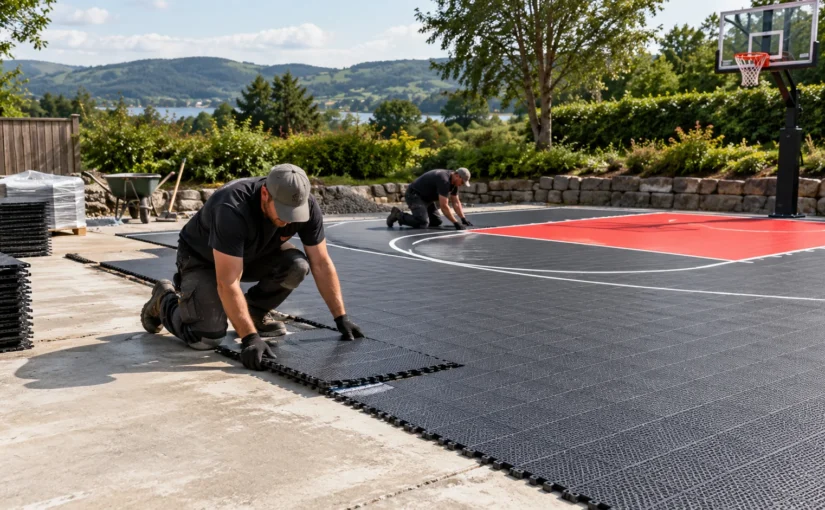
Basketball court installation involves preparing the site, building or checking the foundation, fitting the playing surface, and installing the basketball equipment.
The work depends on whether you’re building a new outdoor court, resurfacing an existing one, or installing an indoor sports floor.
This guide explains the installation process, what affects the price and timeline, and what to check when hiring a basketball court installer.
What Does Basketball Court Installation Involve?
Basketball court installation generally covers three types of projects:
- New court construction: Building a court from bare ground, including excavation, drainage, foundation, playing surface, and equipment.
- Court resurfacing: Preparing and repairing a suitable existing surface before applying a new sports coating or flooring system.
- Surface installation: Fitting modular tiles or another playing surface over a foundation that meets the manufacturer’s requirements.
A quote for installing basketball court tiles may not include constructing the concrete base underneath them.
Before hiring a contractor, confirm exactly which work is included.
Types of Basketball Court Installation
Outdoor Basketball Court Installation
Outdoor basketball courts need foundations and surfaces suitable for weather exposure, ground conditions, and drainage.
Concrete and asphalt are common outdoor bases. Depending on the system, the finished surface may use acrylic coatings or interlocking sports tiles.
The installer must check the site’s soil conditions, drainage, and the chosen surface manufacturer’s specifications.
Indoor Basketball Court Installation
Indoor basketball courts often use maple hardwood or synthetic sports flooring.
Hardwood installation requires a suitable subfloor, moisture testing, controlled temperature and humidity, and space for wood movement.
Synthetic flooring systems have different requirements for adhesives, underlayments, moisture control, and performance testing.
A professional-grade basketball court may need flooring that meets specific requirements for shock absorption, ball rebound, and slip resistance. The installer should confirm which performance standards apply to the facility and its intended level of play.
Backyard and Driveway Basketball Courts
Residential basketball court installation may involve a shooting area, half court, or larger playing space.
An existing driveway can sometimes serve as the base for an approved court surface.
However, cracks, ground movement, excessive slopes, drainage problems, and nearby obstacles can make a driveway unsuitable.
For help choosing a home layout, read our backyard basketball court guide. Our basketball court dimensions guide also explains common court measurements.
Basketball Court Installation Process
A complete new-court installation generally follows these five stages. Surface-only projects may need fewer steps.
Step 1: Site Assessment and Court Design
The contractor checks the available space, ground conditions, access routes, nearby structures, and intended court use.
The design should identify:
- Court dimensions and orientation.
- Foundation and playing surface.
- Hoop positions and overhang.
- Drainage and surface levels.
- Fencing, lighting, and other equipment.
The owner and installer should also establish who handles planning approvals, permits, and underground utility checks before excavation begins.
Step 2: Groundwork, Drainage and Base Preparation
For a new outdoor court, workers remove unsuitable material, prepare the subgrade, and construct the specified foundation.
This may include excavation, aggregate layers, compaction, drainage, and concrete or asphalt installation.
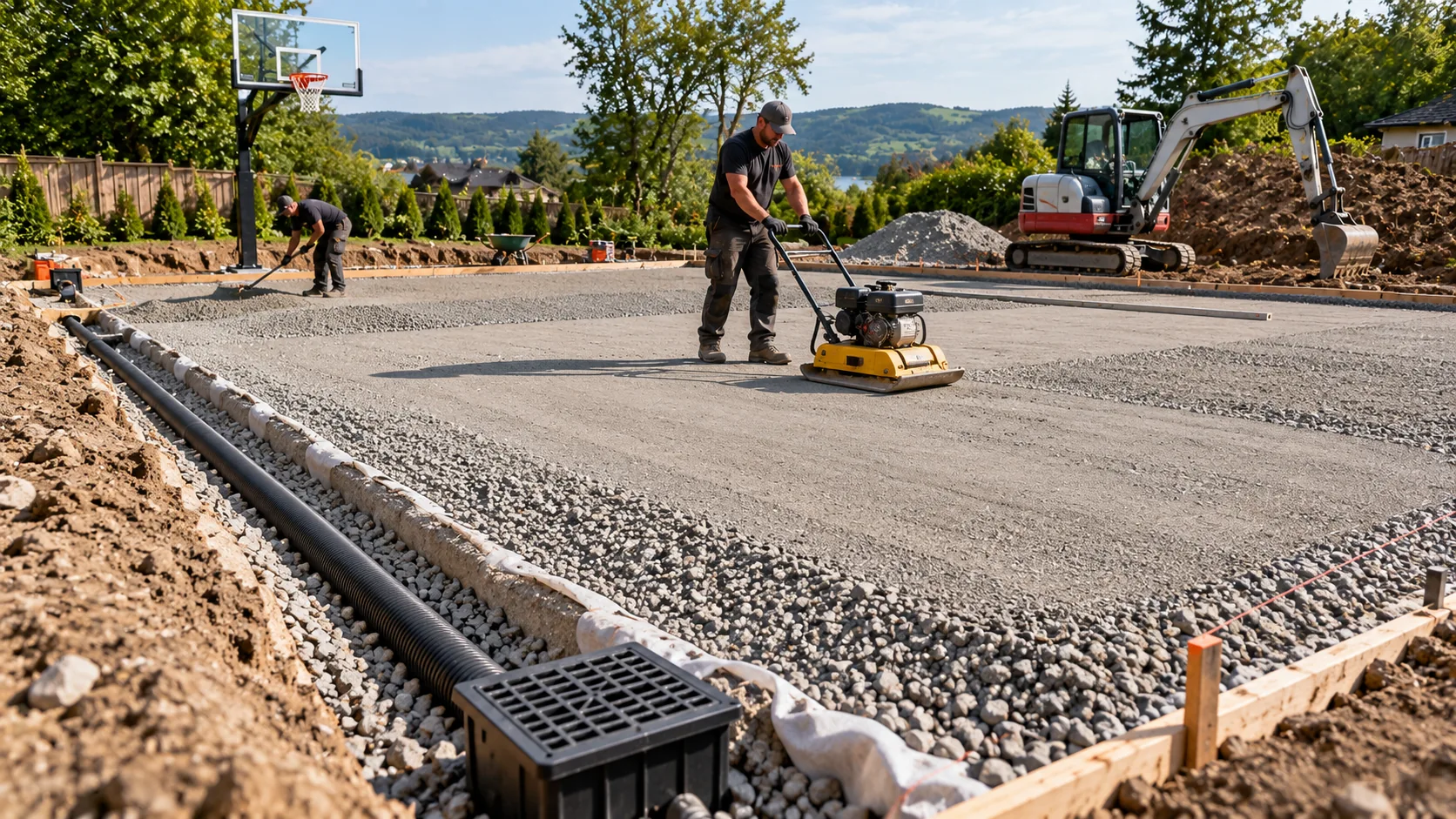
Drainage needs more than a sloped playing surface. The project must also provide a suitable destination for runoff without creating problems for buildings or neighbouring properties.
The durability of a basketball court depends heavily on its foundation and drainage. There is no universal slab thickness or drainage slope suitable for every project. The correct specifications depend on site conditions, engineering requirements, and the selected surface system.
For additional technical resources, consult the American Sports Builders Association’s construction guidance.
Step 3: Installing the Court Surface
The installer checks that the foundation meets the requirements of the playing surface before work begins.
Modular basketball court tiles are laid according to the manufacturer’s instructions for alignment, expansion clearance, edges, and connections.
VersaCourt’s tile installation instructions explain how to position interlocking panels, allow for expansion, and fit court edges.
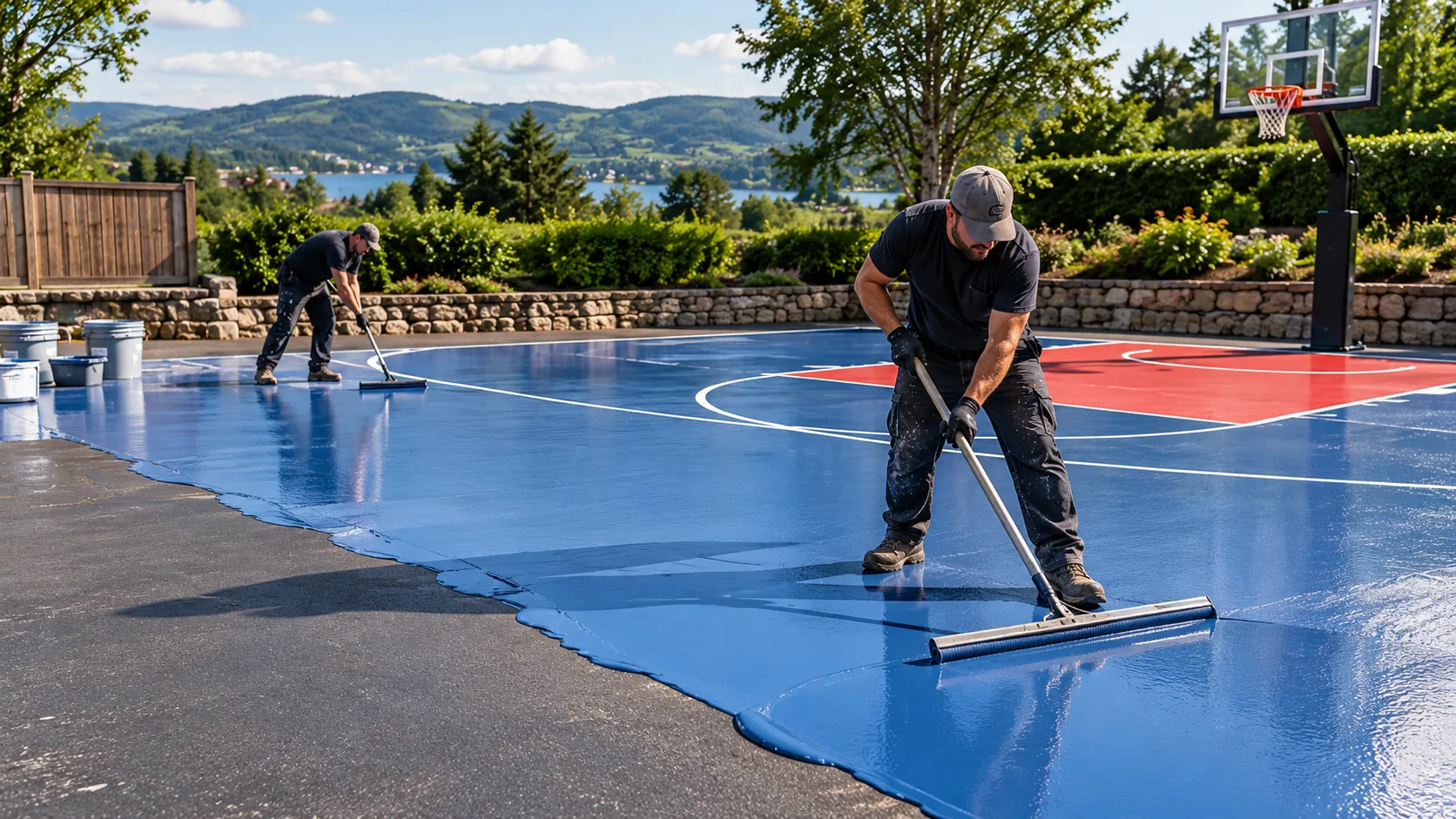
Acrylic sports coatings require a properly cured, clean, sound base. Installers prepare the surface and apply the specified coating layers.
SportMaster’s acrylic resurfacer instructions explain the surface cleaning, repairs, and application conditions required for its coating system.
Indoor hardwood and synthetic flooring require specialist installation methods, particularly where moisture control and sports performance standards apply.
Surface installation should not begin until significant foundation defects have been addressed.
Step 4: Hoop Installation and Court Markings
Basketball hoop systems need suitable foundations or anchor points, correct positioning, and secure assembly. In-ground, wall-mounted, and ceiling-mounted systems have different structural requirements, so the installer must follow the instructions for the specific model.
In-ground basketball hoop installation must follow the specific model’s instructions. Footing dimensions and curing requirements vary.
Goalrilla’s basketball hoop product manuals provide model-specific assembly and installation instructions.
Court markings should match the approved layout. Competition courts must follow the chosen governing body’s rules, while recreational courts may use custom markings.
See our basketball court diagram guide for an explanation of common lines and markings.
Step 5: Final Inspection and Handover
The installer should check the court before handing it over.
Player safety should be part of the final inspection. Check for trip hazards, sharp edges, loose hoop components, and uneven transitions between the court and surrounding ground.
The inspection should cover surface defects, drainage, edges, markings, hoop stability, and any unfinished work.
Ask for the approved layout, product information, maintenance instructions, relevant warranties, and a confirmed safe-to-play date.
Record outstanding defects in writing before accepting the completed project.
How Long Does Basketball Court Installation Take?
Installation time depends on the project scope, site preparation, materials, and weather.
Modular tiles may take one to several installation days once a suitable base and the required materials are ready.
Building a court from bare ground can take weeks or longer when excavation, approvals, foundation work, deliveries, and curing periods are included.
New concrete may need around 28 days of curing before certain acrylic coatings can be applied. That does not mean every basketball court system has the same waiting period.
Ask for a project schedule that separates active installation time, waiting periods, and the date the court can be used.
How Much Does Basketball Court Installation Cost?
Basketball court installation costs vary according to the work required.
Major cost factors include:
- Court size and location.
- Excavation and soil conditions.
- Foundation construction or repairs.
- Surface materials and installation methods.
- Drainage and access restrictions.
- Labour and specialist equipment.
- Basketball hoops, fencing, and lighting.
- Permits, inspections, and site restoration.
Installing a surface over suitable existing pavement may avoid some new foundation work, but repairs and drainage improvements can still be expensive.
Set a realistic budget that includes site preparation, installation, equipment, and a contingency for unexpected work. When comparing contractor quotes, check that they cover the same specifications and clearly identify any exclusions.
For detailed construction cost information, see our basketball court construction cost guide.
How to Choose a Basketball Court Installer
Look for an installer with experience building courts similar to yours.
Ask for completed project examples, preferably including older courts where drainage and surface wear can be assessed.
Check applicable licences or registrations, insurance, references, and experience with the proposed surface.
If you’re choosing a branded modular or specialist flooring system, confirm whether the manufacturer requires an authorised installer for warranty coverage.
Obtain a written quote identifying the foundation, drainage, surface materials, equipment, and responsibilities of any subcontractors.
Questions to Ask Before Installation
Before signing a contract, ask:
- Does the quote cover the entire court or only the playing surface?
- Who handles permits, utility checks, and inspections?
- What foundation and surface products will be installed?
- How will drainage work, and where will runoff go?
- What happens if unsuitable ground or existing pavement is discovered?
- How long will each installation stage take?
- When can the finished court be used?
- Which warranties cover the foundation, surface, workmanship, and hoop?
- Who handles defects discovered during the final inspection?
Get the agreed scope, materials, schedule, payment stages, and exclusions in writing.
Common Basketball Court Installation Problems
Several problems can appear when preparation or installation requirements are missed.
Standing water: Low spots, unsuitable grading, or inadequate drainage may leave puddles on the surface.
Cracking and settlement: Weak ground, unsuitable foundations, or movement can damage the playing area.
Buckling modular tiles: Incorrect expansion clearance or restraint can interfere with normal temperature-related movement.
Peeling acrylic coatings: Moisture, contamination, inadequate preparation, or unsuitable curing conditions can affect adhesion.
Unsafe court edges: Poor transitions, raised tiles, or missing edge treatments may create trip hazards.
Loose basketball hoops: Incorrect footings, anchors, or assembly can affect equipment stability.
The contractor should explain how the proposed installation addresses these risks.
DIY vs Professional Basketball Court Installation
Some modular court systems allow homeowner installation over a suitable, approved foundation.
However, excavation, drainage, foundation construction, specialist coatings, indoor sports flooring, and structural hoop installation may require professional skills and equipment.
Consider the tools needed, safety risks, installation tolerances, warranty requirements, and the cost of correcting mistakes.
Our DIY basketball court guide covers the broader building process for homeowners.
Basketball Court Installation FAQs
Do You Need a Permit for a Backyard Basketball Court?
Possibly. Planning and permit requirements depend on your location, court size, groundworks, drainage, fencing, and lighting.
Check with the relevant local authority before construction. Confirm whether you or the contractor is responsible for applications.
Can You Install Basketball Court Tiles Over Concrete?
Yes, many modular tile systems can be installed over suitable concrete.
The base must meet the selected manufacturer’s requirements for stability, drainage, flatness, and preparation.
Tiles cannot repair serious settlement or foundation failure.
Can You Install a Basketball Court Year-Round?
Some indoor installations and modular surface projects can proceed in cooler weather if the required conditions are met.
Outdoor concrete work, excavation, and acrylic coatings can be delayed by freezing temperatures, rain, or unsuitable surface conditions.
Follow the relevant material and equipment manufacturer’s instructions.
Final Thoughts
Before approving a basketball court installation, confirm the project scope, foundation requirements, drainage plan, surface specification, and contractor responsibilities.
The finished court should match the approved design, pass the agreed inspections, and include clear maintenance and warranty information.
Do not accept the court until the installer confirms when it is safe to use.
One thought on “Basketball Court Installation | Process, Costs & Hiring an Installer”
Comments are closed.