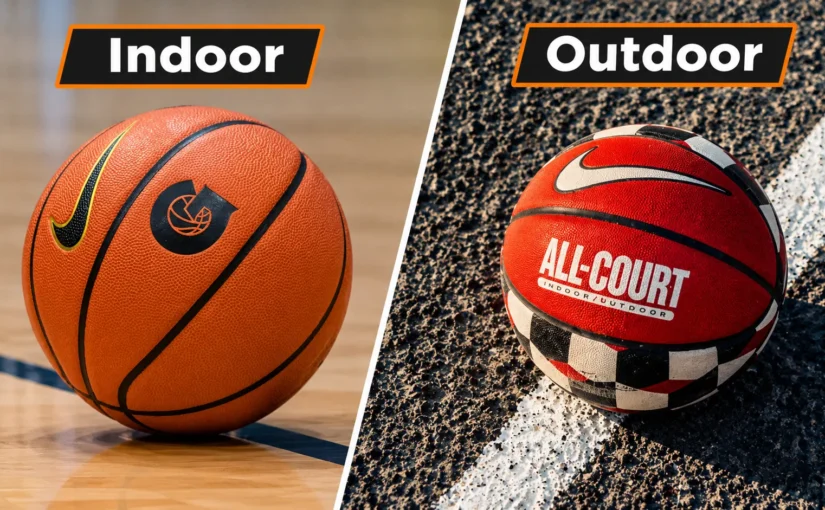
When comparing indoor vs outdoor basketball options, the main difference is where each ball is designed to be used. Indoor basketballs are made for gym courts, while outdoor basketballs are designed for rougher surfaces like concrete and asphalt.
The main difference is the ball’s intended playing surface and cover construction. Indoor basketballs often use genuine leather or softer composite covers. Outdoor basketballs commonly use rubber or durable synthetic materials.
Some basketballs are labelled indoor/outdoor, meaning the manufacturer approves them for both environments.
The simplest rule: Check the basketball’s playing-surface label before buying. Material and price alone won’t tell you where it belongs.
Indoor vs Outdoor Basketball: Key Differences
| Feature | Indoor Basketball | Outdoor Basketball |
|---|---|---|
| Playing surface | Hardwood and suitable indoor courts | Concrete, asphalt, and outdoor courts |
| Common materials | Genuine leather or composite leather | Rubber or durable synthetic covers |
| Feel | Often softer, depending on the model | Often firmer, depending on the model |
| Grip | Varies by cover and condition | Varies by cover and condition |
| Durability | Indoor-only covers can wear quickly on rough surfaces | Designed to tolerate rougher surfaces |
| Maintenance | Genuine leather may need special care | Generally easier to maintain |
| Price | Includes midrange and premium balls | Often includes affordable recreational balls |
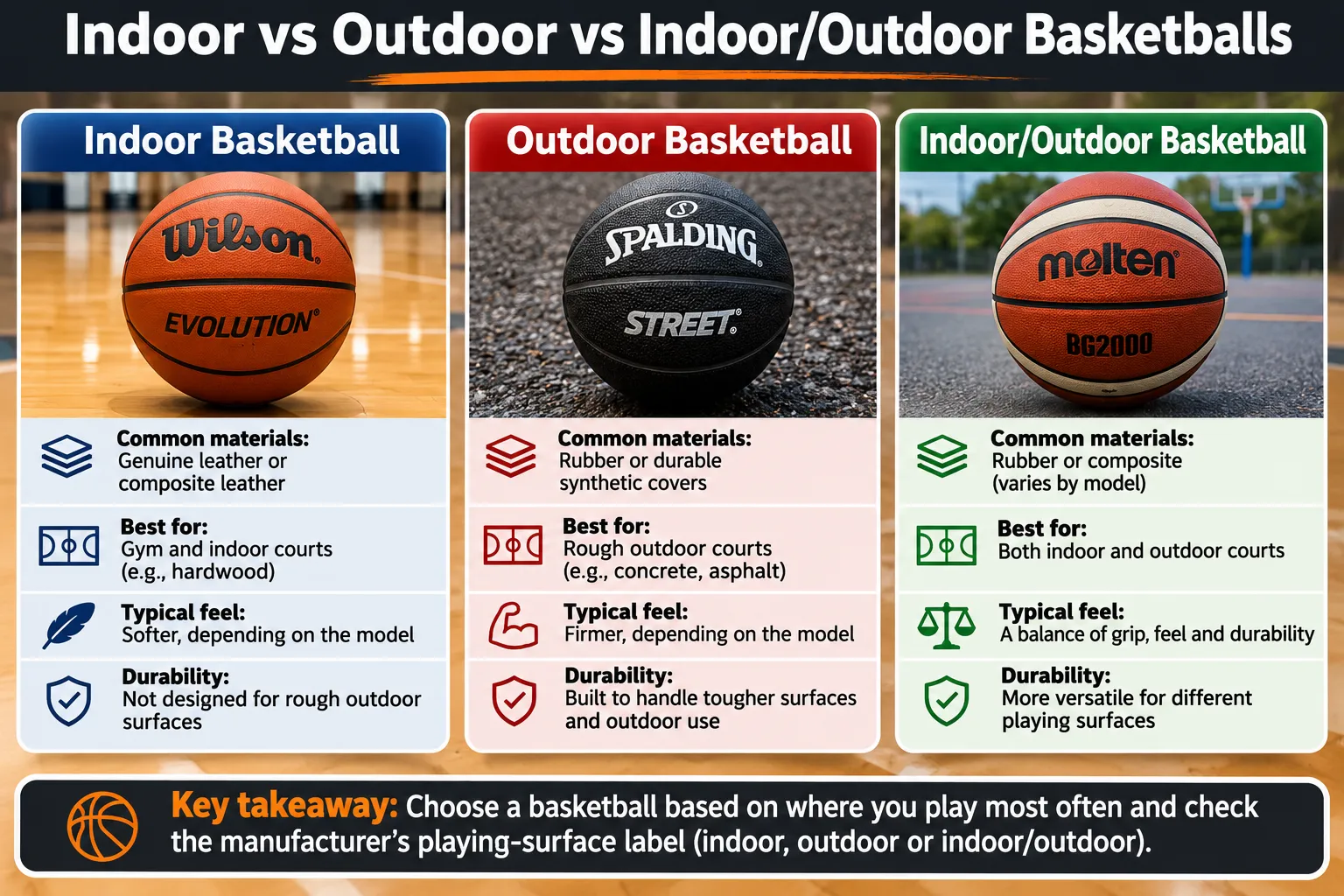
These are general differences, not rules for every basketball.
For example, Spalding sells indoor-only composite basketballs, while other composite models are approved for indoor and outdoor use. Some rubber basketballs are also suitable for both settings.
That is why the exact model’s intended use matters more than its material alone.
Indoor vs Outdoor Basketball Materials
Basketball covers generally fall into three main material categories: genuine leather, composite or synthetic leather, and rubber.
Indoor Basketball Materials
Genuine leather is used for premium game basketballs, including the official NBA game ball.
New leather can initially feel stiff or slippery. Its texture and feel change as the ball breaks in through indoor play.
Wilson specifically recommends breaking in its official NBA game ball on hardwood rather than concrete.
Composite leather is a man-made material designed to provide leather-like playing characteristics.
Many indoor basketballs use composite covers because they offer a softer feel without the same break-in requirements as genuine leather.
However, not every composite basketball is approved for outdoor use.
Outdoor Basketball Materials
Rubber is common in outdoor basketballs because it is generally affordable and suited to rough playing surfaces.
Rubber basketballs often feel firmer than premium indoor balls, although this depends on the construction.
Synthetic and composite covers are also used on outdoor basketballs. Some are specifically designed for both indoor and outdoor courts.
For example, Molten labels its BG2000 rubber basketball for indoor and outdoor use.
The material tells you something about the ball, but its playing-surface designation tells you where the manufacturer intends it to be used.
Indoor vs Outdoor Basketball: Grip, Bounce and Durability
Which Basketball Has Better Grip?
Neither indoor nor outdoor basketballs have universally better grip.
Grip depends on the cover material, surface texture, moisture, dirt, and condition of the ball.
Indoor composite basketballs often feel softer, while outdoor rubber basketballs may feel firmer.
A worn or dirty basketball can also feel different from a clean one.
Choose a ball suitable for your court rather than assuming leather, composite, or rubber always provides the best grip.
Do Indoor and Outdoor Basketballs Bounce Differently?
They can, but cover material alone does not determine bounce.
Inflation pressure, internal construction, ball condition, and the playing surface all affect how a basketball rebounds.
An underinflated indoor basketball may bounce poorly. A properly inflated outdoor basketball can perform normally on a suitable indoor floor.
Before blaming the material, check the recommended pressure printed on the ball.
Which Basketball Lasts Longer?
For concrete and asphalt, an outdoor-rated basketball is generally the better durability choice.
Indoor-only leather and composite covers are not intended for repeated contact with abrasive outdoor surfaces.
However, there is no reliable universal lifespan for either category.
How long a basketball lasts depends on its construction, playing surface, frequency of use, and maintenance.
Can You Use an Indoor Basketball Outside?
Yes, physically, but it is not recommended for indoor-only basketballs.
Concrete and asphalt can wear down the cover faster than suitable indoor courts.
Repeated outdoor play may damage the surface texture and change how the basketball feels.
One outdoor session does not automatically destroy an indoor basketball. However, there is no guaranteed number of outdoor sessions that will be harmless.
If you accidentally use an indoor ball outside, clean it according to the manufacturer’s instructions and inspect its cover.
Cleaning can remove dirt, but it cannot restore material worn away by rough surfaces.
Can You Use an Outdoor Basketball Indoors?
Yes. Many outdoor basketballs can also be used indoors.
Some rubber and composite models are explicitly labelled indoor/outdoor.
Before bringing an outdoor basketball into a gym:
- Remove dirt and debris.
- Check the facility’s rules.
- Make sure the ball is suitable for the floor.
- Use the required game ball for organised competition.
An outdoor ball may feel different from an indoor game ball, but that does not automatically make it unsuitable for indoor practice.
Which Basketball Should You Use on Different Courts?
Choose your basketball based on the actual playing surface, not just whether the court has a roof.
| Playing Surface | Recommended Basketball |
|---|---|
| Hardwood gym court | Indoor composite or suitable indoor/outdoor ball |
| Concrete driveway | Outdoor rubber or approved indoor/outdoor ball |
| Asphalt court | Outdoor rubber or approved indoor/outdoor ball |
| Painted outdoor court | Outdoor or indoor/outdoor ball |
| Outdoor modular sports tiles | Outdoor or indoor/outdoor ball |
| Indoor synthetic sports floor | Indoor or indoor/outdoor ball permitted by the facility |
| Garage with rough concrete flooring | Outdoor or indoor/outdoor ball |
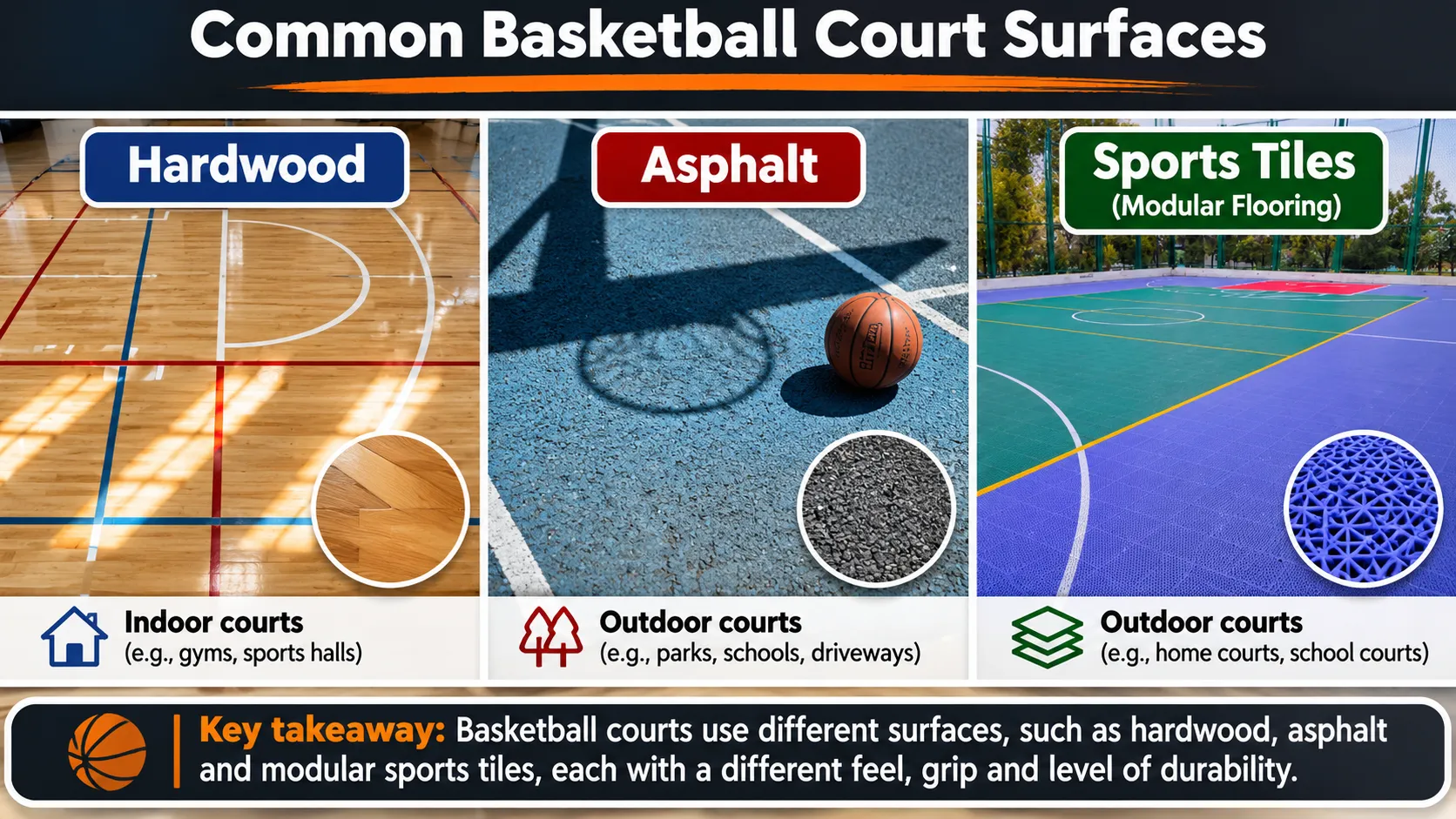
Photo: Rayzonglobal001 / Wikimedia Commons, licensed under CC BY-SA 4.0. Modified and combined with other photographs by BasketballRex. This infographic is shared under CC BY-SA 4.0.
A garage is a useful example.
Even though you are playing indoors, a rough concrete floor can still wear down an indoor-only basketball.
Painted and modular courts also vary in texture. Check your ball manufacturer’s guidance rather than assuming every surface behaves the same.
Indoor vs Outdoor Basketball: Which Should You Buy?
Your best option depends on where you play most often.
| Your Situation | Best Starting Choice |
|---|---|
| Mostly play in a gym | Indoor composite basketball |
| Mostly play on concrete or asphalt | Outdoor rubber basketball |
| Regularly switch between indoor and outdoor courts | Basketball labelled indoor/outdoor |
| Beginner on a budget | Affordable ball approved for your main playing surface |
| Want a genuine-leather game ball | Indoor leather basketball, with appropriate break-in and care |
You do not need an expensive leather basketball to learn shooting, dribbling, or passing.
Choose the correct size first. For example, men’s standard competition uses Size 7, while women’s standard competition uses Size 6. Youth players should check their league requirements.
If you’re putting together a practice setup, our basketball training equipment guide explains which additional tools are useful.
For quieter dribbling practice at home, foam basketballs are another option. Our best silent basketballs guide compares six models, although they are not direct replacements for regular game balls.
How to Clean and Maintain Your Basketball
Basic care helps protect your basketball from unnecessary wear.
- Remove dirt: Wipe rubber and synthetic basketballs with a damp cloth.
- Clean gently: Use mild soap only when suitable for your model.
- Dry properly: Avoid soaking the ball or drying it near direct heat.
- Check inflation: Use the recommended pressure marked on the basketball.
- Store indoors: Keep the ball somewhere dry, away from extreme heat and direct sunlight.
Genuine leather basketballs can require different cleaning products and care methods. Follow the exact manufacturer’s instructions.
Spalding provides additional guidance on cleaning and maintaining basketballs.
If you need to release air before storage or travel, read our guide on how to deflate a basketball safely.
Frequently Asked Questions
Does It Matter if a Basketball Is Indoor or Outdoor?
Yes. Indoor-only basketballs are designed for suitable gym surfaces, while outdoor-rated basketballs are made to handle rougher courts. Using the correct type helps avoid unnecessary cover wear.
How Do I Tell if My Basketball Is Indoor or Outdoor?
Check the markings on the ball, its packaging, or the manufacturer’s product page.
Look for indoor, outdoor, or indoor/outdoor. Do not rely on material or appearance alone.
Can Rubber Basketballs Be Used in Gyms?
Yes, some can. Certain rubber basketballs are approved for indoor and outdoor use. Check the exact model and the gym’s rules.
Are Indoor Basketballs Worth the Extra Money?
They can be if you regularly play on indoor courts and prefer their feel.
However, paying more does not automatically improve shooting accuracy or ball-handling skills.
How Long Should a Basketball Last?
There is no universal lifespan.
Playing surface, frequency of use, construction, and maintenance all matter.
Consider replacing a basketball when it has badly damaged panels, unusable grip, significant shape problems, or persistent air loss that cannot be fixed.
Final Verdict
The difference between indoor and outdoor basketballs comes down to their intended playing surfaces and construction.
For most gym players, an indoor composite basketball is a sensible choice.
For concrete and asphalt, an outdoor rubber basketball is usually the practical option.
If you regularly play in both environments, choose a basketball specifically labelled indoor/outdoor.
Above all, check the exact model’s intended use before buying.
3 thoughts on “Indoor vs Outdoor Basketball | What’s the Difference?”
Comments are closed.