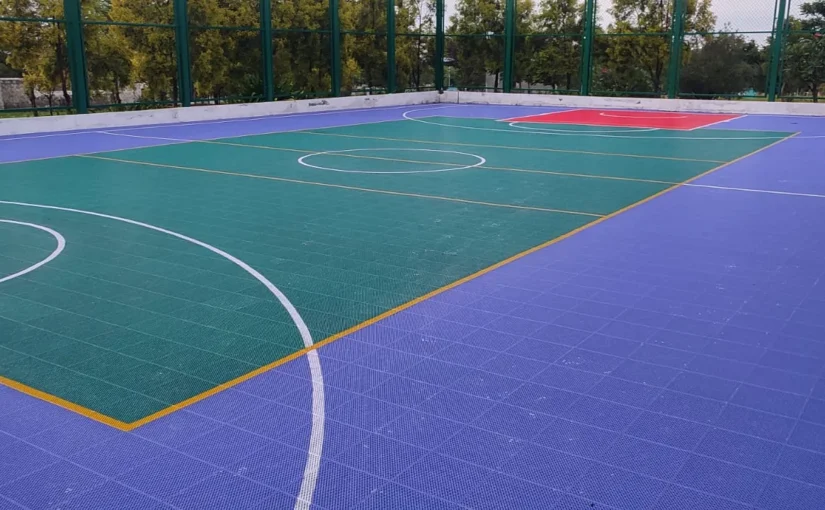
The best outdoor basketball court flooring depends on your budget, existing foundation, local climate, and how often you play.
Acrylic-coated concrete or asphalt is a practical choice for a permanent outdoor basketball court. Interlocking sports tiles offer an alternative with customizable colors, replaceable panels, and a raised drainage design.
If you already have a suitable paved surface, using it without additional flooring may be your cheapest option.
This guide compares outdoor basketball court flooring materials, US prices, installation requirements, and maintenance to help you choose the right playing surface.
What Is Outdoor Basketball Court Flooring?
Outdoor basketball court flooring is the finished surface on which players run, dribble, shoot, and play basketball.
Common outdoor playing surfaces include concrete, asphalt, acrylic sports coatings, interlocking plastic tiles, and specialized cushioned flooring systems.
It is important to understand the difference between the foundation and the finished playing surface.
- Foundation: The supporting base beneath the court, commonly concrete or asphalt.
- Playing surface: The material that players directly interact with, such as acrylic coatings or modular sports tiles.
Concrete and asphalt can serve as both the foundation and the playing surface.
However, installing interlocking tiles over an unsuitable foundation will not solve drainage problems, ground movement, or significant surface damage.
Best Types of Outdoor Basketball Court Flooring
Interlocking Basketball Court Tiles
Interlocking basketball court tiles are modular flooring panels that connect to create a continuous playing surface.
Many outdoor sports tiles are manufactured from polypropylene, a type of plastic suitable for outdoor applications when properly formulated.
These tiles often feature an open-grid surface and raised supporting structure that allows rainwater to pass underneath.
Advantages include:
- Customizable court colors and designs.
- Relatively straightforward installation over an approved foundation.
- Replaceable individual tiles.
- Drainage through the perforated surface.
- Optional cushioning or flexibility, depending on the product.
Disadvantages include:
- Additional costs for a suitable foundation.
- Expansion and contraction during temperature changes.
- Potential debris accumulation underneath the tiles.
- Differences in ball bounce and traction between products.
- Possible movement or buckling if installed incorrectly.
Outdoor basketball court tiles are particularly attractive for homeowners who want a colorful backyard court without applying permanent coatings directly to their existing pavement.
Choose a product specifically designed for outdoor basketball rather than ordinary patio, garage, or general-purpose plastic flooring.
Acrylic-Coated Concrete
Acrylic-coated concrete combines a concrete foundation with a purpose-designed sports coating.
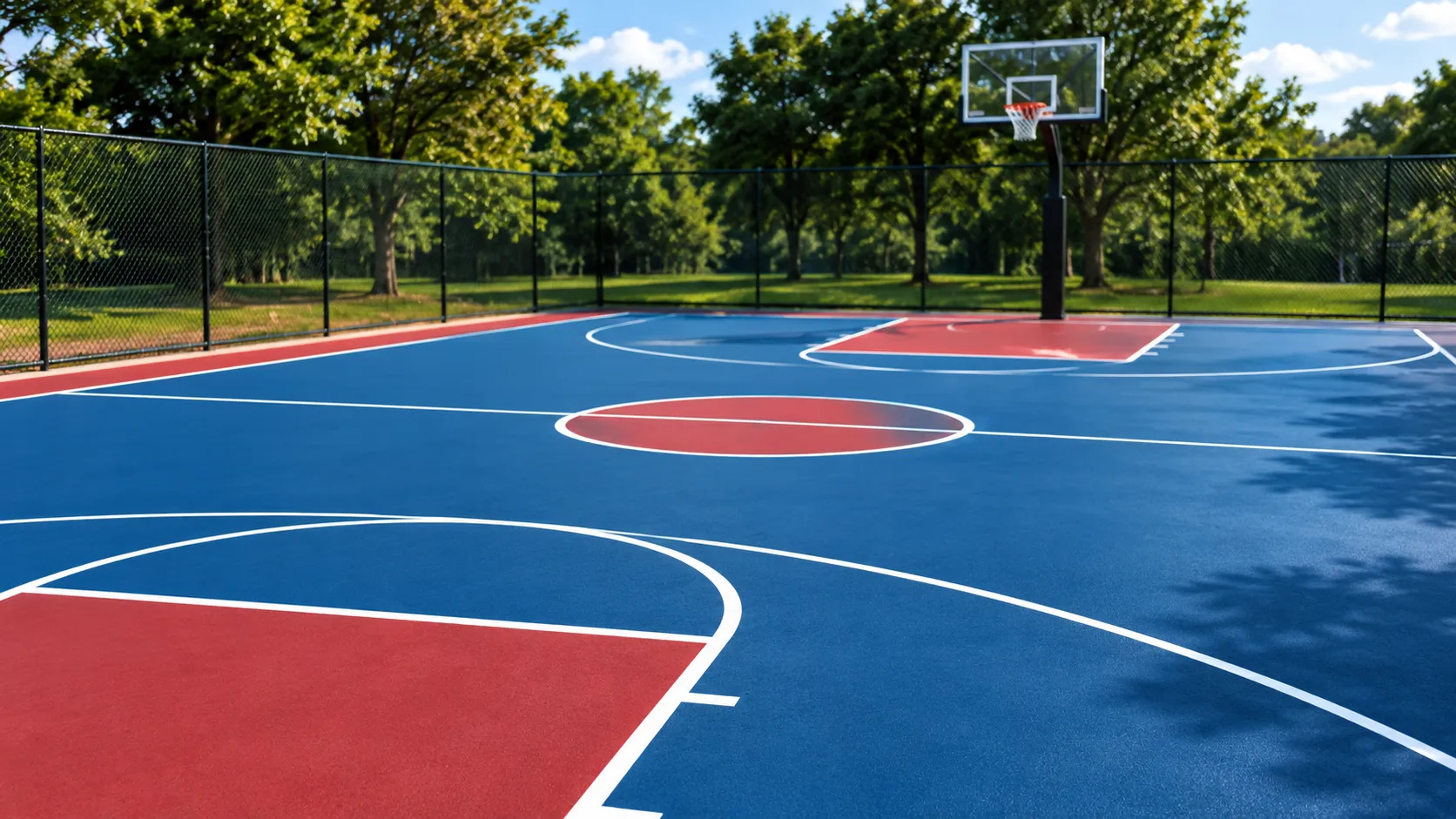
The coating system provides color, surface texture, and court markings. Depending on the product, additional layers may provide cushioning.
Advantages include:
- Firm and generally consistent ball response on a sound foundation.
- Custom colors and basketball court markings.
- A continuous playing surface.
- Suitability for residential and commercial courts.
- The ability to renew the finish through resurfacing.
Disadvantages include:
- Limited cushioning in standard hard-court systems.
- Potential cracking as the concrete moves.
- Professional preparation and coating may be necessary.
- Periodic resurfacing costs.
Acrylic-coated concrete is a strong all-round option for permanent backyard basketball courts, schools, and recreational facilities.
However, the quality of the finished surface depends heavily on the condition and preparation of the concrete beneath it.
Acrylic-Coated Asphalt
Asphalt is another common foundation for outdoor sports courts.
A properly prepared asphalt surface can receive acrylic sports coatings to improve appearance, texture, and visibility of court markings.
Advantages include:
- Potentially lower initial paving costs than concrete in some locations.
- Suitability for dedicated outdoor basketball courts.
- Custom colors and line markings.
- Compatibility with suitable sports coating systems.
Disadvantages include:
- Cracking and surface deterioration over time.
- Sensitivity to prolonged heat and weather exposure.
- Maintenance associated with asphalt aging.
- The need for suitable curing before coating.
New asphalt must be allowed to cure according to the coating manufacturer’s instructions.
For example, SportMaster’s Acrylic Resurfacer instructions specify a curing period of 14–30 days for new asphalt before application.
Acrylic-coated asphalt can provide a practical basketball playing surface, particularly when local construction prices favor asphalt over concrete.
Bare Concrete
Bare concrete is a straightforward option for outdoor basketball, especially when a suitable driveway or concrete pad already exists.
It provides a firm surface without requiring additional tiles or sports coatings.
Advantages include:
- Low additional cost when concrete is already available.
- Predictable ball bounce on an even surface.
- Straightforward routine cleaning.
- No separate flooring system to install.
Disadvantages include:
- A hard playing surface with little cushioning.
- Potential cracking and uneven joints.
- Abrasive surface textures.
- Possible slipping on unsuitable smooth finishes or sealers.
Bare concrete may be sufficient for casual shooting practice, but it does not offer the same finish options as a dedicated acrylic sports surface.
Check the condition, texture, drainage, and available playing space before using an existing concrete pad.
Bare Asphalt
Bare asphalt is another relatively simple option for outdoor basketball.
It is commonly associated with outdoor recreational courts and can be suitable for casual play when the pavement is smooth, stable, and properly drained.
Its main advantages are simplicity and potentially low additional costs when an existing asphalt surface is available.
However, rough asphalt can be abrasive, and cracks, settlement, and weather-related deterioration can affect playability.
Asphalt driveway sealers should not automatically be treated as suitable basketball court coatings. Use products designed for the intended sporting application.
Rubber and Cushioned Sports Flooring
Some outdoor sports flooring systems use rubber components to provide additional surface compliance.
Examples include cushioned acrylic coatings that incorporate rubber-filled layers beneath the finished playing surface.
SportMaster’s ProCushion system is one example of a multilayer cushioned sports coating.
Specialized rubberized flooring may be suitable for basketball when the complete system is designed and tested for the sport.
However, ordinary rubber gym mats, playground flooring, and soft rubber tiles may interfere with ball bounce and player movement.
Before choosing rubber or cushioned flooring, check:
- Basketball rebound performance.
- Surface traction.
- Outdoor weather resistance.
- Foundation requirements.
- Maintenance and repair instructions.
Additional cushioning does not automatically mean a surface prevents injuries or performs better than other basketball flooring materials.
Outdoor Basketball Court Flooring Comparison
The following table compares common outdoor basketball flooring options.
| Flooring type | Ball bounce | Cushioning | Drainage | Main advantage |
|---|---|---|---|---|
| Interlocking sports tiles | Product-dependent | Product-dependent | Through perforations to the base | Customization and replaceable tiles |
| Acrylic-coated concrete | Firm on a sound base | Limited unless cushioned | Across the surface | Continuous sports finish |
| Acrylic-coated asphalt | Firm on a sound base | Limited unless cushioned | Across the surface | Potentially lower foundation costs |
| Bare concrete | Firm | Minimal | Across the surface | Low additional cost on existing concrete |
| Bare asphalt | Firm when in good condition | Minimal | Across the surface | Simple recreational surface |
| Cushioned sports coating | System-dependent | Additional cushioning | Across the surface | Greater surface compliance |
These are general material characteristics rather than results from controlled head-to-head product testing.
Actual basketball performance depends on the complete flooring system, foundation, surface condition, and installation quality.
All outdoor basketball courts require suitable drainage, regardless of whether the flooring contains drainage holes.
How Much Does Outdoor Basketball Court Flooring Cost?
Outdoor basketball court flooring can cost a few dollars per square foot for individual tiles or several thousand dollars for a complete flooring package.
However, surface materials, professional resurfacing, and new court construction represent different expenses.
A $4,000 basketball court flooring kit does not necessarily mean you can build a complete outdoor basketball court for $4,000.
Flooring Costs per Square Foot
The following prices provide useful US budgeting references.
| Flooring option | Published price | What the price covers |
|---|---|---|
| Existing suitable concrete or asphalt | Potentially no additional flooring cost | Existing playing surface |
| DunkStar BaseCourt outdoor tiles | $2.99 per sq ft | Individual tiles |
| Professional basketball half-court resurfacing | $3–$4 per sq ft | Preparation, minor repairs, coatings, and lines on a sound base |
| Premium modular or cushioned systems | Obtain a supplier quote | Depends on the selected system |
Greatmats listed its DunkStar BaseCourt outdoor basketball tiles at $2.99 per square foot when checked in November 2026.
North West Sport Courts publishes a 2026 resurfacing estimate of approximately $3–$4 per square foot for basketball half courts in Northwest Washington.
Its estimate includes cleaning, crack repairs, color coatings, and line markings on a structurally sound slab. More substantial repairs cost extra.
This is a regional contractor estimate, not a nationwide average.
Remember that the tile price covers materials, while the resurfacing estimate includes professional work. They are not directly equivalent quotes.
Real Basketball Court Tile Prices
Manufacturers and retailers sell outdoor basketball flooring as individual tiles or complete court flooring kits.
The following advertised prices were checked in November 2026.
| Product | Size or coverage | Advertised price | Included features |
|---|---|---|---|
| Greatmats DunkStar BaseCourt | 1 sq ft per tile | $2.99 | Individual outdoor sports tile |
| ModuTile shooting court kit | 20 × 24 ft | $1,843 | Tiles and painted lines |
| ModuTile half-court kit | 46 × 30 ft | $4,174 | Tiles and painted lines |
| VersaCourt H7 DIY kit | 1,226 sq ft advertised coverage | $7,270 | Tiles and ramps |
Sources: Greatmats DunkStar BaseCourt, ModuTile 20 × 24 kit, ModuTile 46 × 30 kit, and Purchase Green VersaCourt H7.
The ModuTile 20 × 24-foot kit has optional ramp edging priced at an additional $152. The larger 46 × 30-foot kit has optional ramp edging priced at an additional $285.
Ramp edges provide a transition between the raised flooring and the surrounding pavement.
These are advertised flooring prices, not complete court construction quotes. Prices, shipping charges, and available options may change.
Small, Half-Court and Full-Court Flooring Costs
Court size directly affects how much flooring you need.
Using the advertised DunkStar BaseCourt price of $2.99 per square foot produces the following illustrative material costs.
| Example court size | Flooring area | Estimated tile material cost |
|---|---|---|
| 20 × 24 ft shooting area | 480 sq ft | $1,435 |
| 30 × 46 ft recreational half-court layout | 1,380 sq ft | $4,126 |
| 50 × 94 ft NBA playing area | 4,700 sq ft | $14,053 |
Figures are calculated by multiplying the example floor area by $2.99 and rounding to the nearest dollar.
They exclude installation, shipping, taxes, court markings, ramp edges, additional tiles, and foundation construction.
The full-court calculation covers only the marked NBA playing area. Additional flooring may be required beyond the court boundaries to accommodate appropriate playing clearances.
Similarly, the smaller residential layouts are examples rather than regulation half-court dimensions.
Additional Foundation and Installation Costs
If you do not already have a suitable concrete or asphalt base, your project will require more than outdoor basketball flooring.
Additional expenses may include:
- Excavation and ground preparation.
- Grading and drainage.
- Concrete or asphalt construction.
- Foundation repairs.
- Professional flooring installation.
- Basketball hoops and footings.
- Court markings and edge transitions.
- Fencing and lighting.
- Permits and inspections.
These costs can substantially increase the total project budget.
For example, North West Sport Courts estimates that a new concrete basketball half court with an acrylic finish can cost approximately $42,000–$62,000 in Northwest Washington, before hoops, fencing, and lighting.
That estimate reflects a much larger construction scope than purchasing a flooring kit.
Obtain itemized local contractor quotes before choosing a flooring system.
Best Outdoor Basketball Court Flooring Brands
Several manufacturers and suppliers offer outdoor basketball court flooring.
Rather than choosing a brand based solely on reputation, compare the exact product, installation requirements, warranty, and available performance documentation.
| Brand or supplier | Example product | Flooring type |
|---|---|---|
| VersaCourt | Game Outdoor | Interlocking sports tiles |
| SnapSports | Outdoor BounceBack | Suspended modular sports tiles |
| Sport Court | PowerGame | Outdoor modular sports flooring |
| ModuTile | Backyard basketball court kits | Interlocking sports tiles |
| Greatmats | DunkStar BaseCourt | Outdoor modular sports tiles |
| Mateflex | TopCourt | Perforated outdoor sports tiles |
| SportMaster | Acrylic and ProCushion systems | Applied sports coatings |
These are examples of available flooring systems, not an independent performance ranking.
Some manufacturers offer several tile models with different thicknesses, supporting structures, and intended applications.
For instance, VersaCourt offers different products for residential sports courts and surfaces that may also accommodate vehicle traffic.
Always check the specifications for the exact product you intend to purchase.
Before ordering, ask the supplier about:
- Compatible foundation materials.
- Ball rebound and traction testing.
- Outdoor temperature and UV resistance.
- Required expansion clearances.
- Installation and anchoring requirements.
- Replacement tile availability.
- Material and installation warranties.
Requesting a sample can also help you assess the flooring’s texture, construction, and appearance before committing to a large order.
How to Choose the Best Outdoor Basketball Court Flooring
Start With Your Existing Foundation
Your existing foundation is one of the most important factors when choosing outdoor basketball flooring.
| Existing surface | Recommended approach |
|---|---|
| Sound concrete | Compare acrylic coatings and compatible outdoor sports tiles |
| Sound asphalt | Consider acrylic coatings or approved modular tiles |
| Cracked or uneven pavement | Assess and repair the underlying problems first |
| Existing suitable driveway | Use the pavement or select vehicle-compatible sports tiles |
| Grass or exposed soil | Construct an approved foundation before adding flooring |
If you already have a suitable concrete slab, adding a sports coating or interlocking tiles may avoid the expense of constructing a new foundation.
However, significant cracks, settlement, raised joints, and poor drainage should be investigated before installing another surface.
Consider Your Budget
Bare concrete or asphalt can be the cheapest option when suitable pavement already exists.
For a more finished permanent court, acrylic sports coatings are worth comparing against modular tiles.
Interlocking tiles may appeal to homeowners who value customization, replaceable panels, and straightforward assembly.
Compare the total installed cost rather than the advertised material price alone.
A more expensive flooring system may offer features you need, but it is not automatically a better investment for casual basketball practice.
Consider Weather and Climate
Outdoor basketball courts are exposed to sunlight, temperature changes, rainfall, and sometimes snow or ice.
Different US climates create different challenges.
In hot states such as Arizona, Nevada, and Texas, consider surface temperatures, UV exposure, and thermal expansion.
In colder northern states, foundation drainage and freeze-thaw damage become important considerations.
In areas with frequent rainfall, such as Florida and the Pacific Northwest, consider how quickly water can leave the entire court.
Outdoor-rated flooring should be selected according to the conditions it will experience throughout the year.
Avoid assuming that plastic tiles will always remain cooler than concrete or asphalt. Surface temperature depends on the product, color, weather, and sunlight exposure.
Ball Bounce and Player Comfort
A good outdoor basketball surface should allow players to dribble consistently and move comfortably.
Hard pavement generally provides a firm ball response when the surface is even and in good condition.
Modular sports tiles may provide some flexibility through their supporting structure, but their performance depends on the exact tile design and foundation.
Cushioned acrylic systems provide another option for players who prefer additional surface compliance.
The ASTM F2772-24 standard addresses athletic performance properties of indoor sports floor systems, including ball rebound and force reduction.
Because it is an indoor flooring standard, results obtained using its methods should not automatically be treated as outdoor basketball court certification.
Ask manufacturers for documented performance results rather than relying only on general claims about cushioning, safety, or ball bounce.
Drainage and Traction
Perforated basketball court tiles allow water to pass through openings in the playing surface.
However, water must still drain away from underneath the tiles.
If the supporting concrete or asphalt contains low spots, water may collect beneath the flooring.
Acrylic-coated courts and bare pavement rely on suitable surface grading and drainage to direct water away from the playing area.
Drainage requirements differ between systems.
For example, VersaCourt’s concrete base recommendations specify a slope between 0.5% and 1%.
This is manufacturer-specific guidance, not a universal slope requirement for every basketball court.
Outdoor flooring can also become slippery when wet, regardless of its drainage design. Avoid playing on surfaces affected by rain, standing water, snow, or ice.
How to Install Outdoor Basketball Court Flooring
The installation process depends on the selected flooring and whether a suitable foundation already exists.
Preparing the Foundation
Before installing outdoor basketball flooring, inspect the existing surface for:
- Significant cracks and settlement.
- Raised joints and uneven areas.
- Standing water.
- Loose or deteriorating pavement.
- Dirt, oil, and other contaminants.
- Incompatible existing coatings.
A sound foundation should meet the selected flooring manufacturer’s requirements for stability, surface condition, and drainage.
If you need a new foundation, a qualified contractor should assess soil conditions, drainage, local weather, and the intended use of the court.
VersaCourt provides an example concrete specification that includes a minimum four-inch slab and concrete with a specified strength of 3,000 psi at 28 days.
The company also recommends consulting a local engineer or licensed contractor for the actual foundation design.
These specifications should not be assumed suitable for every property or flooring product.
Installing Interlocking Court Tiles
Modular basketball court tiles are often suitable for DIY installation when the foundation is already prepared.
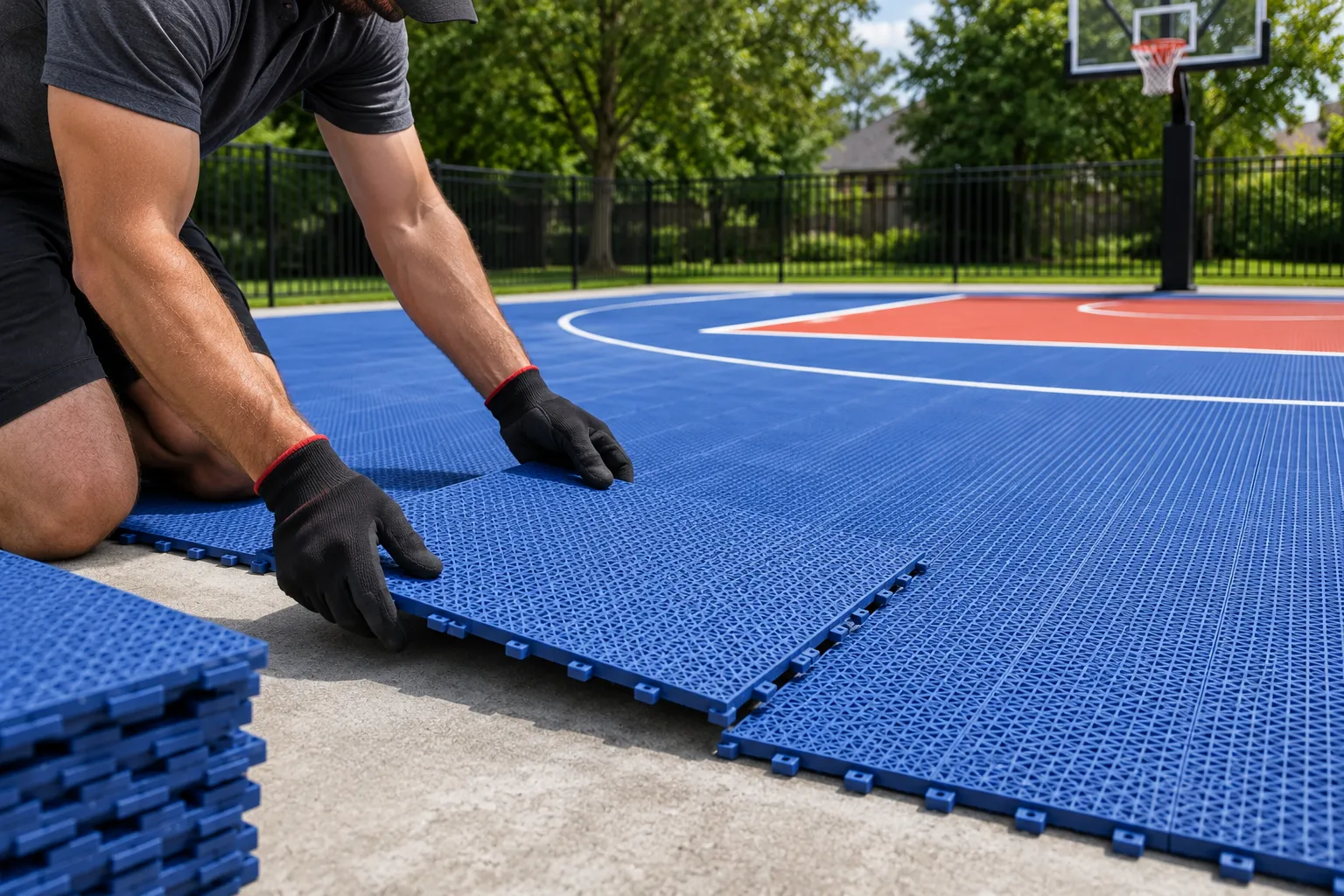
A typical installation involves:
- Cleaning and inspecting the foundation.
- Confirming the court layout and hoop position.
- Arranging and connecting the tiles according to the manufacturer’s instructions.
- Checking alignment and court markings.
- Leaving the required expansion clearances.
- Installing compatible ramp edges and any specified anchors.
Some flooring systems require cutting tiles to fit the available space.
Small outdoor courts may also require specific anchoring arrangements to prevent movement during play.
However, securing every edge can restrict thermal expansion in certain systems. Follow the installation instructions for the exact product rather than using a generic anchoring method.
Applying Acrylic Sports Coatings
Installing an acrylic basketball court surface involves more than painting concrete or asphalt.
A typical sports coating process includes:
- Cleaning and inspecting the existing pavement.
- Repairing suitable cracks, depressions, and surface defects.
- Allowing new pavement to cure as required.
- Applying the specified primer or resurfacer.
- Installing the color coatings and any selected cushion layers.
- Painting the basketball court lines.
- Allowing the finished surface to dry and cure before play.
The required number of coats, preparation methods, and drying times depend on the chosen coating system and weather conditions.
Always use products specifically intended for sports courts.
Ordinary household paint and generic driveway sealers should not be assumed suitable for basketball.
DIY vs Professional Installation
Installing interlocking tiles over an existing suitable foundation is one of the more accessible DIY flooring projects.
However, constructing a new foundation is a separate task that may require professional equipment, engineering, and drainage design.
Professional installation is particularly worth considering when the project involves:
- Major pavement repairs.
- Excavation and grading.
- New concrete or asphalt construction.
- Large or complex basketball courts.
- Specialized cushioned coatings.
- Commercial or competition facilities.
Before attempting DIY installation, confirm that it will not affect the manufacturer’s warranty.
Outdoor Basketball Court Flooring Maintenance and Lifespan
Regular maintenance helps preserve the appearance and playing characteristics of an outdoor basketball court.
Maintenance requirements depend on the flooring material, climate, and frequency of use.
Maintaining Interlocking Basketball Court Tiles
Modular outdoor sports tiles generally require routine cleaning and inspection.
Remove leaves, dirt, and debris from the playing surface and drainage openings.
Check for:
- Loose or damaged tile connections.
- Raised or buckled panels.
- Damaged perimeter ramps.
- Worn court markings.
- Debris or standing water beneath the flooring.
Individual damaged tiles may be replaceable without renewing the entire court.
Keeping spare matching tiles can make future repairs easier.
Use cleaning products and equipment approved by the flooring manufacturer, particularly around painted court lines.
Maintaining Acrylic-Coated Courts
Acrylic sports surfaces require cleaning, inspection, and occasional resurfacing.
Remove dirt, leaves, and other materials that could affect traction.
Inspect the court for worn coatings, cracks, peeling paint, and areas where water collects.
Minor surface defects may be repairable using compatible products.
However, cracks caused by ongoing foundation movement may require more substantial work.
Applying another coating over structural damage will not permanently resolve the underlying problem.
Maintaining Bare Concrete and Asphalt
Bare pavement should be kept clean and checked regularly for cracks, raised edges, and drainage problems.
Repair defects before they become significant playing hazards.
If you intend to add sports flooring later, confirm that any existing sealers or repair materials are compatible with the new system.
How Long Does Outdoor Basketball Court Flooring Last?
There is no single lifespan that applies to every outdoor basketball flooring system.
Durability depends on:
- Product quality.
- Foundation stability.
- Installation methods.
- Weather exposure.
- Frequency of use.
- Maintenance and repairs.
Some manufacturers offer long-term material warranties, but a warranty is not a guarantee of how long the entire court will remain playable.
Check whether the warranty covers flooring materials, painted lines, installation labor, replacement costs, and shipping.
When comparing flooring options, consider future cleaning, repairs, resurfacing, and replacement expenses alongside the initial purchase price.
Frequently Asked Questions
What Is the Best Flooring for an Outdoor Basketball Court?
Acrylic-coated concrete or asphalt is a practical all-round choice for permanent outdoor courts with suitable foundations.
Interlocking outdoor sports tiles are an attractive alternative for homeowners who want customizable designs and replaceable flooring panels.
The best option depends on the existing base, budget, climate, and intended use.
What Is the Cheapest Outdoor Basketball Court Surface?
Using existing suitable concrete or asphalt is often the cheapest option because it avoids purchasing additional flooring.
If you need to construct a new foundation, compare local concrete and asphalt installation prices rather than assuming one material is always cheaper.
Are Outdoor Basketball Court Tiles Worth It?
Outdoor basketball court tiles can be worth buying if you want custom colors, replaceable panels, and a modular flooring system.
However, they still require an approved foundation. Compare the complete installation cost against acrylic-coated pavement before purchasing.
Can Basketball Court Tiles Be Installed Over Concrete?
Yes. Many outdoor basketball court tiles are designed for installation over suitable concrete.
The slab must meet the manufacturer’s requirements for stability, evenness, surface condition, and drainage.
Significant foundation defects should be addressed before installation.
Can You Put Basketball Court Tiles on Grass?
Standard rigid interlocking basketball court tiles should not be installed directly on grass, loose gravel, sand, or soil.
These materials can shift or settle, resulting in an uneven playing surface.
Some manufacturers offer alternative foundation systems that use compacted aggregate and specialized supporting panels. These are complete foundation assemblies rather than ordinary tiles placed directly on grass.
VersaCourt’s installation FAQs explain this distinction.
Is Rubber Flooring Good for Outdoor Basketball?
Purpose-designed rubberized sports flooring may be suitable for outdoor basketball.
However, ordinary rubber gym mats and playground flooring are not necessarily designed to provide appropriate basketball bounce, traction, or outdoor durability.
Check the performance documentation for the exact flooring system.
Do Outdoor Basketball Court Tiles Get Slippery When Wet?
Yes, outdoor basketball court tiles can become slippery when wet.
Perforated tiles allow water to pass through the surface, but this does not guarantee safe traction during rainfall.
Allow the surface to dry and remove any standing water, debris, or ice before playing.
Can You Install Basketball Court Flooring Over an Existing Driveway?
Yes, if the driveway meets the flooring manufacturer’s installation requirements.
If you intend to continue parking vehicles on the driveway, choose a flooring product specifically rated for vehicle traffic.
Standard outdoor basketball court tiles may not be suitable for supporting vehicles.
Final Thoughts
The best outdoor basketball court flooring is a surface that suits your foundation, budget, climate, and playing requirements.
Acrylic-coated pavement provides a practical permanent sports surface, while interlocking basketball court tiles offer greater customization and the convenience of replaceable panels.
Existing concrete or asphalt may be sufficient for homeowners who want a simple, inexpensive shooting area.
Before purchasing any flooring, inspect the foundation, check drainage, compare complete installation costs, and review the manufacturer’s technical requirements.
A properly prepared foundation is just as important as the flooring installed above it.
Featured image: PP Tiles – Multipurpose Court 4 by Rayzonglobal001, via Wikimedia Commons, licensed under CC BY-SA 4.0. Converted to WebP.

3 thoughts on “Outdoor Basketball Court Flooring | Types, Costs & Best Surfaces”
Comments are closed.