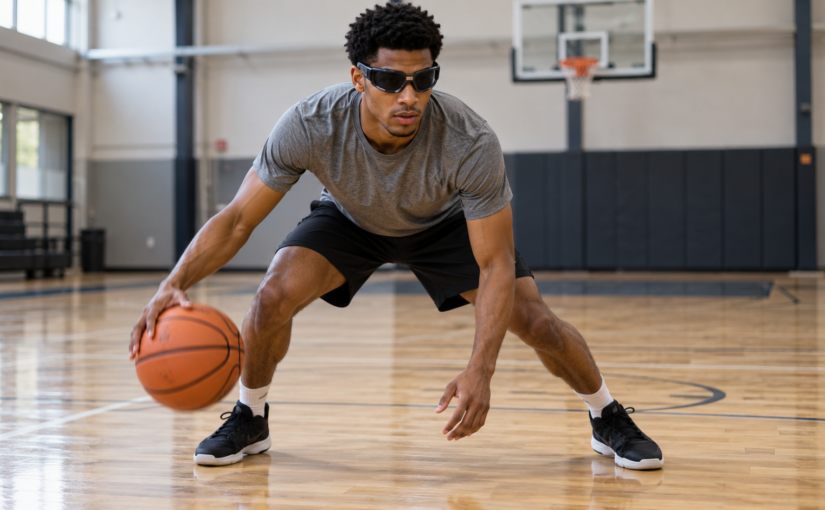
Dribbling goggles can help if you keep looking down at the basketball.
Their job is simple. They block part of your lower vision, making it harder to watch the ball while you dribble. That encourages you to control the ball more by feel and keep your eyes farther out toward the court.
Some real research supports this type of training. However, dribbling goggles are not a shortcut to better court vision, basketball IQ, passing, or decision-making.
They are a training aid for one specific problem: depending too much on seeing the basketball while you dribble.
What Are Dribbling Goggles?
Dribbling goggles are usually lensless frames with a solid lower section.
You can still see forward, while part of your lower field of vision is blocked. This makes it difficult to look down and keep track of the basketball without moving your whole head.
They are sometimes called dribbling glasses, dribble blinders, or ball-handling goggles.
The idea is to make you rely less on watching the basketball.
That matters because basketball players need to see defenders, teammates, open space, and the basket while controlling the ball. Jr. NBA coaching material also teaches players to dribble without constantly looking down so they can see more of the court.
Do Dribbling Goggles Actually Work?
There is some evidence that they can help reduce downward-looking habits.
A 2019 study divided 15 skilled male basketball players into three groups. Five trained with spatial-occlusion goggles, five practiced normally, and five acted as a control group. The players had at least 10 years of basketball experience.
The training groups completed 400 crossover-dribble sequences over four days.
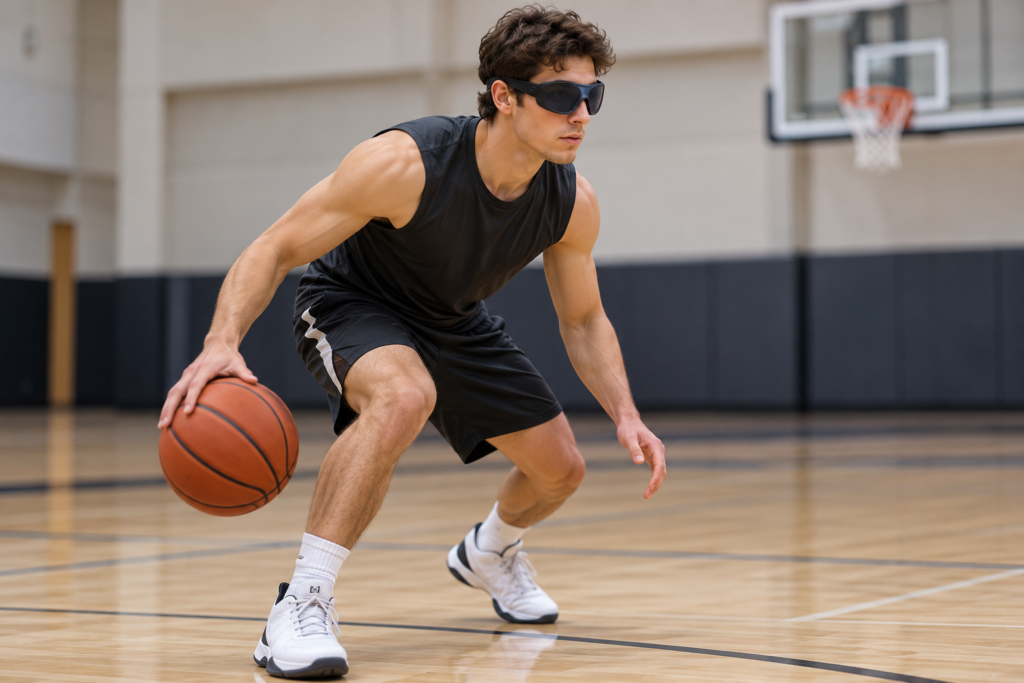
Players who trained with the goggles significantly reduced their downward gaze errors. The improvement was also still seen during later testing after the goggles had been removed.
That is useful evidence.
But the study was small, and the players performed a controlled crossover drill in a laboratory. There were no defenders, teammates, passing reads, or live game decisions.
So the evidence supports a fairly narrow conclusion:
Dribbling goggles can help train you to control the basketball without constantly looking down at it.
They have not been proven to automatically improve overall court vision or game performance.
What Can Dribbling Goggles Help With?
Their most useful role is improving ball control without constantly looking at the ball.
They can help you:
- notice how often you look down
- practice dribbling with an outward gaze
- rely more on feel while controlling the ball
- work on keeping your visual attention away from the basketball
They can also make simple ball-handling skills harder by removing the visual feedback you normally rely on.
Research supports reduced downward gaze during controlled dribbling, although the evidence is still limited.
This makes dribbling goggles useful for a player who already knows how to dribble but keeps checking where the ball is.
What Dribbling Goggles Cannot Teach
Looking up is not the same thing as having good court vision.
Dribbling goggles can make it harder to watch the ball, but they do not teach you what to look at instead.
They cannot automatically teach:
- how to read a defender
- where help defense is coming from
- when a teammate is open
- how to find passing lanes
- change of pace
- crossover technique
- weak-hand control
- ball protection
- footwork
- basketball IQ
Those skills still need proper drills and game-like practice.
This is where some marketing goes too far.
Claims that dribbling goggles improve peripheral vision, reaction time, basketball IQ, or make you improve twice as fast are not supported by the basketball research found.
Who Should Use Dribbling Goggles?
The best candidate is a beginner or intermediate player who can already control a basic dribble but still keeps looking down.
The goggles can expose that habit because the ball becomes harder to see in your lower field of vision.
They may be less useful for a complete beginner.
If you can barely control the basketball yet, occasionally looking at it can still help while you learn the basic hand-ball relationship. You can gradually reduce that dependence as your control improves.
Advanced players may get less benefit if they already dribble naturally without watching the ball.
At that stage, reacting to defenders, reading movement, making passes, and playing small-sided games are likely to be more useful than simply blocking your lower vision.
Best Dribbling Goggles
You do not need an expensive pair.
The basic mechanism is simply blocking the lower part of your vision, and there is no evidence that paying more creates a better training effect.
HoopsKing Basketball Dribble Goggles
The HoopsKing Basketball Dribble Goggles currently cost around $3.99 direct from HoopsKing.
They use a simple adjustable, lensless design that blocks the lower field of vision.
For value, they are probably the most sensible option.
I would ignore HoopsKing’s stronger claims about improving reaction time, peripheral vision, or helping players improve twice as fast. Those are manufacturer claims rather than proven results.
Otter Basketball Ball-Handling Goggles
Otter Basketball also sells a basic pair for around $5.
They use the same general concept: stop the player from easily watching the basketball during ball-handling drills.
There is not much independent owner evidence, but at that price they are another reasonable low-cost option.
SKLZ Court Vision
SKLZ Court Vision is probably the best-known product in this category.
It has an adjustable elastic strap, flexible plastic construction, and blocks part of your lower view during dribbling.
The problem is current US availability.
SKLZ still references Court Vision in its basketball material, but it was not clearly available through the current US product range during the research. Walmart showed a $19.99 listing that was out of stock.
That makes it difficult to recommend over a $4 or $5 alternative unless you find it easily available.
Chin Up Goggles
Chin Up Goggles are the most interesting option from a research point of view.
The product is closely connected with the research group that studied spatial-occlusion training in basketball. The current price found was €14.99 plus international shipping.
For US players, the extra buying hassle probably makes them more interesting as a research-backed example than as the obvious product to buy.
How Should You Use Dribbling Goggles?
There is no proven rule such as:
- 10 minutes every day
- three sessions per week
- 21 days of training
The basketball study used 100 crossover sequences per day for four days, but that does not mean this is the perfect training schedule for everyone.
A more sensible approach is to use goggles for short parts of your workout.
For example:
normal warm-up → goggles drill → remove goggles → repeat the drill normally → add a decision or visual cue
The goal is not to become good at wearing goggles.
The goal is to keep the same head-up control after you take them off.
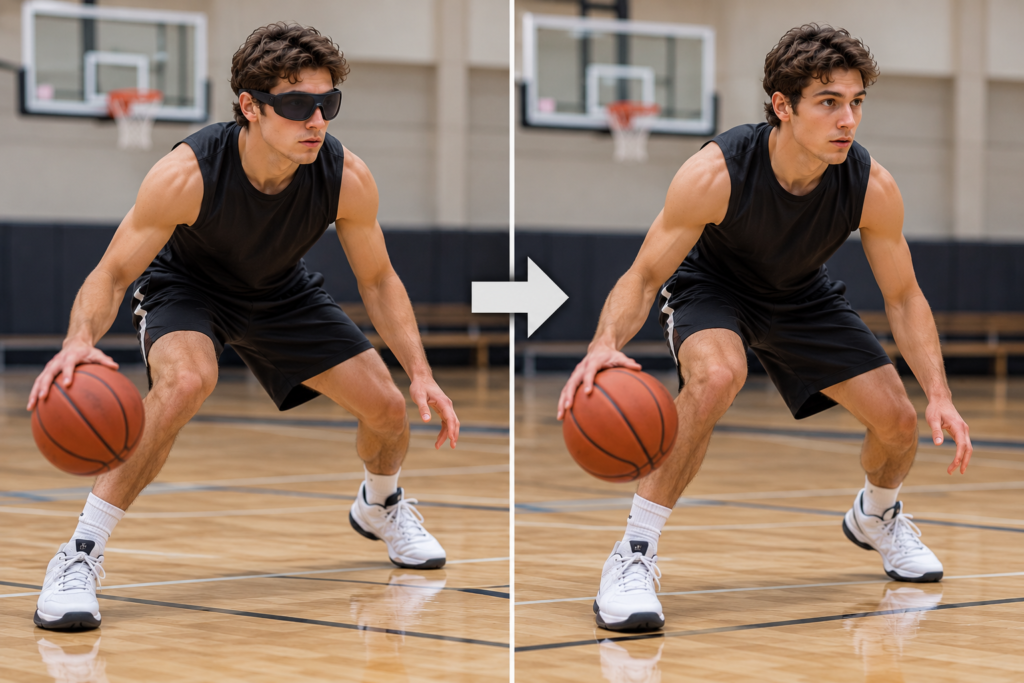
Ball Handling Drills With Dribbling Goggles
Stationary Ball-Handling
Start with simple pound dribbles using each hand.
Then add:
- crossovers
- between-the-legs dribbles
- behind-the-back dribbles
Keep the movement controlled.
These dribbling drills should stay controlled before you add more speed.
The crossover drill is especially relevant because it is similar to the task used in the published spatial-occlusion study.
Moving Dribbling
Once you can control the ball comfortably, start moving.
Walk first, then jog, then add changes of direction.
Do not immediately start sprinting through crowded drills. These goggles deliberately block part of your vision and are not protective eyewear.
Partner Number Drill
Have somebody stand in front of you while you dribble.
They can:
- hold up fingers
- call numbers
- show colors
- point left or right
You have to identify the cue without stopping your dribble.
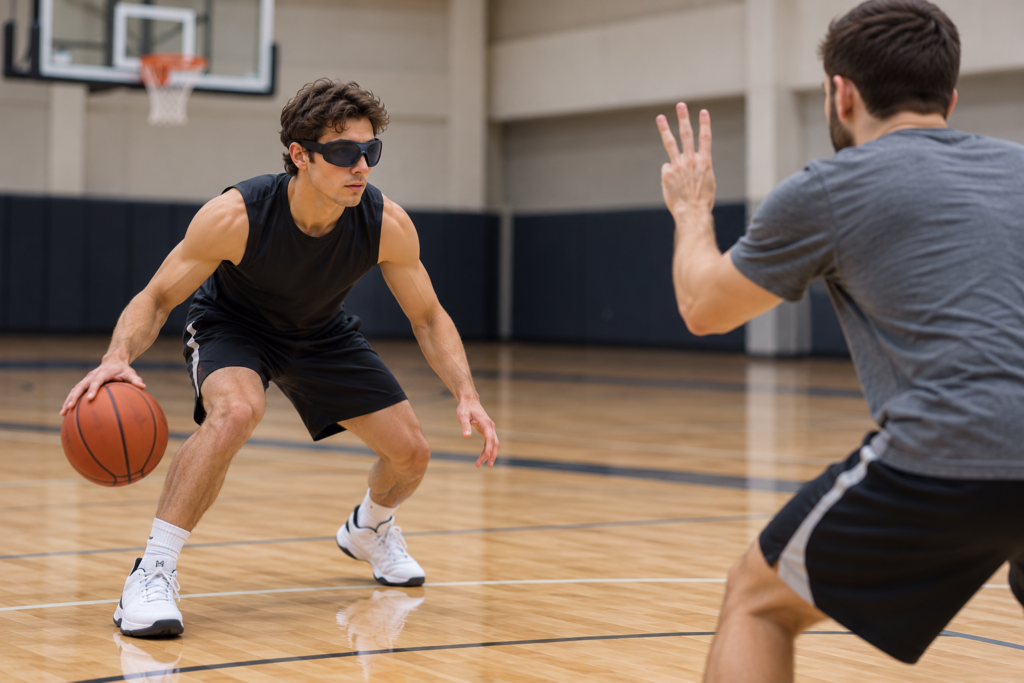
This is better than simply trying to stare straight ahead because your eyes now have something useful to process.
Goggles On, Goggles Off
Perform a short drill wearing the goggles.
Then take them off and immediately repeat the same movement.
Try to keep your gaze outward even though you can see the basketball again.
This directly tests whether the habit is transferring to normal basketball.
Free Alternatives to Dribbling Goggles
You do not need goggles to learn head-up dribbling.
A training partner can hold up fingers while you dribble and ask you to call out the number.
You can also focus on:
- a clock
- a spot on the wall
- the backboard
- a distant object
- colored cones
- directions given by a coach or partner
Small-sided games and one-on-one play become important once you have enough ball control because you have to react to real basketball information.
That is why I would describe dribbling goggles as convenient rather than necessary.
If you already have somebody who can give you visual cues while you dribble, you may not need to buy them at all.
If you’re building a wider training setup, our guide to basketball training equipment also covers other tools and cheaper alternatives.
Common Dribbling Goggles Mistakes
One mistake is wearing them for the entire workout.
There is no evidence that more visual restriction is automatically better. You still need plenty of normal basketball practice.
Another mistake is thinking that “head up” means staring rigidly straight ahead.
Your eyes should move around the court and collect useful information.
You also should not expect the goggles to fix poor dribbling technique. They do not automatically correct your hand placement, stance, footwork, pace, or weak hand.
And do not rush into high-speed drills before you have enough control. Blocking part of your lower vision makes that unnecessarily riskier.
FAQ
Do dribbling goggles improve peripheral vision?
There is no good evidence that they improve your actual peripheral vision.
They restrict part of your vision and encourage you to stop looking down at the basketball. That is different from improving your visual system itself.
Are dribbling goggles good for beginners?
They can be useful once a beginner has enough control to dribble consistently but still keeps looking down.
The main basketball study involved experienced adult players, so dribbling goggles have not been scientifically proven specifically for young beginners.
How long should you wear dribbling goggles?
There is no research-backed exact duration.
Use them in short training blocks, then remove them and repeat the drill normally.
Can you learn head-up dribbling without goggles?
Yes.
Partner cues, wall targets, coach instructions, two-ball drills, and normal game-like practice can all train you to control the ball without constantly watching it.
Are SKLZ Court Vision goggles worth it?
They are a legitimate training aid, but there is no evidence that they train head-up dribbling better than much cheaper goggles using the same basic design.
If you find them easily available and prefer the construction, they can make sense. Otherwise, a cheaper pair can probably perform the same basic job.
Final Verdict
Dribbling goggles can be useful if you repeatedly look down at the basketball.
There is limited but real research showing that spatial-occlusion training can reduce downward gaze during dribbling, and that change can remain after the goggles are removed.
But keep their purpose narrow.
They do not automatically create court vision, basketball IQ, better reactions, or better decisions.
They simply make it harder to watch the basketball.
For a player who needs help breaking that habit, a cheap pair of dribbling goggles can be worth trying.
For everyone else, normal head-up drills, external visual cues, and live basketball practice may be enough without goggles.
One thought on “Dribbling Goggles: Do They Actually Work?”
Comments are closed.