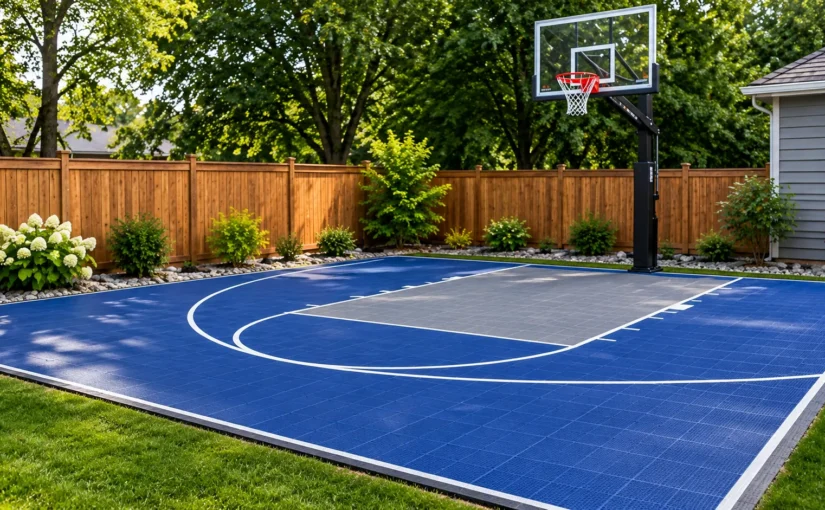
You can build a DIY basketball court without concrete by using an engineered compacted stone base, foundation panels, or gravel-filled pavers. Asphalt and existing paved surfaces are also suitable alternatives.
However, avoiding concrete does not mean you can skip ground preparation. Basketball needs a firm, stable, and even playing surface for consistent ball bounce.
Ordinary interlocking sports tiles should not be placed directly over grass, dirt, or loose gravel.
This guide compares concrete-free basketball court foundations, explains their costs, and helps you choose the right option for your backyard.
Can You Build a Basketball Court Without Concrete?
Yes. Several basketball court foundation systems eliminate the need to pour a concrete slab.
The main alternatives include:
- Engineered compacted gravel and crushed stone bases.
- Interlocking foundation panels.
- Gravel-filled pavers.
- Asphalt pavement.
- Existing driveways and patios.
Some options offer better drainage and are easier to remove than permanent concrete slabs. However, their suitability depends on ground conditions, installation quality, and flooring requirements.
Building without concrete does not necessarily reduce costs. Some engineered foundation systems cost as much as a concrete slab before you add the playing surface.
Best Alternatives to Concrete for a Basketball Court
Each foundation has different installation requirements, costs, and playing characteristics.
1. Compacted Gravel and Crushed Stone
An engineered crushed stone base is one of the more affordable alternatives to a concrete basketball court foundation.
Unlike loose gravel, an engineered stone base contains carefully prepared and compacted aggregate layers that support modular sports flooring.
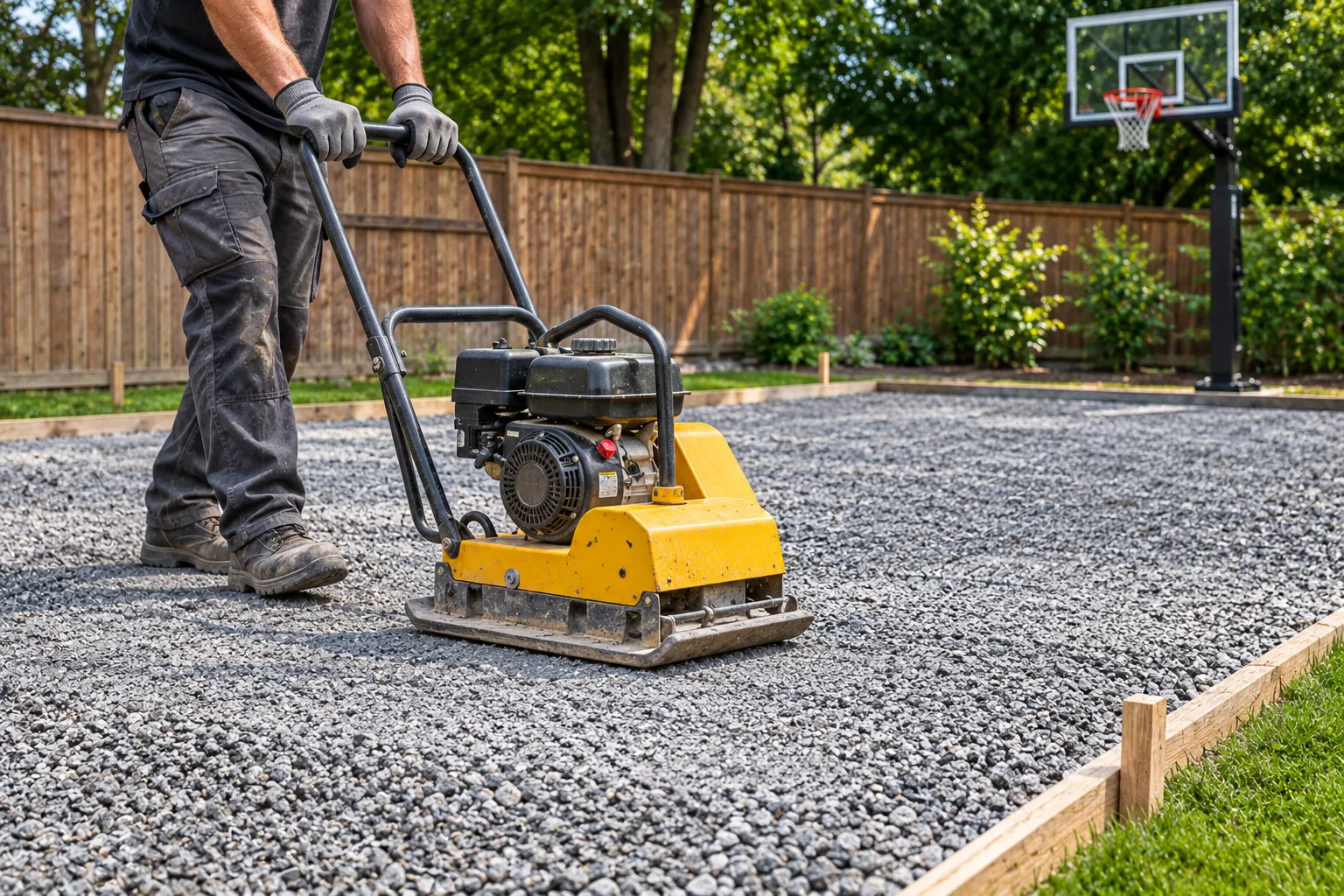
Depending on the flooring manufacturer, the foundation may require:
- Angular crushed stone.
- Geotextile fabric.
- Geogrid reinforcement.
- Edge restraints.
- Fine stone screenings.
- Rubber underlayment.
Manufacturers such as Game Tile Courts, VersaCourt, and FlexCourt provide installation guidance for alternative stone foundations.
However, their specifications differ.
| Manufacturer | Stone base specification | Additional requirements |
|---|---|---|
| Game Tile Courts | 4 inches of compacted crushed stone and 1 inch of smaller stone | Geotextile layers and edge restraints |
| VersaCourt | 2–3 inches of crusher run and 1–2 inches of screenings | Geotextile and rubber underlayment |
| FlexCourt | 3–4 inches of initial crushed stone, then 2–3 inches and 1–2 inches of progressively finer screenings | Geotextile and geogrid |
Sources: Game Tile Courts, VersaCourt, and FlexCourt.
These are individual flooring-system specifications, not universal finished base depths. FlexCourt also specifies a thicker initial layer for courts over 4,000 square feet, which settles to 3–4 inches after compaction and watering. Do not combine the manufacturers’ instructions.
Advantages
- No permanent concrete slab.
- Potentially lower material costs.
- Good drainage with an appropriate permeable design.
- Compatible with certain modular court flooring systems.
Disadvantages
- Requires careful excavation and compaction.
- May settle unevenly over time.
- Ball bounce may be softer than on a rigid slab.
- Some flooring manufacturers and installers do not support stone foundations under their warranties.
A compacted stone base is worth considering if you have a limited budget and can obtain an approved installation specification for your chosen sports tiles.
2. Engineered Foundation Panels
Engineered foundation panels provide a structural base for basketball court flooring without requiring a poured slab.
Unlike ordinary interlocking sports tiles, these panels are designed to support the playing surface above them.
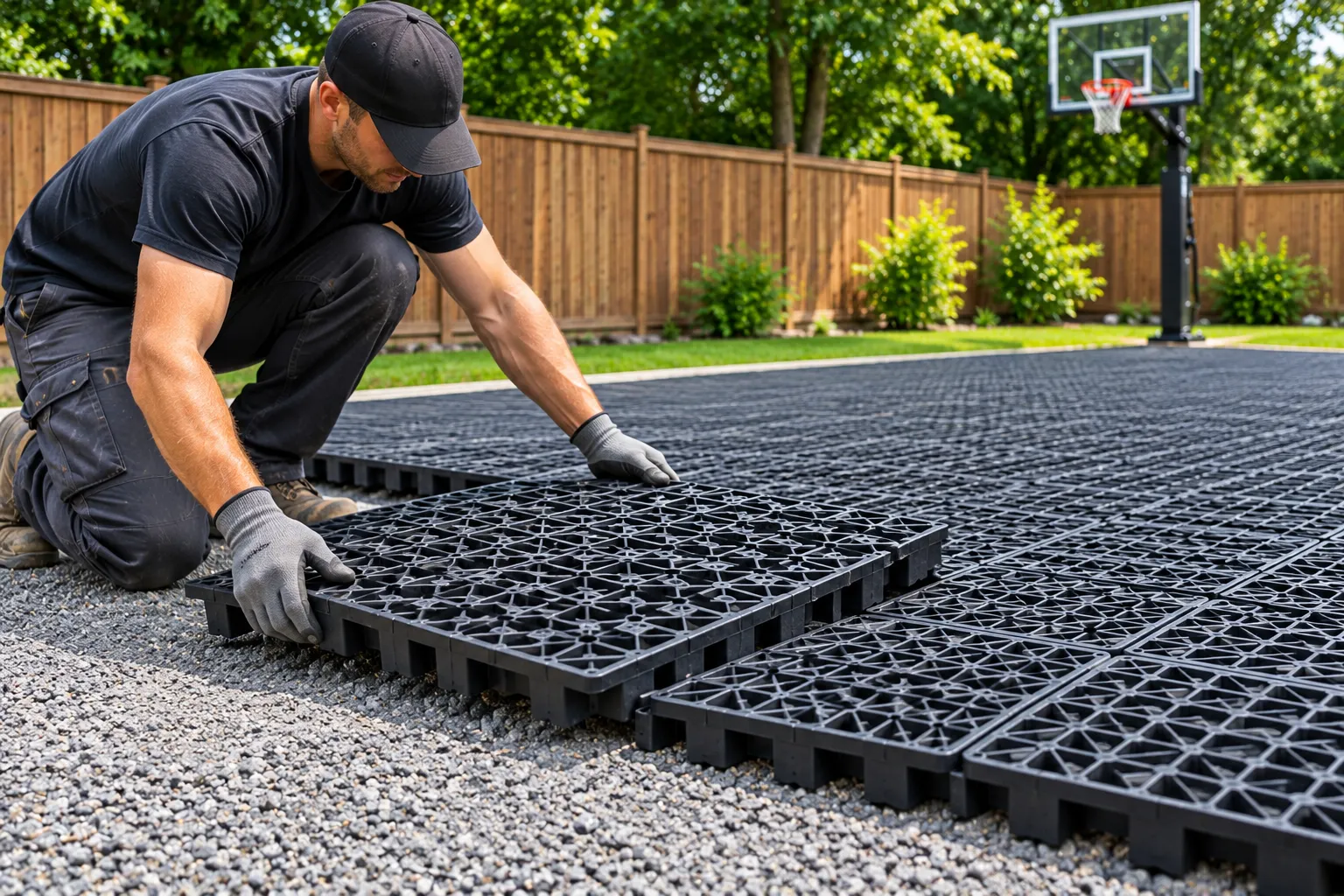
Examples include:
| Foundation system | Intended application | Additional sports tiles required? |
|---|---|---|
| VersaCourt Foundation Panel | Alternative court foundation | Yes |
| Ultra Base Foundation Panel | Alternative sports surface foundation | Yes |
| Ultra Base Court Panel | Standalone court surface | No |
The VersaCourt Foundation Panel uses interlocking panels that allow water to drain through the foundation.
The manufacturer reports that its panels withstand pressures exceeding 500 pounds per square inch and provide vertical drainage of 424.5 inches per hour according to its published specifications.
These figures describe the manufacturer’s panel performance. They do not guarantee that the completed court will drain at the same rate because the underlying soil also affects drainage.
Ultra Base Systems offers foundation panels and court panels designed for installations without concrete.
Foundation panels still require a firm, properly prepared surface. Depending on the product and site conditions, this may involve compacted aggregate or another approved base.
Advantages
- No poured concrete slab.
- Interlocking installation.
- Potential for improved drainage.
- Panels can potentially be removed and relocated.
Disadvantages
- Higher material costs than basic aggregate.
- Ground preparation may still require professional equipment.
- Installation requirements and warranties vary.
- Limited independent basketball bounce performance data.
Foundation panels are particularly worth considering if you want a removable court or face restrictions on permanent paved surfaces. Check whether your local authority counts the entire proposed court assembly as permeable before buying.
3. Gravel-Filled Pavers
Gravel-filled pavers use interconnected grids that hold aggregate in place. They help create a more stable foundation than loose gravel alone.
ModuTile offers gravel pavers for outdoor basketball court foundations.
Its suggested construction includes a compacted ground surface, an aggregate base, gravel-filled pavers, geotextile fabric, and modular sports tiles.
The pavers help restrict aggregate movement, but they do not eliminate the need for excavation, leveling, and compaction.
Advantages
- Permeable foundation design.
- Helps stabilize aggregate.
- No permanent concrete slab.
- Compatible with certain modular flooring systems.
Disadvantages
- Additional material and installation costs.
- Requires careful ground preparation.
- Poor installation may cause uneven surfaces.
- Limited independent basketball performance evidence.
Follow the complete system manufacturer’s instructions rather than purchasing general landscaping grids and assuming they will support basketball flooring.
4. Asphalt
Asphalt provides a firm, paved surface without using a concrete slab.
It supports consistent basketball bounce and can accommodate acrylic sports coatings or compatible modular tiles.
However, asphalt is still a permanent pavement. Standard asphalt also creates an impervious surface, which may be unsuitable if your reason for avoiding concrete is a local drainage or lot-coverage restriction.
Advantages
- Firm playing surface.
- Compatible with several outdoor flooring options.
- May cost less than concrete in some locations.
Disadvantages
- Generally requires professional installation.
- Can develop cracks and surface deterioration.
- Requires maintenance.
- Not easily removable.
Asphalt is a practical alternative if you want to avoid concrete specifically, rather than avoid permanent pavement altogether.
5. Existing Driveways and Patios
Using an existing hard surface is often the simplest and least expensive way to create a basketball court without pouring new concrete.
A suitable driveway, patio, or paved area can support a portable basketball hoop and compatible outdoor basketball court flooring.
Before installing flooring, inspect the existing surface for:
- Large cracks and potholes.
- Uneven sections.
- Standing water.
- Loose paving stones.
- Excessive slopes.
Repair significant defects before installing court tiles.
If you use an existing concrete driveway, you are avoiding new concrete construction rather than creating an entirely concrete-free court.
This option works particularly well for homeowners who want a small shooting area instead of a dedicated full-size basketball court.
Concrete-Free Basketball Court Foundation Comparison
The following table compares the main alternatives based on their typical installation characteristics.
| Foundation | Relative cost | DIY difficulty | Ball bounce | Removable? |
|---|---|---|---|---|
| Compacted stone and tiles | Low to moderate | Moderate to high | May be softer | Yes, with work |
| Foundation panels and tiles | Moderate to high | Moderate | System-dependent | Yes |
| Gravel-filled pavers and tiles | Moderate | Moderate | System-dependent | Yes, with work |
| Asphalt | Moderate to high | Professional installation | Firm | No |
| Existing pavement | Low | Low | Good if suitable | No |
| Grass or dirt | Minimal | Low | Poor and inconsistent | Not applicable |
Actual performance depends on installation quality, soil conditions, drainage, and the selected flooring system.
There is insufficient independent testing to establish that foundation panels or compacted stone systems consistently match concrete in basketball bounce performance or durability.
Can You Install Basketball Court Tiles on Grass, Gravel, or Dirt?
Ordinary basketball court tiles should not be installed directly over grass, dirt, sand, or loose gravel.
These surfaces can shift, compress, and become uneven, particularly after rainfall or repeated use.
Basketball Court Tiles on Grass
Grass does not provide a sufficiently firm foundation for standard sports tiles.
Tiles may sink into wet ground, creating uneven sections and inconsistent basketball bounce. Covered grass may also deteriorate because of limited sunlight.
Remove the grass and prepare an approved foundation before installing flooring.
Basketball Court Tiles on Gravel
Loose gravel can move beneath the tiles and cause sections of the playing surface to settle.
However, certain manufacturers support installations over specially prepared compacted stone foundations.
The important distinction is between loose gravel and a complete engineered aggregate base.
Basketball Court Tiles on Dirt
Bare soil changes with moisture, temperature, and repeated foot traffic.
It can develop depressions, become muddy, or shift beneath the flooring.
Even compacted soil should not support ordinary sports tiles unless the flooring manufacturer specifically approves that installation method.
The VersaCourt FAQ explains why unsupported surfaces can cause tiles to sink and affect playing performance.
How Much Does a Basketball Court Without Concrete Cost?
A concrete-free basketball court can cost several thousand dollars or more, depending on its size, foundation system, flooring, and site preparation.
Avoiding a concrete slab does not automatically make the project cheaper.
Material Costs per Square Foot
The following prices provide examples from US suppliers, distributors, and industry cost guides.
| Material | Example price per square foot |
|---|---|
| Engineered foundation panels | $5.25–$10.01 |
| Gravel-filled pavers | $2.59–$3.89 |
| Interlocking sports tiles | $4–$8 |
| Standalone Ultra Base Court Panels | $6.35–$8.73 |
Pricing references checked November 27, 2026: the Ultra Base August 2024 price list gives preferred and suggested retail prices of $5.25–$7.23 per square foot for foundation panels and $6.35–$8.73 for standalone court panels. These are historical figures, and preferred pricing may not be available to every buyer. Greatmats lists the VersaCourt foundation panel at $54.45 per panel, or about $10.01 per usable square foot. The paver range comes from ModuTile, while the tile range comes from Court Baseline’s 2026 sports tile cost guide. Obtain current quotes before purchasing.
For comparison, Court Baseline’s 2026 basketball court cost guide estimates $6–$11 per square foot for an installed concrete slab, including its base and reinforcement.
Comparing panel material prices with installed concrete prices illustrates why a concrete-free foundation is not necessarily cheaper.
Example Costs for a 30 × 30-Foot Court
A 30 × 30-foot backyard basketball court covers 900 square feet.
The following estimates show selected material costs for that area.
| Foundation and flooring | Estimated cost | Cost basis |
|---|---|---|
| Compacted stone and sports tiles | $4,200–$8,325 | Selected materials |
| Foundation panels and sports tiles | $8,325–$16,209 | Materials |
| Gravel-filled pavers and sports tiles | $5,931–$10,701 | Materials, excluding gravel |
| Standalone court panels | $5,715–$7,857 | Panels only |
| Existing pavement with sports tiles | $3,600–$7,200 | Flooring only |
For the compacted stone example, a combined compacted aggregate depth of 5 inches across 900 square feet requires approximately 13.9 cubic yards of material volume.
For illustration, assuming approximately 1.44–1.62 US short tons per cubic yard of compacted aggregate gives about 20–22.5 tons. At the $30–$50 per ton reference range published by Hello Gravel, that gives about $600–$1,125 for stone. These density assumptions are illustrative, not supplier specifications; local prices can be considerably higher.
Your actual material requirements depend on stone density, compaction, excavation depth, and the supplier’s recommendations.
These estimates exclude labor, delivery, drainage, edging, basketball hoops, permits, and other construction expenses. They also exclude extra material for cuts, waste, and any separate aggregate base required beneath the panels or pavers.
Additional Installation Expenses
Set aside additional money for the following:
- Excavation and soil removal.
- Aggregate delivery.
- Ground leveling.
- Compaction equipment rental.
- Geotextile fabric and geogrid.
- Edge restraints.
- Drainage systems.
- Court markings.
- Basketball hoops.
- Professional installation.
A hillside, poorly draining soil, or restricted construction access can significantly increase project costs.
Obtain separate quotes for ground preparation, foundation materials, and flooring. This makes it easier to compare alternative construction methods accurately.
How to Build a DIY Basketball Court Without Concrete
The installation process depends on your chosen foundation system. After preparing the ground, choose either the approved stone-base method or the approved foundation-panel method. They are alternatives unless your panel manufacturer requires a stone base.
Always obtain the manufacturer’s instructions before purchasing materials or beginning excavation.
Step 1: Prepare the Ground
Choose a location with sufficient playing space, appropriate clearance, and suitable drainage.
Check local permit requirements, property setbacks, and any homeowners association restrictions.
In the United States, contact 811 before digging to arrange underground utility marking.
Remove grass, roots, and unsuitable topsoil according to your foundation system’s requirements.
The prepared ground must provide stable support without soft spots or large depressions.
Consider hiring a professional if the land has a steep slope, expansive clay soil, or serious drainage problems.
Step 2: Install a Compacted Stone Base
A manufacturer-approved stone foundation generally involves the following process:
- Excavate and prepare the underlying soil.
- Install edge restraints and geotextile fabric as specified.
- Add crushed stone in manageable layers.
- Compact each layer using appropriate equipment.
- Install the specified upper aggregate or screening layers.
- Check surface evenness and drainage.
- Add any required flooring underlayment.
For example, Game Tile Courts specifies compacting its main crushed stone layer in 2-inch lifts and checking that the finished base deviates by no more than 3/8 inch across a 10-foot straightedge. It also describes an optional 1% drainage slope. Other flooring systems may require a different slope or flatness tolerance.
VersaCourt uses a different stone foundation design that includes rubber underlayment beneath its sports flooring.
Do not substitute one manufacturer’s instructions for another.
Step 3: Install Engineered Foundation Panels
If you choose foundation panels instead of a conventional stone base, prepare the underlying surface according to the panel manufacturer’s specifications.
Install the required geosynthetic underlayment, connect the panels, and add compatible edge pieces.
Check the foundation for movement and uneven sections before installing the playing surface.
Some panel systems can be installed over firm, compacted ground, while others may require a prepared aggregate foundation.
Confirm the requirements for your particular product before buying.
Step 4: Install Basketball Court Tiles
Once the foundation is ready:
- Check that the surface is stable and even.
- Arrange the tiles according to your court layout.
- Connect the interlocking sections.
- Leave the required expansion space around fixed objects.
- Install compatible edging and ramps.
- Apply court markings using an approved method.
Plastic sports tiles expand and contract with temperature changes. Installing them tightly against walls, fencing, or hoop posts may cause problems.
Use the manufacturer’s specified expansion clearances.
If you purchase a standalone court panel system, follow its surface finishing and marking instructions instead of adding unnecessary flooring.
When Should You Hire a Professional?
Installing interlocking tiles is generally more manageable for DIY projects than preparing the underlying foundation.
Professional assistance is worth considering for significant excavation, drainage design, difficult soil conditions, asphalt paving, structural hoop mounting, and large court installations.
Mistakes beneath the flooring can be expensive to repair after the court is complete.
How to Install a Basketball Hoop Without Concrete
Building a basketball court without a concrete playing surface does not necessarily mean the basketball hoop can also be installed without concrete.
The type of hoop determines the mounting requirements.
Portable Basketball Hoops
A portable basketball hoop is usually the simplest option when you want to avoid pouring concrete entirely.
The hoop uses a weighted base rather than a permanent underground footing.
Depending on the model, the base may require water, sand, or a manufacturer-approved ballast system.
Portable hoops offer several advantages:
- No permanent concrete footing.
- Adjustable positioning.
- Easier removal or relocation.
- Suitable for many driveway and backyard setups.
However, portable hoops can tip if incorrectly assembled, insufficiently weighted, or exposed to strong winds.
Follow the manufacturer’s ballast, placement, and severe-weather instructions.
If you plan to position the weighted base directly on modular sports tiles or foundation panels, confirm that the flooring system can support the concentrated load.
Wall-Mounted Basketball Hoops
A wall-mounted basketball hoop may eliminate the need for a separate concrete footing.
These hoops attach to an appropriate existing structure, such as a garage or dedicated building. Goalrilla’s basketball hoop buying guide identifies wall-mounted hoops as an alternative to in-ground and portable systems.
The mounting surface must support the loads specified by the manufacturer.
Do not assume that siding, brick veneer, or an unsupported exterior wall can safely hold a basketball hoop.
Professional advice may be necessary to determine whether the structure is suitable.
Why Most In-Ground Hoops Require Concrete
Most residential in-ground basketball hoops use concrete footings to stabilize the support pole or anchor system.
Even an anchor-mounted hoop that can be removed from its mounting plate generally requires concrete beneath that plate.
For example, Goalrilla’s in-ground hoop installation guide explains how to set its anchor kit into a concrete footing.
If your goal is to avoid a concrete playing slab, you can still install a conventional in-ground hoop with a separate concrete footing.
If you want to avoid concrete completely, a suitable portable or wall-mounted hoop is generally the better choice.
Never substitute an improvised ground anchor for a manufacturer-required footing.
Common Mistakes to Avoid
Installing Tiles Directly on Grass or Loose Gravel
Ordinary sports tiles rely on the underlying surface for stability. Unsupported tiles may shift, sink, or create uneven playing areas.
Choosing Rounded Gravel
Rounded pea gravel does not interlock like angular crushed stone. Use the aggregate specified by your foundation manufacturer.
Skipping Proper Compaction
Compacting a thick layer of aggregate all at once may leave less stable material underneath.
Follow the required layer thickness and compaction procedure.
Ignoring Drainage
A permeable playing surface does not guarantee effective drainage.
Water still needs somewhere to go after passing through the flooring and foundation.
Clay soil, low-lying areas, and poor drainage can create problems beneath the court.
Ignoring Warranty Requirements
Some manufacturers approve alternative foundations, while others require concrete, asphalt, or another specific subsurface.
Installing flooring over an unsupported base may invalidate warranty coverage.
Get written confirmation before purchasing materials.
Assuming Concrete-Free Courts Are Always Cheaper
Foundation panels, gravel, edging, geotextile, and equipment rental can add up quickly.
Compare complete project costs rather than individual material prices.
Maintenance and Durability
A concrete-free basketball court requires regular inspection to ensure the foundation and playing surface remain stable.
Maintenance requirements depend on the foundation type, climate, soil conditions, and flooring materials.
| Maintenance task | Purpose |
|---|---|
| Remove leaves and debris | Keep drainage openings clear |
| Inspect tiles for movement | Identify loose or uneven sections |
| Check foundation settlement | Find depressions and unstable areas |
| Inspect edge restraints | Limit unwanted aggregate movement |
| Check drainage after rainfall | Identify pooling and excessive saturation |
| Inspect hoop stability | Reduce equipment-related safety risks |
Compacted stone foundations may require periodic leveling if settlement occurs.
Engineered foundation panels can potentially reduce certain problems associated with loose aggregate, but they are not immune to movement beneath the foundation.
Freezing temperatures, saturated soil, and poor drainage can affect court stability.
There is not enough independent long-term testing to establish a universal lifespan for concrete-free basketball court systems.
Use manufacturer maintenance instructions and inspect the court regularly, especially after severe weather.
Frequently Asked Questions
What Is the Cheapest Alternative to Concrete for a Basketball Court?
Using an existing driveway or suitable paved area is often the cheapest option.
If you need to construct a new foundation, an approved compacted stone base with modular sports tiles may offer lower material costs than engineered foundation panels.
Can You Play Basketball on Compacted Gravel?
Compacted gravel alone is generally unsuitable for regular basketball practice because it does not provide the consistent bounce, traction, and evenness of a proper playing surface.
It is better used as part of an approved foundation beneath sports flooring.
How Deep Should a Gravel Basketball Court Base Be?
There is no universal gravel depth for basketball courts.
Manufacturer examples range from approximately 3–5 inches of specified aggregate layers to more substantial multilayer foundations.
Soil conditions, drainage, climate, and flooring requirements determine the appropriate construction depth.
Can You Build a Temporary Basketball Court?
Yes. A portable basketball hoop on a suitable existing hard surface is one of the easiest temporary setups.
Certain engineered foundation systems and modular flooring products can also be disassembled and relocated, although ground preparation and removal may require considerable work.
Do You Need a Permit for a Concrete-Free Basketball Court?
Possibly. Local authorities may regulate grading, drainage, property setbacks, hoop installations, and recreational structures.
Avoiding concrete does not automatically exempt your project from permit requirements.
Check with your local building or planning department before construction.
Is Building a Basketball Court Without Concrete Cheaper?
Not necessarily.
An approved compacted stone foundation may offer savings, but engineered foundation panels and additional sports flooring can cost as much as or more than traditional concrete construction.
Compare complete installation quotes before deciding.
Final Thoughts
Building a DIY basketball court without concrete is possible, but choosing the right foundation is essential.
If you already have suitable pavement, use it to reduce construction costs. If you need a new permeable foundation, consider a manufacturer-approved compacted stone system.
Engineered foundation panels are another option if removability and drainage are important to you.
Whatever foundation you choose, avoid installing ordinary basketball court tiles directly over grass, dirt, or loose gravel.
A properly prepared foundation is more important than simply avoiding concrete.
4 thoughts on “DIY Basketball Court Without Concrete | Best Alternatives”
Comments are closed.