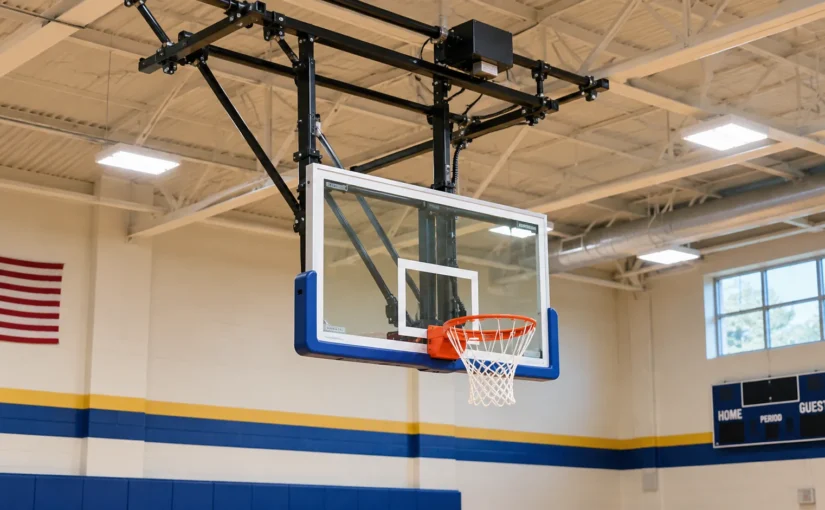
Featured image: AI-generated illustration.
A ceiling-mounted basketball hoop attaches to a building’s overhead support structure instead of a wall or floor-mounted pole.
These systems are commonly used in schools, colleges, recreation centers, and multipurpose gymnasiums. Folding models allow facility managers to clear the playing area when basketball activities finish.
Published US equipment price examples range from approximately $4,700 for a stationary backstop frame to $17,500 for a complete motorized folding package. Professional installation, structural modifications, and electrical work can increase the total cost.
This guide explains the different types of ceiling-mounted basketball hoops, their costs, structural requirements, and safety considerations.
What Is a Ceiling-Mounted Basketball Hoop?
A ceiling-mounted basketball hoop, also known as a ceiling-suspended basketball backstop, is a basketball system supported by the building’s overhead structure.
A typical system includes:
- Structural steel support frame
- Basketball backboard
- Basketball rim and net
- Mounting brackets
- Support braces
- Lifting mechanism on folding models
- Safety equipment
Unlike portable or in-ground basketball hoops, ceiling-suspended systems do not require a support pole extending from the playing surface.
This makes them particularly useful in facilities that host multiple sports and activities.
Types of Ceiling-Mounted Basketball Hoops
Ceiling-mounted basketball hoops are available in several configurations. The right design depends on the building structure, available space, and intended use.
Stationary Basketball Hoops
Stationary ceiling-mounted hoops remain in a fixed playing position.
The support frame attaches to the ceiling structure and may use additional ceiling or wall bracing.
Stationary systems are suitable for dedicated basketball facilities where the equipment does not need to move.
Their simpler construction also eliminates the need for a folding mechanism and lifting motor.
Forward-Folding Basketball Hoops
Forward-folding basketball hoops rise toward the playing court when stored.
These systems are available with front or rear bracing, depending on the available space and structural layout.
Forward-folding backstops are practical for school gymnasiums and recreation centers that regularly switch between basketball and other activities.
Backward-Folding Basketball Hoops
Backward-folding systems retract toward the wall behind the backboard.
This configuration can work well when sufficient storage space is available behind the basket.
The manufacturer must confirm that the building provides enough clearance for the complete folding movement.
Side-Folding Basketball Hoops
Side-folding basketball hoops move sideways toward a designated storage position.
They can be useful in multi-court gymnasiums where forward or backward folding would interfere with other equipment.
Their suitability depends on the building structure and available lateral clearance.
Manual vs Motorized Systems
Folding ceiling-mounted basketball hoops can use manual or electric winches.
Manual systems require an operator to raise and lower the backstop using a hand-operated mechanism.
Motorized systems use an electric winch operated through a control panel, key switch, or compatible remote-control system.
| Feature | Manual System | Motorized System |
|---|---|---|
| Operation | Hand-operated winch | Electric winch |
| Electrical supply | Generally not required for lifting | Required |
| Physical effort | Higher | Lower |
| Frequent operation | Less convenient | More convenient |
| Equipment complexity | Lower | Higher |
| Typical application | Suitable lower-height installations | Frequently used commercial gyms |
ASTM F3731-24 recommends motorized hoists and limits its guidance for manual hoists to ceiling attachment heights of 26 feet or less.
Always follow the equipment manufacturer’s specific operating requirements.
How Much Does a Ceiling-Mounted Basketball Hoop Cost?
The cost of a ceiling-mounted basketball hoop depends on its frame design, mounting height, backboard, lifting mechanism, controls, and installation requirements.
Most commercial manufacturers provide custom quotes because each building has different structural conditions.
Equipment Prices
The following prices provide examples of published US equipment costs.
| Equipment | Published Price | Price Basis |
|---|---|---|
| Stationary wall-braced ceiling backstop | $4,674–$7,902 | 2026 suggested retail examples |
| Stationary ceiling-braced backstop | $4,832–$8,718 | 2026 suggested retail examples |
| Forward-folding backstop (DDTF-20J, safety strap included) | $8,678 | 2026 suggested retail example |
| Complete motorized forward-folding package | $17,500 | Listed package price; installation extra |
The stationary and forward-folding backstop prices come from Draper’s 2026 Sourcewell price list.
These are selected suggested retail prices, not the full range of configurations or complete installed-system quotes. Sourcewell member pricing may differ. Confirm which components are included before ordering.
Practice Sports lists a $17,500 package that includes a glass backboard, breakaway rim, backboard padding, motorized winch, 7–10 ft electric height adjuster, and custom truss substructure.
Installation costs are additional.
Installation Costs
Reliable standalone installation prices are difficult to establish because commercial projects often combine basketball backstops with other gym equipment.
Installation costs depend on:
- Ceiling attachment height
- Existing structural support
- Equipment weight and configuration
- Accessibility for lifting equipment
- Electrical wiring
- Local labor rates
- Removal of existing equipment
- Structural engineering requirements
Request an itemized equipment and installation quote rather than relying on a general price range.
Additional Expenses
Some ceiling-mounted basketball systems require separately purchased components.
The following examples come from Draper’s 2026 suggested retail price list.
| Component | Example Price |
|---|---|
| Manual winch | $1,517 |
| Electric winch | $2,008–$2,830 |
| Automatic safety strap | $851 |
| Electric height adjuster | $1,408–$1,455 |
| 72 × 42-inch glass backboard | $1,090 |
| Breakaway basketball rim | $296 |
| Key switch | $148 |
| EZ-Pad 3.0 controller (relay box separate) | $2,102 |
These are selected component prices, not installed costs. Some components may already be included in a backstop package.
Freight, permits, structural reinforcement, backboard padding, and ongoing maintenance can also increase the total project cost.
Ceiling Height and Structural Requirements
Ceiling height alone does not determine whether a building can accommodate a ceiling-mounted basketball hoop.
The overhead structure must support the equipment, and the gym must provide enough clearance for safe operation.
Ceiling Height and Clearance
Ceiling attachment height refers to the height at which the basketball system connects to the building structure.
This measurement differs from the clear playing height, which is the unobstructed vertical space above the basketball court.
Different manufacturers design their equipment for different attachment heights.
| Manufacturer | Example Attachment Height |
|---|---|
| Draper | Up to 28 ft 4 in for standard models; taller configurations available |
| Porter Athletic | Configurations covering approximately 16–40 ft |
| Bison | Up to 36 ft |
| Jaypro | 18–32 ft for selected models |
| Practice Sports | 18–32 ft for its complete motorized package |
These are manufacturer-specific equipment ranges, not universal minimum ceiling heights.
The NCAA men’s basketball rules recommend at least 25 feet of clearance above the playing court, excluding the basket itself.
Higher clearance is preferable where possible.
For more information about playing space, read our guide to basketball court ceiling height.
Structural Support and Load Requirements
Ceiling-mounted basketball hoops can place substantial loads on a building’s overhead structure.
The complete system includes the steel frame, backboard, rim, bracing, and any lifting equipment.
The structure must accommodate both the equipment’s weight and the forces associated with operation and use.
Suitable attachment points may include engineered steel trusses, beams, or other approved structural members.
However, there is no universal load capacity that makes every ceiling suitable for every basketball backstop.
A qualified structural engineer should review:
- Existing building plans
- Structural member capacity
- Manufacturer-provided reaction loads
- Proposed mounting locations
- Connection details
- Required structural reinforcement
Do not assume that an existing roof or ceiling can support a basketball backstop simply because it has enough vertical clearance.
Ceiling-Mounted vs Wall-Mounted Basketball Hoops
Both systems provide permanent basketball equipment without requiring a floor-mounted support pole.
However, they differ in mounting requirements, costs, and storage options.
| Feature | Ceiling-Mounted | Wall-Mounted |
|---|---|---|
| Primary support | Overhead building structure | Wall structure |
| Equipment cost | Generally higher | Generally lower |
| Installation | Often more complex | Depends on wall and extension |
| Folding options | Forward, backward, and side-fold | Fixed and folding options |
| Residential suitability | Limited | Generally more practical |
| Typical use | Large gyms and multipurpose facilities | Home courts and smaller gyms |
A ceiling-mounted basketball hoop is often the better choice when the basket must extend into a large gymnasium or retract overhead between activities.
A wall-mounted basketball hoop may be more practical when a suitable wall is available close to the playing area.
For residential alternatives, see our guide to the best indoor basketball hoops.
Best Ceiling-Mounted Basketball Hoops for Different Facilities
The best system depends on how the facility operates rather than the manufacturer alone.
Schools and Colleges
Motorized folding backstops are practical for schools and colleges that use their gymnasiums for basketball, volleyball, physical education, and assemblies.
Useful features include:
- Regulation-size backboards
- Breakaway rims
- Automatic safety straps
- Controlled motorized operation
- Backboard padding
- Accessible maintenance arrangements
Height adjusters may also be useful in schools serving younger players.
Recreation Centers and Multipurpose Gyms
Recreation centers often accommodate several sports and age groups.
Folding basketball hoops allow operators to clear the court when the equipment is not required.
Electric height adjusters can provide additional flexibility for youth basketball programs.
Facilities with multiple courts should consider how each backstop moves and where it will be stored to avoid interference with adjacent equipment.
Residential Indoor Courts
Ceiling-mounted basketball hoops are less common in residential properties because most homes lack suitable ceiling height and structural support.
However, custom systems may be possible in purpose-built indoor courts, large barns, and engineered metal buildings.
A wall-mounted system is usually a more practical starting point for homeowners.
If you are planning a dedicated home gym, read our residential indoor basketball court guide.
Leading Ceiling-Mounted Basketball Hoop Manufacturers
Several manufacturers supply ceiling-suspended basketball systems for US schools and commercial facilities.
The following examples are based on published manufacturer information rather than hands-on product testing.
| Manufacturer | Representative Models | Available Configurations |
|---|---|---|
| Draper | EZ-Fold TF-20, TB-25, TS-22 | Forward-fold, backward-fold, stationary |
| Porter Athletic | 900 Series | Forward-fold, backward-fold, side-fold |
| Bison / IPI | IP1350FF, IP1345BF, IP1345CS | Forward-fold, backward-fold, stationary |
| Gared Sports | 2207 and other ceiling backstops | Stationary and folding |
| Jaypro | J849, J826-NF | Forward-fold and stationary |
Draper
Draper manufactures the EZ-Fold range of ceiling-suspended basketball backstops.
Selected models include an automatic safety strap and a 25-year limited warranty.
Porter Athletic
Porter Athletic offers several ceiling-suspended configurations through its 900 Series.
Porter equipment is also specified in public school and municipal gymnasium projects.
Bison
Bison and IPI offer stationary, forward-folding, backward-folding, and side-folding basketball backstops.
The company provides welded and bolted frame configurations for different mounting heights.
Gared Sports
Gared Sports manufactures commercial basketball equipment, including stationary and folding ceiling-mounted backstops.
Its product documentation includes installation and maintenance instructions for individual systems.
Jaypro
Jaypro offers ceiling-suspended basketball backstops alongside compatible winches, height adjusters, and safety equipment.
Selected models accommodate ceiling attachment heights between 18 and 32 feet.
When comparing manufacturers, request specifications and quotes for the same equipment configuration. Comparing frame-only prices with complete motorized packages can produce misleading results.
Ceiling-Mounted Basketball Hoop Installation
Ceiling-mounted basketball hoop installation requires coordination between the equipment manufacturer, structural engineer, installation contractor, and qualified electrical personnel where applicable.
1. Assess the Building
The project begins with an assessment of the gymnasium’s dimensions, overhead structure, playing area, and existing equipment.
The installer identifies potential mounting locations and checks whether the proposed system has enough operating and storage clearance.
2. Complete the Structural Review
The structural engineer evaluates the building using the manufacturer’s equipment specifications and reaction loads.
Any necessary reinforcement or additional support structure must be designed before installation.
3. Select the Basketball System
The facility selects the appropriate backstop configuration, backboard, rim, lifting mechanism, controls, and safety equipment.
The manufacturer prepares the system according to the approved building dimensions and installation requirements.
4. Install the Equipment
Qualified installers assemble and attach the basketball backstop to the approved overhead support structure.
Motorized systems also require appropriate electrical connections and control equipment.
5. Complete Safety and Operational Checks
Before the equipment enters service, qualified personnel should check:
- Structural connections
- Backboard alignment
- Rim height
- Lifting mechanism
- Safety straps
- Limit switches
- Operating controls
- Folding and storage clearance
The completed system should operate according to the manufacturer’s instructions.
For regulation basketball, the basketball hoop height must be 10 feet from the playing surface to the top of the rim.
Safety Standards and Guidelines
Ceiling-mounted basketball hoops require careful design, installation, operation, and maintenance because they suspend heavy equipment above occupied areas.
Several standards and basketball rules provide relevant guidance.
ASTM F3731-24
ASTM F3731-24 is a standard guide for ceiling-suspended and wall-mounted basketball backstops.
It addresses equipment design and safety considerations, including:
- Structural hardware
- Lifting cables and pulleys
- Safety straps
- Hoisting mechanisms
- Operating controls
- Backboard padding
- Welding
The guide calls for safety straps on upward-folding systems and recommends motorized hoists.
ASTM F3731-24 is a voluntary standard guide rather than a building code. Its provisions may become applicable through project specifications or relevant regulatory requirements.
NCAA and High School Basketball Rules
Basketball governing bodies establish rules and recommendations covering equipment and playing areas.
Relevant considerations include regulation rim height, backboard padding, overhead clearance, and support structure positioning.
These sporting requirements are separate from the structural engineering and building code requirements of the installation.
Facilities should confirm the current rules of their governing organization before purchasing equipment.
Automatic Safety Straps
An automatic safety strap provides an additional protective mechanism on folding basketball backstops.
It is designed to help arrest uncontrolled movement if the primary lifting system fails.
A safety strap does not replace correct installation, structural support, or regular maintenance.
Operating Controls
Motorized basketball hoops should use appropriate controls that restrict operation to authorized personnel.
ASTM F3731-24 addresses momentary key-operated or password-controlled systems and recommends locating controls away from directly beneath the equipment.
Operators should follow the manufacturer’s instructions and keep people clear of the equipment’s movement area.
Maintenance and Inspections
Regular maintenance helps identify worn components, damaged equipment, and developing mechanical problems.
Ceiling-mounted basketball hoops should be inspected by qualified personnel according to the manufacturer’s maintenance schedule.
| Component | Inspection Focus |
|---|---|
| Structural frame | Damage, movement, and corrosion |
| Mounting hardware | Loose or damaged connections |
| Lifting cables | Wear, damage, and deterioration |
| Pulleys | Condition and alignment |
| Safety straps | Condition and correct operation |
| Electric winch | Mechanical and electrical condition |
| Limit switches | Correct stopping positions |
| Backboard | Damage and alignment |
| Rim | Damage and correct height |
| Operating controls | Proper operation |
ASTM F3783-26 provides guidance on inspecting and maintaining permanently installed indoor gymnasium equipment.
According to American School & University, the guide recommends inspections and servicing at least annually, with more frequent attention for heavily used facilities.
Some manufacturers recommend shorter inspection intervals.
Follow the applicable manufacturer instructions and arrange additional inspections when damage or unusual operation occurs.
If a backstop shows signs of structural movement, cable damage, or mechanical failure, stop using it until qualified personnel assess the equipment.
What to Consider Before Buying
Before purchasing a ceiling-mounted basketball hoop, confirm the following requirements.
| Buying Consideration | What to Check |
|---|---|
| Building structure | Engineer-approved mounting locations and load capacity |
| Ceiling height | Equipment attachment height and playing clearance |
| Backstop configuration | Stationary, forward-fold, backward-fold, or side-fold |
| Storage position | Clearance from lights, ducts, and other equipment |
| Lifting mechanism | Suitable manual or electric winch |
| Backboard | Size, material, and padding |
| Rim | Appropriate design for the intended level of play |
| Height adjustment | Required adjustment range |
| Safety equipment | Compatible straps, stops, and controls |
| Installation | Qualified contractor and electrical requirements |
| Total cost | Equipment, freight, labor, and structural work |
| Warranty | Coverage for the frame and individual components |
| Maintenance | Inspection schedule and replacement part availability |
Request a complete written quotation that identifies included components and installation responsibilities.
This makes it easier to compare different suppliers and avoid unexpected expenses.
Frequently Asked Questions
Can You Mount a Basketball Hoop to Your Ceiling at Home?
Yes, but only if the building provides suitable clearance and an overhead structure capable of supporting the equipment.
Most standard residential garages are unsuitable for commercial ceiling-suspended basketball systems.
Purpose-built indoor courts and engineered buildings may accommodate them following a structural assessment.
How Much Does a Ceiling-Mounted Basketball Hoop Weigh?
Spoonball Sports reports that some commercial ceiling-suspended basketball backstops weigh approximately 900 to 1,200 pounds, depending on attachment height.
However, actual equipment weight varies by frame size, backboard material, attachment height, and additional components.
Ask the manufacturer for model-specific reaction loads for the structural review.
Are Retractable Basketball Hoops Safe?
Retractable basketball hoops can be suitable for commercial facilities when properly engineered, installed, operated, and maintained.
Automatic safety straps, appropriate controls, and regular professional inspections help reduce equipment-related risks.
Damaged or malfunctioning systems should remain out of service until assessed.
How Often Should Ceiling-Mounted Basketball Hoops Be Inspected?
Professional inspections should generally take place at least annually, or more frequently when required by the manufacturer or facility usage.
Heavily used gymnasiums may require shorter inspection intervals.
Can Ceiling-Mounted Basketball Hoops Be Height Adjustable?
Yes. Some ceiling-mounted basketball systems include manual or electric height adjusters.
Selected commercial height adjusters allow the rim to move between 8 and 10 feet.
The height adjustment mechanism is separate from the winch that raises and lowers the complete folding backstop.
Is a Ceiling-Mounted Basketball Hoop the Same as a Roof-Mounted Basketball Hoop?
Not necessarily.
Commercial ceiling-suspended basketball hoops attach to a building’s overhead structural system.
Residential roof-mounted hoops generally use brackets designed for compatible roof or wall mounting locations.
They are different equipment categories with different installation requirements.
Final Thoughts
A ceiling-mounted basketball hoop is a practical option for schools, colleges, and multipurpose gymnasiums that need permanent basketball equipment without floor-mounted support poles.
Stationary systems offer a simpler configuration, while motorized folding systems provide greater flexibility for facilities hosting multiple activities.
Before buying, obtain a structural assessment, compare complete equipment quotations, and confirm the manufacturer’s installation and maintenance requirements.
3 thoughts on “Ceiling Mounted Basketball Hoop | Types, Costs & Installation”
Comments are closed.