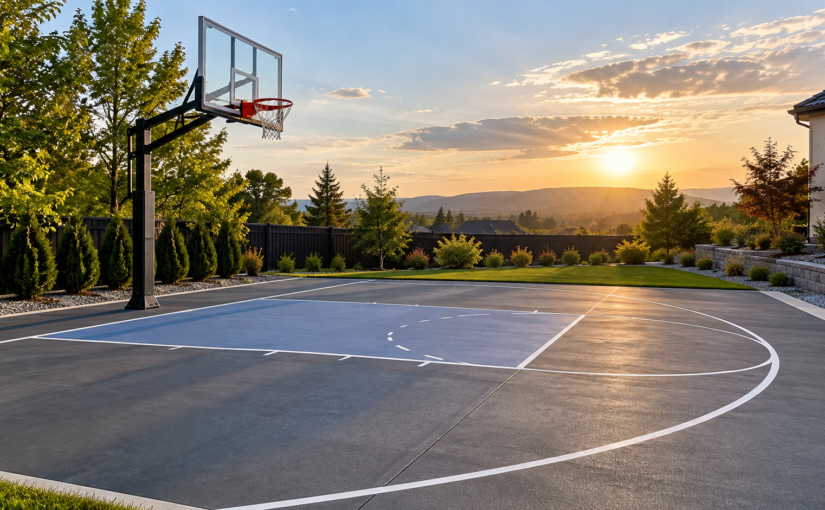
How Much Does It Cost to Build a Basketball Court? | 2026 Prices

How much does it cost to build a basketball court? Prices depend on the court’s size, surface, location, and whether you’re using existing pavement or building from scratch.

For a compact backyard basketball court built from bare ground, a reasonable starting budget is $10,000–$25,000+. The final price depends on the court size, surface material, site preparation, labor, and extra equipment.

Here is a comparison of basketball court construction costs in the United States for 2026.

Basketball court project Estimated cost Price scope
Driveway shooting setup $200–$2,350 Hoop and basic lines on existing pavement
Modular tiles on an existing hard surface $1,800–$5,000+ Retail tile kits; excludes hoop and base repairs
Compact backyard court (900–1,200 sq ft) $10,000–$25,000+ Planning budget for new construction
Residential half court $18,000–$32,000 Published installation-service estimate
NBA-sized half-court footprint (47 × 50 ft) $15,000–$30,000 Regional contractor estimate
Full outdoor court (94 × 50 ft) $35,000–$75,000+ Regional contractor estimate
Premium full outdoor court $85,000–$115,000 Post-tension concrete construction

These are not national averages. The driveway figure is a calculation, the compact-court figure is a planning estimate, and the larger project figures come from published service or contractor estimates. Different locations, specifications, and inclusions explain why some ranges overlap.

Sources: HomeGuide, Sport Court, USA Sports Courts, and Barton Sports Construction.

Basketball Court Construction Costs by Size

The amount of playing space you need is one of the biggest factors in your project cost.

However, a small court built on difficult ground can cost more than a larger court with easier site conditions.

If you’re deciding how much space to use at home, our backyard basketball court guide covers different court sizes, layouts, and surface options.

Driveway Basketball Setup

If you already have a driveway with suitable pavement, installing a basketball hoop and adding basic court markings may be enough.

HomeGuide lists installed hoops at $150–$2,000 and line painting at $50–$350. Combined, these add up to $200–$2,350.

This excludes driveway repairs, resurfacing, and other improvements.

For casual shooting practice, an existing driveway is usually the cheapest starting point.

Compact Backyard Basketball Court

A compact backyard court might measure 30 × 30 feet or 30 × 40 feet, providing 900–1,200 square feet.

For construction from bare ground, budget roughly $10,000–$25,000+, depending on groundwork and materials.

This is a planning estimate, not a national average. Sport Court reports that some small professionally built shooting courts have started at approximately $10,000.

Compact courts can work well for shooting, dribbling, and one-on-one basketball without requiring regulation dimensions.

Residential Half Court

A common residential half-court layout is 30 × 50 feet, or 1,500 square feet.

USA Sports Courts describes that size as a residential half-court option and separately publishes a $18,000–$32,000 estimate for half-court installation.

Its service covers projects from bare ground to a finished court, including base preparation, markings, and hoop installation. However, the published price is a general half-court estimate, not a guaranteed quote for every 30 × 50-foot build.

NBA-Sized Half Court

Half of a standard NBA playing area measures 47 × 50 feet, giving it 2,350 square feet.

Barton Sports Construction lists $15,000–$30,000 for this layout in its Mid-South service region. That estimate includes grading, a concrete base, acrylic coating, court markings, and a hoop.

Its price overlaps with the smaller residential estimate above because they come from different providers and locations.

Full Basketball Court

A standard NBA basketball court measures 94 × 50 feet, or 4,700 square feet. A typical U.S. high school court is smaller at 84 × 50 feet.

Barton estimates $35,000–$75,000+ for a standard full outdoor court and $85,000–$115,000 for a premium post-tension concrete version.

These are regional estimates. Difficult ground conditions, fencing, lighting, and other specifications can increase the final price.

See our basketball court dimensions guide for a closer look at different court sizes.

What Affects Basketball Court Construction Costs?

Two courts with the same playing dimensions can have very different budgets.

Court Size and Available Space

A larger court generally needs more paving, flooring, and line painting.

However, playing area and total construction area are not always the same.

You may need additional space behind the hoops, outside the sidelines, and around fencing or drainage systems. That extra area can increase the amount of paving required.

Our basketball court diagram shows how the main lines and markings fit within a court layout.

Site Preparation and Drainage

Building on level, accessible ground is usually easier than working on a steep or uneven backyard.

Site preparation may involve clearing vegetation, removing soil, grading, and compacting the ground.

Outdoor courts also need effective drainage to prevent standing water and premature surface damage.

HomeGuide provides a broad $1,000–$4,000 drainage allowance, although complex sites can require more extensive work.

Location and Labor

Labor rates, contractor availability, equipment access, local regulations, and soil conditions vary by location.

A contractor’s published estimate may therefore be useful for planning without reflecting the actual cost in your area.

For projects outside the United States, use these dollar amounts as a budgeting reference and obtain local quotes in your own currency.

To understand what professional installation involves before requesting quotes, read our basketball court installation guide.

Basketball Court Surface Costs
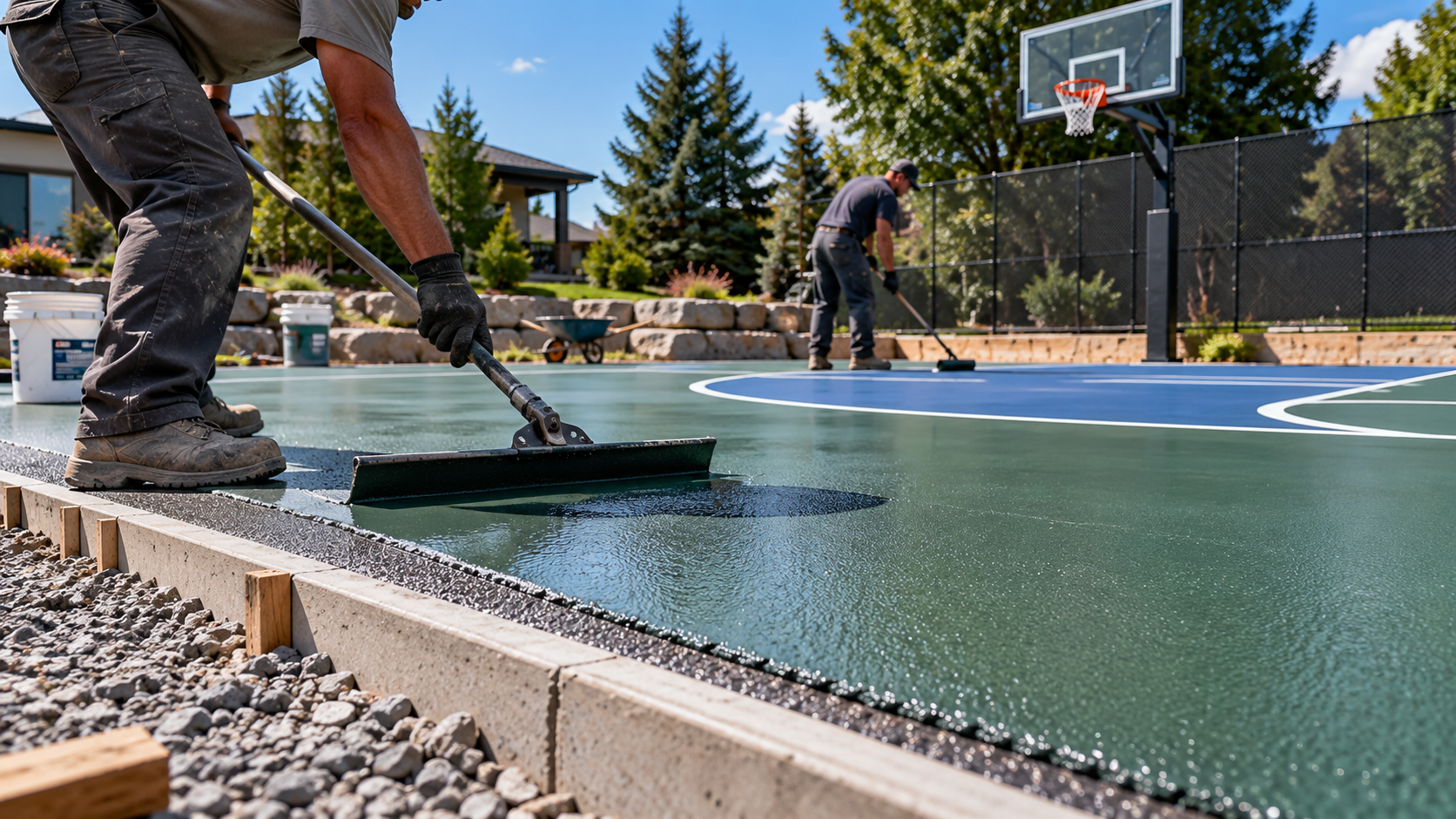
Workers applying a new surface coating to an outdoor basketball court

Your choice of surface affects construction costs, maintenance, and how the court feels during play.

But be careful: the cost of flooring is not necessarily the cost of a completed basketball court.

Court surface Estimated cost What the estimate covers
Concrete slab $6–$12 per sq ft Standard installed slab
Asphalt paving $5–$12+ per sq ft General installed paving
Acrylic resurfacing $3–$6 per sq ft Finish applied to a suitable existing base
Modular tile kits Roughly $3–$4 per sq ft Selected retail kits, before base and extras
Indoor hardwood sports floor $12–$26 per sq ft Installed hardwood sports-floor system

These figures describe different construction layers, not five complete-court alternatives.

Concrete

Concrete provides a firm foundation for outdoor basketball courts.

According to HomeGuide, a standard installed concrete slab costs approximately $6–$12 per square foot.

For a 30 × 30-foot area:

  • 900 sq ft × $6 = $5,400
  • 900 sq ft × $12 = $10,800

That gives a calculated slab budget of $5,400–$10,800.

Court coatings, hoops, markings, and substantial groundwork may cost extra. The slab must also be specified for the actual site and intended court system.

Asphalt

Asphalt is another common outdoor foundation.

General asphalt paving prices are approximately $5–$12+ per square foot installed, based on HomeGuide’s asphalt driveway pricing.

A basketball court may need additional groundwork, sports coating, and markings.

Asphalt can be cheaper initially in some projects, but installed asphalt and concrete prices overlap. Compare complete construction quotes rather than assuming one will always cost less.

Acrylic Coatings

Acrylic sports coatings add color, traction, and a finished appearance to properly prepared concrete or asphalt.

Resurfacing an existing court may cost approximately $3–$6 per square foot, depending on its condition and the coating system.

Acrylic is a finish, not a replacement for a stable foundation. Structural cracking or poor drainage can require separate repairs.

Modular Basketball Court Tiles

Interlocking sports tiles provide a finished playing surface and can be installed over a suitable existing hard base.

Examples from ModuTile include:

Basketball tile kit Listed retail price
20 × 24 ft $1,843
30 × 30 ft Approximately $2,931
50 × 30 ft $4,784

Retail prices checked in October 2026. Kit options, shipping, taxes, base preparation, and basketball equipment may change the amount paid.

The cited 20 × 24-foot and 50 × 30-foot kits include painted lines, although edging and other options vary by product.

These are flooring-kit prices, not completed-court prices.

ModuTile also advises against installing its rigid outdoor tiles directly over grass or other soft ground.

Indoor Hardwood

Hardwood sports flooring is a popular choice for serious indoor basketball.

Junckers estimates $12–$26 per square foot installed for a specialist hardwood system.

That includes the subfloor, hardwood surface, markings, finishing, and installation labor.

It does not include constructing the building.

Other indoor materials, including suitable rubber or synthetic sports flooring, may have different prices and playing characteristics.

Basketball Court Cost Breakdown

A complete construction quote should account for more than the court surface.

Expense What to check
Site preparation Clearing, excavation, grading, and soil removal
Foundation Concrete or asphalt, reinforcement, and compacted base
Drainage Surface slope, drains, and water discharge
Playing surface Coatings, tiles, or another sports-floor system
Basketball equipment Hoop, backboard, footing, padding, and installation
Court markings Boundary lines, key, free-throw line, and three-point line
Optional features Fencing, lighting, landscaping, and seating

Additional expenses Permits, delivery, inspections, taxes, and cleanup

Basketball Hoops and Equipment

HomeGuide lists basketball hoops at approximately $150–$2,000 installed, depending on the type.

Permanent in-ground systems may require a separate concrete footing and professional installation.

Adjustable hoops, stronger backboards, and protective padding can increase costs.

Our basketball hoop height guide explains regulation height and adjustments for younger players.

Fencing and Lighting

Fencing can help prevent basketballs from leaving the playing area, while lighting makes evening practice possible.

Costs depend on the number of lights, electrical work, fence height, and total perimeter.

Rather than relying on one generic figure, ask contractors for separately priced options.

Permits and Extra Costs

Local planning or building rules may apply to permanent paving, grading, fencing, lighting, and electrical work.

Before agreeing to a price, check whether permits, delivery, drainage, site cleanup, and landscaping are included.

Do not add the cost of a new slab to a turnkey quote that already includes the foundation. Doing so would count the same expense twice.

Indoor vs. Outdoor Basketball Court Costs

Building a new indoor basketball facility is generally more expensive than constructing a comparable outdoor court because it also requires an enclosed structure.

However, using an existing building changes the calculation.

Outdoor Basketball Courts

Outdoor construction usually includes ground preparation, a foundation, the playing surface, markings, and basketball equipment.

For a full outdoor court, Barton’s regional estimate is $35,000–$75,000+ for standard construction.

Ongoing expenses can include cleaning, crack repairs, and resurfacing.

Indoor Basketball Courts
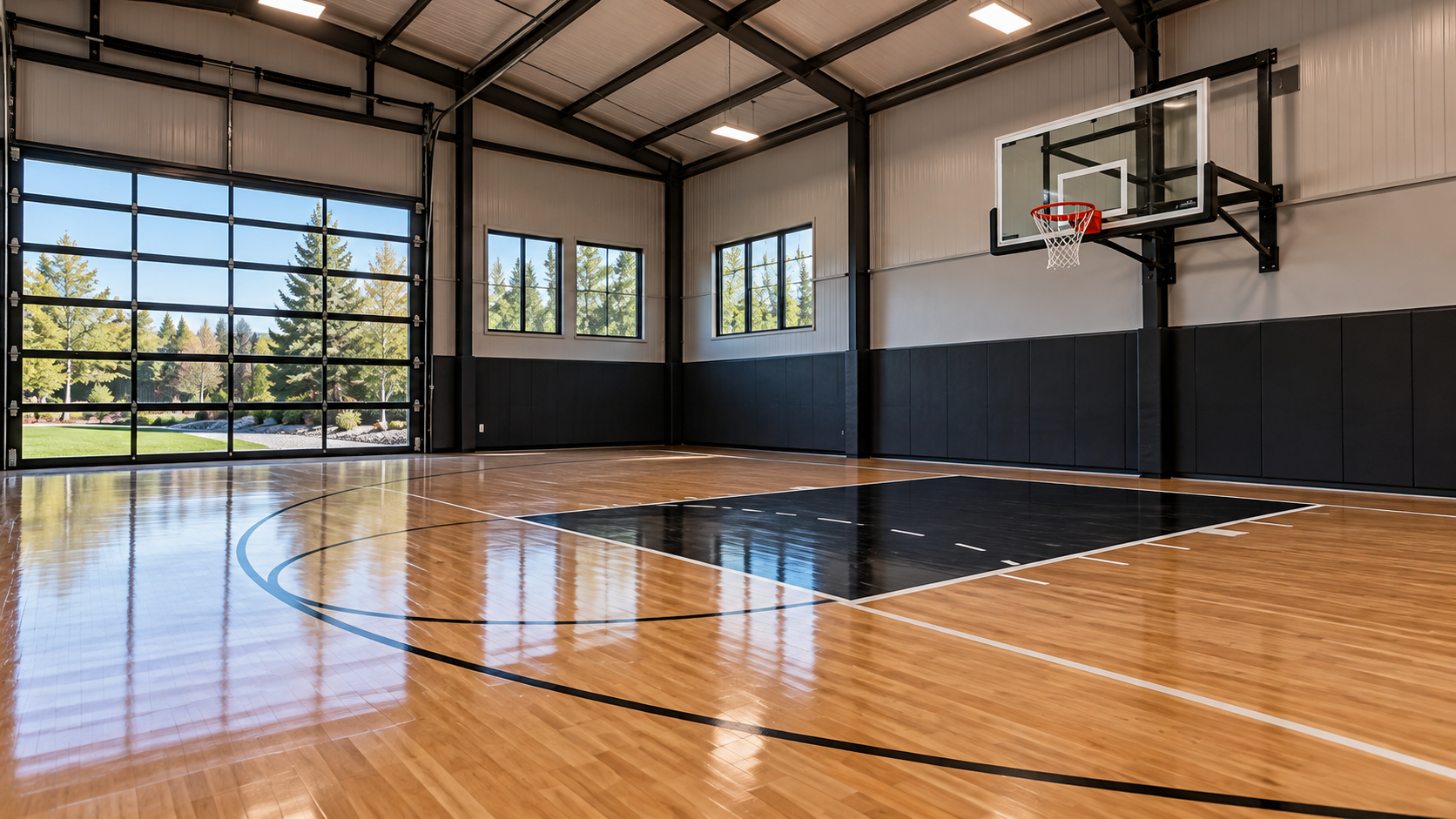
Indoor basketball court with hardwood flooring and a wall-mounted hoop

If you already have a suitable garage or barn, HomeGuide estimates $4–$16 per square foot for a basic conversion involving flooring, hoops, and lines.

For a specialist hardwood floor, Junckers gives $10,000–$45,000 for small residential or training half courts in existing buildings.

Neither figure necessarily covers structural changes, ventilation, lighting upgrades, or other building improvements.

Building an entirely new enclosed space is more expensive. HomeGuide provides a broad $90–$210 per square foot planning range for a new residential addition.

That is a building-cost benchmark, not a basketball-flooring price. A complete indoor facility may need considerably more space than the marked court for safe clearances and access.

DIY vs. Professional Basketball Court Installation

Doing some work yourself can reduce labor costs, especially when you already have a suitable playing surface.

For example, installing compatible modular tiles or painting simple markings may be realistic DIY projects.

For a step-by-step walkthrough, see our DIY basketball court guide to learn how to prepare the ground, choose a surface, and install a hoop.

However, excavation, ground leveling, drainage, concrete construction, permanent hoop footings, and electrical installation involve greater risks.

Poor foundation work can cause cracking, uneven playing conditions, or expensive reconstruction.

For a new court, compare professional installation with the full cost of managing separate trades yourself. Include materials, equipment rental, delivery, waste removal, and possible repairs.

DIY savings are most believable when the existing foundation is already in good condition.

How Much Does Basketball Court Maintenance Cost?

Basketball courts need regular upkeep, although costs vary by material and condition.

Routine maintenance includes removing debris, keeping drains clear, checking hoop hardware, and watching for cracks or standing water.

Outdoor acrylic courts may require resurfacing approximately every 4–8 years, according to Barton Sports Construction.

Barton also publishes a $4,000–$9,000 full-court resurfacing estimate for its region, covering crack treatment, fresh acrylic coating, and markings.

This is not an annual maintenance charge. Serious foundation damage may require more expensive repairs.

Modular tiles generally need cleaning and occasional replacement of damaged sections, while indoor hardwood requires suitable cleaning and environmental conditions.

Budget for both everyday upkeep and larger repairs over time.

How to Build a Basketball Court for Less

You can reduce project costs without compromising important construction work.

  1. Use an existing driveway or slab. Avoiding a new foundation can produce substantial savings if the surface is sound.
  2. Choose a court size that matches your needs. A compact shooting area may be enough for individual practice.
  3. Keep the design simple. Custom graphics, elaborate fencing, and premium lighting increase costs.
  4. Compare itemized quotes. Make sure each contractor includes the same foundation, surface, equipment, and groundwork.
  5. Consider modular tiles over suitable pavement. A flooring upgrade may be cheaper than constructing a court from bare ground.
  6. Add optional features later. Fencing, lighting, and other accessories do not always need to be installed immediately.

Never reduce essential spending on drainage, ground stability, safe playing space, or secure hoop installation just to achieve a lower headline price.

Basketball Court Cost FAQs

What Is the Cheapest Way to Build a Basketball Court?

Using an existing suitable driveway with a hoop and basic markings is generally the cheapest practical approach.

Combining HomeGuide’s installed hoop and line-painting ranges gives approximately $200–$2,350, before any pavement repairs.

How Much Land Do You Need for a Basketball Court?

A 30 × 30-foot compact court needs 900 square feet of playing area. A 30 × 50-foot residential half court needs 1,500 square feet.

A full NBA court measures 94 × 50 feet, or 4,700 square feet.

The total site should be larger where necessary to provide safe clearance, drainage, and access.

Does a Basketball Court Add Value to a Home?

A basketball court may appeal to some buyers, but it does not guarantee a higher property value.

Local demand, installation quality, maintenance, and the amount of yard space used all influence whether buyers see it as an advantage.

Build a court primarily for the enjoyment and use you expect from it.

Do You Need a Permit for a Backyard Basketball Court?

Possibly. Requirements vary by location and can depend on paving, drainage, fencing, lighting, and changes in ground level.

Check local rules and any homeowners association restrictions before construction.

How Long Does It Take to Build a Basketball Court?

A complete outdoor project may take several weeks because of site preparation, permitting, foundation work, curing, and weather delays.

Installing tiles over an existing prepared surface can be much quicker.

Is Concrete or Asphalt Cheaper for a Basketball Court?

Asphalt can have a lower initial cost, but typical installed price ranges overlap with concrete.

Compare quotes using the same dimensions, site preparation, foundation specifications, finishes, and equipment. The cheapest material price does not always produce the cheapest completed court.

Final Thoughts

The cost of building a basketball court depends on its size, location, foundation, and playing surface.

A simple driveway setup can cost a few hundred dollars, while a compact backyard court built from bare ground may require a five-figure budget. A full outdoor court can cost tens of thousands of dollars or more.

Before starting, decide how much playing space you actually need and whether you can reuse an existing suitable surface.

Then request detailed local quotes that clearly separate construction work, materials, basketball equipment, and optional extras. That will give you a more reliable budget than a single average price.
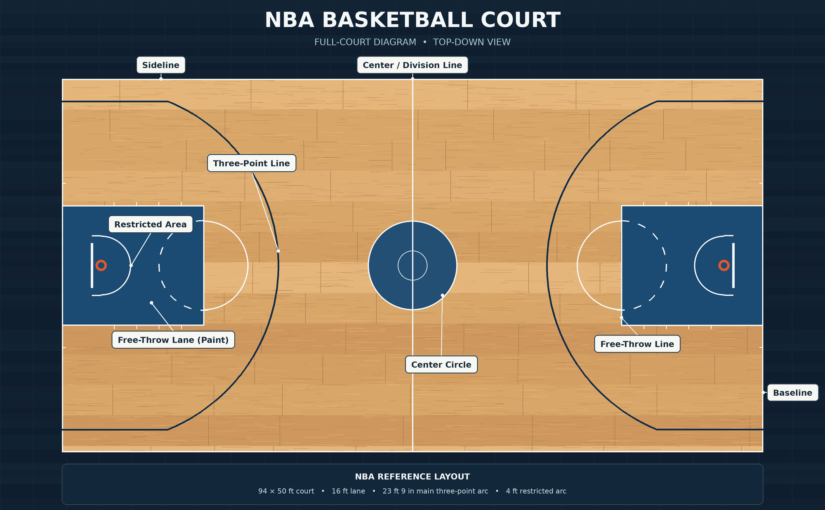
Basketball Court Diagram | Lines, Markings & Layout Explained

A basketball court diagram shows the baskets, boundary lines, and marked playing areas. It helps beginners understand the court, coaches explain positioning, and players recognize where different rules apply.

Below, you’ll find full-court and half-court layouts, explanations of the main markings, and a comparison of NBA, NCAA, FIBA, and high school courts.

Full-Court Basketball Diagram

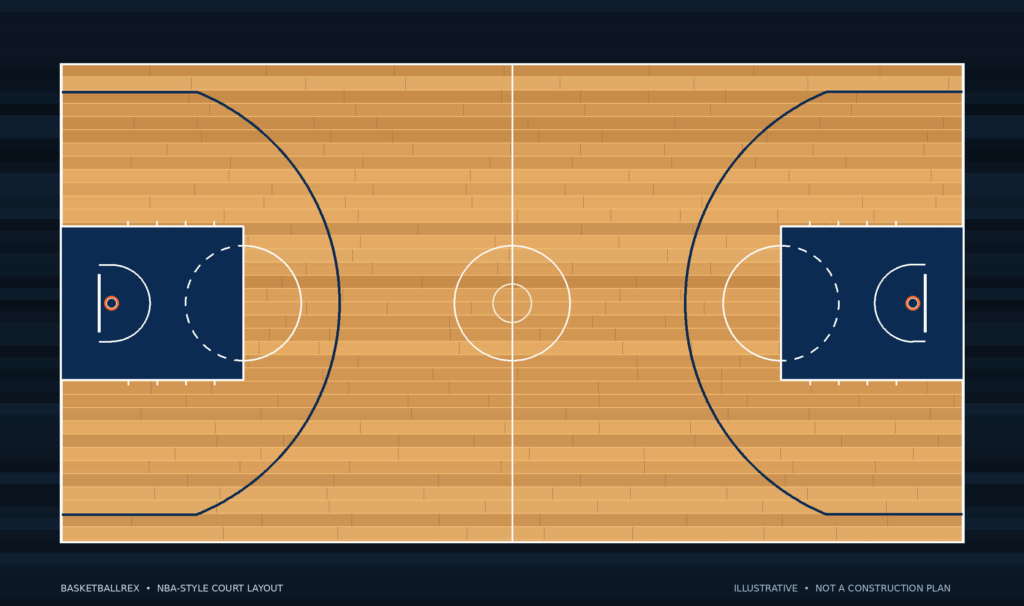
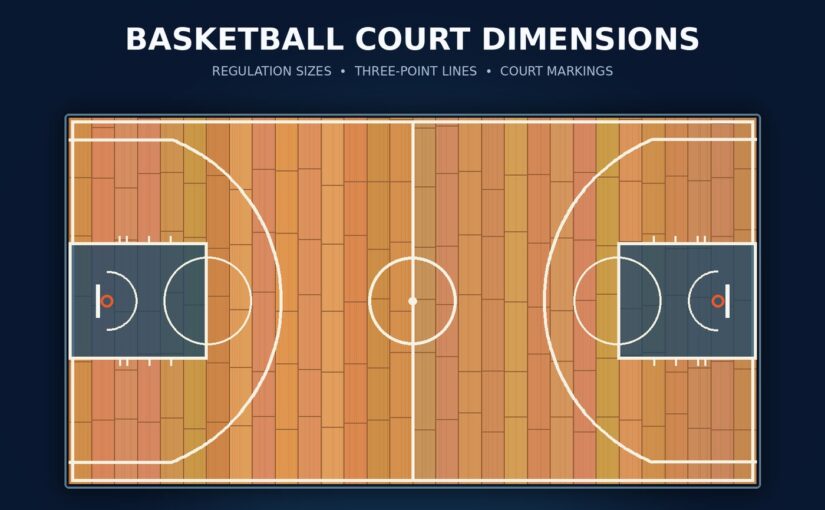
A full-court basketball diagram shows the entire playing surface, including both baskets, sidelines, baselines, center line, center circle, three-point lines, and free-throw lanes.

The center line divides the court into two halves. Each end contains a basket, a free-throw area, and a three-point arc. The basket’s height is another important measurement, which we explain in our basketball hoop height guide.

Official diagrams may also show measurements, lane-space marks, bench areas, and the scorer’s table. These extra details are useful when comparing league rules or planning court markings.

Half-Court Basketball Diagram

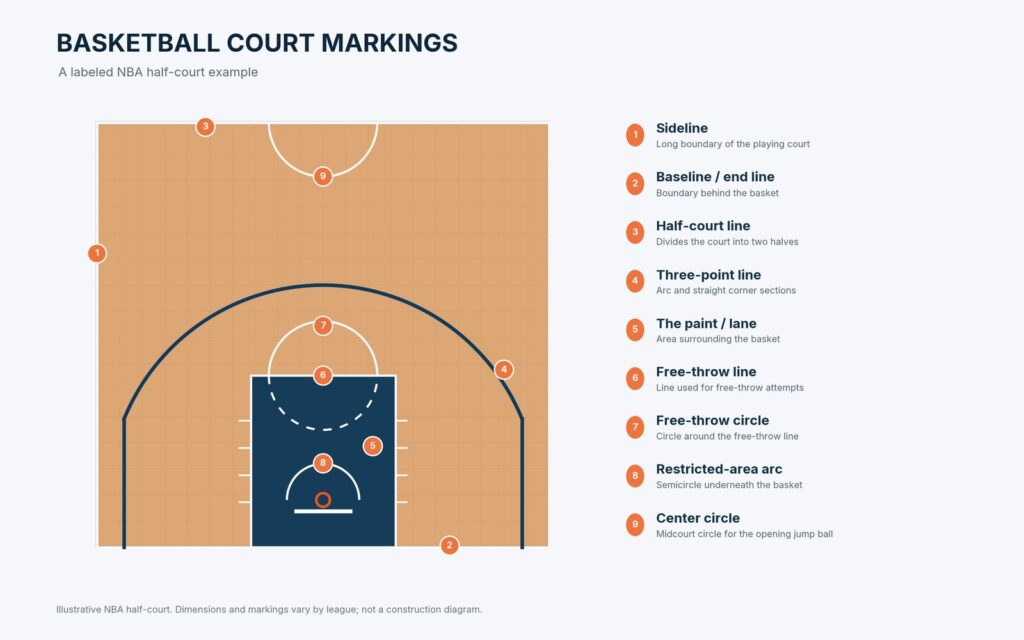
Labeled NBA half-court basketball diagram showing the three-point line, free-throw lane, restricted area, and basket
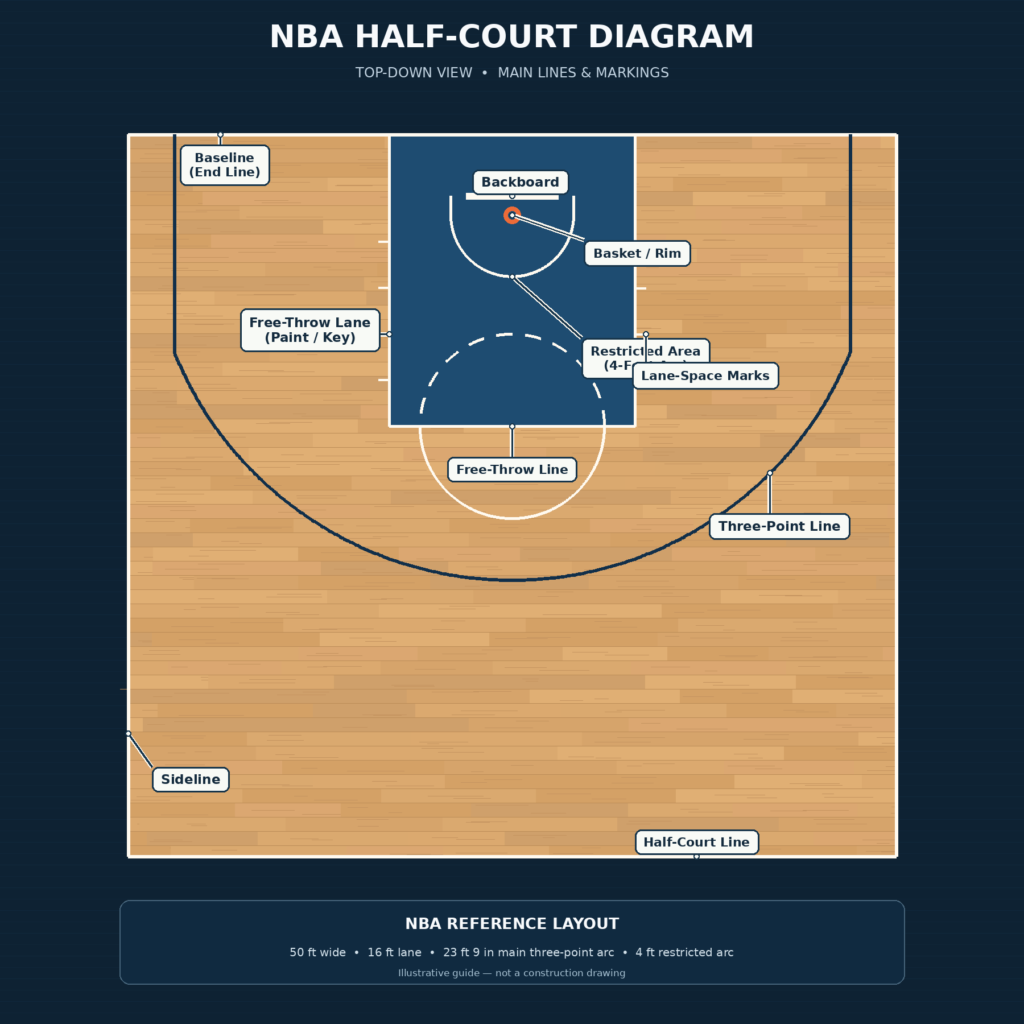
NBA half-court diagram showing the main lines and markings around the basket.

A half-court diagram gives you a closer look at one basket and the surrounding playing area.

If you’re planning a smaller court at home, our backyard basketball court guide covers practical layouts, sizes, and surface options.

Starting near the hoop and moving outward, you can identify the small restricted-area or no-charge arc, the painted free-throw lane, the free-throw line, and the three-point line.

Coaches also use blank half-court diagrams to draw basketball plays, explain player movement, and plan drills.

A half-court diagram is usually a simplified view of one end of a full court, rather than a separate set of official rules.

Basketball Court Lines and Markings Explained

If you’re marking out a court at home, our DIY basketball court guide explains how to prepare the surface, install a hoop, and add the playing lines.

Sidelines and Baselines

The sidelines are the long boundary lines along each side of the court. The shorter boundaries behind the baskets are called end lines or baselines.

A player touching one of these boundary lines is out of bounds. The lines help officials determine whether the ball or a player has left the playing area.

Center Line and Center Circle

The center line, also called the division line, separates the court into two halves.

The center circle marks the location of the opening jump ball. On NBA and NCAA courts, it has a 6-foot radius and a 12-foot diameter.

The division line also helps distinguish a team’s frontcourt from its backcourt.

Three-Point Line

The three-point line separates the areas used to determine whether a successful field goal counts for two or three points.

On NBA courts, the main arc measures 23 feet 9 inches from the center of the basket. Corner three-pointers are shorter because the line runs parallel to the sidelines.

The shooter’s feet must be outside the three-point line when the shot is released for a successful basket to count as three points. A foot touching the line makes it a two-point attempt.

Free-Throw Line and Lane

The free-throw line marks where a player stands to attempt free throws.

On NBA courts, it’s 15 feet from the plane of the front face of the backboard.

The rectangular area extending toward the baseline is commonly called the paint, key, or free-throw lane.

Small lane-space marks identify where players line up during free throws. The free-throw circle, centered on the free-throw line, is another feature shown on official diagrams.

Restricted Area and No-Charge Arc

The small arc beneath the basket is important in certain charging and blocking decisions. To understand the equipment above this area, see our guide to the parts of a basketball hoop.

In the NBA, it’s called the restricted area and has a 4-foot radius measured from the center of the basket ring.

FIBA uses the term no-charge semicircle for its smaller 1.30-meter arc.

However, FIBA calls the larger rectangular paint the restricted area. This is why the same term can point to different markings on NBA and FIBA diagrams.

NBA, NCAA, FIBA, and High School Court Diagrams

Basketball courts share a similar layout, but their measurements and markings vary between leagues.

League Court size Three-point distance Lane width
NBA 94 × 50 ft 23 ft 9 in (main arc) 16 ft
NCAA 94 × 50 ft 22 ft 1¾ in 12 ft
FIBA 28 × 15 m 6.75 m 4.90 m
NFHS high school Typically 84 × 50 ft 19 ft 9 in 12 ft

These are useful reference measurements, not complete construction specifications.

One important NCAA difference concerns the restricted-area arc. The men’s court includes a marked 4-foot arc, while NCAA women’s rules no longer require that painted marking.

FIBA diagrams use metric measurements, while NBA, NCAA, and NFHS diagrams generally use feet and inches.

For a more detailed comparison, read our basketball court dimensions guide.

Planning to build your own court? Read our guide on how much it costs to build a basketball court to compare construction prices and materials.

How to Read a Basketball Court Diagram

Start by checking which rules the diagram follows. An NBA layout shouldn’t automatically be used as a guide for marking an NCAA or FIBA court.

Then identify the main features:

  1. Find the sidelines and baselines to establish the court boundaries.
  2. Locate the center line and center circle to understand the full-court layout.
  3. Find the basket and free-throw lane at each end.
  4. Follow the three-point line around the basket to identify the shooting area.
  5. Check the smaller markings, including restricted arcs and free-throw rebound spaces.

Pay attention to measurement arrows. Official diagrams may measure to the inside or outside edge of a painted line. That difference matters because court markings have width.

A recreational driveway or backyard court may use fewer markings or a smaller playing area. Don’t assume every diagram shows a regulation court.

Printable Basketball Court Diagrams

Blank full-court basketball diagram showing both baskets, three-point lines, free-throw lanes, and center circle
Unlabeled basketball court diagram showing the full playing area and main court markings.

You can find official basketball court diagrams through the organizations responsible for each set of rules.

For coaching, blank full-court and half-court templates are also useful for drawing plays, planning drills, and explaining player positions.

Basketball Court Diagram FAQs

What’s the difference between a full-court and half-court diagram?

A full-court diagram shows both baskets and the entire playing surface. A half-court diagram focuses on one end, making individual markings easier to see.

What is the key on a basketball court?

The key is a common name for the painted free-throw lane near the basket. Its width and official terminology depend on the league.

Why do some basketball courts have multiple three-point lines?

Some gyms are used for different competitions, so they may have separate three-point markings for high school, college, or international basketball.

Are all basketball court diagrams the same?

No. NBA, NCAA, FIBA, and high school courts share basic features, but their measurements and some markings differ.

Basketball Court Dimensions | NBA, FIBA, NCAA & More

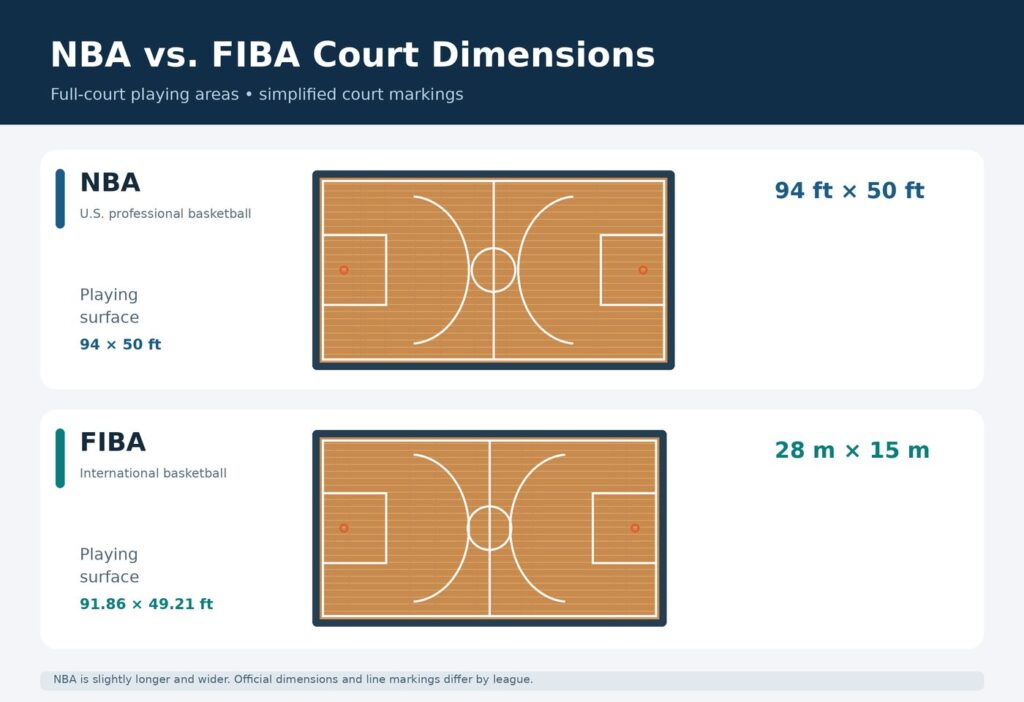
An NBA basketball court measures 94 feet long and 50 feet wide. A FIBA court measures 28 meters by 15 meters (approximately 91 feet 10 inches by 49 feet 3 inches), while the ideal U.S. high school court measures 84 by 50 feet.

However, basketball court dimensions aren’t identical across every league. Three-point lines, free-throw lanes, and restricted-area markings also vary.

This guide compares the official measurements, explains the different court markings, and shows what to consider when planning a smaller home basketball court.

League Court length × width Main three-point distance Lane width
NBA 94 × 50 ft 23 ft 9 in 16 ft
WNBA 94 × 50 ft 22 ft 1¾ in 16 ft
FIBA 28 × 15 m 6.75 m 4.90 m
NCAA men 94 × 50 ft* 22 ft 1¾ in 12 ft
NCAA women 94 × 50 ft* 22 ft 1¾ in 12 ft
NFHS high school 84 × 50 ft ideal; up to 94 ft long 19 ft 9 in 12 ft

Comparison of NBA 94-by-50-foot and FIBA 28-by-15-meter basketball courts

Want to see where these measurements appear on the court? Our basketball court diagram guide shows the main lines, markings, and full-court and half-court layouts.

The NCAA court diagram describes 50 feet as the optimum width.

The three-point measurements refer to the main arcs. Some leagues have shorter corner distances.

All these standards use a basket height of approximately 10 feet (3.05 meters).

The biggest differences are court length, three-point distance, lane width, and restricted-area markings.

NBA Basketball Court Dimensions

These measurements follow the NBA’s official court and equipment rules.

The National Basketball Association uses a playing court measuring 94 feet long and 50 feet wide.

That gives the court an area of 4,700 square feet, excluding space outside its boundaries.

The court has two baskets, a center line, a center circle, and marked shooting and free-throw areas at each end.

NBA Three-Point Line

The NBA three-point arc measures 23 feet 9 inches from the center of the basket.

However, the corner three-point distance is shorter.

The straight sections of the three-point line sit 3 feet inside the sidelines, making the corner distance approximately 22 feet.

This means an NBA three-point shot isn’t always taken from the same distance.

NBA Free-Throw Lane and Restricted Area

The NBA free-throw lane measures 16 feet wide.

The free-throw line sits 15 feet from the plane of the front face of the backboard.

A restricted-area semicircle with a 4-foot radius is marked underneath the basket.

This marking helps officials apply certain charging and blocking rules.

WNBA Basketball Court Dimensions

The Women’s National Basketball Association uses the same overall court size as the NBA.

Its main measurements include:

  • Court length: 94 feet
  • Court width: 50 feet
  • Lane width: 16 feet
  • Rim height: 10 feet
  • Restricted-area radius: 4 feet

The main difference is the three-point line.

WNBA Three-Point Line

The WNBA three-point arc measures 22 feet 1¾ inches from the center of the basket.

That’s shorter than the NBA’s 23-foot-9-inch main arc.

Like the NBA, the WNBA uses straight corner sections positioned 3 feet inside the sidelines.

Therefore, NBA and WNBA basketball courts share the same playing surface dimensions but have different three-point markings.

FIBA Basketball Court Dimensions

FIBA, the International Basketball Federation, uses metric measurements.

These measurements follow FIBA’s official basketball rules.

A regulation FIBA court measures:

  • Length: 28 meters (approximately 91 feet 10 inches)
  • Width: 15 meters (approximately 49 feet 3 inches)
  • Rim height: 3.05 meters
  • Center-circle radius: 1.80 meters

A FIBA court is slightly shorter and narrower than an NBA court.

Its dimensions are measured from the inner edges of the boundary lines.

FIBA Three-Point Line

The FIBA three-point arc measures 6.75 meters, approximately 22 feet 1¾ inches.

This distance runs from the point directly below the basket’s center to the outside edge of the three-point line.

The straight corner sections have their outside edges positioned 0.90 meters from the inside edges of the sidelines.

FIBA Free-Throw Lane and No-Charge Area

The FIBA lane measures 4.90 meters wide.

The free-throw line is 3.60 meters long, with its farther edge positioned 5.80 meters from the inner edge of the end line.

FIBA officially calls the rectangular lane the restricted area.

It calls the semicircle underneath the basket the no-charge semicircle area, which has a radius of 1.30 meters.

This terminology matters because the NBA generally uses Restricted Area to describe the semicircle beneath the basket, rather than the entire rectangular lane.

NCAA Basketball Court Dimensions

NCAA college basketball uses a 94-foot court length, with 50 feet shown as the optimum width in its official court diagram.

The NCAA provides an official basketball court diagram showing the dimensions and markings used in college basketball.

Both men’s and women’s basketball use these main measurements:

  • Court length: 94 feet
  • Optimum court width: 50 feet
  • Three-point arc: 22 feet 1¾ inches
  • Corner three-point distance: 21 feet 7⅞ inches
  • Free-throw lane width: 12 feet
  • Center-circle radius: 6 feet
  • Rim height: 10 feet

The 12-foot lane is narrower than the NBA’s 16-foot lane.

NCAA Men’s vs. Women’s Court Markings

Most major NCAA court dimensions are shared between men’s and women’s basketball.

However, their restricted-area rules differ.

NCAA men’s basketball uses a marked restricted-area arc with a 4-foot radius.

NCAA women’s basketball uses a restricted area directly underneath the basket, without requiring the same painted 4-foot arc.

This distinction is important when comparing NCAA basketball court markings.

High School Basketball Court Dimensions

The National Federation of State High School Associations (NFHS) provides the primary rules framework for U.S. high school basketball.

The NFHS provides an official high school basketball court diagram showing court dimensions and markings.

The ideal high school basketball court measures 84 feet long and 50 feet wide.

However, high school courts can be longer, with lengths up to 94 feet permitted.

This means not every high school basketball court has exactly the same dimensions.

High School Three-Point Line and Lane

The standard NFHS three-point arc measures 19 feet 9 inches.

That’s shorter than the main three-point lines used by the NBA, WNBA, NCAA, and FIBA.

Other measurements include:

  • Lane width: 12 feet
  • Free-throw line: 15 feet from the backboard face
  • Center-circle radius: 6 feet
  • Rim height: 10 feet

The standard NFHS court diagram doesn’t include an NBA-style painted restricted-area semicircle beneath the basket.

Schools planning construction or court repainting should consult the current NFHS court diagram and their state association’s requirements.

Basketball Court Lines and Markings Explained

The lines on a basketball court define boundaries, shooting distances, and areas used during play.

Labeled NBA half-court diagram identifying the three-point line, free-throw line, paint, restricted area, and court boundaries
NBA half-court example. Markings vary by league.

Sidelines, Baselines, and Half-Court Line

Sidelines run along the two longer sides of the court.

Baselines, also called end lines, run behind the baskets.

These lines mark the outer boundaries of the playing area.

The half-court line, or center line, divides the court into two halves.

It also helps determine frontcourt and backcourt violations.

Three-Point Line

The three-point line separates the two-point and three-point shooting areas.

A successful field-goal attempt counts for three points when the shooter releases the ball from the three-point area, without touching the line.

The distance depends on the league.

For example, the NBA’s main three-point arc is 23 feet 9 inches, compared with the NFHS high school distance of 19 feet 9 inches.

Free-Throw Line and Circle

The free-throw line identifies where players attempt free throws.

NBA, WNBA, and NCAA rules position the line 15 feet from the front face of the backboard.

FIBA measures its free-throw line from the end line instead.

The free-throw circle and semicircle markings surround the free-throw area. Their official dimensions depend on the competition rules.

The Key or Paint

The key, paint, and free-throw lane are common names for the rectangular area extending from the baseline toward the free-throw line.

The lane is:

  • 16 feet wide in NBA and WNBA basketball
  • 4.90 meters wide in FIBA basketball
  • 12 feet wide in NCAA basketball
  • 12 feet wide in NFHS high school basketball

This area is used when applying free-throw positioning rules, lane violations, and other playing restrictions.

Center Circle and Jump Ball

The center circle is positioned at midcourt.

It’s used during the opening jump ball and forms part of the court’s central markings.

The NBA and NCAA use a 6-foot center-circle radius.

FIBA uses a 1.80-meter radius.

Restricted Area and Charge Arc

Some basketball courts have a semicircle underneath the basket that affects charging and blocking decisions.

Examples include:

  • NBA and WNBA: 4-foot restricted-area radius
  • FIBA: 1.30-meter no-charge semicircle
  • NCAA men: Painted 4-foot restricted-area arc
  • NCAA women: Restricted area beneath the basket without the same painted arc

The names, markings, and associated rules aren’t identical across leagues.

Hash Marks and Lane Markings

Smaller court markings include hash marks and lane-space markings.

Lane markings identify where players stand during free throws.

Other marks may help define administrative areas or positions used during certain game situations.

Their exact locations depend on the applicable court diagram.

How Are Basketball Court Measurements Taken?

Official basketball court dimensions depend on specific measuring points.

Using the wrong edge of a painted line can produce an inaccurate layout.

Court Length and Width

Court length and width are measured according to the governing body’s boundary-line rules.

FIBA, for example, specifies a 28-by-15-meter playing court measured from the inner edges of its boundary lines.

Three-Point Distance

Three-point distance is measured from the basket’s center projected onto the floor.

It isn’t measured from the front of the rim.

The applicable rulebook also specifies which edge of the painted three-point line is used.

For example, FIBA and NCAA measurements identify the outside edge of the arc.

Free-Throw Distance

In NBA, WNBA, and NCAA basketball, the familiar 15-foot free-throw measurement refers to the plane of the front face of the backboard.

It doesn’t mean 15 feet from the baseline.

FIBA instead specifies that the farther edge of its free-throw line must be 5.80 meters from the inner edge of the end line.

Basket Position and Height

NBA and NCAA court diagrams place the basket center approximately 5 feet 3 inches from the end line.

FIBA specifies 1.575 meters.

The standard rim height is measured from the playing surface to the top edge of the rim.

For more detail, see our basketball hoop height guide.

Half-Court and Backyard Basketball Court Dimensions

You don’t need a full regulation basketball court to practice shooting or play recreational games.

Smaller layouts can work well, depending on available space.

For practical home court sizes, layouts, and surface options, see our backyard basketball court guide.

If you’re planning to build your own playing area, our DIY basketball court guide explains how to prepare the ground, choose a suitable surface, and install a hoop.

How Big Is a Basketball Half Court?

Half the length of an NBA court is 47 feet.

Keeping the full 50-foot width gives a playing area measuring 47 × 50 feet.

Half the length of a FIBA court is 14 meters, giving a 14-by-15-meter playing area.

These figures are useful references when dividing regulation floors in half.

However, specific half-court competitions can have their own requirements.

Backyard Basketball Court Sizes

There’s no universal regulation size for a backyard basketball court.

A home court can be designed around the activities you want to practice.

Possible priorities include:

  • Shooting from different positions
  • Practicing free throws
  • Working on layups
  • Playing one-on-one basketball
  • Including part of a three-point arc

A driveway shooting area can be much smaller than a recreational half court.

The important consideration is whether you have enough usable space for your intended activities and safe movement.

If you’re choosing equipment for your home court, our guide to the parts of a basketball hoop explains the rim, backboard, pole, and base.

Is 30 × 30 Feet Enough for Basketball?

A 30-by-30-foot area can accommodate a compact recreational shooting setup, depending on hoop placement and surrounding space.

It may provide room for shooting drills, close-range practice, and some limited movement.

However, it won’t accommodate a regulation half court.

If you’re planning a home basketball court, consider where the basket will stand and how much room players need around it.

Basketball Court Space and Clearance

The playing court and the total space required for a basketball facility aren’t always the same.

If your gym hosts graduations, concerts, or other events, measure the entire area needing protection before choosing a basketball gym floor covering.

Once you’ve worked out how much space your court needs, see our basketball court installation guide for the construction process, surface preparation, and hiring an installer.

For school gyms and competition courts, our basketball scoreboard guide explains scoreboard sizes, features, prices, and installation requirements.

Space Around the Boundaries

Players need room outside the sidelines and baselines.

For official FIBA basketball, the playing court measures 28 × 15 meters, but the surrounding floor must include an unobstructed boundary lane at least 2 meters wide.

This makes the minimum overall FIBA court-and-surroundings footprint 32 × 19 meters.

Other organizations have their own requirements.

For recreational courts, avoid placing hard obstacles where players are likely to run or land.

If missed shots could reach nearby roads or properties, a basketball backstop net can help contain them. For larger court boundaries, our basketball court fencing guide explains fence heights, player clearance, costs, and installation.

Indoor Ceiling Height

Indoor basketball courts also need enough overhead space for shooting and other play.

A low ceiling can interfere with high-arcing shots.

However, one ceiling-height measurement shouldn’t be treated as suitable for every professional arena, school gym, and home basketball area.

If you’re designing a regulation facility, check the relevant competition and building requirements.

For a home setup, consider the actual ceiling height, the type of hoop, and the activities you intend to practice.

For recommended clearances at different levels of play, see our basketball court ceiling height guide.

Frequently Asked Questions

Are NBA and College Basketball Courts the Same Size?

Both use a 94-foot court length, with 50 feet serving as the standard NBA width and optimum NCAA width.

However, their markings differ.

The NBA has a 16-foot lane and a 23-foot-9-inch main three-point arc. NCAA courts use a 12-foot lane and 22-foot-1¾-inch arc.

Is a WNBA Court Smaller Than an NBA Court?

No. Both use a 94-by-50-foot playing surface.

The WNBA has a shorter main three-point line.

Is a FIBA Court Smaller Than an NBA Court?

Yes. A FIBA court measures 28 × 15 meters, compared with the NBA’s 94 × 50 feet.

How Long Is a High School Basketball Court?

The NFHS ideal length is 84 feet, although courts up to 94 feet long are permitted.

How Far Is the Three-Point Line?

The main three-point distance is 23 feet 9 inches in the NBA, 22 feet 1¾ inches in the WNBA and NCAA, 6.75 meters in FIBA, and 19 feet 9 inches in NFHS high school basketball.

Corner distances can differ.

How Far Is the Free-Throw Line From the Basket?

In NBA, WNBA, and NCAA basketball, the free-throw line is positioned 15 feet from the front face of the backboard.

FIBA uses a different reference point measured from the end line.

Does a Home Basketball Court Need Regulation Dimensions?

No. Home basketball courts can be smaller than regulation courts.

Choose dimensions based on your space, playing needs, and safe clearance around the hoop.

Final Answer

Basketball court dimensions vary by league.

NBA and WNBA courts measure 94 × 50 feet. FIBA courts measure 28 × 15 meters. NCAA courts use a 94-foot length with an optimum width of 50 feet, while the ideal NFHS high school layout measures 84 × 50 feet.

The three-point line, lane width, and restricted-area markings also differ.

For competition use, refer to the current official court diagram. For recreational basketball, choose a court layout that suits your available space and intended activities.