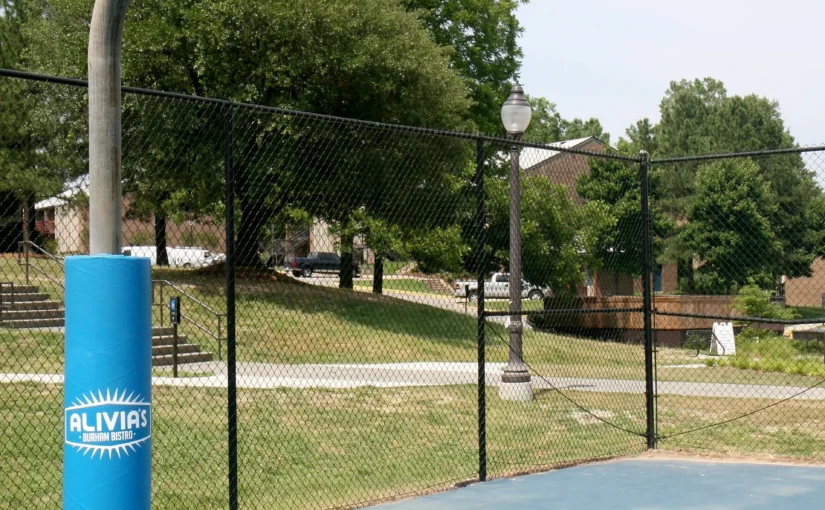
Basketball pole pads are cushioned covers that fit around basketball hoop support poles. They help soften accidental contact when players run or fall into the pole.
Basketball pole pads come in different shapes, sizes, materials, and thicknesses. Some cover only the upright pole, while others extend over the baseplate or mounting hardware.
The most important thing is choosing a pad that fits your hoop and covers the areas players might contact. A thicker or more expensive pad is not automatically safer.
This guide explains the different types of basketball pole padding, how to measure your pole, what pads cost, and how to install and maintain them.
What Is a Basketball Pole Pad?
A basketball pole pad is protective cushioning attached to the vertical support post of a basketball hoop.
Most designs contain foam padding covered by vinyl or another protective material. Straps, hook-and-loop fasteners, zippers, or laces hold the padding in place.
Pole padding is commonly used on:
- In-ground basketball hoops
- Compatible portable basketball hoops
- School and recreational basketball equipment
- Indoor and outdoor basketball courts
The purpose is to cushion accidental contact with the support structure.
However, pole padding cannot eliminate the risk of injury. It does not replace proper hoop placement, secure installation, or sufficient space around the court.
Basketball Pole Padding vs. Other Hoop Padding
Different parts of a basketball system may need different protective products.
| Padding type | What it covers |
|---|---|
| Pole padding | The vertical support pole |
| Base padding | Baseplates, anchor bolts, or other lower mounting components |
| Backboard padding | Exposed edges of the basketball backboard |
| Boom padding | Parts of the support structure extending toward the backboard |
| Portable backstop padding | Designated areas of a larger portable basketball support system |
A standard pole wrap does not necessarily protect exposed anchor bolts or the base of a portable hoop.
For more information about padding around indoor courts, see our basketball court wall padding guide.
Types of Basketball Pole Pads
Basketball pole pads differ mainly in their shape, attachment method, and coverage.
Some are designed for particular hoop models. Others accommodate several pole sizes.
Wrap-Around Basketball Pole Pads
Wrap-around pads fit around the lower section of a basketball pole and are secured using straps or hook-and-loop fasteners.
They are common accessories for residential basketball hoops.
For example, the Silverback Basketball Pole Pad has:
- A height of 49 inches
- 1.5 inches of cushioning
- Hook-and-loop attachment straps
- Compatibility with specified 4 × 4-inch square and 3.5-inch round poles
Wrap-around designs can be convenient because they usually do not require permanent changes to the basketball hoop.
However, the manufacturer’s compatibility instructions still matter. A pad that wraps around one pole may not fit another pole with a different shape or circumference.
Fitted Square Pole Pads
Fitted pads are designed for square support poles.
They may have shaped sections that sit against the front and sides of the upright.
For example, Douglas offers fitted pole padding for specified 4-inch and 6-inch square poles. Its published design includes:
- 72-inch pad height
- 2-inch foam padding
- Vinyl covering
- Model-specific sizing
Some fitted pads protect three sides rather than surrounding the entire pole.
Before buying, check whether players can reach any uncovered side.
Round and Cylindrical Pole Pads
Round pole pads are designed for cylindrical support posts.
Some wrap around the pole, while others use a thicker cylindrical design.
The Jaypro PPP-5HP Protector Pad, for example, is designed for a 4.5-inch-diameter pole.
Its published specifications include:
- 72-inch height
- 4-inch-thick polyurethane foam
- Vinyl enclosure
- Laced attachment
Larger cylindrical pads may be useful in facilities where players can approach a support post from multiple directions.
However, the additional thickness increases the finished outside dimensions. Check that the installed pad will not interfere with nearby equipment or required clearances.
Basketball Pole Pads With Base Protection
Some basketball systems have exposed baseplates, anchor bolts, or support brackets near the bottom of the pole.
A standard upright pad may leave these areas uncovered.
Certain products address this by extending over the lower mounting assembly.
For example, the Goalrilla Universal Basketball Pole Pad is 62 inches tall and includes baseplate coverage.
Other manufacturers, including Douglas, offer separate padding for anchor bolts and lower mounting components.
Check the entire support structure before purchasing. A pad that protects the upright may still leave hard surfaces exposed near the ground.
Basketball Pole Pad Types Compared
| Type | Main advantage | Important limitation |
|---|---|---|
| Wrap-around | Convenient attachment on compatible poles | May not cover the base |
| Fitted square | Designed around specific square-pole dimensions | May leave one side exposed |
| Cylindrical | Can provide substantial surrounding coverage | Must match pole diameter |
| Pole and baseplate | Covers additional lower hardware | Often model-specific |
| Separate base pad | Protects designated anchor or mounting areas | May require a matching upright pad |
The best type depends on your basketball hoop, its surroundings, and the surfaces that need protection.
How to Choose the Right Basketball Pole Pad
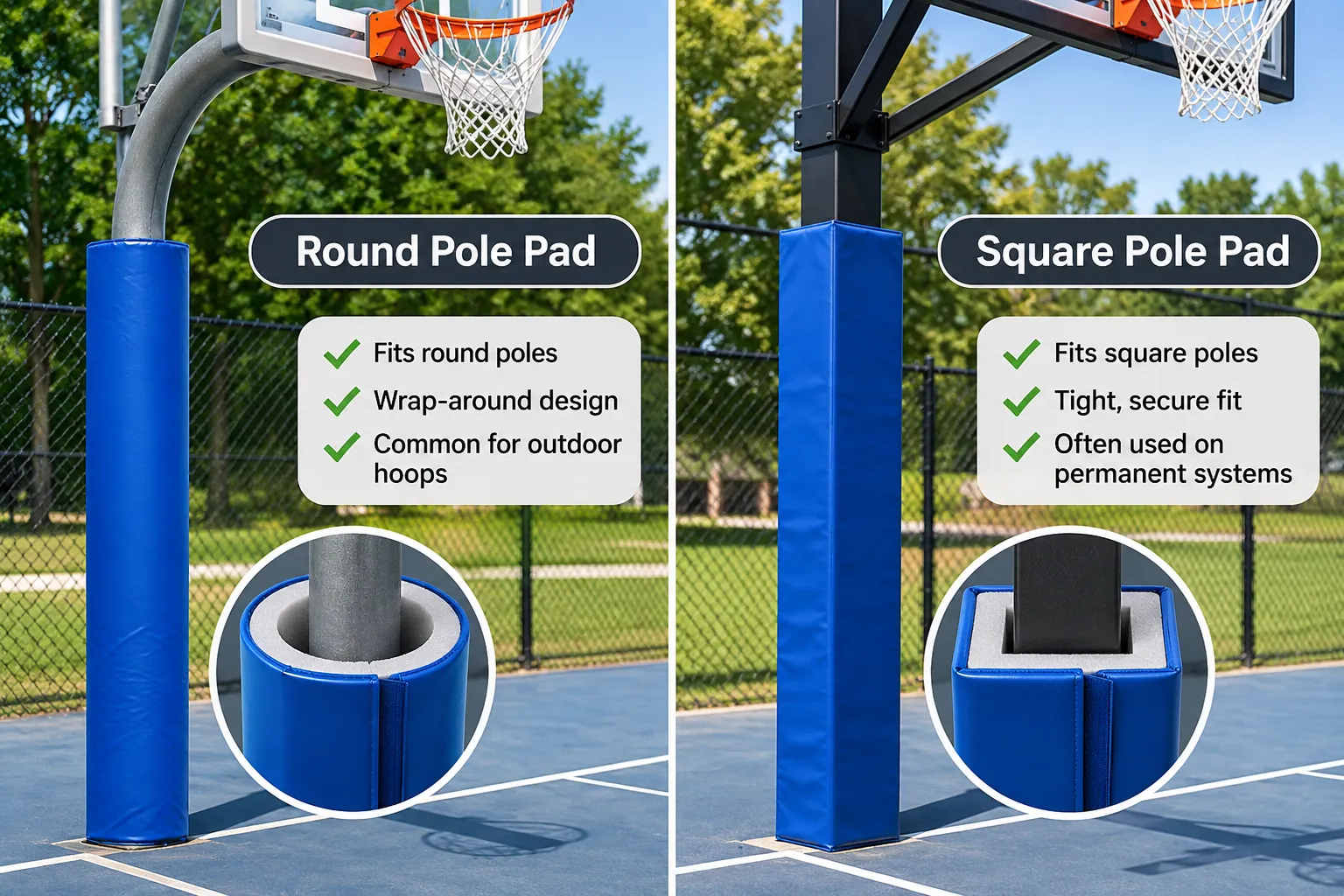
Before comparing prices or materials, identify your basketball hoop’s exact support-pole dimensions.
This is particularly important because manufacturers use different compatibility measurements.
1. Measure Your Basketball Pole
Start by identifying whether the pole is round, square, or rectangular.
For a round pole, measure straight across its outside diameter.
For a square pole, measure the width of one outside face. Do not measure diagonally between the corners.
For a rectangular pole, measure both outside dimensions.
Common published compatibility sizes include:
- 3.5-inch round poles
- 4 × 4-inch square poles
- 5 × 5-inch square poles
- 6-inch square poles
These are examples of manufacturer-listed sizes, not a complete list of basketball pole dimensions.
If your hoop has multiple pole sections, measure the section where the padding will sit.
2. Check Round vs. Square Compatibility
A pad advertised for a 4-inch round pole does not automatically fit a 4-inch square pole.
Although both measurements include the number four, the shapes have different outside perimeters.
Some manufacturers offer products compatible with both shapes.
For example, Silverback specifies certain round and square pole sizes for its B5451W pad.
Other products are designed for one particular shape.
Always check the exact product’s compatibility information rather than assuming that matching measurements guarantee a proper fit.
3. Choose the Right Padding Height
Basketball pole pads are available in different heights.
Examples from manufacturer specifications include:
| Product | Published height |
|---|---|
| Silverback Pole Pad | 49 inches |
| Goalsetter Pole Pad | 60 inches |
| Goalrilla Universal Pole Pad | 62 inches |
| First Team FT75 | 66 inches |
| Douglas Fitted Pole Padding | 72 inches |
These measurements describe how tall the pads are, not how thick their foam is.
A taller pad covers more of the upright, but coverage still depends on how the product fits and where it is positioned.
Consider the areas players could realistically contact.
Also check whether the pad covers exposed lower hardware or requires separate base protection.
There is no single verified residential pole-pad height requirement that applies to every basketball hoop.
4. Check Your Basketball Hoop Model
Your hoop’s manufacturer and model number can help identify compatible accessories.
Look for the model information in the owner’s manual, product documentation, or on the equipment itself.
Check whether the pad interferes with:
- Height-adjustment handles
- Cranks or adjustment mechanisms
- Support braces
- Transport wheels
- Baseplates and mounting hardware
- Important operating instructions or warning labels
Some basketball pole pads have cutouts or notches to accommodate specific equipment features.
If compatibility is unclear, contact the manufacturer before purchasing.
Basketball Pole Pad Materials and Thickness
Basketball pole padding commonly combines a cushioning material with a protective outer cover.
However, manufacturers do not always disclose the same level of detail about their products.
Foam Padding
Foam absorbs and spreads some of the force generated during contact.
Manufacturers use different foam constructions.
Examples include:
Closed-cell foam: Goalsetter specifies closed-cell foam in certain fitted basketball pole pads.
Polyurethane foam: Jaypro lists high-density polyurethane foam in its cylindrical PPP-5HP pad.
High-density foam: Goalrilla describes high-density foam in its square-pole padding, although the published description does not establish its exact chemical composition.
Foam density, thickness, construction, and response to impact can all affect performance.
The term high-density alone does not prove that one product offers better protection than another.
Vinyl Covers and Weather Resistance
Many basketball pole pads use vinyl covers.
These covers help protect the cushioning material from ordinary wear and environmental exposure.
Depending on the product, manufacturers may advertise:
- All-weather vinyl
- Weather-resistant construction
- UV-resistant materials
- Reinforced seams
- Custom colors or graphics
Outdoor suitability should be checked for the exact product.
A weather-resistant label does not guarantee that water cannot enter through seams, fasteners, or damaged areas.
For an outdoor driveway hoop, choose padding specifically intended for outdoor use.
What Thickness Should a Basketball Pole Pad Be?
There is no verified universal best foam thickness for every basketball pole.
Published examples include:
| Product | Published foam thickness |
|---|---|
| Silverback Pole Pad | 1.5 inches |
| Douglas Fitted Pole Padding | 2 inches |
| Jaypro PPP-5HP | 4 inches |
| Bison Post Padding sold by Gopher | 5 inches |
These products differ in size, construction, intended use, and coverage.
A thicker pad is not automatically safer.
Meaningful comparisons require suitable impact-testing evidence under comparable conditions.
Also, avoid confusing foam thickness with the overall dimensions of the finished pad.
For example, a product might have 1.5 inches of foam but list an overall depth of 2 inches.
When choosing padding, consider fit, coverage, construction, and the intended playing environment together.
How Much Does a Basketball Pole Pad Cost?
Basketball pole pad prices vary considerably.
Smaller residential accessories generally cost less than larger fitted or institutional padding systems.
The following prices were listed on US manufacturer or retailer websites during research on November 12, 2026.
They are examples rather than a market-wide average.
Basketball Pole Pad Price Comparison
| Product | Advertised price | Published compatibility |
|---|---|---|
| Lifetime 0602 | $52.50 | 3.5-inch round poles |
| Silverback B5451W | $84.95 | Specified 4-inch square and 3.5-inch round poles |
| Goaliath B7012CW | $94.95 | Multiple specified round and square sizes |
| Spalding SPA0032 | $109.99 | 5- and 6-inch square poles |
| First Team FT75 | $177.10 | Specified 4- or 5-inch posts |
| Goalrilla Square B2700W-1 | $189.95 | Specified Goalrilla 5 × 5-inch poles |
| Goalrilla Universal B2611W | $269.95 | Compatible Goalrilla systems |
| Goalsetter PC816BL | $269.99 | Specified Goalsetter 4-inch poles |
| Goalrilla Deluxe B2607W | $319.95 | Confirm exact model compatibility |
Sources: Lifetime, Silverback, Goaliath, Spalding, First Team, Goalrilla, and Goalsetter.
Prices may change, and availability was not confirmed for every product.
Shipping, taxes, customization, and additional base protection may increase the total cost.
How Much Do Larger Pole Pads Cost?
Larger or specialized products can cost considerably more.
Research examples include:
- Jaypro PPP-5HP: $408 manufacturer-listed MSRP
- Flooring Inc Premium 6-Foot Pole Padding: $445.99 for the researched option
- Greatmats Safety Pole Pad: $489.31 for the researched option
- Bison Post Pads from Gopher: $829
These products are not directly interchangeable.
They have different dimensions, materials, intended applications, and coverage.
Some are made to order or have special delivery conditions.
Before purchasing a custom pad, confirm the final price, shipping costs, lead time, and return policy.
What Affects Basketball Pole Pad Prices?
Several factors can influence the price:
Size: Taller and larger pads require different amounts of material.
Foam construction: Different foam types, thicknesses, and manufacturing methods affect the finished product.
Coverage: Products that include baseplate or anchor protection may cost more than basic upright wraps.
Attachment system: Straps, fitted enclosures, zippers, laces, and specialized hardware vary by design.
Customization: Team colors, logos, and custom dimensions may increase costs.
Price alone does not establish how well a pad performs during an impact.
How to Install a Basketball Pole Pad
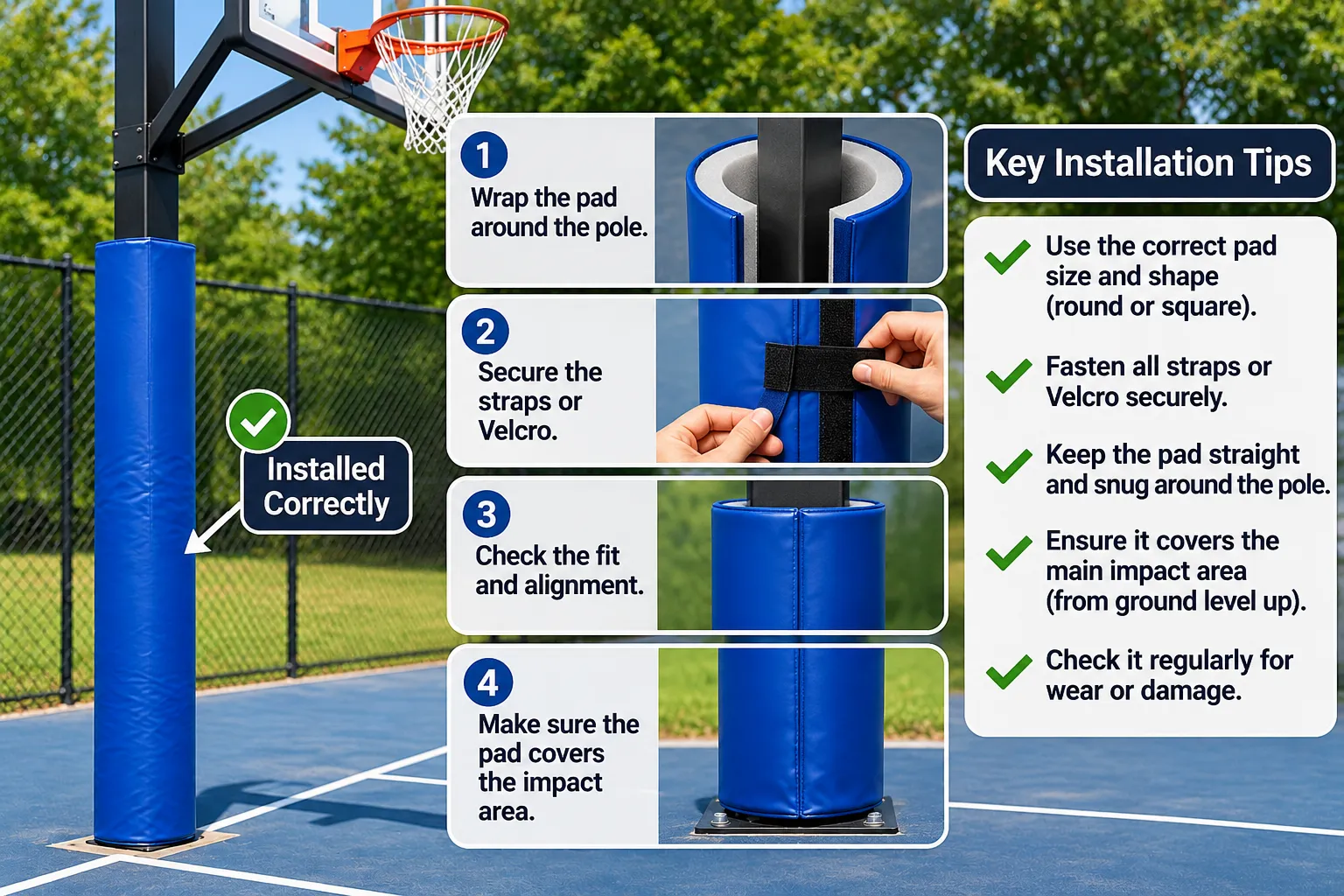
Many residential basketball pole pads use a wrap-around design.
However, installation varies by product.
Always follow the instructions supplied with your exact pad and basketball system.
The following steps describe a general installation process for compatible removable padding.
Step 1: Inspect the Basketball Hoop
Stop play before installing the pad.
Check the support pole for visible damage, loose components, corrosion, or instability.
Do not use padding to hide damaged equipment.
If the basketball hoop is structurally unsafe, address that problem before returning it to use.
Step 2: Confirm the Pad Fits
Check the pad’s model number and compatibility specifications.
Compare them with your pole’s dimensions and shape.
Make sure you have the required straps, fasteners, or other installation components.
Do not force an incompatible pad around the support pole.
Step 3: Position the Padding
Place the pad around the intended section of the basketball pole.
Align its protective surfaces with the areas specified by the manufacturer.
If the product includes a baseplate extension, position that section according to its instructions.
Check that the padding does not cover moving mechanisms or interfere with the hoop’s normal operation.
Step 4: Secure the Fasteners
Close the supplied straps, hook-and-loop sections, laces, or zippers.
Follow the manufacturer’s required attachment method.
For example, a Spalding portable basketball system manual describes wrapping the pole pad around the lower pole and securing it with hook-and-loop straps.
This is an example of one system’s installation method, not a universal procedure.
Some institutional padding assemblies use bolts and other specialized hardware.
Do not drill into a basketball pole or modify its mounting system unless the manufacturer specifically authorizes it.
Step 5: Check the Coverage
Inspect the installed padding from different directions.
Look for:
- Exposed hard corners
- Uncovered anchor bolts
- Open seams
- Gaps between pole and base padding
- Loose or incorrectly positioned fasteners
Check that the pad remains in position during a gentle hand inspection.
Do not deliberately collide with the pole to test the padding.
Step 6: Check the Hoop Before Playing
Make sure the padding does not interfere with height adjustment, transport, or other intended functions.
Check the basketball system itself for stability and proper assembly.
For portable hoops, verify the required ballast according to the owner’s manual.
Padding cannot compensate for an unstable basketball hoop.
For broader installation guidance, read our basketball hoop installation guide.
Are Basketball Pole Pads Required?
Requirements depend on the type of basketball facility, the equipment, and the rules that apply.
A residential driveway hoop is not necessarily subject to the same requirements as a college basketball facility.
Residential Basketball Hoops
The research did not establish a universal US legal requirement for every residential basketball hoop to have a separately purchased pole pad.
It also did not establish a universal residential foam-thickness minimum.
However, this does not mean that every unpadded hoop is safe.
Homeowners should consider the position of the support pole, available playing space, exposed mounting hardware, and the manufacturer’s safety instructions.
A properly fitted pad can be a useful additional precaution where accidental contact is possible.
Schools and Competition Facilities
Organized basketball facilities may have specific equipment and padding requirements.
For example, the 2026–27 NCAA Men’s Basketball Rules include requirements for certain backboard support structures and portable backstop bases.
These requirements concern particular equipment configurations.
They should not be interpreted as a universal rule requiring the same padding on every residential basketball pole.
Facility managers should confirm the rules adopted by their competition organization and any applicable building or safety requirements.
What About ASTM Standards?
Several ASTM documents are relevant to sports padding and basketball equipment.
ASTM F2440-24 addresses impact attenuation for wall padding and other indoor structures used in sports facilities.
ASTM F355-26 describes methods for measuring impact attenuation under specified testing conditions.
ASTM F3740-26 provides guidance about padding around playing areas and fixed objects. Its scope has exclusions, so it should not be treated as a universal certification for basketball pole accessories.
ASTM F1882-26 concerns complete residential basketball systems. Its scope excludes separately sold accessories and add-ons.
These documents do not establish that every basketball pole pad meets a particular impact-performance requirement.
A manufacturer should provide suitable product-specific documentation when compliance matters.
For school or recreational facility projects, consult the responsible facility designer or equipment supplier.
How to Clean and Maintain Basketball Pole Padding
Regular inspection helps identify damage that could affect a pad’s fit or coverage.
Maintenance requirements depend on the product and its materials.
Cleaning Basketball Pole Pads
Check the manufacturer’s cleaning instructions before using any product.
For suitable vinyl-covered padding, gentle cleaning may involve:
- Removing loose dirt.
- Wiping the cover with water and a mild detergent.
- Using a soft sponge or cloth.
- Removing cleaning residue.
- Allowing the padding to dry as directed.
Sportsfield recommends similar methods for its outdoor wall padding, although those instructions should not automatically be applied to every basketball pole pad.
Avoid harsh chemicals, pressure washing, or soaking unless the pad manufacturer permits them.
Maintaining Outdoor Pole Padding
Outdoor basketball pole pads may experience sun exposure, rain, temperature changes, and general wear.
Check for:
- Cracked or torn vinyl
- Loose seams
- Damaged straps
- Exposed foam
- Moisture trapped inside the covering
- Padding that has moved out of position
Some manufacturers recommend removing and storing particular products indoors between uses.
For example, Gopher recommends indoor storage between uses for its Bison post padding to help extend its life.
Follow the instructions for your specific model.
When Should You Replace a Basketball Pole Pad?
There is no verified universal replacement interval for basketball pole padding.
Instead, inspect the product’s condition.
Replacement or manufacturer assessment may be necessary when:
- Foam becomes exposed or deteriorates.
- Straps or closures no longer hold securely.
- The cover has significant tears or open seams.
- Padding no longer provides its intended coverage.
- Moisture or mold problems cannot be resolved.
- The pad no longer fits after equipment changes.
If the underlying basketball pole is damaged, replacing the padding alone will not solve the problem.
Common Basketball Pole Pad Mistakes
Choosing and installing basketball pole padding involves more than matching a product’s color to your hoop.
Here are several mistakes worth avoiding.
Buying the Wrong Pole Size
A pad designed for a round pole may not fit a square pole with the same nominal measurement.
Measure the pole and verify the manufacturer’s compatibility specifications.
Ignoring the Baseplate
Some upright pads leave anchor bolts or mounting brackets exposed.
Inspect the lower support structure and consider compatible base protection where appropriate.
Choosing Based Only on Thickness
More foam does not automatically mean better protection.
The foam material, construction, attachment, coverage, and tested performance all matter.
Blocking Adjustment Mechanisms
An incorrectly fitted pad can interfere with handles, cranks, braces, or transport components.
Check that the basketball hoop operates as intended after installation.
Using Improvised Household Padding
Pool noodles, towels, carpet scraps, and pipe insulation are not established substitutes for purpose-made basketball pole padding.
Their impact performance and attachment security have not been shown to match suitable manufactured products.
Assuming Padding Makes a Hoop Safe
A pole pad cannot fix loose anchors, missing ballast, damaged steel, or unsafe equipment placement.
Treat padding as one part of a broader approach to basketball equipment safety.
Frequently Asked Questions
What Is the Basketball Pole Called?
The upright structure supporting a basketball hoop is commonly called the support pole or support post.
Depending on the equipment, manufacturers may also use terms such as upright or support structure.
The complete basketball system includes other components, such as the backboard, rim, mounting hardware, and base or foundation.
Where Can I Find a Custom Basketball Pole Pad?
Manufacturers and sports-equipment suppliers such as First Team, Douglas, and Goalsetter offer pole-padding options with different sizes, colors, or customization features.
Some products support custom graphics or team branding.
Before ordering, confirm the required dimensions, compatible attachment method, price, production time, and return conditions.
Do Basketball Pole Pads Prevent Injuries?
Basketball pole pads are designed to cushion contact with hard support structures.
However, they cannot guarantee that a collision will not cause injury.
Correct hoop placement, adequate clearance, equipment maintenance, and safe play remain important.
Can You Put a Round Pole Pad on a Square Pole?
Only if the manufacturer explicitly lists compatibility with that square-pole size.
Round and square poles have different shapes and perimeters.
Do not assume a pad will fit simply because the advertised measurements look similar.
Can Basketball Pole Padding Stay Outside All Year?
Some basketball pole pads are designed for outdoor use.
However, weather resistance varies by product.
Inspect the padding regularly and follow the manufacturer’s cleaning and storage instructions.
Outdoor suitability does not mean the pad will last indefinitely without maintenance.
Can You Put Padding on a Portable Basketball Hoop?
Yes, if the padding is compatible with the specific portable basketball system.
Check that it does not interfere with the base, wheels, height adjustment, or transport mechanisms.
Pole padding does not replace the ballast required to stabilize a portable hoop.
How Tall Should a Basketball Pole Pad Be?
Published examples include pads approximately 49 to 72 inches tall.
The appropriate height depends on the support structure, exposed contact areas, and manufacturer guidance.
There is no verified single residential height requirement for every basketball pole.
Can You Make Your Own Basketball Pole Pad?
It is possible to wrap cushioning material around a pole, but that does not establish its protective performance.
Household materials may lack suitable impact testing, weather resistance, or secure attachment.
A purpose-made pad that fits the basketball system is the more reliable starting point.
For public facilities, obtain suitable product documentation and confirm applicable requirements.
Final Thoughts
A basketball pole pad is a useful accessory for protecting the exposed support structure of a basketball hoop.
The right choice depends on your pole’s shape and dimensions, the coverage needed, the pad’s construction, and its compatibility with your equipment.
Before buying, measure your pole, check the manufacturer’s specifications, and inspect the base for exposed hardware.
Most importantly, remember that padding supplements safe basketball equipment installation and maintenance. It does not replace them.
6 thoughts on “Basketball Pole Pads | Types, Sizes, Costs & Installation”
Comments are closed.